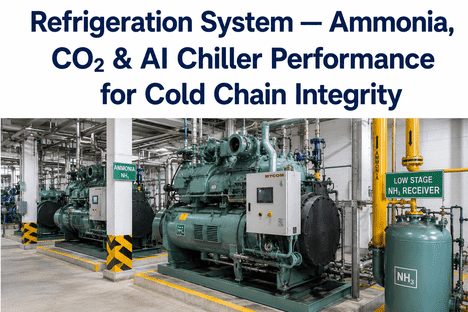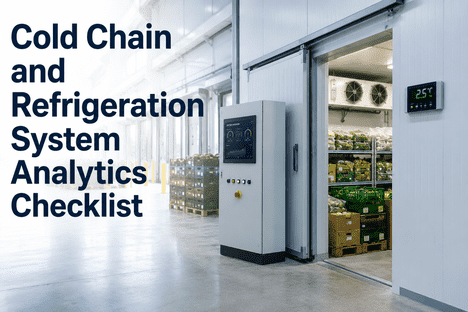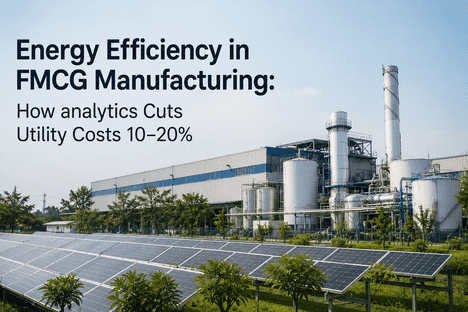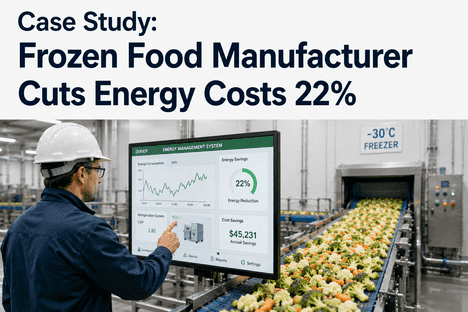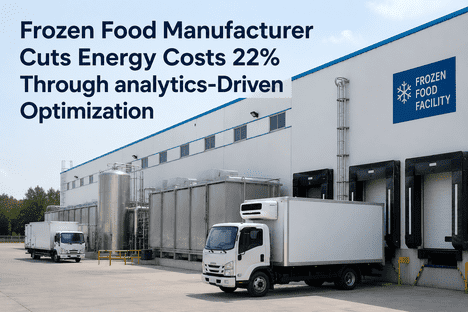
Frozen food manufacturing is one of the most energy-intensive sectors in the food industry, with industrial refrigeration alone consuming 60-75% of total plant electricity. For a 50,000-tonne-per-year facility producing frozen vegetables, ready meals, and specialty frozen products, the annual refrigeration energy cost can exceed $2.6 million. Yet most frozen food plants operate their ammonia refrigeration systems 20-30% above design specifications due to compressor degradation, condenser fouling, evaporator icing, and undetected refrigerant loss. Analytics-driven energy optimization replaces reactive maintenance and fixed setpoint operation with continuous ML-based monitoring that detects efficiency drift, optimizes compressor staging, and automates demand-based defrost cycles. The result: a 22% reduction in refrigeration energy costs, 64% fewer compressor failures, and an 8.5-month platform payback period. Frozen food facility managers and energy directors evaluating analytics-based energy optimization Book a Demo to see real-time refrigeration analytics, compressor efficiency tracking, and automated utility optimization in live frozen food production environments.
Why Frozen Food Plants Waste 20-30% of Refrigeration Energy
Industrial refrigeration systems in frozen food production degrade predictably over time, but most facilities lack the instrumentation and analytics to detect efficiency loss before it compounds into significant energy waste. The four primary drivers of excess refrigeration energy consumption each require different detection and intervention approaches. Energy and sustainability managers assessing their facility's efficiency gaps can see how ML-based monitoring identifies each failure mode with sub-second anomaly detection.
| Waste Driver | Contribution to Excess Energy | Detection & Resolution Method |
|---|---|---|
| Compressor Degradation | 12 percentage points of the 26% excess; worn bearings, fouled oil, and inefficient staging reduce COP | ML models track kW/ton and COP per compressor in real time; deviation from baseline triggers automated work order for inspection and repair within 24 hours |
| Condenser Fouling | 8 percentage points; dirty coils force compressors to run at higher head pressure, increasing energy draw by 12-18% per condenser | Continuous approach temperature monitoring vs. ambient wet bulb; cleaning alerts issued when approach exceeds threshold, restoring efficiency within one cleaning cycle |
| Evaporator Inefficiency | 4 percentage points; fixed-timer defrost cycles waste energy by defrosting when unnecessary, while icing reduces heat transfer | Demand-based defrost using coil temperature, airflow, and frost sensors; defrost activated only when required, reducing defrost energy consumption by approximately 13% |
| Refrigerant Loss | 2 percentage points; undetected leakage drives compressors to run longer to achieve target temperatures | Continuous monitoring of suction superheat, subcooling, and discharge temperature; charge loss detected within hours vs. weeks with manual log review |
Analytics-Driven Refrigeration Optimization Methodologies
iFactory energy optimization deploys three complementary analytics methodologies across frozen food refrigeration systems. Each addresses a specific dimension of energy waste and is selected based on facility instrumentation level, production profile, and existing control infrastructure. Facilities evaluating their analytics approach Book a Demo to see which methodology best matches their refrigeration system configuration and energy reduction targets.
Baseline ML Anomaly Detection learns each refrigeration asset's unique energy fingerprint during a 7-21 day training period, establishing baseline kW/ton, COP, approach temperature, and superheat profiles under varying ambient and production load conditions. Once trained, the model continuously compares live sensor data against the learned baseline, flagging deviations beyond adaptive thresholds with severity scoring and root-cause classification. This methodology is ideal for facilities with existing instrumentation but no real-time analytics layer, as it requires no control system modifications and delivers actionable alerts within days of deployment.
Predictive Demand Optimization uses deep learning to forecast refrigeration demand 24-72 hours ahead with 95%+ accuracy, based on production schedules, ambient temperature forecasts, product throughput targets, and historical load patterns. The AI then pre-cools heavily during off-peak tariff periods, sequences compressor staging to minimize peak demand charges, and shifts non-critical thermal loads to lower-cost time windows. Peak demand charges can account for 30-50% of a frozen food facility's electricity bill; this methodology directly targets that cost component while maintaining product temperature integrity across the cold chain.
Closed-Loop Automated Control connects ML model outputs directly to refrigeration control systems via PLC or BMS interfaces, enabling fully autonomous optimization of compressor staging, floating head pressure setpoints, condenser fan speed, and evaporator defrost scheduling. The AI continuously evaluates multiple control strategies against current conditions and selects the combination that minimizes total energy cost while maintaining all process temperature requirements. This methodology delivers the highest savings potential but requires compatible control infrastructure and validated safety interlocks before autonomous operation begins.
Traditional vs. Analytics-Driven Refrigeration Management
The comparison below evaluates conventional reactive and preventive refrigeration management against analytics-driven optimization across the metrics that define energy performance in frozen food manufacturing.
| Capability | Traditional Management | Analytics-Driven Optimization |
|---|---|---|
| Energy Visibility | Monthly utility bills and manual meter readings; no per-asset consumption breakdown | Real-time energy dashboard with per-compressor, per-condenser, and per-evaporator consumption; cost-per-tonne-of-product KPIs continuously updated |
| Anomaly Detection | Reactive; efficiency loss detected when energy bills spike or equipment fails | Proactive; ML models detect efficiency drift within hours, enabling intervention before waste compounds |
| Compressor Operation | Fixed staging based on suction pressure; manual adjustments by senior operators | AI-optimized staging matching real-time production demand, ambient conditions, and tariff schedules; floating head pressure setpoint optimization |
| Defrost Strategy | Fixed-timer defrost cycles running 2-4 times per day regardless of actual frost accumulation | Demand-based defrost activated only when coil temperature, airflow differential, and frost sensors indicate actual need |
| Maintenance Approach | Calendar-based or breakdown-reactive; no correlation between energy waste and maintenance need | Condition-based; energy degradation triggers automated work orders with root-cause classification and cost-of-waste calculation |
| Energy Cost Reduction | Incremental 3-5% through basic best practices and manual log reviews | 22% measured reduction through ML-driven optimization; sustained over 18+ months post-deployment |
Implementation Roadmap for Frozen Food Facilities
Deploying analytics-driven energy optimization across frozen food refrigeration systems follows a structured five-phase sequence that ensures instrumentation readiness, model accuracy, operator adoption, and continuous improvement are advanced in parallel with technical deployment.
Expert Perspective — Analytics-Driven Energy Optimization in Frozen Food
We deployed iFactory energy analytics across our ammonia refrigeration system approximately eight months ago. Within the first 60 days, we identified six of our nine screw compressors operating at efficiency levels 15-20% below baseline due to worn bearings and fouled oil. The ML models detected the degradation trend within three days per compressor, weeks before traditional vibration monitoring would have flagged an issue. Our condenser cleaning schedule has shifted from calendar-based four-times-per-year to condition-based cleaning triggered by approach temperature thresholds, which has reduced cleaning costs while improving condenser efficiency. The demand-based defrost on our 28 evaporator units has eliminated approximately 13% of our defrost energy consumption without any product temperature impact. For frozen food facility managers considering this approach, the key insight is that analytics-driven optimization does not require a capital refrigeration replacement program; it works with your existing equipment and delivers measurable results in the first billing cycle.
— Director of Engineering, Frozen Vegetable and Ready-Meals Manufacturing FacilityConclusion
Analytics-driven energy optimization delivers a measurable and sustainable 22% reduction in refrigeration energy costs for frozen food manufacturers. ML-based anomaly detection identifies compressor degradation, condenser fouling, evaporator inefficiency, and refrigerant loss days to weeks before conventional methods, enabling proactive intervention that eliminates waste at its source. Predictive demand optimization shifts energy consumption to lower-cost tariff periods. Closed-loop automated control maximizes system efficiency without operator intervention. The result: $672,000 in eliminated annual energy waste, 64% fewer compressor failures, and an 8.5-month platform payback period that improves with each additional system brought under analytics coverage. Frozen food facility managers and energy directors ready to move beyond reactive energy management Book a Demo to see iFactory energy analytics deployed in live frozen food refrigeration environments with real-time per-asset efficiency monitoring, automated anomaly detection, and fully integrated maintenance workflow automation.
Frequently Asked Questions
Minimum requirements include power meters on each compressor, temperature and pressure sensors on condensers and evaporators, and refrigerant flow or level measurement. iFactory energy analytics connects to existing instrumentation via Modbus, BACnet, OPC-UA, or MQTT protocols through an edge gateway that reads data without interfering with control system operation. If instrumentation gaps exist, iFactory can specify and integrate cost-effective wireless sensors that connect directly to the edge gateway.
Most facilities detect actionable efficiency opportunities within the first 7-14 days of baseline model training. Measurable savings typically appear in the first monthly billing cycle following deployment, with the ML model identifying and quantifying energy waste sources within the initial 30-day window. The full 22% reduction compounds over 3-6 months as corrective actions address all four waste drivers and operators gain confidence in acting on anomaly alerts across the complete refrigeration system.
Yes. iFactory energy analytics operates as an overlay layer that reads data from existing BMS, PLC, or SCADA systems without requiring changes to control logic. For closed-loop automated control deployment, iFactory integrates with compatible BMS and PLC platforms through standard OPC-UA and Modbus TCP interfaces, with safety interlocks and operator overrides built into the integration design to ensure production integrity at all times.
Savings are verified through a three-layer framework: continuous per-asset sub-meter data compared against baseline fingerprints, weekly energy performance reports showing cost-per-tonne-of-product trends, and monthly reconciliation against utility billing data. The iFactory platform automatically calculates savings by comparing actual energy consumption against the ML-modeled baseline that accounts for production volume, ambient temperature, and product mix variations, ensuring reported savings reflect genuine efficiency improvement rather than operational changes.
Yes. iFactory energy analytics provides comprehensive WAGES (Water, Air, Gas, Electricity, Steam) tracking with dedicated ML models for compressed air leak detection, compressor scheduling optimization, and pressure setpoint analysis, as well as steam trap acoustic monitoring, boiler efficiency tracking, and steam system energy loss quantification. Frozen food facilities that expanded coverage beyond refrigeration to include compressed air and steam systems achieved an additional 15-20% energy reduction on those utilities, further improving overall plant energy performance and sustainability metrics.