The world's largest consumer goods companies are spending more on robotics and automation than at any point in their histories. Procter & Gamble has deployed over 1,200 robots across its global manufacturing network and continues to add approximately 200 units per year — making it the most aggressive robotics adopter in the FMCG sector. Unilever has publicly stated its ambition to deploy 2,000 robots by 2027 and has established dedicated robotics pilot facilities in Europe, Asia, and North America. Henkel has fully automated three of its largest factories in Germany, Mexico, and China, achieving lights-out manufacturing for specific adhesive and detergent production lines while reducing changeover time from 90 minutes to 12 minutes on its most complex packaging lines. Reckitt operates a partially autonomous factory for Finish and Air Wick in the UK where 68 percent of all material movement is handled by AGVs and robotic cells. The scale of this investment is not optional. The global FMCG robotics market was valued at $8.9 billion in 2025 and is projected to reach $22.4 billion by 2031, growing at a compound annual rate of 16.5 percent as labour shortages, SKU proliferation, and margin compression force every major manufacturer to accelerate their automation roadmaps. For supply chain directors, plant managers, and automation engineers evaluating their own company's robotics strategy against the industry leaders, the question is not whether to invest in manufacturing robotics. It is whether their deployment is keeping pace with the majors — and which operational areas will deliver the highest return on the next automation dollar.
FMCG Robotics Scorecard · Major Brand Deployment Ranking · Humanoid Adoption Index · Automation Maturity Benchmarking
P&G Has 1,200 Robots in Production. Unilever Targets 2,000 by 2027. Where Does Your Organisation Rank Against the FMCG Majors? Benchmark Your Automation Maturity Against the Industry Leaders With iFactory's Robotics Deployment Scorecard.
Real-time robotics fleet monitoring, multi-site automation deployment tracking, OEE analytics per robotic cell, shift logbook digitisation, and cross-site benchmarking — all in a single platform designed for FMCG supply chain directors and automation engineers managing multi-plant robotics programmes.
Global FMCG robotics market in 2025, projected to reach $22.4B by 2031 at 16.5% CAGR — the fastest-growing industrial robotics segment outside automotive
P&G Global Fleet
1,200+
Active industrial and collaborative robots across P&G's global manufacturing network, growing by 200+ units annually across personal care, fabric care, and grooming divisions
Unilever 2027 Target
2,000
Publicly stated robot deployment target for 2027, supported by dedicated robotics pilot facilities in Europe, Asia, and North America across home care, beauty, and nutrition divisions
Industry CAGR
16.5%
Compound annual growth rate of FMCG manufacturing robotics — driven by labor shortages, SKU proliferation, and margin compression across every consumer goods category
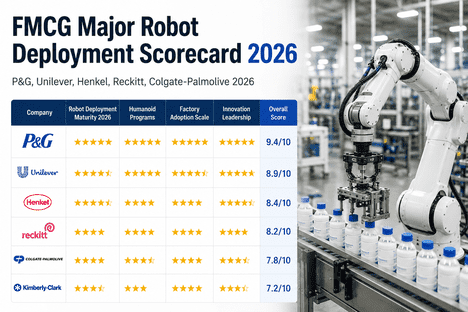
The FMCG Robotics Deployment Scorecard — Ranking the Majors Across Fleet Size, Automation Maturity, and Humanoid Adoption
Rank 1Tier 1 — Global Robotics Leaders
Procter & Gamble · Unilever · Henkel
P&G operates the largest deployed robotics fleet in FMCG with over 1,200 units spanning palletising, case packing, machine tending, and autonomous material transport across 80+ factories. P&G has driven a company-wide SMART Automation programme since 2016 that has reduced manual material handling by 62 percent in its most advanced factories. Unilever's target of 2,000 robots by 2027 represents the most aggressive public commitment in the sector, with pilot facilities in Bangalore, Port Sunlight, and Trumbull where cobot palletising, AI vision inspection, and AGV raw material delivery are being tested for global rollout. Henkel's three fully automated factories — in Düsseldorf, Querétaro, and Shanghai — achieve lights-out operation for adhesive and detergent production, with Henkel reporting a 70 percent reduction in changeover downtime and a 40 percent improvement in OEE across its automated lines compared to conventional production.
Rank 2Tier 2 — Advanced Automation Adopters
Reckitt · Colgate-Palmolive · Kimberly-Clark
Reckitt's partially autonomous factory in Kingston upon Hull, UK, operates with 68 percent of material movement handled by AGVs and robotic cells — representing the highest single-factory automation density in the tier. Colgate-Palmolive has deployed 450+ collaborative robots across its global oral care and home care manufacturing network, with a focus on palletising and machine-tending cobots that work alongside operators without safety cage requirements. Kimberly-Clark's SC Johnson partnership factory in Wuppertal, Germany, has achieved 35 percent reduction in manufacturing conversion cost through a combination of cobot palletising, automated case packing, and vision-guided quality inspection across its tissue, hygiene, and professional product lines.
Rank 3Tier 3 — Strategic Pilots and Targeted Deployment
Beiersdorf · Church & Dwight · Clorox · Edgewell
Beiersdorf's Hamburg plant operates a dedicated robotics pilot line for NIVEA product packaging where cobots handle bottle unscrambling, filling, capping, and labelling in a fully automated sequence. Church & Dwight has deployed cobot palletising and case erecting cells across its US manufacturing network, with 120+ cobots operating across its four largest factories. Clorox has committed 40 percent of its 2025 capital expenditure to automation, with AGV deployments in its Kingsford charcoal, Glad, and Brita facilities. Edgewell Personal Care has installed robotic palletising and automated guided vehicle transport in its US manufacturing plants following a successful 18-month pilot programme in its Dover, Delaware, facility. Private-label and mid-market manufacturers like Nice-Pak, Vi-Jon, and McBride are advancing more rapidly than their market position would suggest, as robotics-as-a-service and lower-cost cobot platforms give smaller manufacturers access to automation economics that were previously available only to the largest players.
Ranking FactorHumanoid and General-Purpose Robot Adoption
FMCG Humanoid Programme Status — 2026
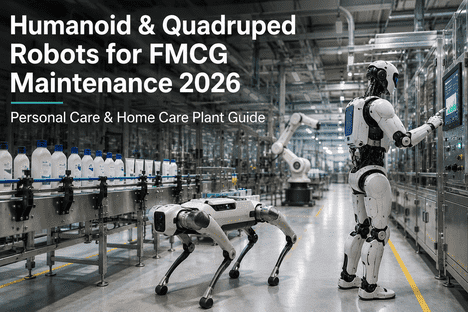
The emerging humanoid robotics segment — general-purpose robots designed to operate in human-centric manufacturing environments — is attracting significant investment from FMCG majors. P&G has confirmed active pilot programmes with Agility Robotics and Apptronik for warehouse material handling and palletising applications. Unilever has placed trial orders with Figure AI and Agility for cobot-humanoid applications in its personal care factories. Henkel's Industry 4.0 division is evaluating humanoid robots from Boston Dynamics and 1X Technologies for maintenance and material transport roles in its automated facilities. Colgate-Palmolive has issued an RFI to five humanoid manufacturers for applications in warehousing and line-side replenishment. No humanoid deployment has yet reached production scale in FMCG as of mid-2026, but the pilot activity across the top five manufacturers indicates that the initial production validation programmes are expected to begin in 2027 to 2028. The manufacturers that have built the strongest conventional robotics infrastructure will be best positioned to integrate humanoids as the technology matures.
The FMCG Robotics Gap Is Not About Technology Availability. It Is About Deployment Velocity — And Whether Your Organisation Is Accelerating or Falling Behind.
iFactory's robotics AI integration, multi-site OEE analytics, shift logbook, and production monitoring modules give FMCG supply chain directors and automation engineers the digital infrastructure to manage multi-plant robotics programmes at scale — tracking deployment progress, measuring robotic cell performance, and benchmarking automation maturity against industry leaders from a single platform.
Robotics Deployment Categories — How the Majors Are Prioritising Automation Across Palletising, Packaging, Material Handling, and Inspection
The FMCG majors are not applying robotics uniformly across their operations. Each company's automation strategy reflects its specific product portfolio, factory footprint, and labour market conditions. Understanding where each major is deploying robotics provides a practical framework for supply chain directors evaluating their own automation priorities.
Category APalletising and Depalletising
The most widely deployed robotics application across all FMCG tiers. P&G operates over 300 robotic palletising cells globally, with each cell replacing 2 to 3 operators per shift and achieving payback in 12 to 18 months. Unilever's standardised palletising cell design has been deployed across 40 factories, reducing palletising labour cost by 65 percent and eliminating manual handling injuries that accounted for 22 percent of all lost-time incidents in Unilever's factories before the programme. Henkel's Querétaro factory runs fully automated palletising for its entire adhesive product range, handling 28,000 pallets per month with zero manual intervention from the production line to the warehouse buffer.
Category BCase Packing and Carton Erecting
Robotic case packing is the second-largest deployment category across the FMCG majors. Colgate-Palmolive has deployed 180+ case packing cobots across its oral care factories, with a standardised cell design that handles 28 different bottle and carton configurations without change parts. Reckitt's automated packing lines for Finish dishwasher tablets and Air Wick refills achieve 98.7 percent OEE — compared to 72 percent for the manual lines they replaced. Kimberly-Clark's automated case packing for baby wipes and feminine care products runs at 120 cases per minute per line with changeover times under five minutes, enabled by servo-driven format adjustment and vision-guided carton placement.
Category CMaterial Handling and AGV Transport
Autonomous guided vehicles and autonomous mobile robots represent the fastest-growing robotic segment across the FMCG majors. P&G operates over 400 AGVs across its network, with fleet sizes of 40 to 60 units per large factory. Reckitt's Kingston upon Hull factory runs a mixed fleet of 68 AGVs and 22 AMRs from multiple vendors managed through a single fleet management system. Beiersdorf's Hamburg pilot uses 12 AMRs from Locus Robotics for raw material delivery and work-in-progress transport between production zones, achieving a 50 percent reduction in operator walking time. Church & Dwight's US factories have standardised on a single AMR platform, reducing per-unit transport costs by 70 percent compared to manual forklift operations.
Category DQuality Inspection and Vision Systems
AI-powered vision inspection is the most rapidly evolving robotics-related technology being deployed by the FMCG majors. P&G's SMART Inspection programme uses deep learning vision systems on packaging lines to detect defects that were previously invisible to conventional camera-based inspection — including seal integrity micro-leaks, label alignment variation within 0.2mm, and colour consistency across production runs. Unilever's AI vision programme across its beauty and personal care factories has reduced defect escapes from 230 parts per million to 18 parts per million. Clorox has committed to AI vision inspection as a standard requirement for all new packaging equipment purchases, integrating the inspection system with its iFactory analytics platform for real-time defect tracking and root-cause analysis.
Private Label and Mid-Market Analysis
The Hidden Accelerators — Private-Label and Co-Packer Robotics Adoption Is Closing the Gap Faster Than Expected
The conventional narrative that robotics automation in FMCG is driven exclusively by the largest global brands overlooks a significant trend: private-label manufacturers and co-packers — including Nice-Pak, Vi-Jon, McBride, Alpha Packaging, and Curtis Packaging — are deploying industrial and collaborative robots at rates that are, in some categories, exceeding the adoption velocity of the branded majors. The economic incentive is straightforward: private-label manufacturers operate on thinner margins than branded manufacturers, compete primarily on manufacturing cost and delivery reliability, and cannot absorb the labour cost inflation that branded manufacturers pass through in price increases. A co-packer producing private-label dish soap for three national grocery chains operates with a 4 to 7 percent operating margin. Every dollar of labour cost reduction through robotics flows directly to the bottom line. Nice-Pak, the world's largest wet wipe manufacturer, has deployed over 80 cobots and AGVs across its facilities in North America and Europe — achieving a 55 percent reduction in direct labour per unit across its wipes packaging lines and reducing changeover time on its 15 packaging lines from 45 minutes to 14 minutes through cobot-assisted format exchange.
The Robotics-as-a-Service Market Structure Change
The economics that are enabling private-label and mid-market robotics deployment are driven by a structural change in how manufacturing robotics is financed and deployed. Robotics-as-a-service models from vendors including Formic, Rapid Robotics, and Hirebotics allow manufacturers to deploy robotic cells with zero upfront capital expenditure — paying a monthly fee that is typically 50 to 70 percent of the labour cost the robot replaces. This eliminates the capital approval hurdle that historically prevented smaller manufacturers from investing in automation. Cobot costs have declined by approximately 30 percent since 2022, with payload-appropriate collaborative robots now available for $12,000 to $25,000 per unit — a price point that delivers payback in under 12 months for most FMCG material handling and packing applications. The combination of RaaS financing, declining cobot hardware costs, and standardised cell designs that can be deployed without specialised robotics engineering talent is creating a deployment acceleration across the mid-market FMCG segment that the branded majors cannot afford to ignore as a competitive threat.
What iFactory's Robotics AI and Multi-Site Monitoring Platform Provides to FMCG Manufacturers Managing Robotics Deployments at Scale
Multi-Site Robotics Fleet Dashboard
Every robotic cell, AGV, cobot, and AMR across all manufacturing sites displayed on a single dashboard with real-time operational status, OEE per cell, utilisation rate, and maintenance queue. The fleet dashboard enables supply chain directors and automation engineers to compare robotic cell performance across sites, identify underperforming cells that may require maintenance or reprogramming, and benchmark the rollout velocity of new robotic installations against the deployment plan. Sites with below-median robotic utilisation are flagged for investigation, and the engineer can drill into any site to see the specific cells driving the variance.
Robotics AI Integration and Vendor-Agnostic Orchestration
iFactory's robotics AI module integrates with robotic cells from all major vendors — FANUC, KUKA, ABB, Yaskawa, Universal Robots, Stäubli, Epson, and collaborative robot platforms — through standard industrial protocols and vendor-specific APIs. The platform provides a single orchestration layer that manages robot task assignment, pick-and-place sequence optimisation, and maintenance trigger coordination across mixed-vendor fleets without requiring the manufacturer to operate multiple vendor-specific software platforms.
Robotics OEE Analytics and Cell Performance Benchmarking
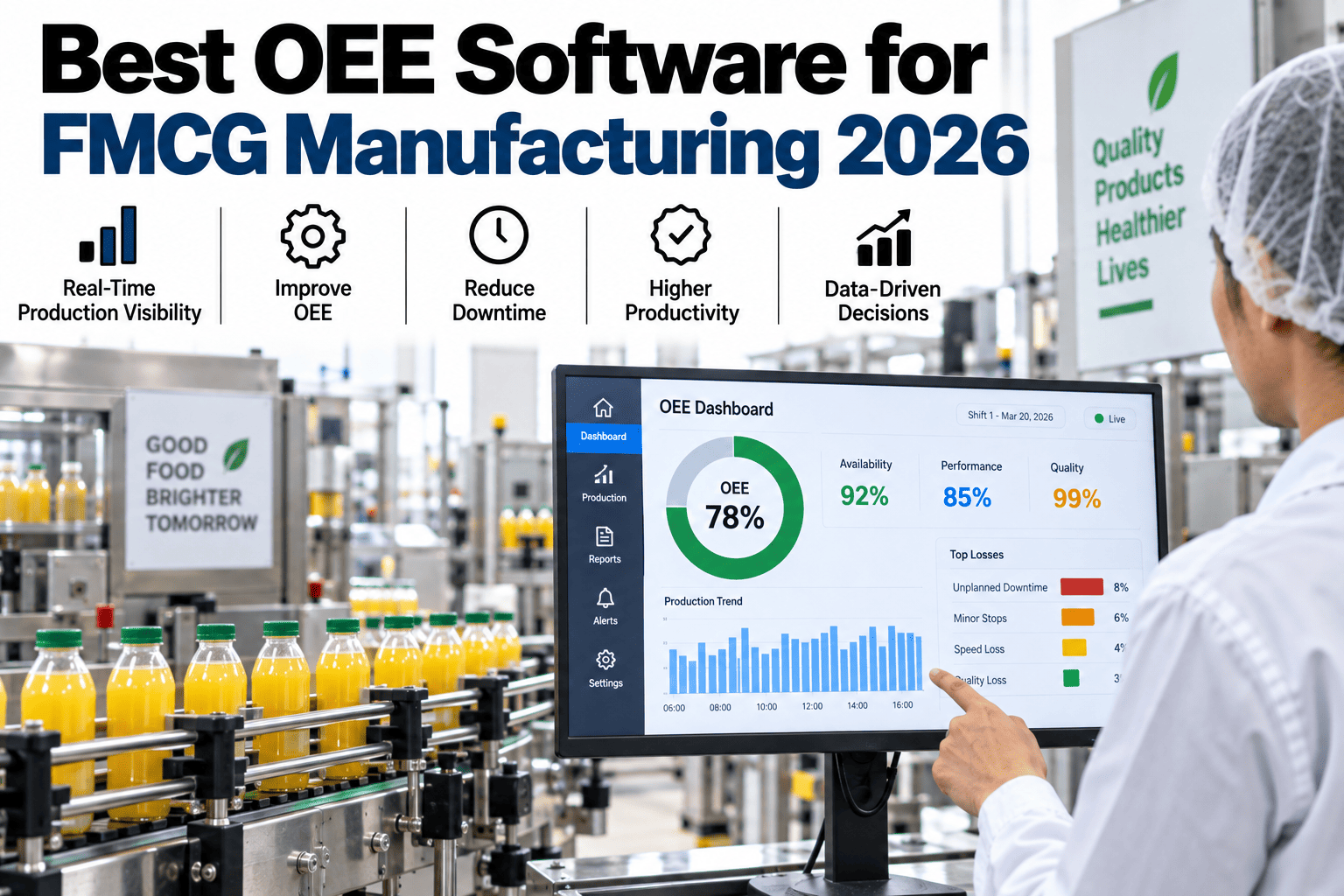
iFactory's OEE analytics module is configured for robotic cell metrics — tracking availability (uptime vs planned production time), performance (actual cycle time vs design cycle time), and quality (defect-free output vs total output) for each cell. The OEE data is aggregated by site, by robot vendor, by application type, and by deployment vintage, enabling the automation engineering team to identify which robot models, which applications, and which deployment approaches deliver the highest OEE and the fastest payback. The cross-site benchmarking capability enables the team to promote best practices from high-performing sites to underperforming sites.
Shift Logbook and Robotics Deployment Documentation
The shift logbook module captures every robotic cell's daily performance, maintenance events, and continuous improvement activities — creating a complete digital record of each cell's operational history from installation through decommissioning. Deployment milestones are tracked against the automation roadmap with automated variance reporting for installations that are behind schedule or underperforming expectations. The logbook also captures lessons learned from each deployment that feeds into the standardisation process for future robotic installations.
What the Scorecard Means for Your Organisation — Benchmarking Your Robotics Deployment Against the FMCG Majors
Tier 1 — Global Leaders
P&G · Unilever · Henkel
1,000+ robots deployed, company-wide automation programmes, dedicated robotics centres of excellence, standards-driven cell designs deployed across 40+ factories, active humanoid pilot programmes. Automation seen as a core competitive advantage with board-level KPIs.
Your Organisation — Where Are You?
Self-Assessment Framework
If your organisation has fewer than 50 robots deployed, no standardised cell design, and no cross-site robotics performance data, you are at Tier 3 or below — where the gap to the majors is measured in years of deployment velocity. The first step is establishing a digital infrastructure that tracks what you have deployed and how it is performing.
Tier 2 — Advanced Adopters
Reckitt · Colgate · Kimberly-Clark
100 to 500 robots deployed, automated at least one flagship factory to high density, standardised cell designs deployed across 10+ sites, active cobot and AGV programmes at scale. Automation managed as a strategic operational function.
Under 100 robots deployed, robotics programme managed at the plant level without corporate-wide standardisation, limited cross-site performance data, cobot-first approach focused on palletising and case packing. Automation investment constrained by capital approval cycles and limited internal robotics engineering capacity.
We manage a portfolio of 14 manufacturing sites across Europe and Asia. When I benchmarked our robotics deployment against the scorecard data from the majors, I realised we were running 42 robots across 14 sites with no standardisation, no cross-site OEE data, and no way to tell whether a cell running at 72 percent utilisation was a problem with the cell itself or a scheduling issue on that specific line. We deployed the iFactory platform to connect every robot across every site to a single dashboard — and within the first 60 days we identified six cells that were underperforming due to programming issues that were specific to individual sites. We fixed those programming issues and the fleet-wide average utilisation went from 68 percent to 84 percent. The year-on-year comparison now shows a clear trend. Our sites are converging in performance as the best practices spread. We are deploying 28 new robots this year, and every new cell goes live on the dashboard from day one. The scorecard gave us the urgency. The platform gave us the visibility.
— Director of Automation & Manufacturing Engineering, Multinational FMCG Manufacturer — 14 Sites, 3 Continents, 42 Robotic Cells
Conclusion
The FMCG robotics deployment gap is widening. Procter & Gamble, Unilever, Henkel, Reckitt, Colgate-Palmolive, and Kimberly-Clark are not pausing their automation programmes. They are accelerating them — deploying standardised cell designs across their global factory networks, building robotics centres of excellence that reduce deployment time from 18 months to 8 months per cell, expanding their pilot programmes for humanoid general-purpose robots, and integrating AI vision and predictive maintenance into every robotic installation. The $8.9 billion FMCG robotics market in 2025 is projected to reach $22.4 billion by 2031, and the manufacturers that are investing in the digital infrastructure to manage their robotics deployments at scale — with cross-site OEE analytics, multi-vendor fleet management, deployment milestone tracking, and continuous improvement documentation — will capture a disproportionate share of the productivity gains that this investment wave will generate.
iFactory's robotics AI integration, multi-site OEE analytics, and shift logbook modules provide FMCG supply chain directors and automation engineers with the platform they need to manage robotics programmes at the scale and velocity that the competitive environment demands. The platform connects every robotic cell across every site to a single dashboard — regardless of robot vendor, application type, or deployment vintage — providing real-time visibility into fleet performance, maintenance status, and deployment progress against the automation roadmap. The cross-site benchmarking capability enables the engineering team to identify and replicate best practices, and the shift logbook captures the continuous improvement lessons that transform individual cell deployments into an organisational automation capability. The platform scales from a single pilot cell to a global fleet of thousands of robots without requiring additional software infrastructure or headcount. Talk to an expert to benchmark your organisation's robotics deployment against the FMCG majors and build your automation roadmap, or Book a Demo to see the multi-site robotics fleet dashboard configured for your factory network.
Frequently Asked Questions
The platform integrates with robot controllers through vendor-provided APIs, standard industrial Ethernet protocols (EtherNet/IP, PROFINET, EtherCAT, OPC-UA), and IIoT edge gateways. For FANUC robots, the platform connects via FANUC's iRPickTool and MT-Linki. For KUKA, via KUKA Connect and KRL data exchange. For ABB, via ABB Ability and RobotStudio data export. For Universal Robots, via UR+ data interface and dashboard server. The platform also supports generic integration via Modbus TCP, MQTT, and file-based import for robots from smaller or legacy vendors. The data ingestion layer normalises all vendor-specific data into a common schema, enabling cross-vendor OEE comparison, utilisation tracking, and maintenance scheduling from a single dashboard without requiring the automation engineering team to operate multiple vendor-specific monitoring platforms. Talk to an expert to discuss integration with your specific robot fleet composition and vendor landscape.
For a typical multi-site deployment covering 8 to 15 factories, the implementation timeline spans: weeks one to two for master dashboard configuration, robot inventory import, and data schema definition; weeks three to eight for site-by-site connection in batches of 3 to 5 factories per week — including edge gateway installation (if required), data point mapping, dashboard configuration per site, and integration testing; week nine for cross-site OEE benchmark configuration, deployment roadmap import, and automation engineering team training; and week ten for go-live with full fleet visibility, automated OEE reporting, and variance alerting active across all connected sites. The platform supports phased deployment where sites are added incrementally as they are ready, and the corporate automation engineering team has full fleet visibility from the moment the first site is connected. The total elapsed time from project kickoff to full fleet visibility for a 12-site deployment is typically 10 to 14 weeks depending on site-level IT network access and robot vendor diversity. Book a Demo to discuss a deployment timeline specific to your factory network size and robot fleet composition.
The platform is agnostic to procurement method and deployment partner. Robots acquired through RaaS providers (Formic, Rapid Robotics, Hirebotics), deployed through system integrators, or purchased directly are all treated identically in the fleet dashboard. The platform tracks each cell's operational data regardless of how it was financed or who installed it. For RaaS deployments, the platform can optionally provide utilisation and OEE data directly to the RaaS provider through a secure API — enabling pay-per-use billing models where the manufacturer pays only for actual production output rather than a fixed monthly fee. The platform also tracks warranty status, service contract details, and spare parts availability for each cell, providing the automation engineering team with a single source of truth for lifecycle management across all procurement methods. The multi-vendor, multi-procurement-method support is essential for FMCG manufacturers that are using RaaS to accelerate deployment velocity at sites where capital approval would otherwise delay automation investment by 12 to 18 months.
ROI across documented multi-site robotics fleet deployments consists of three primary value streams. Utilisation improvement: the most immediate return, typically 10 to 18 percent improvement in fleet-wide robotic cell utilisation within the first 90 days through identification of underperforming cells, programming issues, and scheduling mismatches. For a fleet of 200 robots with an average loaded labour cost of $18 per hour and utilisation improving from 68 percent to 82 percent, the annual value exceeds $450,000. Maintenance optimisation: predictive maintenance triggers and cross-site failure pattern analysis typically reduce unplanned robotic downtime by 25 to 40 percent, with each avoided cell failure saving $4,000 to $12,000 in emergency repair costs and lost production. Deployment velocity acceleration: standardised cell designs and cross-site lessons learned reduce new cell deployment time by 30 to 50 percent, accelerating the flow of benefits from each new installation. Combined across these three streams, documented deployments on FMCG fleets of 50 to 500 robots show a simple payback period of 4 to 8 months. Book a Demo to generate an ROI projection based on your fleet size and current utilisation data.
The platform uses a unidirectional data flow architecture that reads robot controller data without any capability to send commands to the robot or modify its programming. For sites with strict OT network segmentation, the platform deploys read-only edge gateways on the OT network that publish data to the platform cloud instance through an outbound-only connection — eliminating the need to open inbound firewall ports or modify the OT network security configuration. The gateways support hardware-level network isolation with no IP addressable interface between the OT network and the platform cloud. For cloud-connected robot controllers (UR+, KUKA Connect, ABB Ability), the platform connects through the vendor's cloud API, which provides inherent network segregation. All data in transit is encrypted with TLS 1.3. The platform maintains SOC 2 Type II compliance documentation and provides detailed cybersecurity architecture documentation for review by each site's IT and OT security teams. Talk to an expert to discuss your organisation's specific OT security requirements and network architecture.
P&G Has 1,200 Robots. Unilever Targets 2,000 by 2027. Henkel Runs Lights-Out Factories. Where Does Your Organisation Stand? Benchmark Your Robotics Deployment Against the FMCG Majors With iFactory's Platform.
Multi-site robotics fleet management, cross-vendor OEE analytics, deployment milestone tracking, predictive maintenance, and shift logbook digitisation — all in a single platform designed for FMCG automation engineers and supply chain directors managing multi-plant robotics programmes.