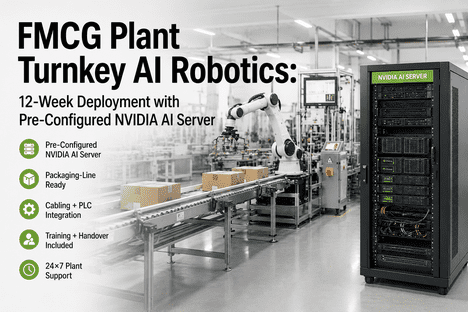
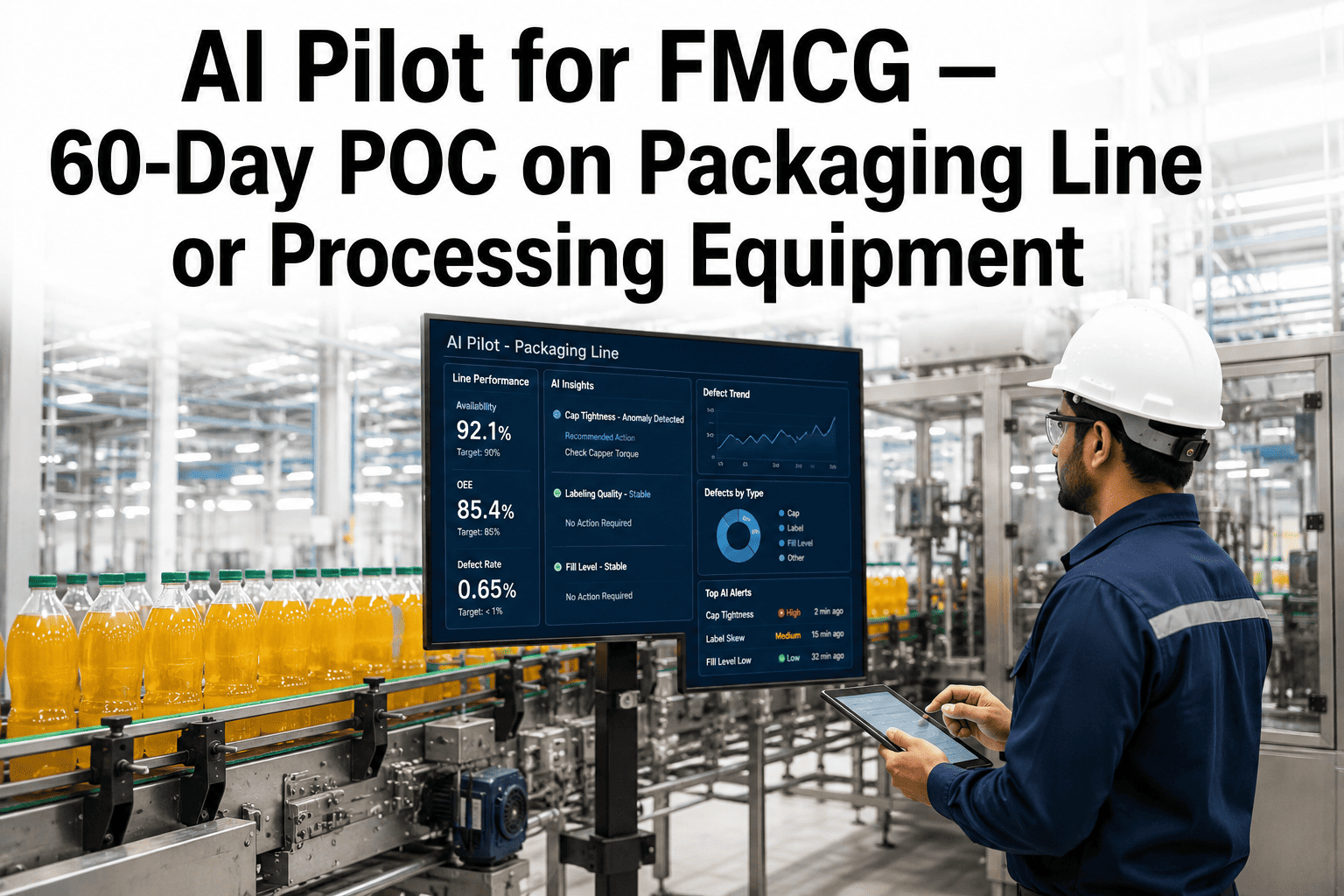
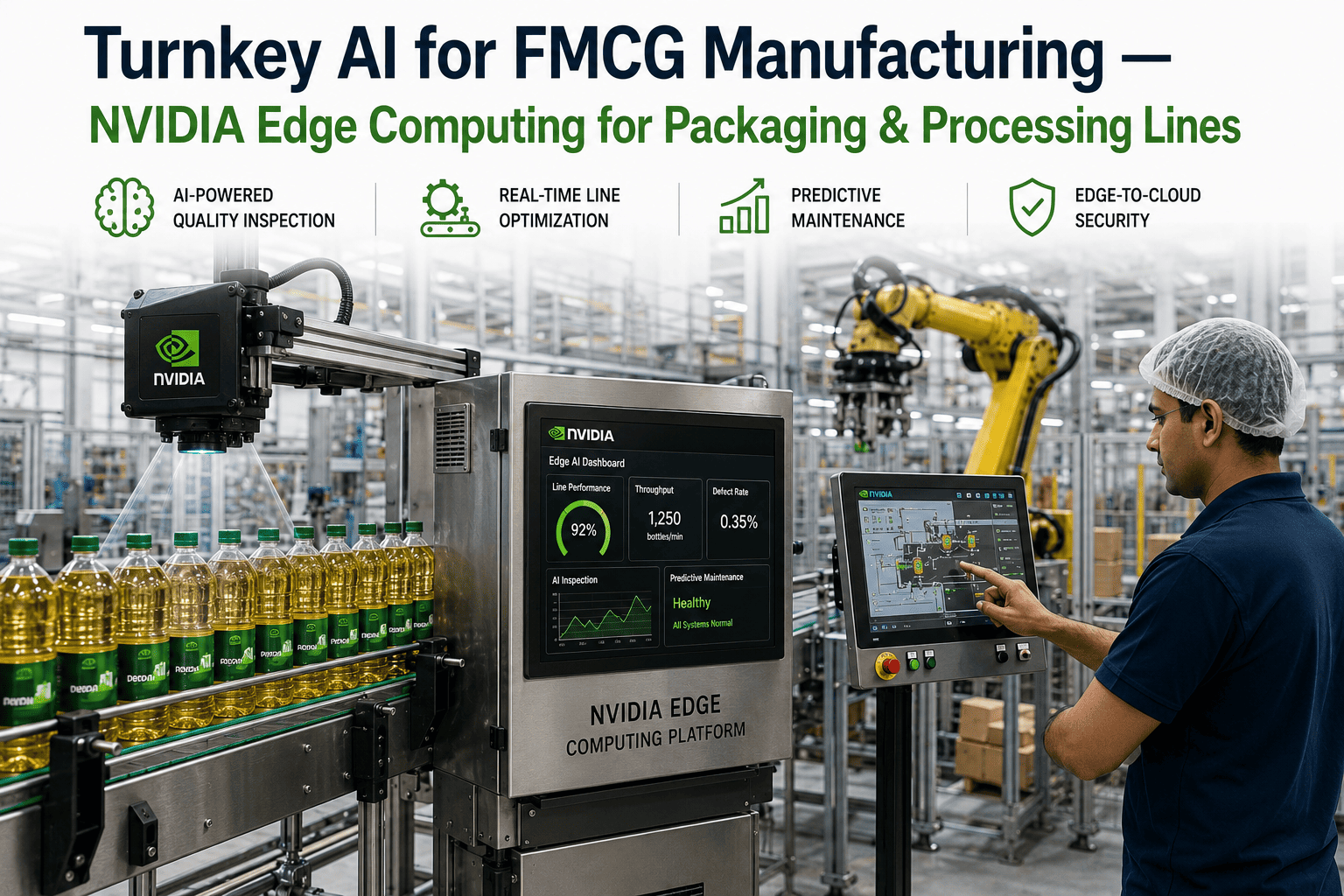
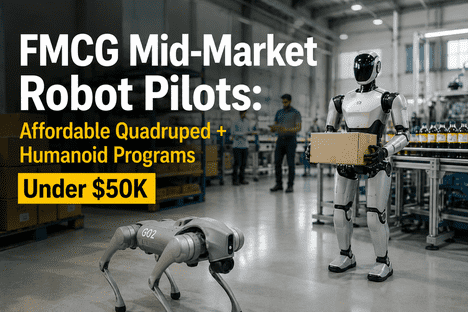
FMCG Plant Turnkey AI Robotics 12-Week Deployment with Pre-Configured NVIDIA AI Server
By Seren on June 20, 2026
FMCG plants lose an average of $39,000 per hour to unplanned downtime. A single packaging line generates thousands of dollars per minute in throughput value, yet the standard path for adopting AI robotics involves selecting a CMMS vendor, sourcing AI compute hardware separately, hiring a systems integrator for PLC/SCADA connections, commissioning robotics integrators for end-of-arm tooling, validating the system against compliance requirements, and training the workforce — each step a separate procurement, separate timeline, and separate point of failure. Schneider Electric's 2026 survey of 1,453 global CPG executives found that manufacturing delays, downtime, and equipment failure already amount to 20.3 percent of final manufactured product cost. Respondents report 15.2 percent of mean manufacturing revenue lost today due to delays, downtime, rework, and quality deviations. Rockwell Automation's 2025 State of Smart Manufacturing Report shows that 86 percent of CPG manufacturers are using or evaluating smart manufacturing technology, yet just one in eight say AI is embedded end-to-end in core operations today. The multi-vendor model creates sequential dependencies, scope gaps, blame cascades when something breaks, and timeline blowout where 12- to 18-month deployments become the norm. iFactory's turnkey AI robotics solution was built to eliminate these failure modes — delivering a pre-configured NVIDIA AI server, packaging-line-ready robotics, validated PLC integration patterns, structured operator training, and 24x7 managed support under a single accountable contract with a 12-week deployment timeline from kickoff to full production.
Turnkey AI Robotics · Pre-Configured NVIDIA AI Server · 12-Week Deployment · 24x7 Managed Support
From Kickoff to Full Production in 12 Weeks. One Contract. One SLA. One Accountable Partner.
Pre-configured NVIDIA AI server, packaging-line-ready robotics, PLC integration, operator training, and 24x7 plant support — delivered as a single turnkey deployment with guaranteed timelines and performance SLAs.
FMCG plants lose $39,000 per hour on average to unplanned downtime — making every week of delayed AI deployment worth $1.2M+ in accelerated downtime reduction
86%
CPG Manufacturers Evaluating Smart Manufacturing
Yet only 13% have AI embedded end-to-end — the gap between evaluation and production deployment is driven by integration complexity, not technology readiness
12 wks
Turnkey Deployment Timeline vs. 12-18 Month Traditional
Turnkey model compresses the timeline from 12-18 months to 12 weeks — with pilot line live by week 6 and full plant rollout by week 12
40-60%
Unplanned Downtime Reduction Within 12 Months
FMCG plants with mature AI deployments consistently achieve 40-60% reduction in unplanned downtime with 91% prediction accuracy within 12-18 months
The Four Barriers Keeping AI Robotics Out of FMCG Plants
The Multi-Vendor Trap
Five separate vendors, five timelines, zero accountability when something breaks.
The standard path for FMCG AI robotics requires selecting a CMMS vendor, sourcing AI hardware separately, hiring a systems integrator, commissioning robotics integrators, and training operators — each a separate procurement with separate SLA and separate support desk. When the AI model underperforms or the robot misses a pick, every vendor points at another. MIT's 2025 study of 300+ enterprise AI deployments found that 95 percent of generative AI pilots produced no measurable P&L impact. Gartner predicts 60 percent of AI projects will be abandoned through 2026 for lack of AI-ready data. The root cause is not weak AI — it is integration and learning gaps that the multi-vendor model cannot solve.
Integration Failure + Budget Blowout
The Downtime Deployment Penalty
Traditional robotics deployments require 4-8 weeks of interrupted production for installation and commissioning.
FMCG plants running at 600+ units per minute cannot afford weeks of line stoppage for technology deployment. Traditional robotic cell installations require production shutdowns for foundation work, safety system integration, PLC reconfiguration, and production ramp-up testing. At $39,000 per hour of downtime, a six-week deployment interruption costs the plant $11.2 million before the system even produces a single unit. The turnkey model eliminates this penalty through pre-validated reference architectures, factory acceptance testing before shipment, and parallel installation during planned maintenance windows — achieving first production value at week 6 rather than month 12.
$11.2M+ Lost Production Value
The Skills Gap Crisis
43% of CPG manufacturers cite AI/data science skills gaps as the #1 barrier to adoption.
Schneider Electric's 2026 survey identifies skills gaps in AI or data science as the primary barrier at 43 percent, followed by legacy automation systems at 37.5 percent, and lack of contextualized operational data at 36.3 percent. The 2025 State of Smart Manufacturing Report confirms that workforce concerns take three of the top five internal obstacles for CPG manufacturers. The IFR's World Robotics 2025 report adds that the wide range of engineering capabilities needed — in vision, process design, and peripherals — often prevents adoption, especially in SMEs. The turnkey model addresses this by delivering pre-trained AI models with FMCG-specific failure patterns, structured operator training built into the deployment timeline, and 24x7 managed support that handles model tuning and optimisation so the plant team does not need in-house data scientists.
Talent Shortage + Adoption Stall
The 18-Month Deployment Timelines
A single cobot cell takes 14-22 weeks; multi-cell deployments take 6-12 months — when they finish at all.
FMCG robotics research output increased 62 percent from 2024 to 2026, yet fewer than 8 percent of FMCG plants in North America have piloted any robotic system introduced after 2023. The barrier is not the technology — it is the absence of structured deployment frameworks that operations directors can justify to CFOs. A plant deploying turnkey AI begins generating returns 12 to 15 months earlier than one taking the traditional multi-vendor path. At $39,000 per hour of downtime cost, each month of accelerated deployment is worth $1.2 million or more in accelerated downtime reduction alone. The 12-week model eliminates the timeline risk that has historically killed the FMCG AI business case.
ROI Delay + Competitive Disadvantage
What Turnkey Actually Means for FMCG — From Multi-Vendor Fragmentation to Single-Contract Delivery
Turnkey in the context of FMCG AI robotics is not a marketing term — it is a contractual and architectural commitment. Every dependency that traditionally derails a project — hardware specification, software integration, PLC connectivity, operator training, plant validation, and ongoing support — is owned by one accountable partner working from pre-validated reference architectures. The result is a deployment model where every component is designed, tested, and documented as a complete system before it reaches the plant floor.
Component 01
Pre-Configured NVIDIA AI Server
Ships with the full software stack pre-installed: NVIDIA AI Enterprise suite (NIM microservices, NeMo framework), iFactory FMCG CMMS platform with food and beverage equipment templates, and pre-trained ML models for fillers, wrappers, labelers, conveyors, and palletizers — trained on FMCG-specific failure patterns including seal degradation, label drift, servo fatigue, and filler valve wear. OPC-UA, Modbus, and EtherNet/IP integration patterns are pre-validated for Siemens S7, Allen-Bradley ControlLogix, Rockwell Automation, Schneider Electric Modicon, and Omron PLCs. The server is rack-level tested and validated before shipment, ensuring plug-and-play deployment when it arrives on the plant floor.
Component 02
Packaging-Line-Ready Robotics
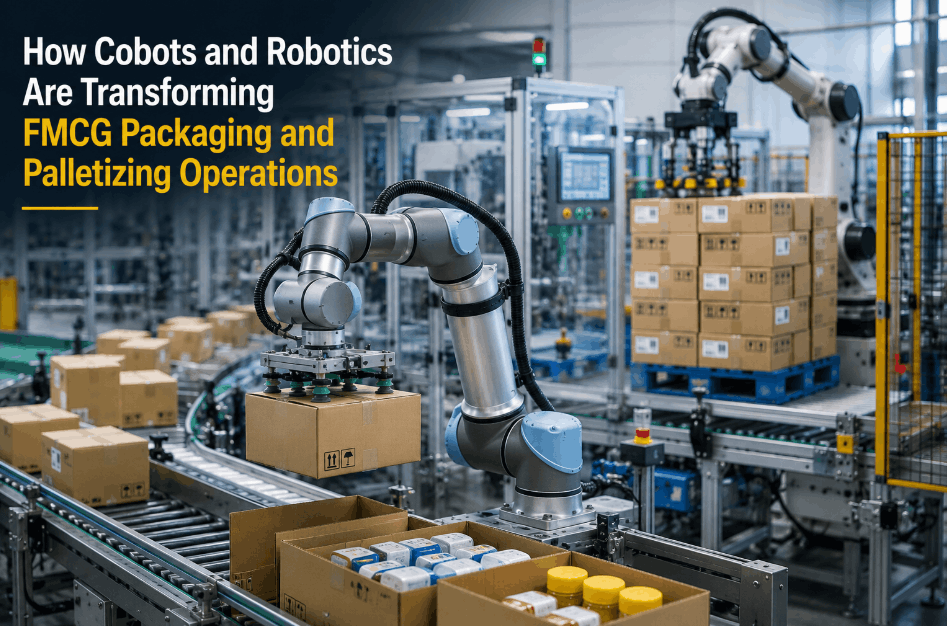
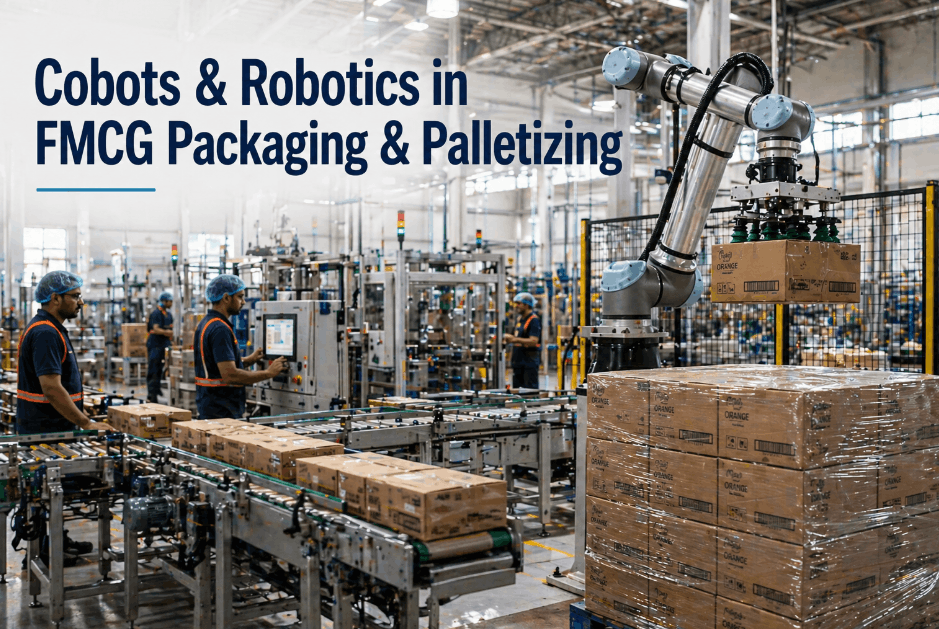
Pre-engineered robotic cells for the three highest-ROI FMCG deployment patterns: end-of-line palletizing with cobot or industrial robot, pre-configured end-effector tooling, safety-rated monitored stop, and quick-change tooling interfaces for multi-SKU operations achieving sub-4-minute changeovers; case packing and pick-and-place with delta or articulated arm, vision-guided random-orientation picking at 240 cycles per minute with 99.6 percent defect detection; and AI vision quality inspection integrated with sorting robotics, trained on synthetic data for rapid deployment in weeks rather than months.
Component 03
Cabling + PLC Integration + Training + 24x7 Support
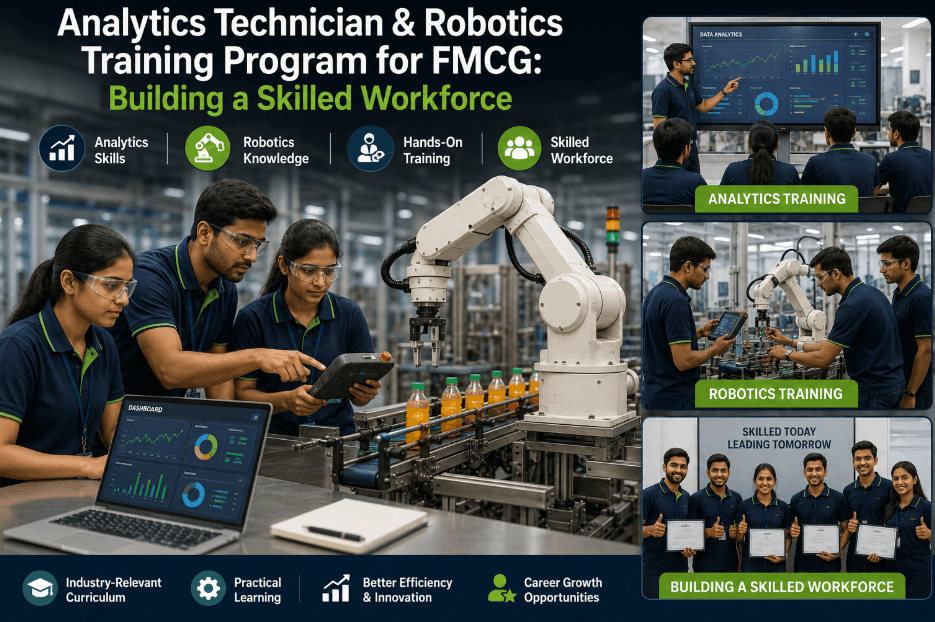
Pre-terminated cabling designed to the plant's existing topology. PLC connectivity established using pre-validated OPC-UA, Modbus TCP, and EtherNet/IP integration patterns — no custom driver development needed. SCADA and MES integration verified before go-live. Structured operator training covering cobot programming interfaces, emergency stop procedures, recipe management, daily vision system calibration, alarm response, and basic troubleshooting. 24x7 managed support from day one with guaranteed response SLAs, AI model performance monitoring, equipment health surveillance, and quarterly optimisation reviews.
Component 04
Single-Contract Accountability
One purchase order covers the NVIDIA AI server, robotic cells, PLC integration, training, and ongoing support. One SLA defines every performance commitment. One support desk handles every incident. When a prediction model underperforms or a robot misses a cycle, one team owns the diagnosis and fix. No scope gaps, no sequential dependencies, no finger-pointing. The plant team focuses on operations while the turnkey partner manages the technology lifecycle.
12-Week Deployment · Pre-Configured NVIDIA AI · FMCG Robotics · 24x7 Managed Support
One PO. One SLA. One Partner. From Site Assessment to Full Production in 12 Weeks.
Pre-configured NVIDIA AI server with FMCG-specific ML models, packaging-line-ready robotic cells, validated PLC integration, structured training, and 24x7 support — delivered under a single turnkey contract with guaranteed timelines.
The 12-Week Turnkey Deployment Process — From Kickoff to Full Production
The turnkey model compresses the traditional 12- to 18-month AI robotics deployment into a structured 12-week program with two critical milestones: pilot line live at week 6 and full plant rollout at week 12. Every phase is pre-defined with specific deliverables, acceptance criteria, and escalation paths — no discovery phase, no scope creep, no timeline uncertainty.
Weeks 1-2: Site Assessment & Architecture Lock
Plant walkthrough covering asset inventory, PLC/SCADA topology, and target use case selection. Network audit of existing IT/OT infrastructure. Reference architecture confirmed — NVIDIA AI server spec locked, robotic cell configuration finalized, integration pattern selected. Hardware BOM finalized on a single PO. KPI baseline established covering OEE, unplanned downtime, changeover times, and defect rates.
NVIDIA AI server pre-configured with iFactory software stack, FMCG equipment templates, and initialized AI models. Robotic arms, AI vision cameras, and edge gateways prepared with end-effector tooling and safety systems. Integration testing at vendor facility with PLC connectivity verified against plant control system specs. Factory Acceptance Testing completed with customer sign-off before shipment.
Weeks 5-7: On-Site Installation & PLC Integration
Physical installation of NVIDIA AI server, robotic cells, and AI vision cameras with pre-terminated cabling. PLC connectivity established using pre-validated OPC-UA, Modbus, and EtherNet/IP patterns. SCADA and MES integration verified. Safety systems certified. Pilot line go-live by end of week 7 — first production use at week 6 from kickoff, demonstrating returns before the project is complete.
Weeks 8-12: Validation, Rollout & Full Production
Parallel manual and robotic operation validating throughput targets. AI model tuning with prediction accuracy baselined. Structured operator qualification covering recipe management, vision calibration, and alarm escalation. Pilot configuration rolled out across remaining lines — each additional line requiring 2-3 days using pre-validated templates. Full production cut-over at week 12 with 24x7 managed support activated, AI model performance dashboard live, and audit-ready documentation completed.
Why the 12-Week Model Changes the Business Case
A plant deploying turnkey AI begins generating returns 12 to 15 months earlier than one taking the traditional multi-vendor path. At $39,000 per hour of downtime cost, each month of accelerated deployment is worth $1.2 million or more in accelerated downtime reduction alone. The pilot line is live at week 6 — meaning the business case begins demonstrating returns before the project is even complete. This is the fundamental structural advantage of the turnkey model: it compresses the time-to-value curve so dramatically that the ROI calculation shifts from hypothetical projection to operational reality within a single fiscal quarter.
What iFactory's Turnkey AI Robotics Platform Actually Delivers
iFactory is not a point solution for one element of the AI robotics stack. It is the complete integration and intelligence platform that connects the pre-configured NVIDIA AI server, robotic cells, PLC infrastructure, and plant operations into a unified system — with every component designed, tested, and supported as a single turnkey deployment. The platform serves as the software intelligence layer that integrates with existing PLCs, SCADA systems, robotic servo drives, CIP control panels, and ERP systems including SAP, Oracle, and Microsoft Dynamics already deployed across the facility.
Capability 01
AI Predictive Maintenance — Purpose-Trained for FMCG Equipment
ML models trained specifically on FMCG failure patterns — fillers, wrappers, labelers, conveyors, and palletizers. Unlike generic predictive models that trigger alerts only when sensor readings exceed fixed thresholds, iFactory's models learn the interaction between multiple variables. A specific combination of vibration amplitude increase, temperature gradient change, and product recipe switch predicts bearing failure on a vertical form-fill-seal machine with 94 percent accuracy at 72 to 96 hours before failure. Achieves 48-hour-plus failure prediction across all monitored equipment, 91 percent-plus prediction accuracy within 12 to 18 months, 30 to 45 percent reduction in unplanned downtime, and 15 to 25 percent extension of asset life.
Capability 02
Digital Shift Logbook — Eliminating the 40% Handover Failure Rate
Over 40 percent of plant incidents occur during shift handover despite covering less than 5 percent of operational time. Paper logbooks are illegible, unsearchable, and incomplete. iFactory's digital shift logbook captures structured entries for equipment status, safety events, production updates, quality concerns, and pending tasks. AI auto-generates shift summaries highlighting the top five critical items for incoming crews. Cross-shift analytics detect degradation trends developing across multiple shift cycles before they escalate into unplanned downtime. Anomaly events are written automatically to the shift timeline, classified by severity, attributed to asset and sensor, and prioritized alongside operator observations.
Capability 03
Real-Time Production Monitoring & OEE Tracking
Tracks Availability, Performance, and Quality across every packaging line — integrating with SCADA and PLC to auto-capture data with zero manual entry. Identifies the Six Big Losses and benchmarks shifts, lines, and SKU changeovers. Typical results from FMCG deployments: beverage manufacturer OEE from 61 percent to 75 percent in six months; snack manufacturer OEE from 62 percent to 84 percent in 11 months; coffee roasting facility at 97 percent equipment uptime post-deployment. Each percentage point of OEE on a high-speed FMCG line is worth $150,000 to $350,000 annually.
Tracks every changeover using SMED methodology — recording setup times, cleaning cycles, allergen protocols, and first-article checks. AI analyzes changeover data to identify bottlenecks, reducing changeover time by 25 to 35 percent on average. Case packer and palletizer changeovers using quick-change tooling interfaces achieve sub-4-minute changeovers with motion parameters and pick patterns that adjust automatically based on recipe selection. Closed-loop integration with CMMS means sensor anomalies auto-generate work orders in SAP PM, Maximo, Oracle EAM, or Fiix — zero manual handoff between detection and response.
The Measurable Impact — Turnkey vs. Traditional AI Robotics Deployment
Traditional Multi-Vendor Approach
12-18 months
Time from kickoff to first production value. Five separate vendors, sequential dependencies, scope gaps, and blame cascades. MIT found 95% of enterprise AI pilots produce no measurable P&L impact under this model.
Turnkey 12-Week Model (iFactory)
6 wks to pilot
Pilot line live at week 6, full plant rollout at week 12. One PO, one SLA, one accountable partner. Pre-validated reference architectures eliminate integration risk. Business case begins demonstrating returns within a single fiscal quarter.
Traditional Multi-Vendor Approach
10-20% downtime reduction
If the project completes at all. Multi-vendor integration typically achieves half the AI prediction accuracy due to fragmented data access and incompatible system architectures across vendor boundaries.
Turnkey 12-Week Model (iFactory)
40-60% downtime reduction
Consistently achieved across FMCG deployments with mature AI models. 91% prediction accuracy within 12-18 months. Beverage manufacturer across 8 facilities saved $15M annually from 45% unplanned downtime reduction.
Traditional Multi-Vendor Approach
3-8 point OEE gain
If the project completes. Limited by fragmented data visibility across vendor-specific systems. Each vendor optimizes its own domain without cross-system awareness.
Turnkey 12-Week Model (iFactory)
12-18 point OEE gain
In the first 12 months on monitored lines. First 5-8 points within 90 days from previously invisible losses. Unilever's Indaiatuba plant sustained 85%+ OEE using predictive AI — up from 72% baseline, producing EUR 3M in productivity gains.
We spent 14 months with a multi-vendor AI robotics project that never made it to production. The CMMS vendor blamed the hardware vendor. The hardware vendor blamed the systems integrator. The systems integrator said the PLCs needed reconfiguration that nobody had scoped. Meanwhile our packaging lines kept losing $39,000 an hour to unplanned downtime and our CFO could not understand why we had spent $2.3 million on technology that had not produced a single prediction. With iFactory's turnkey model, we had a pre-configured NVIDIA AI server on-site in week 5, our first pilot line live in week 7, and all six packaging lines running on predictive AI by week 12. One contract. One SLA. One team that actually owns the outcome. Our unplanned downtime dropped 52 percent in the first eight months and our OEE went from 64 percent to 81 percent. The difference is not the technology — it is the deployment model.
— VP of Engineering, Multi-Site FMCG Food Manufacturing Operation — 22 Years Production Leadership
Conclusion
FMCG manufacturing in 2026 is defined by margin compression, SKU proliferation, workforce shortages, and zero tolerance for unplanned downtime. The industry cannot afford 18-month AI deployments that never reach production, multi-vendor integration projects that blow budgets and timelines, or point solutions that create data silos instead of operational intelligence. Rockwell Automation's 2025 State of Smart Manufacturing Report confirms that 86 percent of CPG manufacturers are evaluating smart manufacturing technology, yet just 13 percent have AI embedded end-to-end in core operations — and the gap is not driven by technology readiness. It is driven by the absence of deployment models that operations directors can justify to CFOs and that plant teams can actually operate without data science degrees on staff.
The turnkey model — pre-configured NVIDIA AI server with FMCG-specific ML models, packaging-line-ready robotics, validated PLC integration patterns, structured operator training, and 24x7 managed support — collapses the deployment timeline from 18 months to 12 weeks while eliminating the integration risks, skills gaps, and accountability failures that have historically prevented AI from delivering at scale. The pilot line is live at week 6. The full plant is operational at week 12. The business case begins demonstrating returns within a single fiscal quarter. Industry benchmarks across hundreds of FMCG deployments show 40 to 60 percent reduction in unplanned downtime, 12 to 18 point OEE improvement, 30 to 45 percent reduction in maintenance costs, and a 12 to 18 month payback period with 91 percent AI prediction accuracy within 12 to 18 months.
The question is no longer whether AI robotics works for FMCG. It is whether your plant can afford to deploy it faster than your competitors — and whether you can afford another 18-month multi-vendor project that may never reach production. Talk to an expert to discuss your plant's current infrastructure and deployment timeline, or book a demo to see iFactory's turnkey AI robotics platform in action on your own FMCG production data.
Frequently Asked Questions
No. iFactory's integration engine is designed as an overlay layer that connects to existing plant infrastructure through pre-validated protocol gateways. Siemens S7, Allen-Bradley ControlLogix, Rockwell Automation, Schneider Electric Modicon, and Omron PLCs remain in place and continue to operate normally. iFactory reads data from these systems through OPC-UA, Modbus TCP, and EtherNet/IP interfaces — no controller replacement, no rewiring, no disruption to ongoing production. The pre-configured NVIDIA AI server ships with integration patterns already validated for each PLC make and model identified during the site assessment phase. Closed-loop CMMS integration with SAP PM, Maximo, Oracle EAM, and Fiix means sensor anomalies auto-generate work orders in your existing system with zero manual handoff. Talk to an expert to discuss compatibility with your specific PLC and ERP configuration.
SLA performance is monitored continuously from day one through the AI model performance dashboard, which tracks inference accuracy, false positive rates, prediction lead times, and robotic cell throughput in real time. If any metric falls below the guaranteed threshold, the 24x7 managed support team initiates a structured remediation process: root cause diagnosis within four hours, corrective action plan within 24 hours, and resolution within the SLA window. Model accuracy typically starts at 75 to 80 percent during the first two weeks of calibration and reaches the 91 percent target within 12 to 18 months as the models train on plant-specific failure data. Throughout this period, the iFactory support team handles all model tuning and optimisation — the plant team monitors results through the dashboard without needing data science capabilities in-house. Talk to an expert to see how the SLA monitoring dashboard presents real-time performance metrics and remediation status.
No specialised AI, data engineering, or robotics programming skills are required. The platform is designed for existing plant maintenance teams and production supervisors. AI models are pre-trained on thousands of hours of FMCG production data and self-calibrate to each facility's specific equipment and failure patterns during the first two weeks of operation. The robotic cells ship with pre-configured pick patterns and quick-change tooling interfaces — operators select the product recipe from a touchscreen interface and the robot adjusts motion parameters and pick patterns automatically. Operator training is structured into the deployment timeline during weeks 8 and 9, covering cobot programming interfaces, emergency stop procedures, recipe management, daily vision system calibration, alarm response, and basic troubleshooting. Maintenance technician training covers routine PM tasks, end-effector replacement, and quick-change tooling procedures. Most plant teams are fully productive on the platform within the 12-week deployment window. Talk to an expert to see the operator interface and training curriculum.
The deployment follows a pilot-first, then roll-out model. One production line is selected as the pilot during the site assessment phase (weeks 1-2), and that line is fully operational by week 7 — including the NVIDIA AI server connection, robotic cell integration, PLC interface, operator training, and AI model calibration. During weeks 10 and 11, the validated pilot configuration is rolled out to remaining lines using pre-validated templates. Each additional line typically requires 2 to 3 days rather than weeks, because the integration pattern, model configuration, and operator training materials have already been validated on the pilot line. A plant with six packaging lines typically achieves full deployment across all lines within the 12-week timeline. The pilot-first approach also means the business case begins generating measurable returns from week 7 — while traditional approaches would still be in the integration phase with zero production value. Talk to an expert to discuss how the deployment timeline maps to your specific plant layout and line configuration.
Yes. iFactory's platform architecture supports multi-site deployments where each facility has different equipment configurations, different PLC brands, and different line layouts. Each site receives its own pre-configured NVIDIA AI server with integration patterns validated for that facility's specific equipment and control systems, while all sites report to a central portfolio-level dashboard that provides cross-site OEE benchmarking, multi-plant downtime tracking, consolidated maintenance cost analysis, and standardized AI model performance monitoring. This is the correct architecture for FMCG operations that have accumulated different machinery and control systems across different facilities over different acquisition or expansion cycles. The portfolio-level AI identifies best-practice strategies from high-performing plants and recommends deployment across underperforming sites. The multi-site deployment is sequenced one plant at a time, with each plant following the same 12-week timeline, and lessons learned from each deployment accelerating the next one. Talk to an expert to discuss how the multi-site architecture maps to your specific portfolio configuration and deployment priorities.
Your FMCG Plant Has Been Waiting 18 Months for AI That Delivers. iFactory Delivers It in 12 Weeks.
Pre-configured NVIDIA AI server with FMCG-specific ML models, packaging-line-ready robotics, validated PLC integration, structured operator training, and 24x7 managed support — all under a single turnkey contract with guaranteed performance SLAs. Pilot line live by week 6. Full production by week 12.