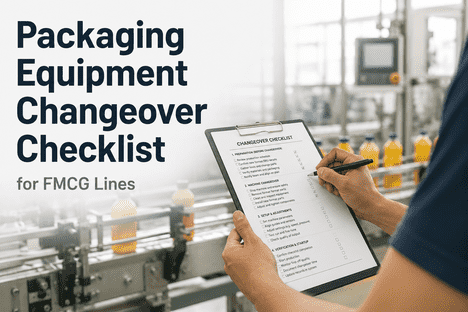
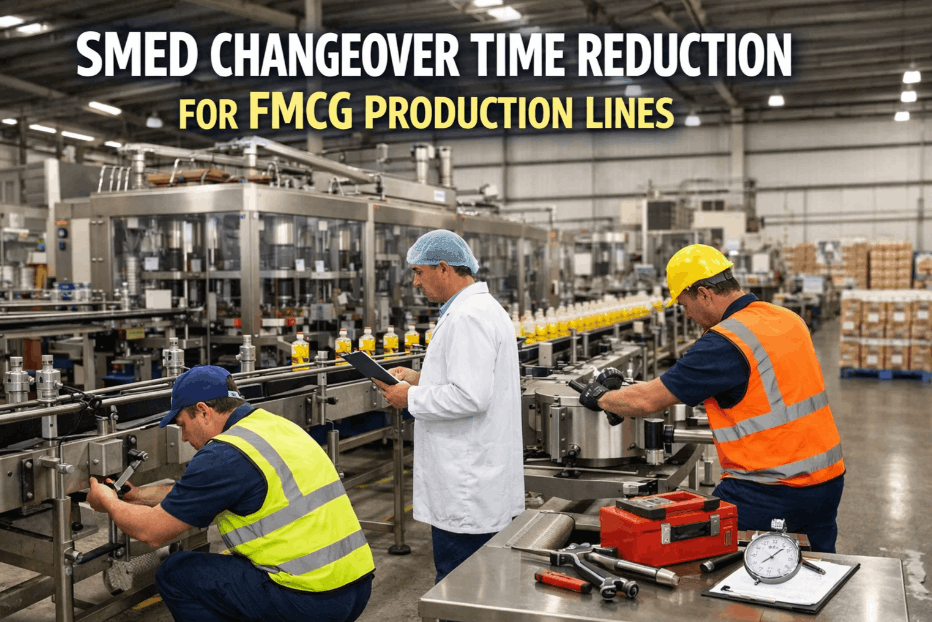
Every FMCG production line loses 15 to 30 percent of its available operating time to changeovers. In a high-speed packaging facility running 16 SKUs across three shifts, those changeover minutes accumulate into hundreds of lost production hours per year — hours that directly reduce OEE, delay customer orders, and inflate unit costs in a margin environment where every decimal point matters. The global FMCG market surpassed $11.2 trillion in 2025, with private-label brands growing at 8.4 percent annually and demanding ever-shorter production runs to support SKU proliferation. A standard format changeover on a flow-wrapping line takes 45 to 90 minutes when performed by skilled operators working from tribal knowledge — and 120 to 180 minutes when the experienced changeover technician is on holiday or has left the company. SMED methodology, developed by Shigeo Shingo at Toyota, proved that 90 percent of changeover activities can be converted from internal to external setup — yet most FMCG plants still perform the majority of setup work while the line is stopped because they lack the robotics and digital infrastructure to execute those activities in parallel. iFactory's production monitoring and OEE analytics platform, combined with robotics AI integration and shift logbook digitisation, was purpose-built to close this gap — converting changeover operations from a manual, variable, experience-dependent bottleneck into a predictable, automated, data-driven process that accelerates every SKU switch and recovers hundreds of production hours per year.
Stop Losing 30% of Production Time to Changeovers. Start Automating Every SKU Switch — With iFactory's AI-Powered Changeover Acceleration Platform.
Real-time OEE tracking, SMED-compliant changeover workflows, robotics integration for format-part exchange, shift logbook digitisation, and AI-driven line balance optimisation — all in a single platform designed for production managers, not robotics engineers.
Global FMCG market value in 2025, with private-label brands growing at 8.4% CAGR driving SKU proliferation and shorter production runs
Annual Changeover Cost
$4.8B
Estimated annual cost of unplanned changeover downtime across global FMCG manufacturing — lost production, labour inefficiency, and waste
OEE Improvement
15–30%
OEE recovery achievable through SMED-driven changeover reduction — eliminating the single largest source of planned downtime in high-mix FMCG lines
Robotics CAGR
14.2%
CAGR of FMCG changeover robotics market — from $2.1B in 2025 to $6.9B by 2033, driven by labour shortages and SKU complexity
The Real Cost of Manual, Experience-Dependent FMCG Changeovers
The Tribal Knowledge Trap
Changeover procedures exist only in the heads of your most experienced operators.
When the senior changeover technician with 18 years of experience retires or calls in sick, the 45-minute changeover becomes a 120-minute ordeal. New operators follow written procedures that were last updated when the line was commissioned — before three packaging format changes, two film suppliers, and four SKU additions. The result is changeover time variance that ranges from 40 to 180 minutes for the same SKU pair, making production scheduling a guessing game and forcing planners to pad every schedule with changeover buffers that hide 8 to 12 hours of avoidable downtime per week. This is not an operator skill problem — it is a knowledge capture and automation problem that SMED methodology and robotics integration were specifically designed to solve.
The Internal-External Blindness
Most changeover work is done while the line is stopped — but 90% could be done externally.
Shingo's foundational SMED principle states that separating internal setup (work that requires the line to be stopped) from external setup (work that can be done while the line is running) is the single highest-leverage improvement in changeover reduction. Yet in most FMCG plants, operators are fetching tools, locating change parts, and adjusting machine settings while the clock is running on lost production. A 2024 benchmarking study of 87 FMCG packaging lines found that 68 percent of changeover activities classified as internal could be converted to external setup with proper pre-staging, standardised tooling, and parallel work coordination — yielding an average changeover time reduction of 54 percent without any capital investment in automation.
The Format-Part Chaos
Change parts are lost, damaged, or stored in the wrong location — every single shift.
A typical FMCG packaging line requires 12 to 18 format-specific change parts per SKU — forming sets, sealing jaws, film guides, date coders, conveyor rails, and product buckets. In a facility running 20 SKUs, that is 240 to 360 change parts that must be located, transported, inspected, and installed for every changeover. Without a digital tracking system and robotics-assisted retrieval, operators spend 8 to 15 minutes per changeover searching for parts — time that compounds across every SKU switch on every shift. Facilities implementing RFID-tracked change parts with automated guided vehicle delivery reduce part retrieval time by 80 percent and eliminate the most common cause of changeover delays.
The OEE Blind Spot
Changeover time is tracked as planned downtime — hiding its true impact on OEE.
Most FMCG facilities classify changeover time as planned downtime in their OEE calculations, effectively removing it from the performance denominator and masking the single largest source of lost production capacity. When changeover time is correctly accounted for as a speed loss in the OEE calculation — measuring actual production time against gross available time — the true OEE of a high-mix line drops by 15 to 25 percentage points. iFactory's OEE analytics module captures changeover time as a separate loss category, giving production managers visibility into the actual cost of every SKU switch and enabling data-driven decisions about run quantity optimisation, standard work development, and automation investment prioritisation.
SMED Methodology · Robotics Format Exchange · OEE Analytics · Line Balance AI · Shift Logbook
Your Operators Spend 40 Minutes Looking for Change Parts. iFactory Spends That Time Producing Product.
iFactory's platform digitises every changeover procedure, tracks every format part, measures every second of internal vs external setup time, and integrates with robotics systems to automate format-part exchange. The result is changeover time reduced by 50 to 70 percent, OEE recovered by 15 to 30 percent, and a complete digital record of every SKU switch for continuous improvement analysis.
How SMED Methodology + Robotics + AI Converts Changeover Minutes into Production Hours — A Five-Stage System
iFactory's changeover acceleration platform integrates SMED methodology with robotics automation and AI-powered line balance optimisation through a five-stage system that converts every changeover from a manual, variable, downtime event into a predictable, automated, high-speed transition. Understanding this system is essential for production managers evaluating changeover reduction platforms — because the speed of the SKU switch depends on the rigour of the preparation infrastructure, not the speed of the operator executing the last step.
01
Procedure Digitisation
Every changeover procedure is documented step-by-step in iFactory's shift logbook — with video guides, parts lists, tool requirements, and estimated times attached. Operators access standardised workflows on the line-side tablet, eliminating variance caused by tribal knowledge and undocumented procedure drift.
02
SMED Internal vs External Analysis
Each step is classified as internal or external. Steps identified as internal-but-convertible are flagged for re-engineering — pre-staging change parts, preheating sealing jaws, pre-setting film registration parameters while the line is still running the previous product.
03
Robotics Format Exchange
Collaborative robots and automated guided vehicles handle format-part retrieval, transport, and installation. Jaws, guides, and change parts are exchanged by robotic arms operating while the line is running external setup steps — compressing internal changeover time to the minimum physically required.
04
Line Balance AI
iFactory's AI analyses changeover history and production schedules to recommend optimal run sequences — minimising changeover impact by grouping compatible SKUs, scheduling complex changeovers at shift boundaries, and balancing line speed adjustments to reduce downstream starvation during changeover events.
05
Measurement & Continuous Improvement
Every changeover is timed, recorded, and compared against the standard. Variance outside the control limit triggers automated root-cause analysis. Improvement ideas are captured in the shift logbook and tested in the next scheduled changeover — creating a continuous improvement loop that drives changeover time toward the theoretical minimum.
The outcome of this integrated system is measurable and repeatable: FMCG facilities implementing iFactory's SMED-plus-robotics platform report changeover time reductions of 55 to 72 percent within the first six months. A high-mix snack food facility running 35 SKUs across four packaging lines reduced average changeover time from 64 minutes to 22 minutes over nine months — recovering 1,280 production hours per year and increasing line OEE from 58 percent to 76 percent without adding a single operator or packaging machine.
Format-Part Humanoids and Multi-SKU Changeover Robotics — Automating the Physical Exchange That Takes the Most Time
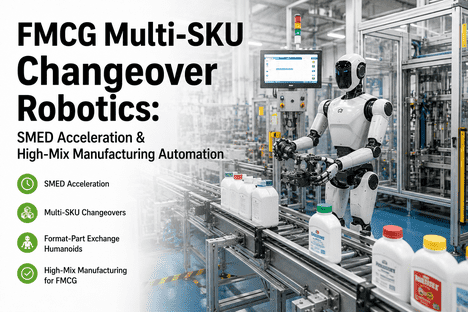
The physical exchange of format parts — forming sets, sealing jaws, film reels, date coders, conveyor guides, and product buckets — accounts for 55 to 70 percent of internal changeover time in FMCG packaging lines. Unlike process parameters that can be adjusted digitally, format parts must be physically removed, transported, stored, retrieved, inspected, and installed. This is the domain where robotics delivers the highest return in changeover acceleration, and where iFactory's robotics AI integration module provides the digital infrastructure to coordinate automated format exchange with manual parallel work.
Collaborative Robot Format Exchange
Cobots equipped with quick-change end effectors remove and install forming sets, sealing jaws, and film guides while operators perform parallel external tasks. A single cobot can complete a full forming-set exchange in under three minutes — compared to 12 to 18 minutes for manual exchange — and can be reprogrammed for new format configurations in under 30 minutes using the iFactory robotics AI module's drag-and-drop sequence builder.
Automated Guided Vehicle Parts Logistics
AGVs retrieve pre-staged change parts from the central storage rack and deliver them to the line-side staging area before the changeover begins — converting part retrieval from a 10-minute internal activity into a zero-minute external activity. iFactory's platform tracks every change part's location, condition, and cycle count via RFID tagging, generating replenishment alerts when parts approach end-of-life and ensuring that the correct parts arrive at the correct line at the correct time.
Vision-Guided Setup Verification
AI vision cameras verify that every format part is installed correctly before the line restarts — detecting misaligned sealing jaws, incorrect film threading, and misplaced product guides in under five seconds. This eliminates the most expensive changeover failure mode: restarting the line only to produce defective product for 10 to 30 minutes before the misalignment is detected and the line must be stopped again for correction.
The impact of robotics on FMCG changeover speed is transformative: facilities deploying cobot-assisted format exchange report 60 to 75 percent reduction in physical change part installation time. When combined with AGV-based parts logistics and AI vision verification, total internal changeover time for complex multi-format switches drops from 90 minutes to under 20 minutes — and the changeover quality check failure rate drops from 12 percent to under 1 percent, eliminating the hidden cost of restarting the line to produce scrap while operators chase setup errors.
SMED Maturity Framework
The SMED Maturity Model — From Tribal Knowledge to Fully Automated Changeover, and How iFactory Accelerates Every Stage
SMED implementation follows a well-documented maturity progression from ad-hoc manual changeover to fully automated format exchange. Each stage delivers measurable OEE recovery, but the speed of progression and the sustainability of the gains depend on the digital infrastructure supporting the changeover process. iFactory's platform is designed to support facilities at every maturity level while providing the data and automation foundation needed to advance to the next stage.
Stage 1
Ad-Hoc Manual
No standard procedures. Changeover time varies 3:1 between operators. Parts are stored randomly. All setup is internal. Average changeover: 90–180 minutes. iFactory's shift logbook digitisation captures current-state procedures and establishes the baseline.
Stage 3
Internal-External Separation
60% of setup converted to external. Change parts are pre-staged. Parallel work teams are coordinated. Average changeover: 30–50 minutes. iFactory's SMED workflow engine enforces internal vs external classification and tracks adherence.
Stage 5
Fully Automated Robotics
Cobots handle format-part exchange. AGVs manage parts logistics. AI vision verifies setup. Changeover optimisation is continuous and data-driven. Average changeover: 8–20 minutes. iFactory's robotics AI module orchestrates all automated systems.
How iFactory Accelerates SMED Maturity Progression
iFactory's changeover acceleration platform provides the digital infrastructure for every SMED maturity stage. At Stage 1, the shift logbook captures current-state procedures with video and parts documentation, eliminating the 3:1 variance caused by undocumented tribal knowledge. At Stage 3, the SMED workflow engine enforces internal vs external classification, tracks parallel work team coordination in real time, and measures every second of changeover activity against the standard. At Stage 5, the robotics AI module orchestrates cobot format exchange, AGV parts logistics, and AI vision setup verification from a single dashboard — with every automated action logged, measured, and fed into the continuous improvement loop. Facilities typically advance one full SMED maturity stage every three to four months on the platform, compared to 9 to 18 months for paper-based SMED programmes.
What iFactory's Changeover Acceleration Module Actually Does — Capabilities That Convert Every SKU Switch from Downtime into Data
SMED Workflow Engine & Shift Logbook
Every changeover procedure is digitised as a step-by-step workflow in the shift logbook, with classification tags for internal vs external setup, video guides, tool and parts lists, and time standards per step. Operators execute changeovers from the line-side tablet interface, checking off each step as completed. Variance from the standard is flagged in real time, and every completed changeover generates a detailed report showing actual vs standard time per step, internal vs external time split, and root-cause annotations for any delays — creating the data foundation for the next SMED kaizen event.
Digital WorkflowsReal-Time Variance AlertsKaizen Data Feed
OEE Analytics with Changeover Loss Visibility
Changeover downtime is tracked as a separate loss category in iFactory's OEE analytics module — giving production managers a precise view of how much production capacity is consumed by each SKU switch, each line, each shift, and each operator team. The OEE dashboard shows changeover time as a percentage of gross available time, enabling data-driven decisions about minimum run quantities, SKU rationalisation, and changeover automation investment. When changeover time is reduced from 15 percent to 6 percent of available time, the OEE impact is visible immediately — and the savings in lost production capacity are directly attributable to the changeover improvement programme.
Changeover Loss CategoryLine-Shift-Operator VarianceRun Quantity Optimisation
Robotics AI Integration & Cobot Orchestration
iFactory's robotics AI module integrates with collaborative robots, automated guided vehicles, and AI vision systems to orchestrate format-part exchange from a single dashboard. Changeover sequences are programmed as reusable templates that include cobot movement paths, AGV delivery timing, and vision inspection criteria. When the line signals a pending changeover, the robotics module triggers cobot format retrieval and AGV parts delivery automatically — executing external setup steps before the line stops and completing internal format exchange in under three minutes. The module supports all major cobot brands and integrates via standard industrial protocols.
Multi-Brand Cobot SupportAGV Parts LogisticsAI Vision Verification
Line Balance AI & Production Scheduling Optimisation
iFactory's AI engine analyses historical changeover data, current line performance, and upcoming production schedules to recommend optimal run sequences that minimise total changeover impact. The AI identifies SKU families with compatible format settings, schedules complex changeovers at shift boundaries where natural downtime exists, and balances line speed adjustments to prevent downstream starvation during changeover events. Production managers approve or modify AI recommendations with a single click, and the optimised schedule is pushed to the line-side dashboard and the shift logbook — eliminating the manual scheduling guesswork that currently forces planners to pad every schedule with 20 to 30 percent changeover buffers.
Sequence OptimisationSKU Family GroupingBuffer Reduction
What the Numbers Show — The ROI of Transitioning from Manual Tribal-Knowledge Changeovers to iFactory's AI-Driven SMED Plus Robotics Platform
Manual Changeover (Before)
1,200+ hrs
Annual changeover downtime for a 4-line facility running 35 SKUs at 64 minutes per changeover and 3 changeovers per line per day. Does not include the 10 to 15 percent scrap produced during post-changeover line stabilisation.
AI + Robotics SMED (iFactory)
$380K–$720K
Annual value of recovered production time for the same facility at 22 minutes per changeover — including reduced scrap, labour efficiency gains, and avoided overtime. Platform investment recovered within 6 to 9 months.
Manual Changeover
3:1 variance
Ratio of best-to-worst changeover time for the same SKU pair across different operators and shifts — the direct cost of undocumented tribal knowledge and unstandardised procedures.
AI + Robotics SMED
12% variance
Maximum observed variance between the fastest and slowest changeover for any SKU pair after procedure digitisation, SMED workflow enforcement, and cobot-assisted format exchange — enabling predictable scheduling.
Before iFactory, our changeover process was a black box. We knew we were losing too much time to SKU switches, but we could not measure exactly how much, where the time was going, or which changes would make the biggest difference. The shift logbook gave us the first accurate picture of our actual changeover time — 72 minutes average, not the 45 minutes our operators were reporting. Within three months of digitising procedures and enforcing internal-external separation, we dropped to 38 minutes. When we added the cobot format-exchange module, the same changeover dropped to 18 minutes. Our line OEE went from 62 percent to 81 percent in nine months. The platform paid for itself in the first quarter on recovered production alone. Every FMCG plant in our group is now deploying the same system.
— Plant Operations Director, Global FMCG Manufacturer — 50+ Packaging Lines Across 12 Facilities
Conclusion
The FMCG manufacturing landscape is being reshaped by forces that directly amplify the cost of slow changeovers. Private-label brands are growing at 8.4 percent annually, demanding shorter production runs and more frequent SKU switches. Labour shortages are making it harder to maintain the experienced operator workforce that manual changeovers depend on. Customer service level agreements are tightening, with major retailers imposing penalty clauses for late deliveries that eat directly into already-thin FMCG margins. And every minute of changeover downtime on a high-speed packaging line represents $5,000 to $20,000 in lost production value — value that is gone forever the moment the line stops. The facilities that will win in this environment are not those with the fastest packaging machines. They are the facilities with the fastest changeovers — because changeover speed determines how effectively a plant can respond to demand variability, how much OEE it can recover from its existing assets, and how many SKUs it can support without adding lines or shifts.
The SMED methodology has been proven for over 50 years. Robotics technology for format-part exchange is commercially available and cost-effective today. AI-driven line balance optimisation and production scheduling have moved from experimental to proven in high-mix FMCG environments. The missing piece is the digital platform that connects these technologies into a coherent, measurable, continuously improving changeover system — and that is what iFactory provides. The iFactory AI platform gives production managers a shift logbook that digitises every changeover procedure, an OEE analytics module that tracks changeover time as a separate loss category, a robotics AI module that orchestrates cobot format exchange and AGV parts delivery, and a line balance AI that optimises run sequences to minimise total changeover impact — all in a single dashboard designed for FMCG production managers, not robotics engineers.
Every FMCG production line in your plant performs 800 to 1,200 changeovers per year. Each one is an opportunity to either lose production time or recover it. With iFactory's SMED-driven changeover acceleration platform, those changeovers become predictable, measurable, and continuously improving — converting hours of lost production time into hours of additional output, and transforming changeover operations from a scheduled downtime inevitability into a competitive advantage. The platform, the methodology, and the technology exist today. The only remaining variable is whether your facility will be among the first wave of FMCG plants to deploy integrated SMED-plus-robotics changeover automation, or whether you will continue losing 15 to 30 percent of your production capacity to changeovers while your competitors accelerate past you. Talk to an Expert to learn how the platform maps to your specific line configuration and SKU profile, or Book a Demo to see iFactory's SMED changeover acceleration platform in action on your own production data.
Frequently Asked Questions
No machine replacement is required. iFactory's changeover acceleration platform connects to existing packaging line equipment via standard industrial protocols — OPC-UA, Modbus TCP, Profinet, and Ethernet/IP — reading line status, speed, and fault data without any modification to the machine control system. The shift logbook interface runs on line-side tablets or existing HMI panels. Cobot integration is add-on hardware mounted on the machine frame or floor, operating independently of the packaging machine controller. AGV systems interface with the iFactory robotics AI module via REST API. The platform is designed to work with existing equipment from any manufacturer — Bosch, Sigpack, Ulma, Ishida, Hayssen, Flowpack, PFM, and all major FMCG packaging machine builders. Talk to an Expert about your specific line configuration and machine compatibility.
For a typical 4-line FMCG facility, the implementation timeline spans: weeks one to two for line assessment, SMED baseline measurement, and procedure documentation in the shift logbook; weeks three to four for digital workflow deployment and operator training on the line-side tablet interface; weeks five to eight for SMED internal-external conversion implementation and parallel work team coordination; weeks nine to twelve for cobot and AGV installation, programming, and integration with the iFactory robotics AI module; and week thirteen for system commissioning, OEE dashboard configuration, and continuous improvement process handover. Measurable changeover time reduction begins in week one as soon as procedures are digitised and operators see actual vs standard time for every step. Book a Demo to discuss a timeline specific to your facility's line count, SKU complexity, and current SMED maturity level.
No specialised technical staff are required. iFactory's SMED changeover platform is designed as a production management tool, not a data science or robotics engineering platform. The shift logbook interface is used by operators and team leaders with minimal training — typically two to three hours to become fully productive. SMED workflow templates are configured by the production manager or continuous improvement lead using a drag-and-drop workflow builder. Cobot and AGV sequences are created from pre-built template libraries that cover 90 percent of FMCG format-exchange operations, with custom sequences programmable in under 30 minutes using the visual sequence builder — no robot programming language knowledge required. The OEE analytics and line balance AI modules generate recommendations in plain language with the supporting data visible in the dashboard. Most production managers are fully independent on the platform within one week of training.
Private-label and co-packer SKU variability is one of the primary use cases iFactory's changeover platform was designed to address. When a new private-label SKU is added with short lead time, the production manager creates the new changeover procedure in the shift logbook by cloning an existing procedure for a similar format and adjusting the parameters — film width, bag length, sealing temperature, date code position, and conveyor guide settings. The procedure is published to the line-side tablet immediately, and the first changeover to the new SKU is guided step by step with video instructions, parts lists, and tool requirements. The cobot format-exchange sequence for the new SKU is generated from the template library in under 30 minutes. After the first changeover, the actual time and variance data are captured automatically and fed into the continuous improvement loop — so the second changeover to the same SKU is typically 20 to 30 percent faster than the first. This capability is especially valuable for co-packers who may run 50 to 200 different SKUs per year with low repeat frequency.
For a typical 4-line FMCG facility, the iFactory SMED changeover platform investment is recovered within 6 to 9 months from direct production savings — the value of recovered production time from reduced changeover duration. The digitisation-only phase (shift logbook + SMED workflows + OEE analytics) typically generates 35 to 50 percent changeover time reduction with a sub-3-month payback period from labour efficiency and scrap reduction alone. The robotics phase (cobot format exchange + AGV parts logistics + AI vision verification) adds an additional 25 to 35 percent changeover time reduction with a 6 to 9 month payback period that includes cobot hardware costs. The total return across a five-year horizon for a 4-line facility running 35 SKUs exceeds $2.5 million in recovered production value, reduced scrap, labour efficiency, and avoided overtime — making changeover automation one of the highest-ROI investments available in FMCG manufacturing today. Book a demo to see a detailed ROI projection for your specific facility parameters.
Yes. iFactory provides native integration connectors for SAP S/4HANA, Oracle JD Edwards, Microsoft Dynamics 365, and custom MES platforms via REST API and webhook interfaces. Production schedules from the ERP are imported into the iFactory line balance AI engine, which optimises run sequences based on changeover impact data. Completed changeover records — actual time, scrap quantity, and variance annotations — are written back to the ERP for cost accounting and production performance reporting. The integration is bidirectional, configurable, and typically implemented within two to three weeks. iFactory also provides direct PLC and sensor integration for real-time production monitoring, enabling the changeover analytics module to detect line stops automatically and trigger changeover timing without manual operator input. Talk to an expert about your specific ERP and MES integration requirements.
Your FMCG Lines Are Telling You How Fast They Can Switch. iFactory Lets You Hear It Before the Next SKU Arrives.
SMED-based changeover acceleration, robotics format-part exchange, OEE analytics with changeover loss visibility, line balance AI, and digital shift logbook workflows — all in a single platform designed for FMCG production managers, not robotics engineers.