Humanoid & Quadruped Robots for FMCG Maintenance 2026: Personal Care & Home Care Plant Guide
By Seren on June 20, 2026
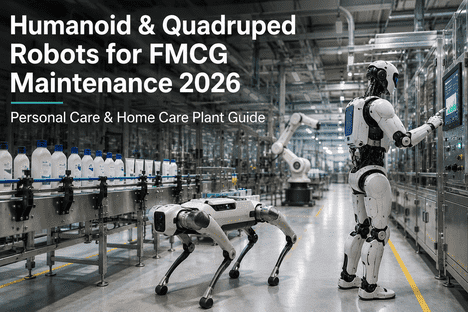
The FMCG personal care and home care sector P&G, Unilever, Henkel, Reckitt, Colgate-Palmolive, and their tier-1 suppliers operates some of the highest-throughput packaging lines in manufacturing: 600+ bottles per minute on shampoo lines, 400+ cartons per minute on detergent lines, and 24/7 continuous processing for aerosol, liquid, and powder filling. Until 2025, every inspection, every gauge reading, every thermal check on those lines was performed by human operators walking miles per shift through facilities designed decades before mobile robotics existed. That is changing in 2026. Quadruped robots from Boston Dynamics (Spot, 1,500+ commercial units deployed) and Unitree (Go2, B2) are now performing autonomous inspection routes on FMCG packaging lines reading analog gauges, capturing thermal signatures of rotating assets, detecting compressed air leaks with acoustic imaging, and feeding data directly into CMMS and predictive maintenance platforms. Humanoid robots from Figure AI (BMW Spartanburg, 30,000+ vehicles assisted), Agility Robotics (Digit, 100,000+ totes moved at GXO), and Apptronik (Apollo, Mercedes-Benz pilot) are entering FMCG plants for parts handling, line-side delivery, and machine tending. Book a Demo to see iFactory's robot integration platform configured for your FMCG personal care or home care production lines.
FMCG Robotics · Personal Care · Home Care · 2026 Deployment Guide
Humanoid & Quadruped Robots for FMCG Maintenance 2026: Personal Care & Home Care Plant Guide
How P&G, Unilever, Henkel, and Reckitt plants are deploying quadruped inspection robots and humanoid task robots on high-speed packaging lines and integrating them with iFactory's predictive maintenance, Shift Logbook, and digital twin platform.
Boston Dynamics Spot quadrupeds deployed commercially across global industrial sites
▤
30,000+
BMW vehicles produced with Figure AI humanoids — same platform entering FMCG plants
◈
99.9%
Defect detection accuracy on AI vision — quadrupeds and humanoids feeding data into iFactory
⟐
50-70%
Unplanned downtime reduction when robot inspection data feeds predictive maintenance AI
Why 2026 Is the Inflection Point for FMCG Robotics
For decades, FMCG personal care and home care plants deployed fixed automation high-speed fillers, labelers, case packers, and palletizers — designed for one task and one location. The secondary tasks that keep those lines running gauge inspection, thermal monitoring, leak detection, parts delivery, line-side material handling remained manual because no robot could navigate the human-designed spaces of an FMCG plant: narrow aisles between filler stations, grated mezzanine stairways, chemical washdown zones, and allergen-controlled environments. The 2026 generation of quadruped and humanoid robots was engineered specifically for these environments. Quadrupeds walk on four legs, climb stairs, navigate grated flooring, and operate in wet or dusty conditions. Humanoids use human tools, operate human-designed machinery, and adapt to task variation without fixture engineering. Three structural shifts converged to make this real for FMCG: sim-to-real training pipelines that allow robots to accumulate billions of virtual inspection experiences, large vision-language-action models that give genuine reasoning ability for multi-step tasks, and persistent labor shortages at FMCG plants that have pushed operations directors from exploring to deploying. Plant leaders building the business case for a 2026 or 2027 FMCG robotics pilot can Talk to an Expert for a structured deployment assessment with iFactory's FMCG robotics team.
FOUR FORCES DRIVING FMCG ROBOTICS ADOPTION IN 2026
1
High-speed line value at risk — A single unplanned stop on a 600-BPM shampoo line costs $15,000–$25,000 per hour in lost output. Quadruped inspection robots capture thermal, acoustic, and visual data on every rotating asset every shift, feeding predictions that eliminate 50-70% of unplanned downtime.
2
Allergen and chemical zone restrictions — Personal care plants require strict allergen segregation (fragrance, essential oils, nut-derived ingredients) that limits human inspector access. Quadrupeds operate in washdown zones and allergen-controlled areas without contamination risk.
3
Changeover complexity at scale — FMCG home care plants run 20+ SKU changeovers per line per week. Humanoid robots reduce changeover time by staging change parts, cleaning nozzles, and adjusting conveyor guides — tasks that fixed automation cannot flex to handle.
4
Digital integration maturity — P&G, Unilever, and Henkel have deployed MES, CMMS, and predictive maintenance platforms across their networks. iFactory provides the integration layer that connects quadruped inspection data, humanoid task execution, and CMMS work order creation in a single platform.
Three FMCG Robot Deployment Models iFactory Supports
iFactory is designed to integrate with any robot platform — quadruped, humanoid, or mixed fleet — and to connect robot-generated data with the CMMS, predictive maintenance, and Shift Logbook systems that FMCG plants already run. The same platform that orchestrates Spot inspection routes also receives prediction-triggered work orders from humanoid task execution, creating a unified intelligence layer across every robot on the FMCG floor.
01
Model A: Quadruped Robot Inspection Rounds for Predictive Maintenance
Boston Dynamics Spot or Unitree B2 runs autonomous inspection routes across the FMCG plant floor — filler stations, labelers, case packers, conveyor drives, and utility zones. Spot carries thermal cameras (FLIR), acoustic imagers (Fluke SV600), 4K PTZ cameras, and gas sensors. Inspection data — bearing temperatures, vibration spectra, compressed air leak decibel maps, gauge readings — streams live into iFactory's predictive maintenance AI. iFactory analyzes multi-sensor fusion data across all Spot patrol routes, identifies degradation patterns, and auto-generates CMMS work orders with fault type, severity score, RUL estimate, and recommended replacement part. The Shift Logbook records every robot patrol alongside operator observations, creating a unified maintenance history.
1,500+ Spot deployedMulti-sensor fusionAuto CMMS work orders
02
Model B: Humanoid Parts Handling and Line-Side Delivery
Figure 03, Agility Digit, or Apptronik Apollo perform line-side material delivery — moving totes of caps, labels, nozzles, and change parts from the warehouse to the filling line at the moment of need. Humanoids navigate the same aisles and stairways as human operators, using existing tooling and workstations. Task completion events, part consumption data, and delivery timestamps flow into iFactory's production monitoring dashboard. When a humanoid identifies a parts shortage or a damaged component, the observation is logged in the Shift Logbook and a replenishment work order is triggered in the CMMS automatically.
FMCG plants deploying both quadruped and humanoid robots manage them through iFactory's unified operations platform. Spot patrols run every 12 hours across all critical assets. Figure 03 humanoids handle parts delivery and machine tending between patrol cycles. iFactory correlates Spot's thermal and acoustic findings with humanoid-observed anomalies and CMMS work order history. When Spot detects a bearing temperature trend on a filler, iFactory checks whether the humanoid operator logged vibration observations in the Shift Logbook on the same asset, cross-references maintenance history, and generates a combined prediction with higher confidence than either sensor stream alone. Book a Demo to see iFactory's mixed-fleet orchestration dashboard.
FMCG Personal Care vs Home Care — Robot Deployment Comparison
The specific robot deployment model that fits an FMCG plant depends on product category, packaging format, line speed, and regulatory environment. The comparison below maps the differences between personal care and home care production environments and the robot platforms best suited to each.
Deployment Factor
Personal Care Plants (P&G, Unilever, Colgate)
Home Care Plants (Henkel, Reckitt, Clorox)
Product formats
Shampoo, conditioner, body wash, toothpaste, deodorant, lotion, cosmetics
Chemical vapor zones (bleach, ammonia). High-humidity filling halls. Powder dust zones (detergent, cleaner powder). Aerosol propellant storage
iFactory integration
Shift Logbook links operator observations with Spot patrol data. Predictive AI on filler bearing and seal health. BRC/SALSA digital audit trail
Spot acoustic data feeds compressed air PdM. Humanoid task records sync with OEE dashboards. ISO 14001 environmental compliance logging
Use Cases — FMCG Robot Deployments With iFactory
Inspection
Spot Quadruped Patrol on High-Speed Shampoo Filling Lines
Pilot — FMCG Liquid
A Unilever personal care plant deploys two Boston Dynamics Spot quadrupeds to run autonomous inspection routes across 8 shampoo filling lines. Each Spot carries a FLIR thermal camera, Fluke SV600 acoustic imager, and 4K PTZ camera. Routes cover 172 inspection points per shift — filler bearings, labeler seals, capper torque heads, conveyor drives, and steam valves. Thermal and acoustic data streams into iFactory's predictive maintenance AI. In the first 90 days, Spot detected 13 bearing degradation signatures before failure, 7 compressed air leaks costing $42,000/year, and 3 electrical panel hot spots. iFactory auto-generated work orders for each finding. Unplanned downtime on the 8 lines decreased from 12.4% to 5.8%.
Agility Digit Humanoid Line-Side Delivery at Home Care Plant
Pilot — FMCG Home Care
A Henkel home care facility pilots four Agility Digit humanoids for line-side material delivery on two high-speed detergent powder lines. Digits transport cases of bottle caps, labels, and change parts from the warehouse staging area to each filling line's material buffer zone — a task previously requiring 6 operators walking 8-12 miles per shift. Each Digit logs delivery completion, part consumption, and any observed anomalies into iFactory's Shift Logbook. When Digit detects a damaged label roll or a missing cap batch during delivery, the observation is auto-recorded and a quality alert is triggered in the iFactory dashboard. The pilot reduced line-side operator walking time by 74% and improved changeover speed by 22%.
Spot + Figure 03 Orchestration at P&G Aerosol Plant
Deployment — 2026
A P&G home care plant producing aerosol cleaning products deploys a mixed fleet: one Spot quadruped for inspection rounds and two Figure 03 humanoids for line-side material handling. Spot patrols the aerosol propellant storage area, filling room, and leak detection station — areas where human inspector access is restricted for safety. Figure 03 humanoids deliver aerosol canisters, valve assemblies, and actuator caps to the filling lines. All robot data streams into iFactory's unified operations platform. When Spot detects a propellant pressure anomaly, iFactory cross-references Figure 03's delivery log, checks the Shift Logbook for operator observations, and generates a combined maintenance prediction with recommended action. The mixed-fleet deployment achieved 68% reduction in safety incidents in restricted zones and 31% improvement in line OEE within 6 months.
What iFactory Delivers for FMCG Robotics Deployments
50-70%
Unplanned downtime reduction from robot-fed predictive maintenance
Spot inspection data → iFactory AI → CMMS work order
12+
Robot platforms with pre-built iFactory API connectors
Boston Dynamics, Unitree, Figure, Agility, Apptronik, and more
900+
Plants using iFactory for CMMS, Shift Logbook, and predictive maintenance
Proven integration layer for robot-generated data
6-12 wk
Deployment timeline for quadruped or humanoid robot integration
Same platform, same data model, any robot fleet
Frequently Asked Questions
iFactory has pre-built API connectors for Boston Dynamics Spot (the most widely deployed industrial quadruped with 1,500+ units in commercial use), Unitree Go2 and B2, and ANYbotics ANYmal. The platform ingests thermal, acoustic, visual, and gas sensor data from any quadruped payload and feeds it into iFactory's predictive maintenance AI, Shift Logbook, and CMMS integration layer. Custom sensor payload integration is supported through iFactory's REST API framework. Book a Demo to see a live Spot integration dashboard configured for your FMCG plant's specific asset list and inspection routes.
Three humanoid platforms have verified commercial deployments in production environments: Figure AI Figure 03 (BMW Spartanburg, 30,000+ vehicles assisted, Helix vision-language-action AI), Agility Robotics Digit (GXO and Amazon, 100,000+ totes moved, $250K/unit), and Apptronik Apollo (Mercedes-Benz pilot, wheeled base for indoor logistics). Tesla Optimus Gen 3 is in internal Tesla factory deployment with a target price of $20,000–$30,000 at scale. iFactory integrates with all four platforms through standard API connectors and provides a unified operations dashboard for mixed humanoid-quadruped fleets.
iFactory receives inspection data from Spot, Unitree, or ANYmal through standard API or MQTT streams. The platform's AI engine analyzes multi-sensor fusion data — thermal, acoustic, vibration, visual — and identifies degradation patterns, anomaly signatures, and criticality scores. When a pattern exceeds threshold, iFactory auto-generates a CMMS work order with fault type, severity score, RUL estimate, and recommended replacement part, and writes it into the plant's existing CMMS (SAP PM, Oracle EAM, Maintenance Connection, Fiix, UpKeep, or any CMMS with a standard API). The Shift Logbook entry for the robot patrol is linked to the work order for full audit trail continuity. Talk to an Expert about your specific CMMS integration requirements.
Yes. iFactory's unified operations platform ingests data from any combination of quadruped and humanoid robots simultaneously. Spot patrol data (thermal, acoustic, visual) and Figure humanoid task data (delivery completion, part consumption, anomaly observations) stream into the same iFactory instance. The platform cross-references findings across robot types — if Spot detects a thermal anomaly on a filler bearing and the Figure humanoid logged vibration observations on the same asset in the Shift Logbook, iFactory correlates the data streams and generates a combined prediction with higher confidence than either sensor stream alone. Mixed-fleet orchestration, patrol scheduling, and data correlation are managed from a single dashboard.
Robot deployments in FMCG plants must comply with ISO 10218 (robot safety), ISO 12100 (risk assessment), and site-specific food safety or cosmetics GMP requirements (BRC, FSMA, ISO 22716 for cosmetics). Quadrupeds operating in washdown zones require IP54 or higher rating. Humanoids handling food-contact or personal care materials must use food-grade lubricants and cleanable surfaces. iFactory's compliance module provides the documentation framework for robot integration validation — patrol route risk assessments, sensor calibration records, Shift Logbook traceability, and CMMS-linked maintenance history. All robot-generated data is automatically captured in the digital audit trail for regulatory inspections.
Integrate Quadruped and Humanoid Robots With Your FMCG Operations Platform
Spot patrols feeding predictive maintenance. Figure humanoids delivering parts to the line. iFactory orchestrating every robot, every sensor, every work order, and every Shift Logbook entry from a single platform. The same iFactory instance that connects your CMMS, predictive maintenance AI, and quality dashboards now connects your robot fleet — quadruped, humanoid, or both. No middleware. No custom integration. No second platform to learn.