Sustainability Trends in FMCG Manufacturing & analytics
By Seren on June 4, 2026
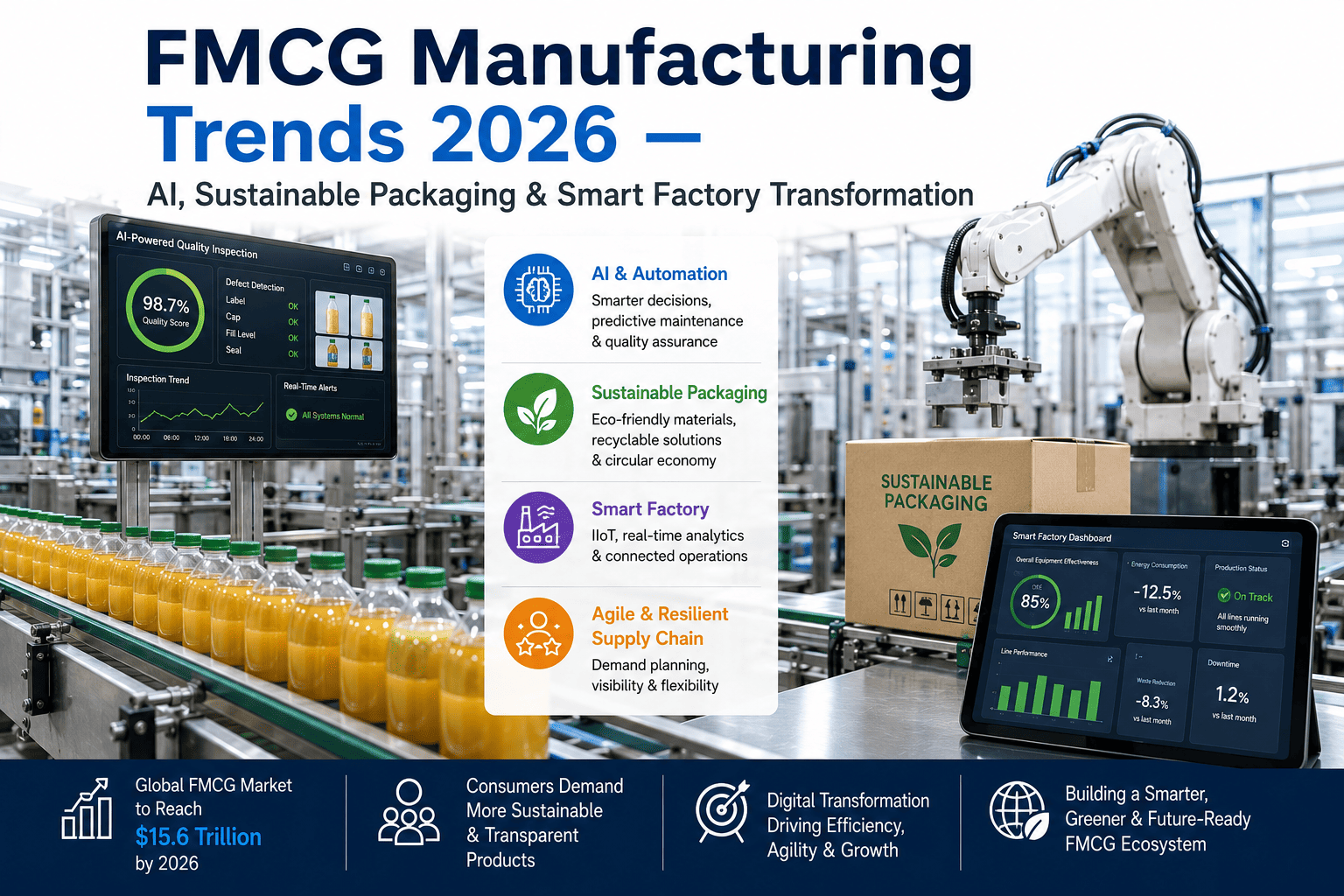
Sustainability in FMCG manufacturing has evolved from a compliance requirement to a competitive differentiator — driven by consumer demand for eco-friendly products, regulatory pressure from carbon pricing and extended producer responsibility legislation, and the operational cost savings that come from reducing energy, water, and material waste. FMCG manufacturers face the challenge of measuring and improving sustainability across diverse production environments: food processing plants with high energy and water intensity, beverage bottling lines generating significant packaging waste, personal care and home care facilities managing complex chemical and plastic material streams, and cold chain operations with substantial refrigeration energy footprints. iFactory AI's manufacturing analytics platform provides FMCG manufacturers with real-time visibility into energy consumption, water usage, waste generation, and ESG metrics across all production assets — transforming sustainability from a periodic reporting exercise into a continuous operational improvement capability. Book a Demo to see how iFactory helps FMCG manufacturers track, analyse, and reduce their environmental footprint while improving operational efficiency.
Sustainability · FMCG Manufacturing · 2026
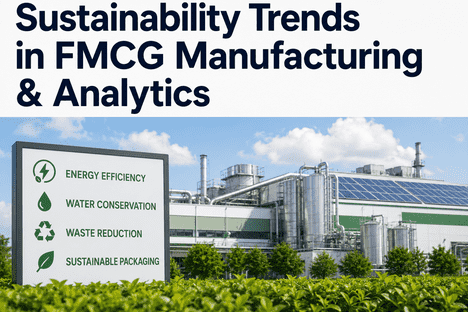
Sustainability Trends in FMCG Manufacturing & Analytics
Energy monitoring · water conservation · waste elimination · ESG reporting · circular economy · supply chain transparency — the trends, technologies, and analytics capabilities shaping sustainable FMCG production.
Five Key Sustainability Challenges Shaping FMCG Manufacturing Analytics
FMCG manufacturers face mounting pressure from multiple stakeholders — consumers demanding sustainable products, investors applying ESG criteria, regulators enforcing carbon reporting and waste reduction mandates, and internal cost reduction targets that align with sustainability objectives. These five challenges are driving investment in manufacturing analytics platforms that can measure, monitor, and improve environmental performance across production operations.
01
Energy Intensity & Carbon Footprint
FMCG production is energy-intensive — food processing requires steam, refrigeration, and drying; beverage bottling consumes significant compressed air and conveyor power; personal care manufacturing involves mixing, heating, and packaging energy. Without real-time energy monitoring per product and line, manufacturers cannot identify the specific processes driving carbon emissions or target reduction investments effectively.
02
Water Consumption & Wastewater Management
Water is a critical resource in FMCG — used for cleaning, rinsing, cooling, steam generation, and as a product ingredient. Water scarcity and wastewater discharge regulations are tightening across all operating regions. Manufacturers need granular water usage data per process, CIP cycle, and shift to identify conservation opportunities and comply with discharge permits.
03
Material Waste & Circular Economy
Packaging waste, product rework, and scrap material represent both a cost and environmental liability. Extended producer responsibility regulations in Europe and North America require manufacturers to track packaging material streams, report recycling rates, and fund end-of-life collection. Analytics platforms that track waste by material type, production line, and shift enable targeted reduction initiatives.
04
ESG Reporting & Regulatory Compliance
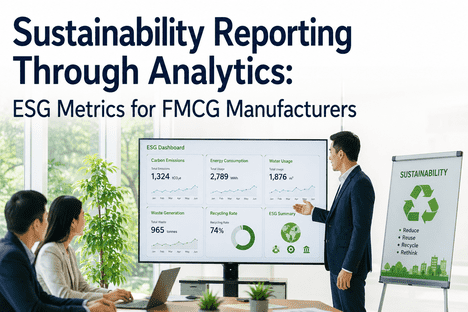
CSRD, SEC climate disclosure rules, and national carbon reporting frameworks require FMCG manufacturers to produce auditable ESG data with defined methodologies and materiality assessments. Manual data aggregation from spreadsheets and paper records cannot meet the assurance standards that regulators and investors now expect. Automated ESG data collection and reporting is a compliance necessity.
05
Supply Chain & Scope 3 Emissions
For most FMCG manufacturers, Scope 3 emissions — from raw material production, packaging supply, logistics, and product use — account for 70–90% of total carbon footprint. Gathering primary data from hundreds of suppliers and calculating product-level carbon footprints requires a platform that can ingest diverse data sources and apply standardised emission factors.
Traditional vs AI-Powered Sustainability Management
The gap between traditional sustainability management approaches — spreadsheet-based tracking, annual energy audits, manual waste weighing — and AI-powered platforms that provide continuous real-time monitoring, automated anomaly detection, and predictive optimisation is substantial. The table below maps the difference across the sustainability capabilities that matter most to FMCG manufacturers.
Capability
Traditional Approach
iFactory AI Platform
Energy monitoring
Monthly utility bill review
Real-time energy consumption per machine, line, and product with automated anomaly alerts
Water tracking
Manual meter readings, weekly logs
Continuous flow monitoring with leak detection, CIP optimisation, and usage forecasting
Waste analytics
Monthly waste weigh-ins, manual sorting
Real-time waste tracking by material type, line, and shift with root-cause correlation
ESG reporting
Manual data collection, annual reports
Automated ESG data aggregation, CSRD/SEC-ready reports, auditable data lineage
Carbon footprint
Annual estimates, industry averages
Product-level carbon footprint per production batch with Scope 1, 2, and 3 tracking
Compliance management
Paper records, manual audits
Automated compliance monitoring with real-time alerts and audit-ready documentation
Supply chain visibility
Supplier surveys, sporadic audits
Supplier data ingestion with automated emission factor application and gap analysis
Three Implementation Approaches for Sustainability Analytics
FMCG manufacturers adopt sustainability analytics platforms at different scales depending on their maturity, regulatory exposure, and internal sustainability targets. iFactory AI offers three deployment paths aligned with common FMCG sustainability programme stages, each with a defined scope and timeline.
Path A
Energy & Carbon Foundation
6–8 weeks
Real-time energy monitoring deployed on production lines with automated carbon emission calculations. Monthly energy reports, anomaly alerts, and baseline establishment. Ideal for manufacturers beginning their sustainability analytics journey.
Best fit
Single-site FMCG plants · first sustainability deployment · energy cost reduction priority
Wk 1–2 Energy audit + sensor deployment plan
Wk 3–5 Edge gateway + dashboard configuration
Wk 6–8 Baseline establishment + team training
Path B
Full Sustainability Suite
10–14 weeks
Energy, water, waste, and ESG reporting deployed across multiple lines. Automated data collection from utility meters, production sensors, and waste management systems. CSRD-ready reporting configured.
Wk 1–4 Multi-stream sensor integration + data mapping
Wk 5–10 Dashboard + reporting configuration
Wk 11–14 Pilot + full rollout + ESG report generation
Path C
Enterprise ESG Platform
14–20 weeks
Multi-site sustainability platform with Scope 3 supply chain data ingestion, product-level carbon footprints, automated regulatory reporting across jurisdictions, and sustainability analytics integrated with production planning.
Find the Right Sustainability Analytics Path for Your FMCG Operation
iFactory's sustainability practice runs a focused 90-minute workshop against your specific production processes, existing utility metering, regulatory obligations, and sustainability targets. You leave with a defended path recommendation, a deployment timeline, and a projected ROI grounded in your facility's energy, water, and waste profile.
Eight Evaluation Criteria for FMCG Sustainability Analytics Platforms
The sustainability analytics market includes everything from basic energy dashboard tools to comprehensive ESG platforms. These eight evaluation criteria separate purpose-built manufacturing sustainability platforms from generic reporting tools that lack the real-time monitoring depth, data integration capability, and regulatory readiness that FMCG manufacturers require.
01
Real-time monitoring granularity
Ask:
"Can the platform monitor energy, water, and waste at the individual production line and machine level, or is it limited to facility-level totals?"
Machine-level granularity is essential for identifying the specific processes driving environmental impact. Facility-level dashboards cannot reveal which production line is consuming 40% more energy per unit than an identical line running the same product.
02
Data integration & IoT connectivity
Ask:
"Does the platform connect directly to utility meters, production sensors, and waste management systems, or does it rely on manual data entry?"
Manual data entry is the leading cause of sustainability reporting gaps and errors. Production-grade platforms ingest data automatically from power meters, water flow meters, compressed air sensors, steam meters, and waste management weigh-scales via standard industrial protocols.
03
ESG reporting automation
Ask:
"Does the platform generate CSRD, SEC, or GRI-compliant reports automatically, or do we need to export data and build reports externally?"
Regulatory reporting frameworks require specific methodologies, boundary definitions, and assurance-ready data lineage. Look for platforms with pre-built report templates aligned to the frameworks applicable to your operating regions.
04
Scope 1, 2 & 3 carbon tracking
Ask:
"Does the platform support Scope 3 supply chain data ingestion and product-level carbon footprint calculation?"
Scope 3 emissions typically represent 70–90% of an FMCG manufacturer's carbon footprint. A platform that cannot ingest supplier data, apply emission factors, and calculate product-level carbon footprints cannot support comprehensive decarbonisation programmes.
05
Waste & circular economy tracking
Ask:
"Can the platform track waste by material type, disposal method, and production source with automated reporting?"
Extended producer responsibility regulations require detailed waste stream tracking with mass balance calculations. Platforms with waste module capability enable manufacturers to identify the production lines and processes generating the most waste and target reduction investments.
06
Water management & conservation analytics
Ask:
"Does the platform provide real-time water balance monitoring, leak detection, and CIP optimisation analytics?"
Water is a critical resource in FMCG with rising costs and regulatory scrutiny. Platforms that offer continuous water flow monitoring with automated anomaly detection can reduce water consumption by 20–30% through early leak detection and process optimisation.
07
Regulatory compliance & audit readiness
Ask:
"Does the platform maintain immutable audit trails, version-controlled methodology documentation, and assured data lineage for regulatory inspections?"
Sustainability data must meet the same audit standards as financial data under emerging regulatory frameworks. Platforms should provide tamper-evident records, methodology documentation, and complete data provenance from sensor to report.
08
Multi-site scalability
Ask:
"Does the platform support multi-site deployment with standardised metrics, consolidated reporting, and site-level drill-down?"
FMCG manufacturers typically operate multiple production sites with different processes, utility configurations, and regulatory exposures. The platform should provide standardised sustainability metrics across sites while allowing site-specific configuration for local conditions and reporting requirements.
Want to evaluate your shortlisted sustainability analytics platforms against this 8-criterion framework? Book a Demo to run a vendor evaluation working session with our sustainability analytics team.
Expected ROI From Sustainability Analytics in FMCG Manufacturing
The business case for sustainability analytics in FMCG manufacturing extends beyond compliance risk reduction. Manufacturers who deploy production-grade sustainability platforms with real-time monitoring see measurable returns across four dimensions in the first year of operation.
15–25%
Energy Cost Reduction
Real-time energy monitoring with automated anomaly detection identifies energy waste from compressed air leaks, steam trap failures, HVAC inefficiencies, and equipment scheduling optimisation. FMCG manufacturers typically recover 15–25% of production energy costs in the first year.
20–30%
Water Consumption Reduction
Continuous water flow monitoring detects leaks, optimises CIP cycle duration, and identifies water reuse opportunities. Combined with wastewater quality monitoring, manufacturers reduce water intake and discharge costs simultaneously.
30–50%
Waste Reduction
Real-time waste tracking by material type and production line enables targeted reduction initiatives. Material waste from packaging overruns, product rejects, and raw material spoilage is reduced through root-cause analysis and process adjustment.
6–12 mo
Platform Payback Period
Combined energy, water, and waste savings typically recover the platform investment within 6–12 months. Additional value from regulatory compliance assurance, ESG reporting automation, and brand reputation enhancement extends the ROI beyond direct operational savings.
Expert Perspective
"The most significant shift in FMCG sustainability over the past three years is the transition from annual reporting to continuous improvement. Traditional sustainability programmes collected data once a year, produced a report, and moved on to the next cycle. Today's regulatory frameworks — CSRD, SEC climate rules, EPR — require auditable data with defined methodologies and continuous monitoring. The manufacturers that are succeeding with sustainability are those that treat environmental data the same way they treat production data: real-time, granular, and integrated into operational decision-making. A sustainability analytics platform is no longer a reporting tool — it is an operational optimisation platform that happens to produce regulatory reports as a by-product of continuous monitoring."
— Sustainability Practice Lead, 2026 industry insight
6–12 mo
typical payback from combined energy, water, and waste savings
70–90%
of FMCG carbon footprint is Scope 3 — requires supply chain data ingestion
Zero rip
of existing utility meters, production sensors, or control systems required
Frequently Asked Questions
How does iFactory's platform collect sustainability data from existing plant systems?
iFactory connects to existing utility meters (power, water, gas, steam), production sensors (temperature, pressure, flow), waste management systems (weigh-scales, bin-level sensors), and building management systems through standard industrial protocols including Modbus, OPC-UA, MQTT, BACnet, and API integrations. The platform is deployed as a non-invasive overlay that reads data from existing sensors and control systems without disrupting production operations or replacing existing infrastructure.
Can iFactory generate CSRD, SEC, and GRI-compliant sustainability reports?
Yes. iFactory includes pre-built report templates aligned with CSRD (ESRS), SEC climate disclosure rules, GRI Standards, and GHG Protocol methodologies. Reports are generated automatically from live data with complete data lineage, methodology documentation, and audit trails. The platform supports dual materiality assessment for CSRD compliance and Scope 1, 2, and 3 carbon reporting with automated emission factor application.
Does the platform support product-level carbon footprint calculation?
Yes. iFactory calculates product-level carbon footprints by allocating energy, water, and material consumption to individual products based on production routing data, machine-level energy monitoring, and batch tracking. The platform supports both attributional and consequential LCA methodologies and can ingest supplier-specific emission factors for Scope 3 calculation.
How does iFactory handle water monitoring and leak detection?
iFactory monitors water flow at the facility, production line, and process level through inline flow meters and existing water utility meters. The platform establishes baseline consumption patterns per process and shift, then detects deviations that indicate leaks, equipment malfunction, or optimisation opportunities. Automated alerts are generated for abnormal consumption patterns, enabling maintenance teams to respond to leaks within hours rather than weeks. Book a Demo to see iFactory's water monitoring and leak detection capabilities.
Can iFactory track waste by material type and disposal method for EPR compliance?
Yes. iFactory's waste module captures waste generation data by material type, production line, disposal method (recycling, incineration, landfill), and waste management vendor. The platform calculates recycling rates, tracks waste reduction progress against targets, and generates EPR compliance reports with mass balance documentation required for packaging and battery regulations in Europe and North America.
What is the typical timeline for deploying sustainability analytics at an FMCG facility?
Deployment timeline depends on scope. Path A (Energy & Carbon Foundation) deploys in 6–8 weeks with real-time energy monitoring and carbon calculations. Path B (Full Sustainability Suite) adds water, waste, and ESG reporting in 10–14 weeks. Path C (Enterprise ESG Platform) deploys across multiple sites with full supply chain integration in 14–20 weeks. All deployment paths include structured onboarding with pilot phases and training to ensure user adoption and value realisation.
Run the Sustainability Analytics Workshop for Your FMCG Operation
iFactory's sustainability practice runs a 90-minute workshop against your real production processes, utility metering configuration, regulatory obligations, and sustainability targets. You leave with a defended path recommendation, a deployment timeline, and a projected ROI grounded in your facility's current environmental profile.