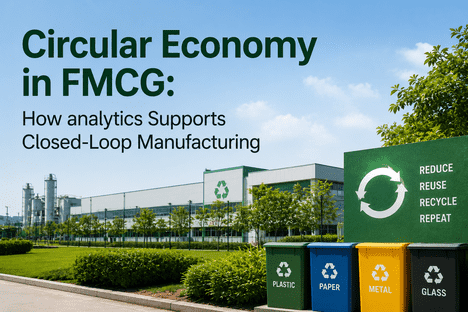
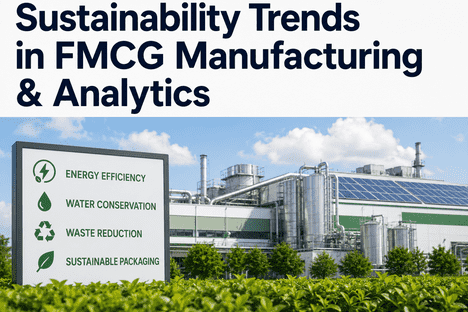
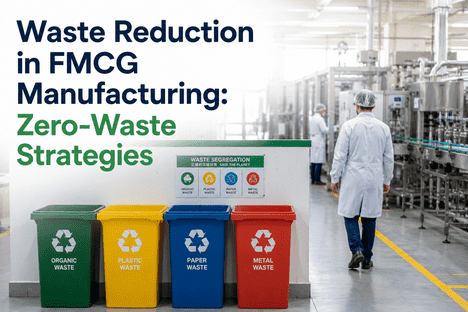
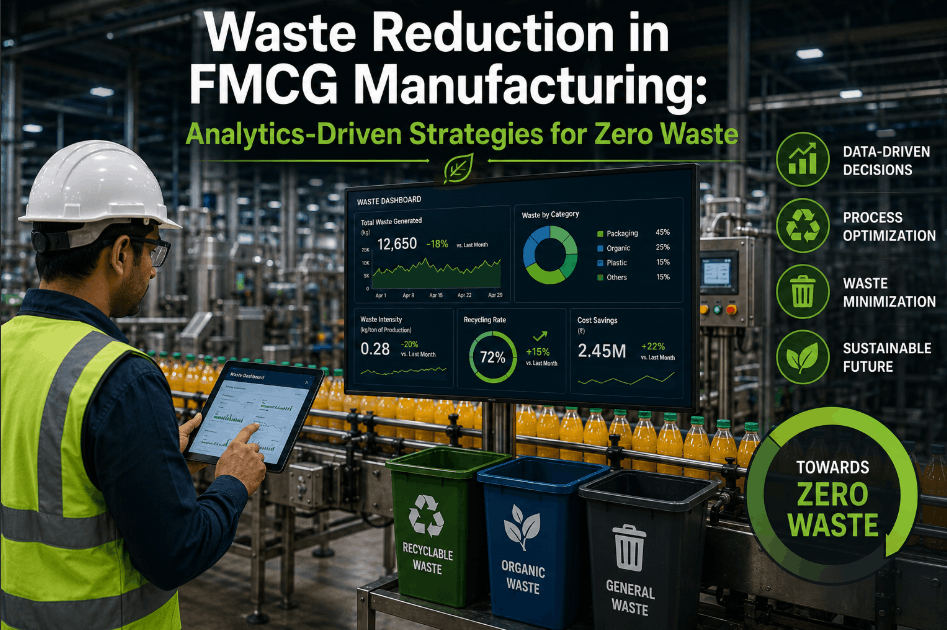
Fast-moving consumer goods (FMCG) production generates substantial waste streams — from packaging offcuts and spoiled ingredients to spent process water and expired finished goods. For a mid-sized FMCG manufacturer producing 400,000 tonnes of packaged goods annually, approximately 38,000 tonnes end up as solid waste while 1.2 billion litres of water are consumed. This case study examines how iFactory AI's analytics platform enabled a multi-site FMCG producer to implement circular economy principles across three production facilities, achieving 73% waste diversion, 41% reduction in virgin material consumption, and $4.6M in annual value recovery with full platform ROI realised within nine months.
Circular Economy in FMCG: Analytics for Sustainability
AI-powered analytics enabling equipment remanufacturing, waste-to-value conversion, and closed-loop manufacturing for sustainable consumer goods production
The $8.2M Linear Economy Problem Facing FMCG Producers
The three-site FMCG operation produced packaged foods, beverages, and personal care products across facilities in the Midwest and Southeast United States. Each site operated on a linear take-make-dispose model: virgin raw materials entered the production line, finished goods shipped to retailers, and process waste — including trimmings, off-spec batches, contaminated packaging, and spent cleaning solutions — was sent to landfill or incineration at a combined cost of $8.2M annually. Key pain points included off-spec batches averaging 4.7% of total output being discarded rather than reprocessed, single-use packaging materials with no recovery loop, and spent process water discharged after a single use despite being suitable for treatment and reuse. The absence of real-time waste analytics meant the plant could not quantify which production lines generated the most waste, which products had the highest scrap rates, or where material recovery investments would yield the greatest financial and environmental return.
Analytics-Driven Circular Economy: The Implementation
The deployment followed a structured five-phase approach spanning 18 weeks from kickoff to full production. The iFactory AI team integrated production data, waste management records, supply chain inputs, and energy consumption logs into a unified circularity analytics engine trained on 24 months of historical production and waste data.
Want to see how your FMCG operation's circularity performance compares to industry benchmarks? Book a Demo for a free circularity readiness assessment.
$4.6M Annual Value Recovery: The ROI Breakdown
Within nine months of full deployment, the FMCG producer documented $2.8M in direct cost savings and $1.8M in revenue from recovered materials. The table below breaks down value recovery by category across the first year of operation.
| Value Recovery Category | Annual Impact | Primary Driver |
|---|---|---|
| Off-Spec Product Reprocessing | $1,420,000 | AI-optimised reblending formulations recovered 83% of off-spec batches; reprocessed product sold at 92% of standard margin |
| Organic Waste to Biogas | $890,000 | Anaerobic digestion of 6,200 tonnes of organic trimmings generated 1.8 MWh of biogas; offset 22% of site natural gas demand |
| Packaging Material Recovery | $760,000 | Computer vision sorting diverted 2,400 tonnes of plastic and cardboard to recyclers; revenue from baled materials plus avoided landfill tax |
| Process Water Recycling | $640,000 | Closed-loop water treatment reduced freshwater intake by 340 million litres; eliminated wastewater discharge fees at two sites |
| Virgin Material Reduction | $530,000 | 41% reduction in virgin packaging procurement through recycled content integration and lightweighting |
| Regulatory Compliance & Reporting | $360,000 | Automated ESG reporting eliminated manual data collection; avoided non-compliance penalties and reduced audit preparation costs |
| Total First-Year Value Recovery | $4,600,000 | ROI achieved in month 9 |
How iFactory AI Powers Circular Economy Transformation
Five core modules of the iFactory AI platform drove the FMCG producer's circularity program: Analytics & Reporting for circularity KPI tracking, OEE Analytics for production efficiency, Quality Control for off-spec detection, Scraps Inventory for waste material tracking, and EHS Management for regulatory compliance.
Analytics & Reporting
Real-time circularity dashboards track diversion rates, material efficiency, cost-per-tonne waste, and carbon footprint across all production lines. Automated reporting supports CSRD, GRI, and SASB compliance with ESEF XHTML output for regulatory filings.
OEE Analytics
Overall equipment effectiveness tracking identifies production lines with the highest waste generation rates. AI models correlate OEE parameters including availability, performance, and quality with material consumption to pinpoint circularity improvement opportunities.
Quality Control Management
AI-powered quality analytics detect off-spec conditions before batches complete, enabling real-time corrective action. Computer vision inspection identifies packaging defects and contamination for immediate sorting and reprocessing, reducing scrap from 4.7% to 1.2%.
Scraps Inventory & Waste Tracking
Complete traceability of every waste category from generation point to end-of-life disposition. Barcode and RFID tracking integrate with material recovery economics to identify which waste streams have the highest value recovery potential.
Expert Review
"The FMCG industry has talked about circular economy for over a decade, but the missing link has always been granular, real-time data on what is actually being wasted and where the economics of recovery work. What this case study demonstrates is that when you apply AI-powered analytics to material flows, circularity stops being a sustainability initiative and becomes a profit centre. The 67% circularity rate achieved here is remarkable for a multi-site FMCG operation, but what matters more is that every percentage point of improvement was driven by data — not by guesswork. The integration of OEE data with waste tracking is particularly powerful because it connects production efficiency directly to material circularity, giving plant managers a single source of truth for both operational and sustainability KPIs."
Conclusion
The $4.6M annual value recovery achieved by this multi-site FMCG producer proves that circular economy principles, when powered by real-time analytics, deliver both environmental impact and financial return. By shifting from a linear take-make-dispose model to a data-driven circular operation, the company diverted 73% of waste from landfill, reduced virgin material consumption by 41%, and recovered full platform investment within nine months. For FMCG sustainability directors and plant managers evaluating circular economy initiatives, the deciding factor is no longer whether closed-loop manufacturing is feasible — it is how quickly analytics can identify the highest-value material recovery opportunities across your specific product categories and production processes.
Ready to build your business case for circular economy analytics in your FMCG operation? Book a Demo with iFactory AI's sustainability team.
Frequently Asked Questions
Start Your Circular Economy Journey
iFactory AI helps FMCG producers reduce waste, recover value, and achieve measurable circularity improvements within months — not years.