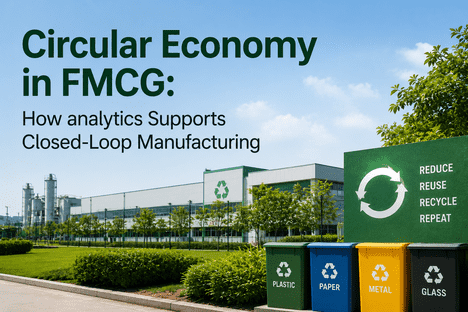
Circular Economy in FMCG How analytics Supports Closed-Loop Manufacturing
By Seren on June 11, 2026
Every kilogram of material flowing through an FMCG production line follows a trajectory: raw ingredient, processed good, packaged product, consumer purchase, and far too often landfill. In a linear take-make-dispose model, the environmental and economic cost of that trajectory is externalized until it shows up as volatile commodity pricing, regulatory carbon penalties, or brand erosion from conscious consumers. Closed-loop manufacturing rewires that trajectory, and analytics is the circuit board that makes the possible tracking material flows, forecasting recovery value, and optimizing remanufacturing cycles so that what leaves the factory floor returns as feedstock rather than waste.
iFactory Circular Manufacturing
Circular Economy in FMCG: Closed-Loop Manufacturing Powered by Analytics
Extend asset lifecycles, recover material value, and transform waste streams into production inputs with AI-driven lifecycle analytics, waste tracking, and remanufacturing workflow automation.
of FMCG emissions embedded in raw materials & packaging
2–5x
asset life extension possible with predictive remanufacturing
$4.5T
global circular economy opportunity by 2030
The Linear Leak: What FMCG Manufacturing Loses in a Take-Make-Dispose Model
An FMCG facility processing beverages, packaged foods, personal care, or household goods depends on high-throughput, continuous-run assets fillers, sealers, labelers, conveyors, CIP skids, and packaging lines. In a linear operating model, each of those assets follows a predictable curve: install, run until failure, replace. Meanwhile, packaging materials flow in one direction: virgin polymer, virgin paperboard, virgin aluminum used once, discarded. The cost of this linearity is compounding. Raw material price volatility hits margins unpredictably. Waste disposal fees rise with tightening landfill regulations. Scope 3 emissions reporting requirements force brands to account for every gram of packaging that leaves their control.
Virgin Material Dependency
FMCG packaging relies on 95% virgin feedstock in many categories. Price swings of 20–40% annually destabilize procurement budgets and margin forecasts.
Asset Replacement Cost
Replacing a high-speed filler or packaging line costs $500k–$2M. Most FMCG plants scrap equipment at 40–60% of its usable life due to reactive maintenance models.
Waste as Liability
Production waste, off-spec product, and rejected packaging carry disposal costs of $50–$150 per ton. Landfill taxes in regulated markets are rising 8–15% year over year.
Carbon Embedded in Waste
Every ton of FMCG waste represents 2–5 tons of embedded CO₂ from processing, packaging, and transport — emissions that cannot be recovered in a linear model.
How Analytics Enables Closed-Loop Manufacturing in FMCG
Closed-loop manufacturing replaces the linear trajectory with a regenerative cycle: materials are recovered, assets are remanufactured rather than replaced, and waste streams become secondary feedstocks. Analytics makes this cycle viable by providing the visibility, forecasting, and optimization layer that connects each loop. The production manager no longer asks "how much waste did we produce?" but "what is the optimal recovery path for each material stream today?"
Track
Real-time material flow monitoring across all production lines and waste streams
Analyze
AI models forecast recovery value, contamination risk, and optimal sorting path for each stream
Route
Automated workflow directs materials to remanufacturing, recycling, or waste-to-resource channels
Recover
Material value captured and fed back into production as secondary feedstock or refurbished component
Sustain
Closed loop maintained; virgin material demand and waste output progressively reduced
See how iFactory's Asset Lifecycle Management and Waste Tracking modules can close your loops. Book a demo and we will walk through your material streams live.
Asset Lifecycle Analytics: The Foundation of Circular Asset Management
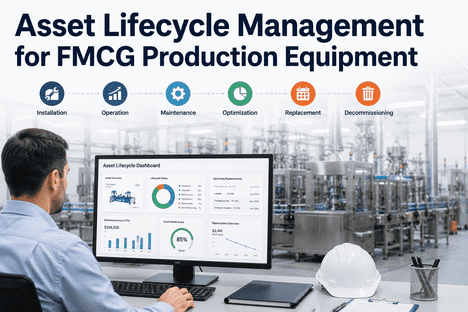
In FMCG manufacturing, production assets represent the largest capital concentration on the floor. A closed-loop asset strategy replaces the replace-on-failure mindset with remanufacturing, refurbishment, and component recovery. Asset lifecycle analytics provides the data layer that makes this shift operational — tracking every run hour, vibration signature, temperature profile, and maintenance event to predict not just when an asset will fail, but which components can be recovered and at what cost.
Capability
Traditional Asset Management
Circular Asset Lifecycle Analytics
End-of-life approach
Replace on failure or PM schedule
Predictive remanufacturing window identified
Component tracking
Asset-level only
Sub-component condition and recovery value tracked
Recovery optimization
None — scrap entire asset
AI recommends which components to recover, refurbish, or recycle
Lifecycle cost visibility
Purchase price + estimated maintenance
Full cradle-to-cradle cost including recovery value
Carbon accounting
Not tracked at asset level
Embedded carbon per component; savings from remanufacturing
Spare parts strategy
Inventory of new replacement parts
Refurbished component pool prioritized; new parts as backup
Close the Asset Loop
Asset Lifecycle Extension with Circular Analytics
iFactory's Asset Lifecycle Management module gives you component-level visibility, predictive remanufacturing windows, and recovery value optimization. Extend asset life 2–5x while reducing spare parts spend and embedded carbon.
Waste-to-Resource Analytics: Turning Disposal Cost into Feedstock Value
The waste stream in an FMCG facility is not homogeneous. Packaging trimmings, off-spec product, expired ingredients, spent process water, and rejected labels each have different recovery potential and different contamination profiles. Waste-to-resource analytics categorizes every stream in real time, forecasts the optimal recovery channel — mechanical recycling, chemical recycling, anaerobic digestion, or remanufacturing — and tracks the value recovered against the cost of disposal.
Packaging Recovery
Sorts polymer, paperboard, and aluminum trimmings by grade; forecasts recyclate value and contamination risk before baling.
Organic Byproduct
Routes off-spec food and beverage product to anaerobic digestion or animal feed; tracks methane offset and nutrient recovery value.
Process Water Reuse
Monitors CIP wastewater quality in real time; forecasts treatability and routes to reuse loops when contamination thresholds are met.
Chemical Recovery
Tracks solvent and caustic usage in cleaning cycles; predicts optimal recovery timing and concentration for reuse.
Expert Review: What FMCG Sustainability Leaders Are Saying
"We set a target of 40% recycled content in our packaging by 2028. The challenge was not willingness — it was visibility. We could not track what was leaving our lines as waste with enough granularity to know which streams were clean enough to reintegrate. Deploying iFactory's waste tracking and lifecycle analytics gave us SKU-level material flow visibility and a recovery value forecast for each stream. Within six months, we identified 1,200 tons of high-grade PET trim that could be closed back into our preform operation. That single loop cut virgin polymer procurement by 8% and saved $420,000 in material cost — before we even addressed the other 14 recovery streams the system flagged."
Maria Vasquez
Director of Sustainability, Global Beverage Packaging
Start Your Circular Transition
See Closed-Loop Analytics on Your FMCG Lines
We connect to your existing MES, ERP, and waste tracking data — no rip-and-replace. In a live walkthrough, we will show you which material streams in your facility have the highest recovery value and what the closed-loop economics look like.
Conclusion: From Linear Throughput to Regenerative Cycles
Circular economy in FMCG manufacturing is not a regulatory checkbox or a sustainability report line item. It is a fundamental shift in how production economics works — treating every output as an input, every asset as a recoverable resource, and every kilogram of material as a unit of value to be preserved rather than discarded. Analytics makes that shift possible by providing the visibility to see the loops, the forecast to optimize them, and the workflow automation to operate them at scale.
iFactory AI's Asset Lifecycle Management and Waste Tracking modules give FMCG manufacturers the closed-loop analytics layer needed to extend asset life, recover material value, and reduce environmental impact — without compromising the throughput and efficiency that define the industry. The loops exist. The data is on your floor. The question is which loop you close first.
Start with a live walkthrough. Book a demo and bring your facility's material flow and asset data.
Frequently Asked Questions
What is closed-loop manufacturing in FMCG?
Closed-loop manufacturing replaces the linear take-make-dispose model with a regenerative cycle where materials, components, and assets are recovered, remanufactured, and reintegrated into production. In FMCG, this includes recovering packaging polymers for reuse, remanufacturing filler and sealer components, routing organic byproducts to energy recovery, and treating process water for closed-loop reuse.
How does analytics support circular economy initiatives in FMCG?
Analytics provides the visibility and forecasting layer that makes circular loops operational. AI models track material flows at SKU level, predict contamination risk in waste streams, forecast optimal recovery timing for remanufacturable assets, and calculate the economic and carbon value of each recovery path. Without analytics, circular initiatives remain manual, inconsistent, and difficult to scale.
What is the difference between asset lifecycle management and traditional maintenance?
Traditional maintenance focuses on keeping an asset running until replacement is unavoidable. Circular asset lifecycle management tracks every component's condition, predicts optimal remanufacturing windows before failure, and quantifies the recovery value of each sub-component. The goal is to extend useful life 2–5x by cycling components through refurbishment rather than replacing the entire asset.
How does iFactory integrate with existing FMCG plant systems?
iFactory connects to existing MES, ERP, PLC, and scale systems via standard industrial protocols and APIs. Integration is read-first — the platform ingests production data, material flow records, waste weighments, and maintenance logs without writing to process controls. Deployment typically takes 2–4 weeks per facility with no disruption to ongoing operations.
What is the typical payback for closed-loop analytics in an FMCG facility?
Customers typically see payback within 6–12 months based on material cost savings from recovered packaging streams, reduced virgin procurement, extended asset life, and lower waste disposal fees. A mid-size FMCG facility processing 200+ tons of packaging material per month can recover $300,000–$800,000 annually in material value alone, with additional savings from asset remanufacturing and energy recovery.