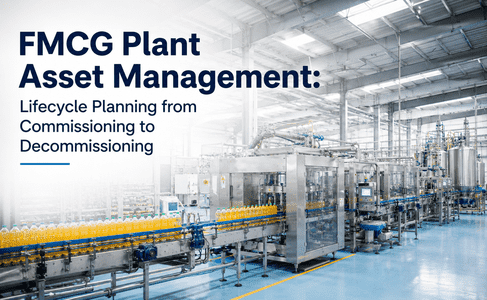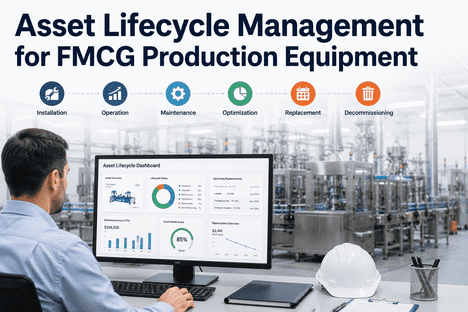
FMCG production equipment represents one of the largest capital investments a food manufacturing facility makes — and one of the most poorly managed. Conveyor systems, fillers, wrappers, pasteurizers, homogenizers, refrigeration units, and packaging lines each pass through distinct lifecycle phases: capital planning and procurement, installation and commissioning, operational use and maintenance, performance degradation, and eventual replacement or decommissioning. Most FMCG facilities manage these phases in operational silos — capital planning handled by finance, maintenance managed by reliability teams, replacement decisions driven by emergency failures rather than lifecycle economic analysis. The result is systematic underperformance: equipment is kept in service past its economic optimum point, capital replacement budgets are allocated reactively rather than strategically, and total cost of ownership across the equipment fleet is significantly higher than it would be with structured lifecycle management. iFactory AI's asset lifecycle management platform unifies these phases into a single data-driven framework — connecting capital planning, maintenance history, performance monitoring, and financial depreciation data to give FMCG facility managers the complete lifecycle visibility needed to optimize equipment replacement timing, capital allocation, and maintenance strategy. Book a Demo to see how iFactory AI connects your equipment lifecycle data into a single decision-support platform.
AI-powered lifecycle tracking from capital planning through decommissioning — OEE-based replacement timing, depreciation-integrated asset records, and automated capital planning for food manufacturing facilities.
Why Asset Lifecycle Management Is Critical for FMCG Profitability
Equipment-related costs represent 30 to 50 percent of total operating expenditure at a typical FMCG manufacturing facility when capital depreciation, maintenance labor, spare parts, energy consumption, and downtime losses are aggregated. Despite this magnitude, most facilities lack a structured lifecycle management framework — equipment is acquired without clear lifecycle cost projections, maintained without systematic performance degradation tracking, and replaced only when failure forces the decision. The financial impact of this unstructured approach is substantial: equipment kept in service two to three years past its economic optimum point accumulates escalating maintenance costs — typically 15 to 25 percent higher annually than if replaced at the optimal lifecycle point — while simultaneously degrading production throughput as performance declines. Facilities that implement structured lifecycle management with AI-powered decision support consistently achieve 12 to 18 percent total cost of ownership reduction across their equipment fleet within two to three lifecycle cycles. Book a Demo to see how iFactory AI's lifecycle platform identifies the optimum replacement point for each asset in your FMCG facility.
Facilities using AI-powered lifecycle tracking reduce total ownership costs across equipment fleets within 2–3 lifecycle cycles through optimized replacement timing.
Emergency equipment replacement costs 3 to 5 times more than planned capital replacement when including expedited procurement, installation overtime, and production loss.
Annual maintenance costs increase 15–25% for equipment kept in service 2–3 years past the optimal economic replacement point.
Facilities relying on intuition-based replacement decisions typically err by 2+ years from the economic optimum, costing hundreds of thousands per asset class.
The Six Phases of Equipment Lifecycle Management in FMCG
Asset lifecycle management in FMCG manufacturing follows a structured progression through six distinct phases. Each phase generates data that feeds into subsequent phases — but without a unified platform, this data remains fragmented across capital planning spreadsheets, CMMS maintenance records, ERP depreciation schedules, and production OEE dashboards. iFactory AI consolidates all six phases into a single asset record with continuous lifecycle cost tracking and AI-powered replacement timing recommendations.
| Phase | Key Activities | Data Generated | Common Gap | iFactory AI Capability |
|---|---|---|---|---|
| 1. Capital Planning | Needs assessment, ROI modeling, vendor selection, budget allocation | Projected lifecycle cost, expected useful life, capital budget | No connection between projected and actual lifecycle costs | Lifecycle cost tracking linked to capital budget with variance analysis |
| 2. Procurement & Installation | Equipment purchase, installation, commissioning, documentation | Asset tag, warranty terms, installation records, OEM manuals | Commissioning records lost or stored outside the maintenance system | Digital asset record with full commissioning documentation and warranty tracking |
| 3. Operational Use | Production runs, performance monitoring, operator training | OEE, throughput, quality data, energy consumption | Performance data isolated from asset lifecycle records | Real-time OEE and performance data linked to asset lifecycle dashboard |
| 4. Maintenance & Repair | Preventive maintenance, corrective repairs, parts replacement | Work orders, parts costs, labor hours, downtime events | Maintenance costs not aggregated for lifecycle TCO analysis | Automatic maintenance cost aggregation with lifecycle TCO calculation |
| 5. Performance Decline | Degradation monitoring, condition assessment, rebuild evaluation | OEE trend, failure rate increase, maintenance cost escalation | No systematic trigger for rebuild-or-replace analysis | AI-powered replacement timing based on OEE, maintenance cost, and depreciation curves |
| 6. Replacement & Decommissioning | Capital re-investment, equipment removal, asset disposal | Disposal value, replacement cost, decommissioning records | No lifecycle closure — historical cost data lost for future planning | Complete lifecycle record with actual vs projected cost comparison for planning updates |
How iFactory AI Powers Asset Lifecycle Management
iFactory AI's asset lifecycle management platform transforms fragmented equipment data into structured lifecycle visibility — connecting capital planning projections, maintenance cost history, real-time performance data, and financial depreciation schedules into a single asset record that tracks total cost of ownership from procurement through decommissioning.
Unified Asset Lifecycle Register
Every piece of production equipment gets a digital asset record that spans its entire life — from capital planning approval through procurement, installation, operational use, maintenance history, and decommissioning. All lifecycle data is accessible from a single asset dashboard with drill-down to work orders, cost history, performance trends, and depreciation schedules.
AI-Powered Replacement Timing
The platform analyzes OEE trends, maintenance cost escalation patterns, energy consumption increases, and depreciation curves to identify the economic optimum replacement point for each asset. Instead of relying on intuition or fixed calendar-based replacement schedules, facility managers receive data-driven recommendations updated continuously as new performance and cost data accumulates.
Total Cost of Ownership Tracking
Capital cost, installation expense, annual maintenance labor and parts, energy consumption, and production loss due to downtime are continuously aggregated into a running TCO calculation. Actual lifecycle costs are compared against capital planning projections, feeding back into more accurate ROI models for future equipment acquisitions.
Depreciation-Integrated Asset Records
Asset records are linked to ERP depreciation schedules — straight-line, declining balance, or units-of-production — providing a single view of financial book value alongside physical asset condition. This integration ensures that capital planning decisions reflect both accounting value and operational performance.
Capital Planning Decision Support
Multi-year capital replacement plans are generated automatically based on asset lifecycle status, replacement timing recommendations, and budget constraints. What-if analysis allows facility managers to model different replacement schedules against TCO impact, helping finance teams make data-driven capital allocation decisions instead of reactive emergency replacements.
Shift Logbook Handover Integration
Equipment condition notes, performance observations, and maintenance events recorded in iFactory AI's Shift Logbook are linked directly to the asset lifecycle record — ensuring that the cumulative operational experience of every shift feeds into lifecycle decision-making rather than being lost at shift changeover.
Real-World Impact: FMCG Packaging Line Lifecycle Transformation
A mid-size FMCG facility operating six high-speed packaging lines across two shifts tracked the following outcomes after deploying iFactory AI's asset lifecycle management platform over a 24-month period. The facility had previously managed equipment replacement on an ad-hoc basis — lines were kept running until failure rates triggered emergency replacement decisions, with no systematic TCO tracking or lifecycle planning.
Frequently Asked Questions
The most expensive piece of equipment in an FMCG facility is not the one that costs the most to buy. It is the one that stays in service three years past its optimal replacement point — accumulating escalating maintenance costs, degrading production throughput, consuming more energy per unit produced, and failing at the worst possible moment during a peak production run. Structured lifecycle management with AI-powered replacement timing is the single highest-ROI capital planning improvement a food manufacturing facility can make. The data to support this decision is already in your CMMS, your ERP, and your production monitoring system — it just needs to be connected and analyzed together.
Conclusion
Asset lifecycle management is not a theoretical concept in FMCG manufacturing — it is a measurable driver of capital efficiency, maintenance cost reduction, and production throughput optimization. Facilities that implement structured lifecycle tracking with AI-powered replacement timing consistently achieve 12 to 18 percent TCO reduction across their equipment fleets, eliminate the systematic overextension of equipment past its economic optimum, and transform capital planning from reactive emergency spending to strategic, data-driven allocation. iFactory AI's asset lifecycle management platform provides the unified data foundation, AI analytics, and decision support tools needed to make this transition — connecting capital planning, maintenance history, OEE trends, and depreciation schedules into a single lifecycle record for every piece of production equipment.
Book a Demo today to see how iFactory AI can transform your equipment lifecycle data into a structured capital planning framework that reduces TCO and optimizes replacement timing across your entire FMCG facility.
Transform Equipment Lifecycle Data into Capital Planning Intelligence
iFactory AI gives your facility unified lifecycle records, AI-powered replacement timing, TCO tracking, and multi-year capital planning — so every equipment decision is based on complete lifecycle economics rather than reactive intuition.