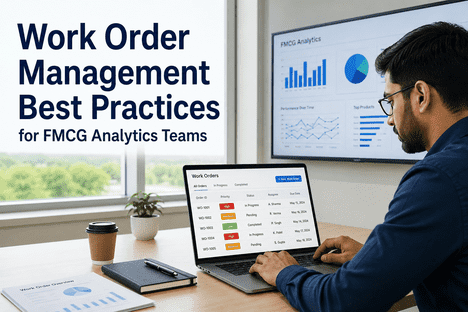
The analytics team lead opens the work order dashboard on Monday morning. Across eight FMCG production lines -- packaging, filling, labelling, case packing, palletising -- there are 347 open work orders. Thirty-four percent of them, 118 work orders, were created last week with incomplete data: missing asset IDs, no failure codes, empty labour hour fields. The analytics team spends the first four hours of the week scrubbing data instead of analysing trends. The maintenance planner cannot tell which of the 347 work orders are urgent because priority was assigned manually based on who shouted loudest. The compliance manager needs a food safety audit pack by Friday and the corrective action work orders from last month's line 3 shutdown are missing root cause documentation. This is the reality of work order management in FMCG analytics without standards, automation, and AI-driven classification. This guide covers the best practices that eliminate the data scrub, automate the priority matrix, and transform work order management from administrative overhead into a continuous improvement engine for FMCG analytics teams.
The Work Order Lifecycle in FMCG: Why Standards Matter to Analytics
A work order in an FMCG plant is not a piece of paper or a digital form. It is the primary data record that connects every maintenance activity to the analytics that drive OEE, compliance, and continuous improvement. Every work order captures data about an asset, a fault, a root cause, a corrective action, parts consumed, labour hours, and production impact. When that data is incomplete or inconsistent, the analytics team cannot produce reliable MTBF trends, accurate failure mode distributions, or compliance-ready audit evidence. The analytics team's ability to produce actionable insights is directly determined by the quality of the work order data entering the system -- and the quality of that data is determined by the standards enforced at the point of creation and closure.
The FMCG context adds layers of complexity that discrete manufacturing does not face. Production runs are measured in hours, not days. Changeover windows are tight. Sanitation downtime is mandatory and scheduled. Cold chain assets cannot wait. A filler on a juice line that goes down at 10 AM during a 6-hour production run costs $12,000 to $18,000 per hour in lost throughput. The work order for that filler cannot be created with a generic "mechanical failure" code and no asset tag. The analytics team needs to know: which specific filler? Which valve or seal failed? What was the root cause -- wear, contamination, operator error? How many production minutes were lost? Was there a food safety impact? Without these data points in the work order, the analytics team cannot identify the recurring failure pattern, justify the root cause investment, or satisfy the auditor's request for corrective action documentation.
Work Order Creation Standards: Setting the Analytics Foundation
The work order lifecycle in an FMCG plant consists of six defined stages: request intake, validation, planning, scheduling, execution, and closure. Every stage has mandatory data requirements. When a work order is created, the system must enforce at minimum: asset ID, failure code, root cause code, corrective action taken, parts consumed, labour hours, and GMP or compliance steps completed. The standardised taxonomy must cover the specific failure modes relevant to FMCG equipment: filler valve wear, conveyor jam, label misalignment, case sealer glue failure, palletiser gripper malfunction, CIP spray ball blockage, and the dozen other failure types that recur across production lines. When the taxonomy is enforced at creation time, the analytics team can produce accurate Pareto distributions by line, by asset class, and by shift -- identifying the top three failure types that consume 70% of maintenance effort.
The data standard applies to creation but also to closure. A work order cannot be closed with mandatory fields empty. The system must prevent closure until the technician has recorded the failure code, the corrective action, the parts consumed, and the production downtime impact. This enforcement eliminates the 34% of work orders that close with incomplete data and ensures that every work order in the system is a complete, analytics-ready record.
AI-Powered Priority Classification: Moving Beyond FIFO and Loudest Voice
Most FMCG plants still triage work orders using first-in-first-out or the "loudest voice" method -- whoever calls the maintenance supervisor most urgently gets their work order prioritised. Neither method considers asset criticality, production impact, safety risk, or food safety classification. An urgent call about a minor conveyor guide rail adjustment on a non-critical line gets the same attention as a filler valve failure on a high-speed juice line that is losing $18,000 per hour. AI-powered priority classification eliminates this by computing a priority score for every work order at the moment of creation, based on a weighted matrix that includes asset criticality, production impact, safety risk classification, food safety classification, and failure mode severity.
The priority matrix is not static. AI models trained on historical work order data and production outcomes continuously refine the priority weights. If a specific failure mode on a specific asset class consistently leads to longer downtime than the initial priority score predicted, the model adjusts the weight for that failure mode in future classifications. The analytics team can review the priority distribution dashboard to see how many work orders are classified at each priority level, whether the classification matches actual outcomes, and where the model needs recalibration.
Assignment Optimisation: Matching Work Orders to Technician Capacity
The most common mistake in FMCG maintenance scheduling is over-assignment: assigning more work orders than technician capacity allows, then measuring poor schedule compliance as a performance problem. Over-assignment happens because the planner does not have real-time visibility into technician workload, skill certifications, or current job status. The planner assigns work orders based on a morning meeting with the maintenance supervisor, and by midday the schedule is already obsolete because two emergency work orders have been created and the planner does not adjust the remaining assignment.
Capacity-matched scheduling solves this by comparing the total work order backlog in labour hours against the available technician capacity and producing an optimised assignment plan that maximises wrench time while respecting technician constraints. When a new emergency work order is created, the system automatically recalculates the assignment plan, re-prioritising work orders and re-assigning jobs to the nearest available technician with the required skills. The dispatch notification is sent automatically with the full job package. Best-practice dispatch time drops from 47 minutes to 8 minutes.
Completion Tracking: Closing the Loop for Analytics
A work order is not complete when the technician finishes the repair. It is complete when every mandatory field is populated, the digital evidence is captured, the compliance checklist is signed off, and the production team confirms custody transfer. Completion tracking must enforce these requirements at the system level -- the work order cannot transition to "closed" status until every required field and attachment is present. This enforcement is what produces analytics-ready work order data.
The completion workflow also captures the data that feeds predictive models. Every closed work order with a complete failure code, root cause, corrective action, and parts consumed record adds a training instance to the predictive maintenance dataset. Over 6 to 12 months, the accumulated work order data enables failure prediction models that flag assets approaching failure probability thresholds and generate pre-emptive work orders before the failure occurs.
What Changes When FMCG Analytics Teams Enforce Work Order Standards
The analytics team's Monday morning changes fundamentally when work order standards are enforced. Instead of spending the first four hours scrubbing incomplete data, the analytics lead opens the dashboard and sees 347 work orders with 100% complete data fields. The AI priority classification has already tagged the urgent work orders. The capacity-matched schedule shows that every technician has an optimised job list with the full package pre-loaded. The compliance manager opens the audit evidence pack and finds every corrective action from last month's line 3 shutdown fully documented.
Before we enforced work order standards, our analytics team spent Monday mornings scrubbing data from the previous week. We had 34% of work orders closing with missing failure codes, which meant our MTBF calculations were unreliable, our failure mode distributions were incomplete, and our audit evidence packs required days of manual compilation. After implementing iFactory's AI-driven work order management with mandatory field enforcement, standardised failure taxonomy, and capacity-matched scheduling, our analytics team shifted from data cleaning to predictive model building. We reduced dispatch time from 47 minutes to 8 minutes, improved wrench time by 28%, and cut repeat failures by 41%. The data quality improvement alone paid for the platform in the first quarter.
-- Analytics and Continuous Improvement Lead, Multi-Site FMCG Manufacturer -- Beverage and Snack Foods, 12 production lines across 4 sitesConclusion
Work order management in FMCG is the foundation on which analytics, predictive maintenance, and continuous improvement are built. When work orders are created with complete data, classified by AI priority, assigned by capacity-matched scheduling, and closed with enforced standards, the analytics team has the data it needs to produce actionable insights that drive OEE improvement, reduce downtime, and maintain regulatory compliance.
The transition from data-incomplete, manually triaged, over-assigned work order management to standards-driven, AI-classified, capacity-optimised work order management is not primarily a technology implementation. It is a process and standards implementation enabled by technology. The technology -- mobile-enabled work order management with AI classification, capacity-matching, and enforced completion standards -- makes the standards enforceable at scale. But the standards themselves must be defined by the analytics and maintenance teams who will use the data.
iFactory's AI-driven work order management platform is purpose-built for FMCG analytics teams -- delivering creation standards enforcement, AI priority classification, capacity-matched scheduling, and compliance-ready completion tracking. Book a Demo to see the platform running on an FMCG use case matched to your production configuration, or talk to an expert about a free work order data quality and analytics readiness assessment for your FMCG operation.