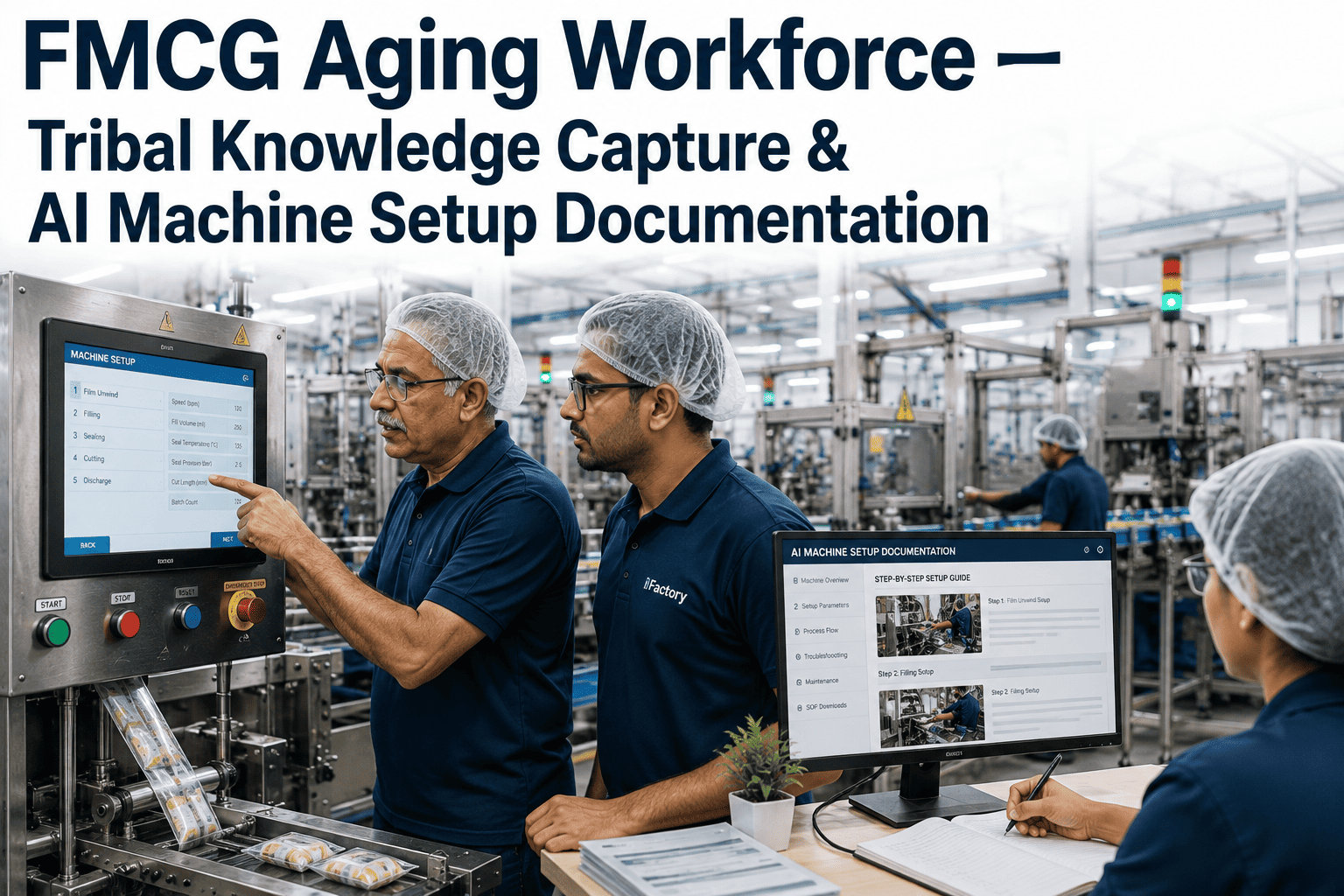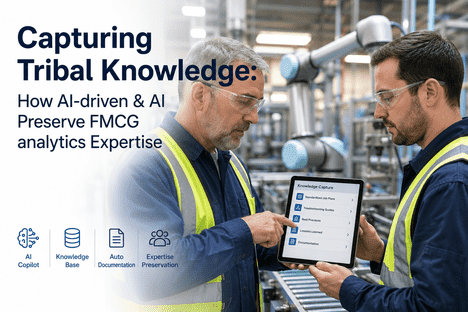
Seventy percent of critical operational knowledge in FMCG manufacturing is undocumented. It exists only in the minds of experienced technicians the machine quirks they know to watch for, the diagnostic shortcuts that cut troubleshooting time in half, the vendor workarounds that never made it into any manual, and the process adaptations that keep a high-speed packaging line running at target OEE when conditions deviate from specification. With 25% of the U.S. manufacturing workforce aged 55 or older and 50% of FMCG maintenance technicians projected to retire by 2030, that undocumented knowledge is walking out the door at an accelerating rate. The annual cost of institutional knowledge gaps to a large manufacturing organization is estimated at $47 million and for U.S. manufacturing as a whole, undocumented-expertise-driven human error accounts for $92 billion in losses every year. AI-driven knowledge capture systems AI copilots that mine work order history, voice-to-text tools that document technician reasoning in real time, and automated knowledge bases that surface the right procedure at the moment of need transform an organization's most fragile asset into its most durable one. Book a Demo of iFactory's Knowledge Base and AI Documentation platform to see how AI-driven knowledge capture preserves FMCG analytics expertise before it retires.
Why Tribal Knowledge Loss Is the Most Urgent Workforce Risk in FMCG
Tribal knowledge in FMCG plants encompasses the undocumented expertise that keeps production running when conditions deviate from standard. A veteran filler technician knows the specific vibration pattern that precedes a reject-spike on the labeler. An experienced packaging line lead hears the difference between a normal sealer cycle and the sound that means a heating element is degrading. A CIP specialist knows that the third rinse cycle on the yogurt line needs two extra minutes during winter months because the ambient temperature changes chemical reaction rates. None of this knowledge is in any SOP, manual, or training document. It is held entirely by individuals whose average age is 55 and whose retirement date is approaching faster than the plant's ability to replace them. The cost of losing that knowledge is quantified in the metrics below.
What Happens When Tribal Knowledge Walks Out the Door
The operational impact of losing a senior technician without knowledge capture is measurable within weeks — not months. The table below maps the before-and-after metrics documented across FMCG plants that experienced unmanaged veteran departures.
| Performance Metric | With Veteran Technician | After Departure | Operational Impact |
|---|---|---|---|
| Mean Time to Repair (complex failures) | 45 minutes | 2-3 hours | 3-4x longer downtime per event |
| First-Time Fix Rate | 85% | 55-60% | 40% more repeat repair visits |
| Repeat Failures (30 days) | 8% | 22% | 2.75x recurring repair costs |
| New Hire Ramp Time to 80% Productivity | 3-4 months | 8-12 months | 6+ months lost productivity per hire |
| Safety Near-Misses per Quarter | 2-3 | 6-10 | 3x safety risk increase |
| Escalation Rate to Senior Engineers | Low | High | Senior staff become bottleneck |
Beyond the operational metrics, the financial impact compounds. Replacement cost for a specialized maintenance technician ranges from 50-200% of annual salary, with direct hiring costs of $20,000-$40,000 per skilled worker. Each year, 2.8 million manufacturing workers will retire by 2033, representing 70 million-plus years of combined experience leaving the industry. For FMCG plants running high-speed packaging and processing lines where a single undocumented diagnostic shortcut can save 90 minutes of downtime per event, the cost of unmanaged departure is not theoretical — it is a direct P&L impact. Book a Demo to see how iFactory's AI Knowledge Base captures and preserves that expertise before departure.
Seven AI-Driven Knowledge Capture Methods for FMCG Analytics Expertise
Effective tribal knowledge capture combines multiple methods that address different types of expertise — from diagnostic reasoning that requires structured interviews to sensory knowledge that requires video demonstration. AI makes each method more scalable and less dependent on technician willingness to spend extra time documenting.
Work Order Mining with AI Pattern Extraction
AI reads historical work order text across thousands of completed repairs, automatically identifying symptom-cause-remedy patterns that no human analyst could synthesize. The system builds diagnostic trees from hundreds of similar faults and surfaces the relevant guidance when a technician creates a new work order for the same asset class.
Voice-to-Text Knowledge Elicitation
Voice-based interfaces allow experienced technicians to describe troubleshooting steps, machine quirks, and diagnostic reasoning naturally while working. A 30-minute voice interview can capture a technician's key knowledge for an entire asset class before retirement. AI transcribes, structures, and indexes the content automatically.
Shift Logbook AI Analysis
NLP parsing of free-text shift log entries extracts equipment IDs, fault descriptions, actions taken, and outcomes in real time. AI generates prioritized handover summaries, detects recurring patterns across weeks and months that human reviewers miss, and converts unstructured observations into structured knowledge records linked to specific assets.
Structured SOP Co-Creation with AI
AI presents experienced technicians with structured prompts drawn from work order history: "You have resolved this fault 40 times. What is the first thing you check?" Responses are captured and converted into standardized job plans that are expert-reviewed and novice-tested — converting undocumented intuition into repeatable procedures.
Video Walkthrough with AI Transcription
Technicians record video walkthroughs of common failure mode diagnoses as they perform them. AI transcribes speech, timestamps key actions, extracts procedural steps, and indexes the content by asset, fault code, and symptom — creating a searchable video knowledge base that preserves visual and sensory knowledge text cannot capture.
Automated Documentation at Work Order Close
AI prompts technicians to document fault cause and resolution at work order close with minimal friction. Voice-to-text capture replaces typing. AI structures free-text notes into searchable symptom-cause-remedy format and links photo and video attachments to the asset history. Every repair becomes a knowledge record without a separate documentation step.
Conversation-Based Knowledge Elicitation
AI-powered conversational agents conduct structured knowledge interviews with experienced operators: "What do you do when the filler discharge pressure fluctuates? How do you know when a seal jaw is about to fail?" Responses are captured, transcribed, and converted into structured knowledge base articles that preserve the diagnostic reasoning process.
What Knowledge Transfer Programs Deliver: Documented ROI
Knowledge transfer programs that combine structured capture methods with AI-powered documentation deliver measurable returns within the first quarter of deployment. The investment required — typically $60,000-$80,000 for program setup — is recovered within 6-11 months through MTTR reduction, scrap reduction, and faster new hire ramp times.
The 90-Day Tribal Knowledge Capture Roadmap
Effective tribal knowledge capture follows a repeatable five-phase sequence that iFactory has validated across FMCG plant deployments. The roadmap prioritizes high-risk knowledge areas first and embeds capture into existing workflows rather than requiring separate documentation effort.
The critical principle is that knowledge capture must be embedded in existing workflows, not added as a separate task. When documentation happens automatically through AI analysis of work order text, voice-to-text capture at repair completion, and shift logbook NLP parsing, the capture burden on technicians drops to near zero while the knowledge base grows continuously. Book a Demo to see how iFactory's AI Knowledge Base captures tribal knowledge automatically from your existing maintenance workflow.
How a Multi-Site FMCG Plant Network Preserved 300 Pages of Operational Knowledge in One Month
An FMCG production facility faced the scenario playing out across the industry: all original process engineers had departed with only a two-day handover window. The plant operated on paper-based shift logs with just 30 minutes of overlap between three shifts per day. Critical knowledge about machine-specific startup sequences, seasonal process adjustments, and diagnostic patterns for the plant's high-speed fillers and sealers existed only in the memories of senior operators nearing retirement. Within one month of deploying an AI-powered shift logbook and knowledge capture platform, the facility generated 300 pages of searchable operational knowledge from 61 completed shift handovers. The AI's NLP engine extracted 3.2 times more actionable content than the previous manual handover process, converting free-text operator observations into structured, searchable knowledge records linked to specific assets, products, and shift conditions.
61 Shift Handovers Captured in Month One
Every shift handover became a structured knowledge capture event rather than a verbal handoff. AI extracted equipment IDs, fault descriptions, actions taken, and outcomes from free-text operator entries, building a searchable knowledge base with zero additional documentation burden on operators.
3.2x More Actionable Content Captured
The AI system identified and structured significantly more actionable information from each handover than the manual process captured. Patterns that operators considered too minor to write down — small adjustments, early warnings, recurring observations — were surfaced and preserved as structured knowledge records.
300-Page Operational Knowledge Base
One month of AI-powered shift log capture produced the equivalent of a 300-page operational manual — built entirely from the daily knowledge operators already possessed. The knowledge base is continuously updated with each new shift, growing without requiring any separate documentation project.
Natural Language Querying Across All Plant Data
Operators and maintenance technicians can query the knowledge base in natural language: "What causes the filler discharge pressure to drop during yogurt changeover?" The AI retrieves relevant handover entries, work order histories, and documented resolutions — delivering answers in seconds rather than requiring hours of manual logbook searching.
Eight Best Practices for FMCG Tribal Knowledge Capture Programs
Knowledge capture programs that succeed share a common set of principles. The following best practices are drawn from deployments across FMCG and discrete manufacturing environments where AI-powered knowledge capture has delivered measurable MTTR reduction, faster onboarding, and documented knowledge retention.
Start with Work Order Mining
The highest-leverage entry point requires no new data collection. AI analysis of existing work order history can extract symptom-cause-remedy patterns across thousands of completed repairs, building diagnostic trees from data the plant already owns. Most FMCG plants have 3-10 years of work order data that contains undocumented expertise patterns no human has ever analyzed.
Prioritize the 80/20 Knowledge Areas
Twenty percent of undocumented knowledge drives 80% of operational impact. Focus capture efforts on safety-critical procedures, highest-frequency tasks, highest-error-cost processes, and onboarding bottlenecks. The Knowledge Risk Matrix (criticality x departure risk) identifies which knowledge areas to capture first.
Start 12-18 Months Before Retirement
Knowledge capture for critical departing experts should begin 12-18 months before their planned retirement date. This timeline allows for multiple capture sessions, validation by the expert, and transfer testing with novice technicians. Rushed capture in the final weeks before departure inevitably misses context-dependent knowledge.
Capture the Why, Not Just the What
Procedures without context are fragile. Capturing the reasoning behind the action — "tap the pressure gauge because it sticks when below 40°F" — is what makes knowledge transfer resilient to changing conditions. AI voice capture excels at preserving diagnostic reasoning because technicians naturally explain their thought process when speaking.
Embed Capture in Daily Workflows
Knowledge capture must be a byproduct of normal work, not a separate activity. Voice-to-text work order close-out, AI-analyzed shift handovers, and automated pattern extraction from maintenance logs generate knowledge continuously without requiring technicians to spend additional time documenting.
Test Knowledge Transfer Objectively
Knowledge has not transferred until someone else can independently perform the task using only the captured documentation. Test by having a novice technician resolve a documented fault using only the knowledge base. Track first-time fix rate, MTTR, and escalation rate for knowledge base users as objective transfer metrics.
Conclusion: Tribal Knowledge Is the Last Untapped Asset in FMCG Analytics — and the Most Urgent One to Protect
FMCG plants have invested decades in process automation, sensor infrastructure, and data analytics platforms — yet the most valuable intelligence in the facility remains undocumented in the minds of experienced technicians. With 50% of the maintenance workforce retiring by 2030 and 70% of critical knowledge undocumented, the window for capture is measured in months, not years. AI-powered knowledge capture changes the economics of preservation. It eliminates the documentation burden that made previous knowledge transfer programs fail. It extracts patterns from existing work order data that no human could synthesize. It structures free-text observations into searchable knowledge bases that deliver answers in seconds rather than hours. And it embeds capture into the daily workflow — shift handovers, work order close-out, voice documentation — so the knowledge base grows continuously without requiring additional technician effort. If your plant has not started capturing the undocumented expertise of its most experienced technicians, Book a Demo of iFactory's Knowledge Base and AI Documentation platform and begin preserving your FMCG analytics expertise before it walks out the door.