SCADA, PLC & Robotic Controller Integration with AI-driven for FMCG
By Seren on June 11, 2026
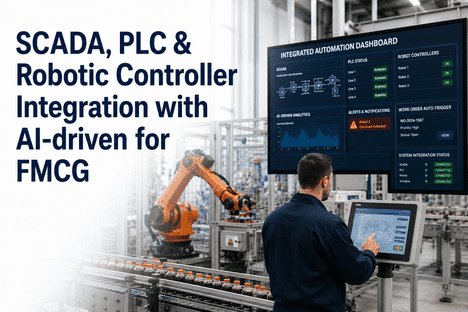
The FMCG production manager opens the SCADA dashboard at 06:30 and sees that filling line 3 is running at 87% of target throughput. The PLC data shows the servo drive on station 4 has been cycling 12% slower for the last 47 minutes — not enough to trigger a fault, but enough to cost 3,200 lost units by shift end if the trend continues. Meanwhile, the robotic palletizer on line 2 logged 14 micro-stalls in the last hour — the gripper alignment drifted 0.3 mm after the last tool change, and the robot controller compensated each time with a retry cycle that added 8 seconds per pallet. No alarm was raised. No work order was created. The SCADA system recorded the data, the PLC executed the compensatory logic, and the robot controller absorbed the inefficiency silently. The production manager will discover the lost output at the end-of-shift report — eight hours too late to intervene. That is the gap that AI-driven SCADA, PLC, and robotic controller integration closes.
SCADA Integration · PLC Analytics · Robotic Controller AI · Automated Work Orders · FMCG Production
Your SCADA Records Every Data Point. Your PLCs Execute Every Command. Your Robot Controllers Compensate for Every Drift. But None of Them Create a Work Order — Until It Is Too Late. AI-Driven Integration Closes That Gap.
iFactory's AI-driven integration layer connects SCADA systems, PLCs, and robotic controllers with intelligent work order automation — detecting production anomalies, servo drift, and robot micro-stalls in real-time and triggering corrective actions before output is lost.
Reduction in unplanned downtime achievable when AI-driven SCADA-PLC integration automates work order creation from production anomalies
12-18%
OEE improvement realized by FMCG plants after deploying AI-driven integration across SCADA, PLC, and robotic control systems
$39K
Average cost per hour of unplanned downtime on a high-speed FMCG packaging line — downtime that AI-driven integration helps prevent
3-5x
ROI multiplier reported by FMCG manufacturers in the first year of AI-driven SCADA-PLC-robotic integration deployment
Why FMCG Manufacturers Need AI-Driven SCADA, PLC, and Robotic Controller Integration
Fast-Moving Consumer Goods (FMCG) production lines operate at speeds that leave no room for manual monitoring. A beverage filling line runs at 600 bottles per minute. A snack packaging line cycles at 200 packs per minute. A robotic palletizer completes four picks per minute across three shift-change handovers. At these velocities, the gap between when an anomaly occurs and when it is detected determines whether the line loses 50 units or 5,000 units. Traditional SCADA systems record every data point — temperatures, pressures, cycle times, servo positions, robot joint angles — but they are architected for visibility, not action. A SCADA alarm requires a human operator to interpret the alert, assess the severity, and decide whether to create a work order. In an FMCG plant running 24 hours a day across multiple production lines, that human decision loop takes 45 minutes on average — time during which the anomaly continues to degrade output quality and quantity.
The solution is an AI-driven integration layer that connects SCADA systems, PLCs, and robotic controllers directly to an automated work order engine. When the PLC detects a servo position drift exceeding the adaptive threshold, the AI engine evaluates the trend against historical failure patterns, determines the urgency, and creates a precisely scoped work order with the affected asset, the likely root cause, and the recommended corrective action — all within 30 seconds. When the robot controller logs a micro-stall during a pick cycle, the integration layer correlates it with joint torque data from the preceding 100 cycles, determines whether the drift is progressive or transient, and escalates the work order only when the trend predicts an imminent failure. The human operator is not removed from the loop — the operator is elevated from data monitor to decision maker, reviewing AI-validated work orders rather than scanning raw SCADA screens for anomalies.
Traditional Integration vs AI-Driven Integration: The Response Time Comparison
Event Type
Traditional Response
AI-Driven Response
PLC Servo Drift
Operator notices throughput drop on HMI, reports to shift lead, shift lead creates manual work order — 35-60 minutes elapsed
PLC position data triggers AI threshold model, work order auto-created with asset ID, drift value, and recommended calibration — 30 seconds elapsed
Robot Micro-Stall
Robot controller logs retry event, operator may or may not notice, micro-stall accumulates across shift — discovered at end-of-day report 8-12 hours later
AI detects micro-stall pattern exceeding adaptive baseline, correlates with joint torque trend, creates work order for gripper alignment inspection — 45 seconds elapsed
SCADA Alarm Cascade
Operator inundated with 20+ alarms from single event, spends 15-25 minutes triaging before identifying root cause and creating work order
AI engine correlates alarm cascade to single root cause, suppresses secondary alerts, creates consolidated work order with ranked root cause — 60 seconds elapsed
AI predicts temperature trajectory will exceed threshold in 18 minutes, creates preventive work order with time-to-failure forecast — automated action before alarm triggers
End-of-Shift Report
Manual compilation of SCADA data, PLC logs, and operator notes — report ready 2-4 hours after shift end
Real-time dashboard with live anomaly feed, work order status, and OEE projection — available continuously during the shift
The Integration Architecture: How SCADA, PLC, and Robotic Controllers Connect to the AI Work Order Engine
The integration architecture follows a layered data flow model that preserves the integrity and security of each control system while enabling cross-system intelligence. At the base layer, the SCADA system, PLCs, and robotic controllers continue to operate independently, executing their primary control functions without modification. The AI integration layer reads data from each system through standard industrial communication protocols — OPC-UA for SCADA and PLC connectivity, MTConnect for CNC controllers, and ROS2 or vendor-specific APIs for robotic controllers. No write access is required to the control systems, ensuring that the AI layer cannot interfere with real-time control functions. The data flows through an edge computing gateway that performs initial normalization, timestamp alignment, and protocol translation before passing it to the AI inference engine. The inference engine runs machine learning models trained on historical production data — detecting patterns that indicate developing anomalies, predicting failure trajectories, and classifying the severity of each detected event.
Layer 01: SCADA System Data Acquisition
The SCADA system aggregates data from thousands of sensors across the FMCG plant — temperatures, pressures, flow rates, fill levels, conveyor speeds, and quality metrics. In a typical configuration, the SCADA historian stores tag data at polling intervals ranging from 100 milliseconds to 1 second. The AI integration layer connects to the SCADA historian via OPC-UA DA (Data Access) for real-time streaming and OPC-UA HDA (Historical Data Access) for trend analysis. The layer reads approximately 200-500 tags per production line, configurable based on the specific equipment and process requirements. Tags are mapped to a unified data model that normalizes naming conventions across different SCADA vendors — Siemens WinCC, Rockwell FactoryTalk, Schneider ClearSCADA, and Ignition — allowing the AI models to operate on a consistent data schema regardless of the underlying SCADA platform.
Quality: 10-20 tags (fill weight, capping torque, seal integrity)
Energy: 8-15 tags (kWh, compressed air flow, steam flow)
Layer 02: PLC-Level Real-Time Monitoring
PLCs execute the real-time control logic for individual machines and production cells. They operate on scan cycles of 1-50 milliseconds and maintain internal registers that contain granular data not typically exposed through the SCADA layer — servo position deviation registers, cycle time counters, fault buffers, and diagnostic codes. The AI integration layer connects directly to PLCs via native protocols (Siemens S7, Rockwell CIP, Mitsubishi MC Protocol) or through OPC-UA where available. Direct PLC connectivity provides sub-second data resolution that captures transient events invisible to the SCADA historian — micro-stalls lasting 200 milliseconds, servo torque spikes of 50 milliseconds, and cycle time excursions of 300 milliseconds. These transient events are the early indicators of developing failures, and capturing them requires connectivity at the PLC level rather than through the SCADA historian alone.
PLC Integration Benefits
Scan Resolution: 1-50 ms vs 100-1000 ms via SCADA
Transient Capture: Events as short as 50 ms detected
Diagnostic Data: Fault buffers, error codes, status registers
Layer 03: Robotic Controller Integration and AI Analytics
Robotic controllers in FMCG plants — Fanuc, ABB, KUKA, Yaskawa, Universal Robots — operate with proprietary control systems that log joint positions, torques, speeds, accelerations, program execution states, and error events at millisecond resolution. Modern collaborative robots additionally stream force-torque sensor data and safety-rated monitored stop events. The AI integration layer connects to each robotic controller through its native API — Fanuc Karel/SNPX, ABB RobotStudio SDK, KUKA Sunrise.OS, Yaskawa MotoPlus, or UR Dashboard/RTDE servers. The layer reads approximately 50-150 data points per robot, including joint angles, motor currents, TCP position and orientation, program line number, cycle count, and error history. The AI models analyze this data to detect gripper wear patterns, joint stiffness degradation, TCP drift, and trajectory deviations — all of which proceed failure by hours to days but remain invisible to standard robot monitoring systems that only alert on hard faults.
Robot Anomalies Detected by AI
TCP Drift: Tool center point deviation >0.3 mm
Joint Stiffness: Torque increase >8% over baseline
Gripper Wear: Cycle time increase >5% on pick/place
Trajectory Deviation: Path error >1 mm from taught path
Micro-Stall Pattern: >3 retries per 100 cycles above baseline
Your SCADA Sees the Data. Your PLCs Execute the Logic. Your Robot Controllers Compensate for the Drift. But None of Them Create a Work Order Until Output Is Lost. AI-Driven Integration Creates the Work Order Before the Next Bottle Leaves the Filler.
iFactory's AI integration layer connects to any SCADA, PLC, or robotic controller — reading real-time data through native protocols, detecting anomalies with purpose-trained machine learning models, and triggering automated work orders through a unified work order engine that dispatches the right technician with the right parts and the right procedure.
Data Mapping and Work Order Automation: From SCADA Tag to Technician Dispatch
The core of the integration is the data mapping layer that translates production data from SCADA, PLC, and robotic controller formats into actionable work order fields. Every SCADA tag, PLC register, and robot data point is mapped to a standardized asset hierarchy and failure mode taxonomy. When the AI engine detects an anomaly, it populates the work order with the affected asset ID from the asset hierarchy, the detected failure mode from the taxonomy, the severity classification based on the anomaly magnitude and trend direction, the recommended corrective action from the knowledge base, and the required skill set and spare parts linked to the asset type. The work order is then routed through the iFactory work order engine, which assigns priority, checks technician availability, verifies spare parts inventory, and dispatches the work order to the appropriate maintenance team — all without human intervention. The entire cycle, from anomaly detection to technician notification, completes in under 60 seconds.
"
We run eight high-speed packaging lines producing 2.4 million units per day. Before deploying AI-driven integration, our average time from anomaly detection to work order creation was 52 minutes — and that was when the operator noticed the anomaly on the SCADA screen. The real gap was that 40% of anomalies were never detected at all during the shift. They appeared on the end-of-shift report as lost OEE points with no explanation. After connecting our Siemens SCADA, Rockwell PLCs, and Fanuc robot controllers to iFactory's AI integration layer, our work order trigger time dropped from 52 minutes to 45 seconds. But the bigger impact was the anomalies we started catching — the servo drift that would have cost us 12,000 units, the robot gripper wear that was adding 0.4 seconds per cycle, the temperature excursion on the sealer bar that was invisible to the SCADA system because it stayed within the configured alarm limits. In the first quarter, automated work orders from AI-detected anomalies recovered 7.2% of lost OEE. The payback period was four months.
— Engineering Manager, Multi-Line FMCG Beverage and Packaging Facility — 8 High-Speed Lines, 24/7 Production
AI Model Training: How the Integration Learns Your FMCG Production Patterns
The AI models that power the integration layer are not generic anomaly detection algorithms — they are purpose-trained on the specific equipment configurations, production profiles, and failure patterns of each FMCG facility. The training process begins with a data ingestion phase where the integration layer collects 30 to 90 days of historical SCADA, PLC, and robotic controller data alongside corresponding work order records. This data establishes the baseline operating envelope for each asset — the normal range of servo positions, robot joint torques, SCADA temperature values, and PLC cycle times under standard production conditions. The models learn to distinguish between normal process variation (a 2% cycle time increase during a changeover) and abnormal variation (a 2% cycle time increase accompanied by a servo torque spike and temperature rise). Once deployed, the models continue to learn adaptively, updating their baselines as equipment ages, production profiles change, and seasonal demand patterns shift. This adaptive learning ensures that the anomaly detection thresholds remain accurate without requiring manual recalibration.
30-90 Days
Historical data ingestion period for baseline model training on your specific equipment and production patterns
2-4 Weeks
Deployment timeline from SCADA-PLC-robot connectivity to first automated work order — phased by production line
94%
Anomaly detection accuracy achieved after 90 days of adaptive model training on FMCG production data
< 60s
End-to-end time from anomaly detection to automated work order creation and technician notification
Conclusion
FMCG production lines operate at speeds where every minute of undetected anomaly costs thousands of units. SCADA systems collect the data, PLCs execute the control logic, and robotic controllers compensate for mechanical drift — but without an AI-driven integration layer, none of these systems create a work order until output is already lost. The gap between when an anomaly forms and when a technician is dispatched is the gap where FMCG margins disappear. AI-driven integration closes that gap by connecting SCADA, PLC, and robotic controller data directly to an intelligent work order engine that detects, classifies, and responds to anomalies in under 60 seconds.
iFactory's AI-driven SCADA, PLC, and robotic controller integration platform is purpose-built for FMCG production environments — connecting to any SCADA system, PLC brand, or robotic controller through native industrial protocols, processing data through purpose-trained machine learning models, and triggering automated work orders through a unified work order management engine. With live anomaly detection, adaptive threshold models, and automatic work order creation with asset, root cause, and corrective action data, the platform transforms FMCG production monitoring from a retrospective reporting function into a real-time intervention system. Book a Demo to see AI-driven SCADA-PLC-robotic integration configured for a high-speed FMCG production environment, or talk to an expert about a connectivity assessment for your SCADA, PLC, and robotic control systems.
Frequently Asked Questions
The integration layer supports all major SCADA platforms including Siemens WinCC, Rockwell FactoryTalk, Schneider ClearSCADA/EcoStruxure, Inductive Automation Ignition, GE Digital iFIX, ABB System 800xA, and AVEVA System Platform. Connectivity is established through OPC-UA DA for real-time data streaming and OPC-UA HDA for historical trend analysis. The platform also supports native SCADA protocols where OPC-UA is not available. The data mapping layer normalizes tag naming conventions across different SCADA vendors into a unified asset hierarchy, enabling the AI models to operate on a consistent data schema regardless of the underlying SCADA platform. Most SCADA integrations are completed within 2-3 days per production line. Book a Demo to see a live SCADA integration walkthrough configured for your FMCG production environment.
iFactory supports direct PLC connectivity for all major industrial automation brands including Siemens (S7-300/400/1200/1500 via native S7 protocol and TIA Portal compatibility), Rockwell/Allen-Bradley (ControlLogix, CompactLogix, MicroLogix via EtherNet/IP and CIP), Mitsubishi (MELSEC iQ-R, iQ-F, Q, FX series via MC Protocol), Schneider Electric (Modicon M340, M580 via Modbus TCP/IP), Omron (CJ, NJ, NX series via EtherNet/IP), and Beckhoff (TwinCAT via ADS). Direct PLC connectivity provides sub-second data resolution — typically 10-50 ms scan cycle access — that captures transient events invisible to SCADA historians polled at 1-second intervals. The platform reads PLC diagnostic buffers, fault registers, and cycle time counters to detect micro-events that precede equipment failure by hours. Talk to an expert about a PLC connectivity assessment for your specific controller configurations.
The integration layer connects to each robotic controller through its native API or communication protocol. Supported robot brands include Fanuc (Karel/SNPX/RPC), ABB (RobotStudio SDK/PC SDK), KUKA (Sunrise.OS/CrossComm), Yaskawa/Motoman (MotoPlus/High-Speed Ethernet), Universal Robots (Dashboard Server/RTDE), Stäubli (VALstudio), Epson (RC+ API), and Kawasaki (AS/K-ROSET). For each robot, the platform collects approximately 50-150 data points including joint positions and angles, motor currents and torques, TCP position and orientation, program execution state and line number, cycle count and cycle time, error history and event logs, and payload and gripper status. The AI models analyze this data to detect gripper wear patterns, joint stiffness degradation, TCP drift exceeding 0.3 mm, and trajectory deviations — anomalies that typically precede robot failure by hours to days.
The deployment follows a phased approach designed to deliver measurable value within the first 30 days. Phase one (weeks 1-2) establishes connectivity to one production line or pilot area — connecting the SCADA system data stream, 2-4 PLCs, and 1-2 robotic controllers to the integration platform. During this phase, the AI models begin ingesting historical data and establishing baseline operating envelopes. Phase two (weeks 3-4) activates automated work order creation from detected anomalies on the pilot line, with the AI engine operating in a human-validated mode where work orders are reviewed by the maintenance team before full automation. Phase three (months 2-3) expands the deployment to additional production lines and transitions the AI engine to fully automated work order dispatch. Most FMCG facilities achieve full deployment across 4-8 production lines within 90 days. The specific timeline depends on SCADA system complexity, PLC and robot count, and data availability for model training. Talk to an expert about a deployment roadmap tailored to your FMCG facility.
Your SCADA Records It. Your PLCs Execute It. Your Robots Compensate for It. But None of Them Create a Work Order Until Output Is Lost. AI-Driven Integration Creates the Work Order Before the Next Cycle Completes. Stop Reporting Production Loss. Start Preventing It.
iFactory's AI-driven SCADA, PLC, and robotic controller integration platform for FMCG production — connecting any SCADA, PLC, or robot controller to an intelligent work order engine that detects anomalies, classifies severity, and dispatches corrective actions in under 60 seconds. Book a walkthrough configured for your FMCG production environment.