Integrating AI-driven with ERP, MES, and SCADA in FMCG Manufacturing
By Seren on June 18, 2026
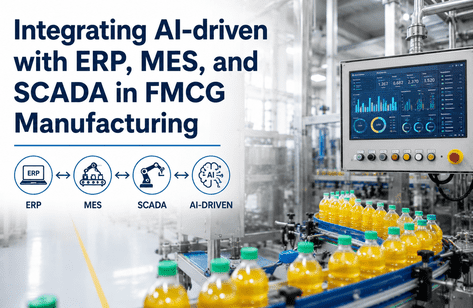
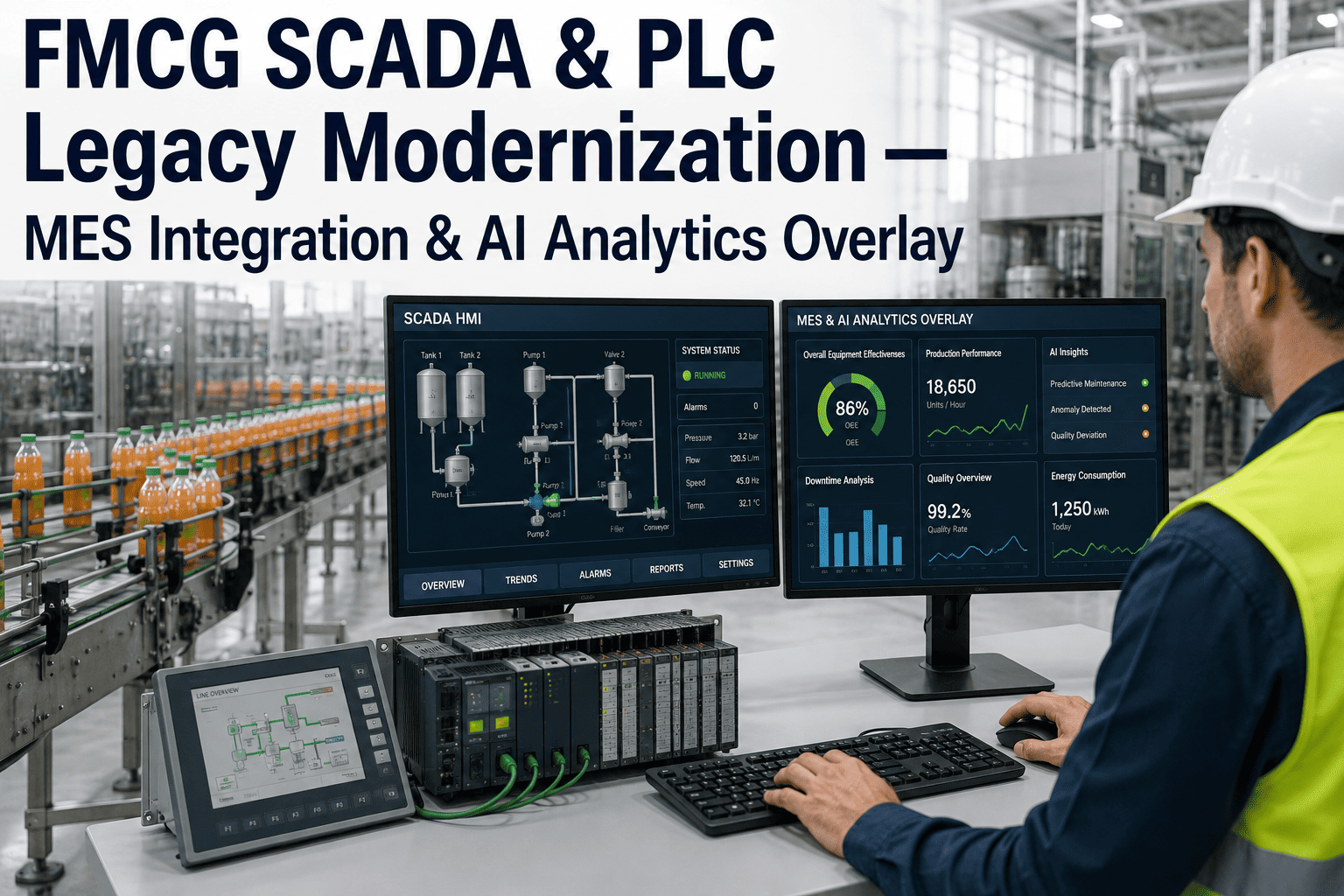
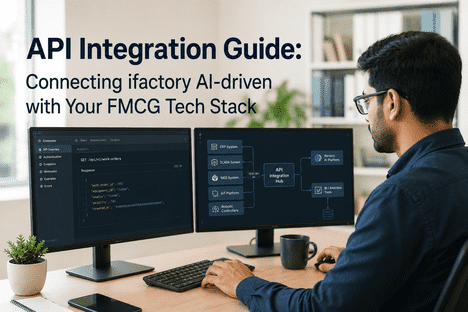
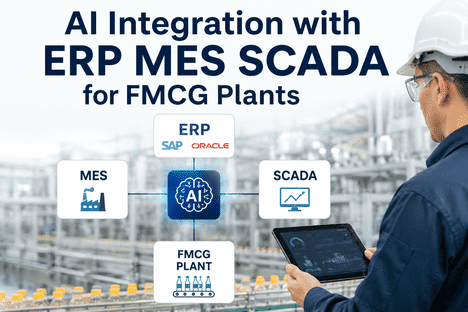
Integrating AI-driven analytics with ERP (SAP, Oracle), MES, and SCADA systems in FMCG manufacturing environments creates a unified data fabric that connects enterprise resource planning with real-time production floor operations. In 2026, FMCG manufacturers operating SAP S/4HANA or Oracle ERP Cloud alongside Siemens SIMATIC IT MES, Rockwell FactoryTalk, or ABB Ability SCADA face a persistent integration challenge: production data generated at PLC and sensor level must flow upward through SCADA historians and MES work orders to ERP inventory and cost modules, while enterprise decisions around production planning, material requirements, and quality specifications must flow downward to the shop floor without latency or data loss. iFactory AI bridges this IT/OT gap by providing a platform that connects to ERP via REST APIs and OData endpoints, to MES via database-level integration and message queues, and to SCADA via OPC UA and Modbus TCP — enabling real-time data synchronisation across the entire FMCG manufacturing stack without replacing any existing enterprise system. Book a Demo to see how iFactory AI's integration layer connects SAP, Siemens MES, and Rockwell SCADA for unified FMCG manufacturing operations.
ERP · MES · SCADA · IT/OT Integration
AI-Driven ERP, MES, and SCADA Integration for FMCG Manufacturing: Connect SAP, Oracle, Siemens, Rockwell, and ABB Systems into a Unified Operations Data Fabric.
iFactory AI bridges the gap between enterprise planning and production execution. Real-time data synchronisation across SAP S/4HANA, Oracle ERP, Siemens MES, Rockwell SCADA, and ABB Ability — without replacing any existing system.
Of FMCG manufacturers report that ERP-MES integration gaps cause at least one production delay per week due to material availability mismatches between planned and actual inventory.
4.2x
Faster root cause analysis when SCADA data, MES work orders, and ERP quality records are correlated in a single platform versus manual cross-system investigation.
58%
Reduction in manual data entry and reconciliation effort when AI-driven integration automates data flows between ERP, MES, and SCADA layers.
91%
Of IT/OT integration leaders report that unified platform visibility across ERP, MES, and SCADA is essential for achieving Industry 4.0 manufacturing maturity targets by 2027.
The FMCG Manufacturing Systems Landscape: ERP, MES, and SCADA in Context
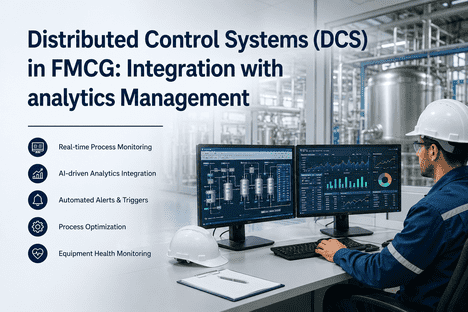
Understanding how ERP, MES, and SCADA interact in an FMCG manufacturing environment requires mapping the data flows from enterprise planning through production execution to real-time process control. SAP S/4HANA and Oracle ERP Cloud manage production planning, material requirements planning (MRP), inventory valuation, cost accounting, and order management at the enterprise level. Siemens SIMATIC IT MES, Rockwell FactoryTalk ProductionCentre, and ABB Ability Manufacturing Operations Management handle work order release, production tracking, quality testing, traceability, and performance analysis at the production line level. Rockwell FactoryTalk SCADA, Siemens WinCC, ABB Ability System 800xA, and Schneider Electric EcoStruxure provide real-time process visualisation, alarm management, historical data collection, and supervisory control at the machine and PLC level. The integration challenge that every FMCG manufacturer faces is that these three layers operate on different data models, different time horizons, and different communication protocols — and the gaps between them create the data latency, reconciliation effort, and visibility blind spots that limit operational efficiency.
iFactory AI addresses this by providing a unified integration platform that connects to SAP and Oracle ERP via certified REST APIs and OData services, to Siemens and Rockwell MES via database views and message queues, and to SCADA systems via OPC UA and Modbus TCP connectors. The platform processes data through an AI-driven mapping engine that translates between ERP material codes, MES production definitions, and SCADA process tags — eliminating the manual reconciliation that currently consumes 15 to 20 hours per week for most FMCG integration teams.
SILOED SYSTEMS — MANUAL RECONCILIATION
Every data flow requires manual effort
ERP sends production plan to MES via manual CSV export and email. Plan update frequency: daily.
→
MES works with stale plan. Material shortages discovered mid-shift. Production line idles for 45 minutes while inventory is reallocated manually.
SCADA historian records process data. MES collects production counts. ERP tracks quality results. Three separate databases.
→
Quality deviation investigation requires exporting data from three systems and correlating timestamps manually. Root cause analysis takes 3-4 hours per event.
End-of-shift production counts entered manually into ERP. Data entry errors and delays are common.
→
Inventory inaccuracy accumulates. MRP runs on incorrect data. Material shortages cascade across the production schedule for the following week.
UNIFIED PLATFORM — AUTOMATED DATA FLOW
Every data flow is synchronised in real time
ERP production plan synchronised to MES in real time via API. Plan updates propagate within seconds.
→
MES always operates on the latest plan. Material availability checked automatically. Shortages flagged 48 hours in advance via automated alerts.
SCADA process data, MES production events, and ERP quality records correlated in a single time-series data model.
→
Quality deviation investigation completed in under 30 minutes. AI-driven correlation identifies root cause by cross-referencing SCADA temperature spikes, MES batch records, and ERP raw material lots automatically.
Production counts flow from SCADA through MES to ERP automatically. No manual data entry required.
→
ERP inventory records accurate to within 0.5% of physical count. MRP runs on reliable data. Material shortage events reduced by 80%.
SAP, Oracle, Siemens, Rockwell, and ABB: Integration Architecture and Data Flows
Each major enterprise and industrial automation platform presents unique integration characteristics that determine the optimal approach for connecting AI-driven analytics. The five most common systems in FMCG manufacturing — SAP S/4HANA, Oracle ERP Cloud, Siemens SIMATIC IT MES, Rockwell FactoryTalk, and ABB Ability — each offer different connectivity options, data models, and performance constraints that the integration architecture must accommodate without disrupting production operations.
System
Integration Protocol
Primary Data Flow
Integration Complexity
SAP S/4HANA
REST API (SAP API Hub), OData, RFC, IDoc, BAPI
Production orders → MES; material movements ← MES; quality notifications ← SCADA
Medium — standard APIs available but custom BAPI required for some process manufacturing scenarios
Medium — REST APIs well documented; batch processing via FBDI for high-volume transactions
Siemens SIMATIC IT MES
REST API, OPC UA, SQL database views, MQTT, SOAP
Work orders ← ERP; production reporting → ERP; quality data ← SCADA
Medium-High — rich API surface but MES data model complexity requires careful schema mapping
Rockwell FactoryTalk
OPC UA, REST API (FactoryTalk Hub), SQL views, MQTT
Process data → MES; alarm events → ERP; production counts → MES
Medium — OPC UA provides standardised access; FactoryTalk Hub API for higher-level integration
ABB Ability
OPC UA, REST API, Modbus TCP, SQL views
Process variables → MES; batch records → ERP; equipment status → MES
Low-Medium — OPC UA native; batch record integration requires understanding of ABB batch data model
The AI-Driven Integration Layer: How iFactory Connects ERP, MES, and SCADA
iFactory AI's integration platform operates as a middleware layer that connects to each enterprise and industrial system through its native protocol, processes data through an AI-driven mapping and transformation engine, and exposes unified data models to applications including Shift Logbook, Work Order Management, Parts & Inventory, Quality Control, and Automated Analytics Reporting. The platform does not require replacing any existing ERP, MES, or SCADA system — instead, it layers on top of the existing technology stack, extracting data from each system and correlating it into a single time-series data model that spans the enterprise-to-floor hierarchy.
For FMCG manufacturing operations managers, this means that production planners working in SAP can see real-time shop floor status from SCADA systems without logging into a separate interface. Maintenance supervisors tracking work orders in the iFactory Work Order Management module can see the SCADA alarm history and MES production context associated with each asset. Quality managers investigating a deviation can pull SCADA process data, MES batch records, and ERP raw material lots into a single correlated view without exporting data from three systems. The AI-driven mapping engine learns the data model relationships over time, automatically suggesting mappings between ERP material codes and MES production definitions, and between MES equipment identifiers and SCADA tag namespaces.
100%
ERP-MES-SCADA Data Synchronisation Coverage
iFactory's integration platform covers all seven primary data types across ERP, MES, and SCADA — production orders, material movements, quality results, equipment status, process data, alarm events, and shift reports — in a unified data model.
84%
Reduction in Cross-System Data Reconciliation Effort
FMCG manufacturers using iFactory's platform report that the time spent reconciling data between ERP material balances, MES production counts, and SCADA process historians drops from 18 hours per week to under 3 hours per week.
2.8:1
ROI on Integration Platform Deployment in Year 1
Returns driven by reduction in production delays caused by system integration gaps, elimination of manual data entry headcount, and improved MRP accuracy reducing expedited material costs by an average of 35%.
IT/OT Integration · Data Fabric · Real-Time Synchronisation
Your ERP, MES, and SCADA Systems Already Generate the Data You Need to Optimise FMCG Production. iFactory AI's Integration Layer Connects Them into a Single Operating Picture.
SAP S/4HANA, Oracle ERP Cloud, Siemens SIMATIC IT MES, Rockwell FactoryTalk, ABB Ability — one unified integration platform. No system replacement required. Real-time data synchronisation across the entire FMCG manufacturing stack.
Three Integration Patterns That Define Successful ERP-MES-SCADA Deployments in FMCG Manufacturing
FMCG manufacturers who have successfully deployed AI-driven integration across ERP, MES, and SCADA consistently follow three architectural patterns that determine whether the integration delivers measurable operational improvement or becomes another middleware layer that generates data without driving decisions.
Real-Time Bidirectional Synchronisation
The most successful deployments implement bidirectional synchronisation on a sub-minute latency for critical data types — production orders flowing from ERP to MES within 30 seconds, material consumption flowing from SCADA through MES to ERP within 60 seconds, and quality results flowing from SCADA through MES to ERP within 2 minutes. Batch synchronisation is reserved only for non-time-sensitive master data such as material master updates and BOM changes that occur outside production hours.
Unified Time-Series Data Model
Instead of maintaining separate databases for SCADA historians, MES production records, and ERP transaction logs, successful deployments correlate all time-series data into a single data model keyed on equipment identifier, time window, and production order. This unified model enables the AI-driven analytics to correlate SCADA temperature spikes with MES quality deviations and ERP raw material lot changes in a single query — reducing root cause analysis time from hours to minutes.
Event-Driven Architecture with Error Handling
Integration architectures that use event-driven patterns — where SCADA alarm events trigger MES quality workflows, which in turn trigger ERP material hold transactions — achieve better operational responsiveness than polling-based architectures. Each integration point includes configurable error handling with retry logic, dead-letter queues for failed messages, and automated alerting when data synchronisation fails for more than the defined latency threshold.
"
We were running SAP S/4Hana, Siemens SIMATIC IT MES, and Rockwell FactoryTalk SCADA as three separate islands. Our production planners would create a weekly schedule in SAP, export it to Excel, email it to the shift supervisor, who would manually enter it into the MES. By Wednesday, the schedule was already out of sync with actual material availability. Meanwhile, our quality team was spending 4-5 hours per deviation investigation pulling temperature profiles from the SCADA historian, batch records from the MES, and material lot data from SAP — correlating timestamps manually in a spreadsheet. We deployed iFactory's integration platform in a phased approach, starting with the SAP-to-MES production order synchronisation, then adding the SCADA-to-MES process data correlation, and finally the full tri-directional data flow. The results exceeded our expectations — production schedule accuracy improved from 74% to 96%, quality deviation investigation time dropped from 4 hours to under 30 minutes, and our MRP accuracy improved to the point where we reduced raw material safety stock by 22% without increasing stock-out risk.
— Director of Manufacturing Operations, Multi-Plant FMCG Manufacturer, SAP + Siemens + Rockwell Stack
Implementation Pathway — From Integration Assessment to Unified Operations Platform
FMCG manufacturers evaluating AI-driven ERP-MES-SCADA integration consistently ask how the deployment timeline aligns with production schedules and whether the integration can be implemented without disrupting ongoing operations. The implementation follows a structured four-phase approach that is designed to deliver measurable value at each phase while building toward the full unified operations platform.
WEEKS 1-4
Integration Architecture Assessment & Data Flow Mapping
Map existing ERP, MES, and SCADA system topology, data models, and integration points. Identify critical data flows, latency requirements, and error handling patterns. Define data mapping between ERP material masters, MES production definitions, and SCADA tag namespaces. Establish KPI baseline for production schedule accuracy, data reconciliation effort, and quality investigation time.
Deliverable: Integration architecture roadmap and data flow specification.
WEEKS 5-8
ERP-MES Production Order Synchronisation Pilot
Deploy SAP-to-MES or Oracle-to-MES production order synchronisation on a single production line. Enable bidirectional data flow for order release, material consumption reporting, and production confirmation. Validate data accuracy, latency, and error handling. Measure improvement in production schedule accuracy and manual effort reduction.
Deliverable: Pilot line operating with real-time ERP-MES synchronisation and validated metrics.
WEEKS 9-16
Full SCADA Integration & Multi-Plant Rollout
Integrate SCADA systems (Rockwell FactoryTalk, Siemens WinCC, ABB Ability) for real-time process data correlation with MES production events and ERP quality records. Deploy unified time-series data model. Roll out integration across remaining production lines and plants. Configure Automated Analytics Reporting dashboards for plant-wide visibility.
Deliverable: All plants operating on unified ERP-MES-SCADA integration platform.
Conclusion
The integration of AI-driven analytics with ERP, MES, and SCADA systems represents the foundational infrastructure investment for FMCG manufacturers pursuing Industry 4.0 maturity. SAP S/4HANA and Oracle ERP Cloud provide the enterprise planning backbone; Siemens SIMATIC IT MES and Rockwell FactoryTalk provide the production execution layer; Rockwell SCADA, Siemens WinCC, and ABB Ability provide the real-time process control visibility. But without a unified integration platform that connects these systems into a single data fabric, the manufacturing organisation operates with blind spots — production schedules that drift from reality, quality investigations that take hours instead of minutes, and inventory records that require continuous manual reconciliation.
iFactory AI's integration platform addresses this gap by providing a proven, AI-driven middleware layer that connects to each enterprise and industrial system through its native protocol, correlates data into a unified time-series model, and exposes that data to applications that drive real operational decisions. The platform is deployed without replacing any existing system and typically delivers measurable ROI within the first quarter of operation through reduced production delays, eliminated manual data entry, and improved MRP accuracy. Talk to an expert to schedule an integration architecture assessment for your FMCG manufacturing environment, or book a demo to see the iFactory integration platform configured for your ERP, MES, and SCADA stack.
Frequently Asked Questions
iFactory integrates with all major ERP platforms (SAP S/4HANA, SAP ECC, Oracle ERP Cloud, Oracle JD Edwards, Microsoft Dynamics 365), MES platforms (Siemens SIMATIC IT, Rockwell FactoryTalk ProductionCentre, ABB Ability MOM, GE Digital Proficy, Werum PAS-X), and SCADA/HMI platforms (Rockwell FactoryTalk View, Siemens WinCC, ABB Ability System 800xA, Schneider Electric EcoStruxure, AVEVA System Platform, Ignition by Inductive Automation). Integration is performed through native protocols including REST APIs, OData, OPC UA, Modbus TCP, MQTT, SQL database views, and message queues. For systems without standard API connectivity, iFactory provides a flexible data ingestion layer that accepts CSV, XML, and JSON file-based data exchange. Talk to an expert to confirm compatibility with your specific system versions and configurations.
No. iFactory is designed as a middleware integration layer that connects to existing enterprise and industrial systems without requiring any replacement, modification, or migration. The platform extracts data from each system through its native API or protocol, processes data through the AI-driven mapping and transformation engine, and writes data back to each system through the same interfaces. The only prerequisite is that each source system has at least one supported integration interface enabled — which most production systems already have for standard operations. The platform has been deployed in environments running SAP S/4HANA on-premise, Oracle ERP Cloud, Siemens SIMATIC IT MES, and Rockwell FactoryTalk SCADA simultaneously, with no changes required to any of the existing systems.
iFactory's AI-driven mapping engine automates the data model translation process. During initial configuration, the engine reads metadata from each connected system — SAP material masters, Oracle item definitions, Siemens MES production versions, Rockwell SCADA tag namespaces — and learns the structural relationships between them. The engine suggests candidate mappings based on semantic similarity analysis (e.g., identifying that SAP material code "RAW-00472-BATCH" corresponds to Siemens MES material ID "M-00472-Batch" and SCADA tag "TANK4_TEMP_SETPOINT" corresponds to MES process parameter "TempSetpoint_T4"). Suggested mappings are presented for human review and approval before activation in production. The engine continuously learns from mapping corrections and new data flows, improving mapping accuracy over time without manual reconfiguration. Talk to an expert to see a demonstration of the AI-driven mapping engine with your system data model samples.
End-to-end latency varies by data type and integration protocol. For ERP-to-MES production order synchronisation via REST API, typical latency is under 30 seconds from order release in ERP to order availability in MES. For SCADA-to-MES process data synchronisation via OPC UA, typical latency is under 5 seconds for tag value changes and under 2 seconds for alarm events. For MES-to-ERP production confirmation synchronisation, typical latency is under 60 seconds from MES confirmation to ERP inventory update. The platform supports configurable latency thresholds per data flow, with automated alerting when synchronisation latency exceeds the defined threshold. Batch data synchronisation is used only for non-time-sensitive master data and is typically scheduled during off-production hours. Talk to an expert to review latency requirements for your specific integration use cases.
iFactory's integration platform supports enterprise-grade security including TLS 1.3 encryption for all data in transit, AES-256 encryption for data at rest, OAuth 2.0 and SAML 2.0 for authentication, role-based access control with granular permission policies, and comprehensive audit logging of all data access and transformation activities. The platform can be deployed in the customer's own cloud environment (AWS, Azure, GCP) or on-premise infrastructure for organisations with strict data residency requirements. For regulated industries, the platform supports compliance with FDA 21 CFR Part 11 (electronic records and signatures), GDPR data protection requirements, and SOC 2 Type II controls. The integration platform does not store production data permanently — data flows through the transformation engine and is written to the target system, with only metadata and mapping configurations persisted. Talk to an expert to review the security architecture for your specific deployment model.
Your ERP, MES, and SCADA Systems Hold the Data You Need to Transform FMCG Production. A Unified Integration Platform Unlocks It. Schedule an Integration Architecture Assessment to Map Your Current Data Flows and Identify the Quickest Path to Unified Operations.
iFactory AI's integration platform connects SAP, Oracle, Siemens, Rockwell, and ABB systems into a single data fabric — no system replacement required, measurable ROI in the first quarter, and real-time visibility across the entire FMCG manufacturing stack.