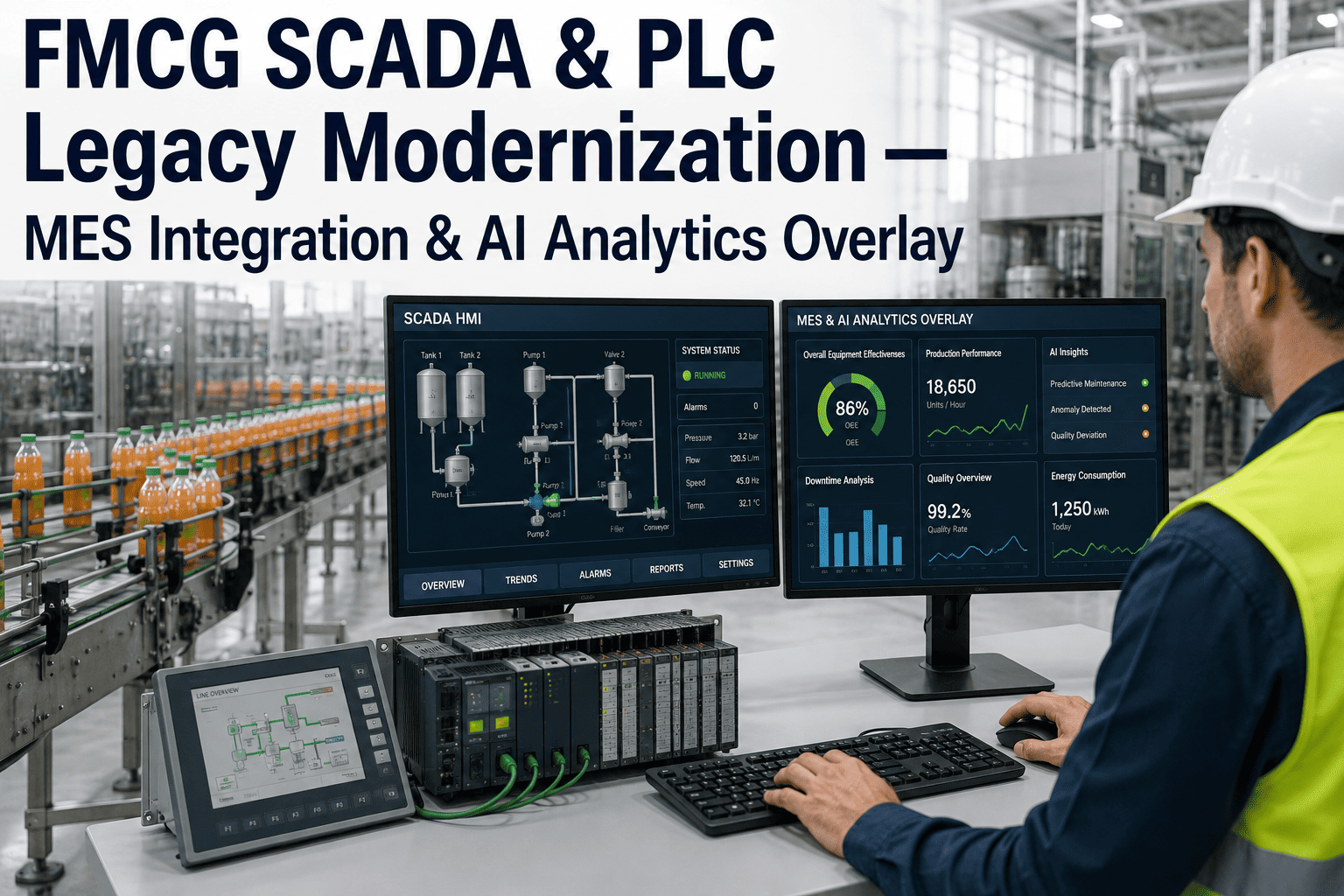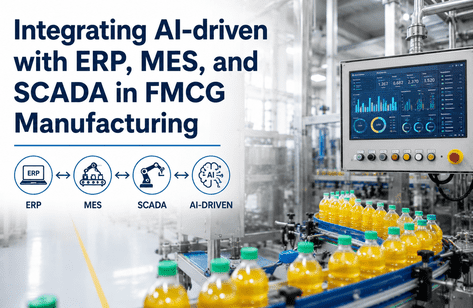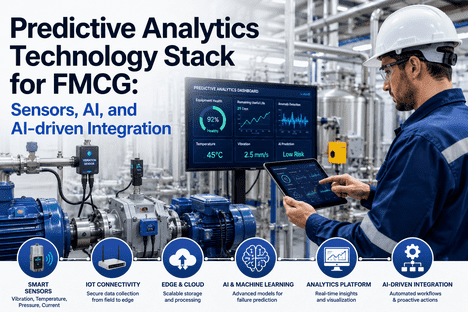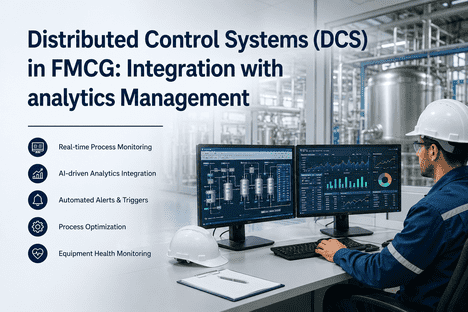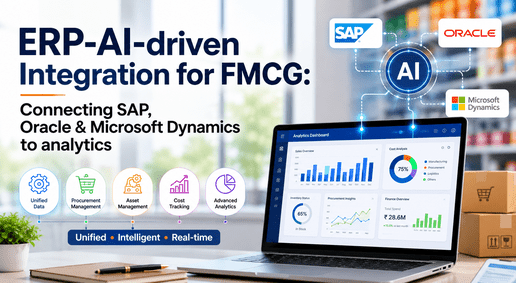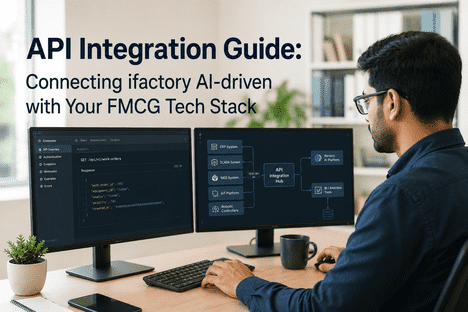
A typical FMCG production line runs on a stack of software systems that were never designed to exchange data in real time. ERP handles planning and procurement. SCADA manages machine-level control. MES tracks shop-floor execution. IoT platforms stream sensor telemetry. Robotic controllers manage packaging and palletizing. BI tools sit on top trying to make sense of fragmented data. The cost of this disconnect is measurable: delayed production decisions, manual data reconciliation, and missed opportunities for AI-driven optimization. iFactory's API platform and Integration Hub bridge these silos through a unified REST API layer, pre-built connectors for 50+ industrial and enterprise systems, and real-time data synchronization that eliminates manual handoffs. Whether you are connecting SAP S/4HANA to a filling line or feeding AI predictions into your Power BI dashboard, iFactory provides the integration fabric that makes your FMCG tech stack intelligent. To see how iFactory connects to your specific system landscape, Book a Demo with our integration engineering team today.
The FMCG Integration Challenge: Why Most Tech Stacks Stay Fragmented
Disconnected Systems Create Hidden Operational Costs
The typical FMCG facility runs five to eight distinct software layers. SAP or Oracle manages enterprise planning. A dedicated MES — Siemens Opcenter, Rockwell FactoryTalk, or AVEVA — tracks batch execution and genealogy. SCADA platforms like Wonderware, Ignition, or WinCC handle real-time machine monitoring. Robotic controllers from FANUC, ABB, or KUKA manage packaging lines. IoT edge gateways stream sensor data from vibration monitors, temperature probes, and flow meters. And BI tools like Power BI, Tableau, or Qlik attempt to aggregate these disparate streams into dashboards. The problem is structural: none of these systems share a unified data model or communication protocol. The result is manual CSV exports, scheduled file drops, fragile middleware scripts, and a week-long delay between a production event and its appearance in a management dashboard. iFactory's Integration Hub replaces this fragile architecture with a durable, real-time integration layer that connects every tier of the FMCG tech stack through standard REST APIs, OPC-UA, MQTT, and webhook interfaces — without requiring changes to any underlying system. Book a Demo to see how your current stack maps to iFactory's integration architecture.
iFactory API Platform: Architecture Overview
REST-First, Event-Driven, Built for Industrial Scale
iFactory's API platform is built on a REST-first architecture with OAuth 2.0 authentication, role-based access control, and comprehensive audit logging compliant with SOC 2 standards. Every integration method — REST APIs, OData, GraphQL, webhooks, event streaming — is designed for industrial manufacturing environments where data integrity, security, and sub-second latency are non-negotiable. The platform acts as a unified namespace that normalizes data from every connected system into a canonical data model aligned with ISA-95 standards, ensuring that a production order from SAP, a batch record from MES, and a temperature reading from a PLC are all represented in a consistent, queryable format. Whether you are connecting a single filling line or unifying a global enterprise across 50 facilities, the same API surface scales horizontally with predictable performance.
ERP Integration: Connecting Enterprise Planning to Shop-Floor Reality
Bidirectional Sync with SAP, Oracle, and Microsoft Dynamics
Enterprise Resource Planning systems are the backbone of FMCG operations — managing production orders, material masters, BOM structures, inventory positions, and financial transactions. But ERP systems operate on transactional batch cycles that are fundamentally misaligned with the real-time rhythm of a production line. iFactory bridges this gap through certified REST API connectors that establish bidirectional, real-time data exchange with SAP S/4HANA, SAP ECC, Oracle Fusion Cloud, Microsoft Dynamics 365, and Infor CloudSuite. Production orders flow from ERP to the shop floor in real time. Material consumption, yield data, quality results, and production confirmations flow back to ERP without manual intervention. For legacy SAP ECC environments, iFactory supports IDoc, RFC, BAPI, and OData interfaces — ensuring compatibility regardless of where your SAP modernization journey stands. The integration completes in 5-10 business days for standard scenarios, with no custom ABAP development required. Book a Demo to review your ERP integration scope with our team.
| ERP Platform | Integration Method | Data Flow Direction | Typical Deployment Timeline |
|---|---|---|---|
| SAP S/4HANA | REST API / OData | Bidirectional | 5-7 business days |
| SAP ECC 6.0 | IDoc / RFC / BAPI | Bidirectional | 7-10 business days |
| Oracle Fusion Cloud | REST API / OData | Bidirectional | 5-7 business days |
| Microsoft Dynamics 365 | REST API / Webhooks | Bidirectional | 3-5 business days |
| Infor CloudSuite | REST API / SOAP | Bidirectional | 5-8 business days |
| Legacy / Custom ERP | Custom REST / File-Based | Configurable | 2-4 weeks |
SCADA, PLC & Robotic Controller Integration
Real-Time Machine Data Without Disrupting Your Control Layer
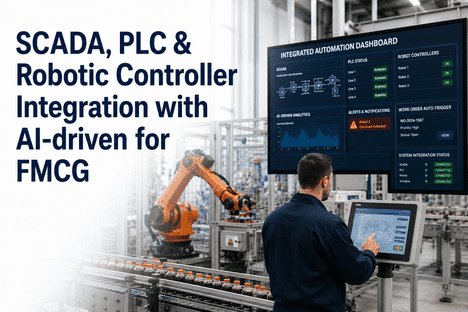
SCADA systems and PLCs carry the lifeblood of FMCG operations — real-time process variables, alarm states, equipment status, and control logic outputs. Robotic controllers from FANUC, ABB, KUKA, and Yaskawa manage high-speed packaging, palletizing, and material handling. iFactory connects to these systems through a read-first architecture that extracts data without writing to the control layer, preserving OT network security and production integrity. Native support for OPC-UA, Modbus TCP, MQTT Sparkplug B, and EtherNet/IP ensures compatibility with Siemens WinCC, Rockwell FactoryTalk View, Wonderware, Ignition, and Schneider EcoStruxure. For robotic controllers, iFactory's connectors parse controller-specific data streams — joint positions, cycle times, payload metrics, fault logs — and normalize them into the unified data model. Edge processing delivers sub-100ms latency for local analytics, and all connections use TLS 1.3 encryption with certificate-based authentication. No changes to existing SCADA configuration or PLC logic are required.
MES & IoT Platform Connectivity
Unifying Execution Data with Edge Intelligence
The Manufacturing Execution System layer translates ERP-level planning into shop-floor execution. iFactory AI's integration adapters for Rockwell FactoryTalk, Siemens Opcenter, GE Proficy, and AVEVA MES synchronize work order dispatch, operator instructions, electronic batch records, and product genealogy in real time. IoT edge gateways stream sensor data from vibration, temperature, pressure, and flow monitors into the same unified namespace, where AI models analyze patterns and generate actionable insights. The combination of MES data and IoT telemetry enables real-time OEE tracking, predictive quality control, and autonomous root-cause analysis — all without breaking the existing MES workflow. Data flows through a streaming ETL pipeline that normalizes, contextualizes, and enriches every data point before it reaches the AI engine. Book a Demo to see how iFactory unifies your MES and IoT data streams into a single real-time intelligence layer.
BI & Analytics Integration: Turning Connected Data into Decisions
Feed AI-Powered Insights into the Tools Your Teams Already Use
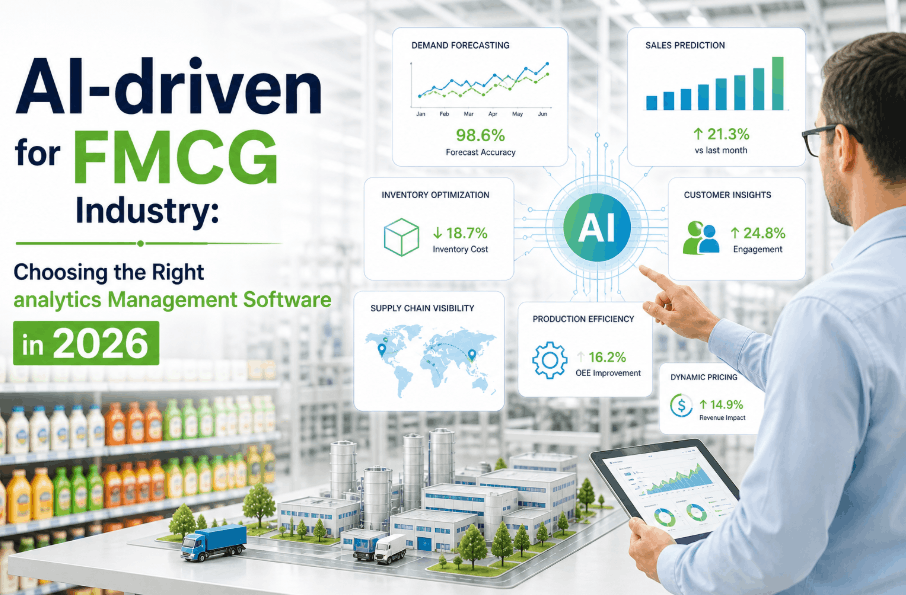
The final layer of the integration stack connects iFactory's AI-generated insights to the business intelligence tools that drive decision-making across your organization. Power BI, Tableau, Qlik, and Looker pull data from iFactory's REST API and OData endpoints, providing real-time dashboards for OEE, production throughput, quality yield, energy consumption, and maintenance KPIs — all grounded in data that flows directly from the shop floor without manual reconciliation. Custom webhook integrations push AI alerts — predicted equipment failures, quality deviations, energy anomalies — directly into Slack, Teams, email, or pager systems. For organizations that operate custom analytics pipelines, iFactory's GraphQL endpoint and Kafka event stream provide flexible access to the full normalized data model. The result is a single source of truth that your planning, operations, maintenance, and finance teams all work from — eliminating the "which number is right?" debate that plagues disconnected manufacturing organizations.
| BI / Analytics Tool | Integration Method | Data Available | Update Frequency |
|---|---|---|---|
| Microsoft Power BI | OData / REST API | OEE, quality, energy, maintenance KPIs | Real-time / Scheduled |
| Tableau | REST API / Web Data Connector | Production, downtime, yield analytics | Real-time / Scheduled |
| Qlik | REST API / Qlik Web Connector | Asset health, predictive scores, RUL | Real-time / Scheduled |
| Looker | REST API / Custom JDBC | Full normalized data model | Real-time |
| Custom Analytics Pipeline | GraphQL / Kafka / Event Hub | All platform data streams | Streaming real-time |
Security, Authentication & Governance
Enterprise-Grade Security Across Every Integration Point
Every iFactory API integration is secured through a multi-layered authentication and authorization framework. OAuth 2.0 with PKCE provides token-based access for REST API and OData connections. TLS 1.3 encryption protects all data in transit. Role-based access control (RBAC) ensures that each connected system and user has precisely scoped permissions aligned with operational responsibilities. Comprehensive audit logging captures every API request, data transformation, and system interaction in an immutable audit trail — supporting SOC 2, FDA 21 CFR Part 11, and FSMA 204 compliance requirements. For OT networks, the iFactory edge appliance operates in an air-gapped deployment model with zero cloud dependencies, connecting to plant-floor systems through read-only protocol channels that enforce security at the transport layer, not just the policy layer. No SCADA configuration or PLC logic is ever modified by the integration layer unless explicitly configured with safety limit validation and manual override.
Integration Deployment: From Assessment to Go-Live
Structured Onboarding That Respects Your Production Schedule
iFactory's integration deployment follows a structured four-phase methodology designed to minimize production disruption while building a complete, validated integration layer. Each phase delivers measurable milestones that build toward the full connected architecture.
Frequently Asked Questions
How does iFactory connect to SAP without custom ABAP development?
iFactory uses SAP's standard OData services and BAPI interfaces — no custom ABAP required for standard integration scenarios. For SAP ECC environments, IDoc and RFC adapters provide equivalent capability. Your Basis team approves transport requests; no developer hours required.
Will iFactory integration disrupt my existing SCADA or PLC operations?
No. iFactory connects to SCADA systems and PLCs via read-only OPC-UA, Modbus TCP, MQTT, or API channels — extracting real-time process data without writing to the control layer. No changes to SCADA configuration, PLC logic, or HMI screens are required. Write-back channels are optional and configured with safety limits and manual override.
Can iFactory integrate with legacy or proprietary systems that don't have modern APIs?
Yes. iFactory deploys lightweight data connectors that read from the system's database layer (with read-only permissions), historian databases, CSV exports, or OPC-DA bridges where OPC-UA is not available. In cases where even these routes are blocked, iFactory can integrate via the MES or SCADA's own reporting module output.
How long does a typical integration deployment take?
Standard connectors for popular systems like SAP, Siemens PLCs, and QuickBooks deploy in 3-10 business days. Custom integrations for legacy or proprietary systems typically take 2-4 weeks. Full multi-system integrations covering ERP, SCADA, MES, and BI average 4-6 weeks to go live.
What security and compliance standards does iFactory's integration platform support?
All data exchanges use TLS 1.3 encryption with OAuth 2.0 authentication, role-based access control, and comprehensive audit logging. The platform complies with SOC 2 standards and supports FDA 21 CFR Part 11 and FSMA 204 requirements. Air-gapped on-prem deployment is available with zero cloud dependencies.
Can iFactory replace our existing MES or does it work alongside it?
Both models are supported. Most customers keep their existing MES and add iFactory as the AI intelligence layer that unifies MES, ERP, and SCADA data. For plants operating without an MES, iFactory alone serves as the execution-layer analytics platform with native MES capabilities — without the 12-month implementation timeline typically required.