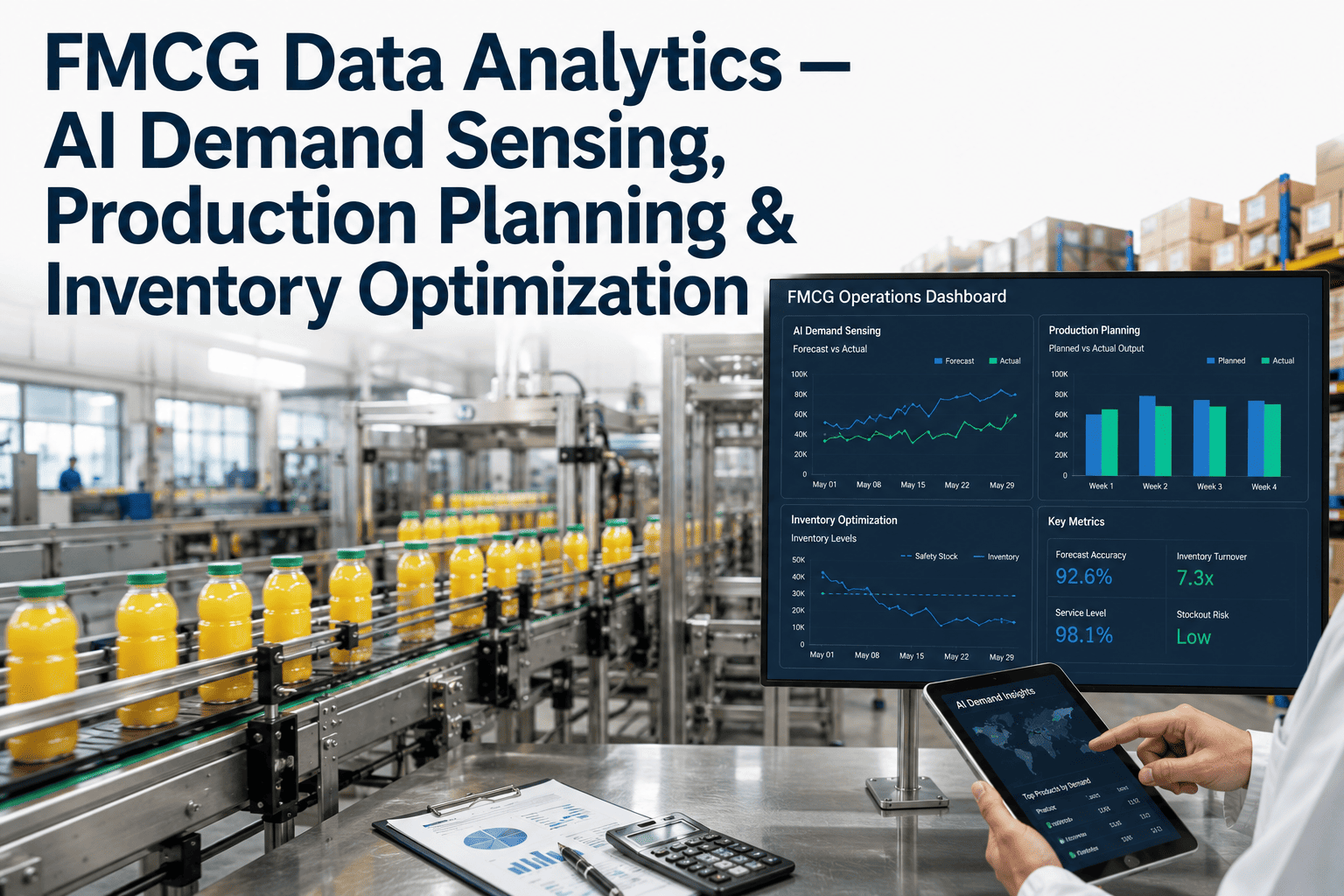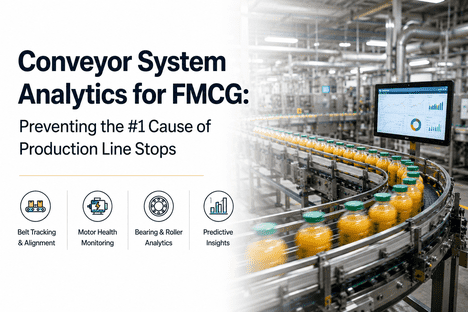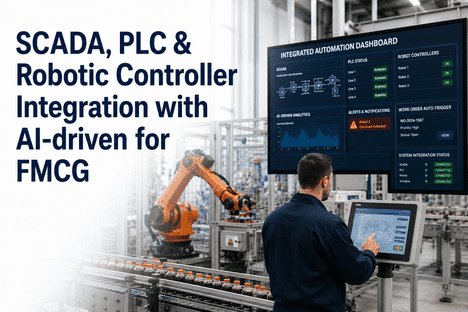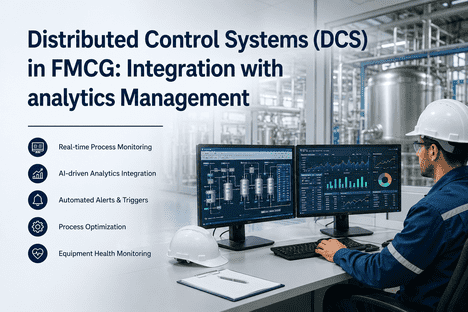
A Distributed Control System (DCS) is the central nervous system of every modern FMCG process plant — managing hundreds of control loops across blending, cooking, fermentation, drying, and packaging operations while collecting thousands of process variables every second from sensors measuring temperature, pressure, flow, level, pH, viscosity, and composition. The DCS ensures that every batch of product meets its specification by maintaining process conditions within tight control limits, but it does something else that is equally valuable: it generates a continuous stream of data that, when properly connected to an analytics platform, can predict equipment failures before they occur, detect quality deviations before they affect the product, and optimize process settings in real time for energy efficiency and throughput. The challenge for most FMCG plants is not data availability it is data connectivity. The DCS operates as a closed system, isolated from the maintenance management platform, the quality system, and the production analytics tools that could turn its data into actionable intelligence. iFactory's DCS Integration and Automated Triggers module bridges this gap, connecting DCS process data directly to maintenance workflows, quality alerts, and analytics dashboards in real time. Book a Demo to see how iFactory connects your FMCG plant's DCS to AI-driven analytics for predictive maintenance, process optimization, and automated quality monitoring.
DCS Architecture in FMCG From Field Sensors to Control Room to Analytics Platform
The DCS in an FMCG process plant is organized in a hierarchical structure that mirrors the plant's physical and functional layout. At the field level, sensors and actuators measure and control process variables temperature elements in cooking vessels, pressure transmitters on steam headers, flow meters on ingredient feed lines, level transmitters in mixing tanks, pH probes in fermentation vessels, and viscosity sensors in homogenization lines. These field devices connect to distributed control nodes — remote terminal units or programmable logic controllers that execute the control logic for their assigned process area. The control nodes communicate over a dedicated control network to the DCS servers, which host the operator interface, the historical database, and the alarm management system. At the top of the hierarchy, the DCS provides supervisory control and data acquisition functions that give operators a plant-wide view of process conditions and enable centralized control of production campaigns.
iFactory's DCS Integration module connects to the DCS at the historian level — the system component that stores time-series process data for trending, analysis, and reporting. The connection uses standard industrial communication protocols — OPC UA, OPC DA, Modbus TCP, or DCS-specific API interfaces to ingest process data into the iFactory analytics platform at sampling intervals that match the dynamics of each process variable. Fast-changing variables such as pressure and flow may be sampled every second, while slower variables such as tank level and batch temperature may be sampled every 10–30 seconds. The ingested data is time-stamped, quality-tagged, and stored in a time-series database that is optimized for the analytical workloads that the iFactory platform executes machine learning model inference, anomaly detection, trend analysis, and automated alert generation. Book a Demo to see the DCS connector configuration for your FMCG plant's control system architecture.
Automated Analytics Triggers Turning DCS Alarms into Maintenance Actions
Every DCS generates alarms thousands of them every day in a typical FMCG process plant. A temperature that exceeds its setpoint by 2°C, a pressure that drifts above the normal operating range, a flow rate that drops below the minimum for the current recipe, a level that reaches the high-high alarm threshold. In most plants, these alarms serve a single purpose: they alert the operator to take corrective action to bring the process variable back within its control limits. The operator adjusts a valve, changes a setpoint, or calls a process engineer to investigate. But the alarm data contains information that the operator cannot act on in the moment — a gradually increasing valve position that signals a control valve that is sticking and will need maintenance within the next two weeks, a recurring temperature deviation that correlates with fouling in a heat exchanger, a pressure drop trend that indicates a filter approaching its change-out threshold.
iFactory's Automated Triggers module captures this high-value alarm data and converts it into automated maintenance triggers work orders that are generated in the CMMS when DCS alarm patterns cross predefined thresholds. The automation logic is configurable for each alarm type, each process area, and each equipment unit: a single temperature excursion above the high-high limit may generate an operator notification only, while a pattern of three temperature excursions above the high limit within a 24-hour period generates a preventive maintenance work order for the heat exchanger cleaning schedule. A pressure drop trend that crosses its threshold in the positive direction for three consecutive hours generates an inspection work order for the filter bank. A control valve position that has increased by more than 15% over a 30-day period generates a diagnostic work order for the valve positioner and actuator. These automated triggers eliminate the dependency on operator intuition to connect process data to maintenance actions the connection is made by the analytics platform, consistently and without fail, every time the trigger condition is met.
Process Control Optimization Using DCS Data to Improve FMCG Production Performance
The DCS maintains process conditions within control limits, but the control limits themselves are often set conservatively — wider than necessary to ensure product quality is maintained even under worst-case conditions. The gap between the actual process capability and the control limit envelope represents an opportunity for throughput improvement, energy reduction, and quality optimization. A cooking process with a temperature control limit of 95±3°C may be capable of consistent operation at 95±1°C, enabling a higher cooking temperature without exceeding the upper limit and reducing cooking time by 8–12%. A drying process with a moisture content control limit of 3.0±0.5% may be capable of consistent operation at 3.0±0.2%, enabling the operator to shift the target moisture content upward to 3.3% without exceeding the upper specification limit, increasing throughput by 4–6% while maintaining product quality.
iFactory's process optimization module analyzes DCS historical data to calculate the actual process capability for every critical control parameter in the FMCG plant not the capability that the process design specifies, but the capability that the plant actually achieves under current operating conditions. The platform compares actual capability against the control limit envelope and identifies parameters where the control limits can be narrowed or the setpoint can be adjusted to improve throughput, reduce energy consumption, or improve quality without increasing the risk of out-of-specification production. These optimization recommendations are generated by the AI Insights engine and presented to the process engineering team with supporting data and projected benefit calculations. FMCG plants using iFactory's process optimization module typically identify 8–15 process parameter optimization opportunities per plant, delivering combined annual benefits of $150,000–$400,000 from throughput improvement, energy reduction, and quality yield improvement. Book a Demo to see how iFactory's process optimization analytics can improve your FMCG plant's production performance without capital investment.
Real-Time Equipment Health Monitoring from DCS Process Variables
Every piece of rotating equipment in an FMCG process plant pumps, agitators, compressors, centrifuges, fans, conveyors — has a measurable relationship between its process conditions and its mechanical health. A centrifugal pump operating at a flow rate near its best efficiency point has different vibration characteristics and bearing loads than the same pump operating at a flow rate near its minimum or maximum. An agitator in a high-viscosity mixing vessel has different motor current draw and shaft deflection than the same agitator in a low-viscosity blend. A compressor running at full load during the summer has different discharge temperature profiles and interstage pressure ratios than the same compressor running at part load during the winter. These relationships mean that DCS process variables — flow rates, pressures, temperatures, motor currents, valve positions — contain information about equipment health that is not captured by vibration sensors or oil analysis programs.
iFactory's equipment health monitoring module applies machine learning models that learn the normal relationship between DCS process variables for each piece of equipment. The models are trained on historical DCS data during periods when the equipment was known to be in good health, establishing a baseline of normal behavior across the full range of operating conditions the equipment experiences. Once deployed, the models continuously compare actual process variable relationships against the learned normal baseline and generate health scores that indicate deviation from expected behavior. A pump whose motor current is 5% above the expected value for its current flow rate and fluid viscosity receives a yellow health score — requiring investigation within the next operating week. A pump whose motor current is 12% above the expected value receives a red health score — requiring immediate inspection and probable bearing replacement. FMCG plants using iFactory's DCS-based equipment health monitoring detect 60–80% of mechanical degradation events 2–6 weeks before they would have been detected by conventional vibration monitoring or until they caused a functional failure. Book a Demo to see how iFactory transforms your DCS process data into continuous equipment health intelligence.
DCS Alarm Management Analytics From Alarm Floods to Actionable Intelligence
Alarm flooding is one of the most persistent operational challenges in FMCG process plants. When a process disturbance occurs — a utility failure, a feedstock quality variation, a control loop malfunction — the cascading effect can generate hundreds of alarms in minutes, overwhelming the operator with information that arrives too fast and too densely to be processed effectively. Studies across process industries consistently show that plants with high alarm rates — more than 10 alarms per hour during normal operation — experience significantly longer operator response times to critical alarms, higher rates of operator error during upset conditions, and increased risk of safety incidents and product quality events. iFactory's DCS Alarm Management Analytics module addresses this challenge by analyzing alarm data to identify the patterns and root causes that drive alarm flooding.
The platform analyzes DCS alarm history to categorize alarms by type, frequency, duration, and correlation with other alarms. Alarm analytics reports identify the top 10 most frequent alarms, the alarms that are most frequently standing (active for extended periods without operator response), the chattering alarms (alarms that cycle on and off repeatedly), and the alarm pairs that consistently occur together — indicating a cause-and-effect relationship where one alarm is a symptom of another. The analytics platform also calculates the alarm rate during normal operation and during upset conditions, providing plant management with objective data to assess the effectiveness of alarm rationalization efforts. FMCG plants that deploy iFactory's Alarm Management Analytics typically reduce their standing alarm count by 40–60% within three months, reduce their peak alarm rate during process upsets by 50–70%, and improve operator response time to critical alarms by 30–50% — all driven by data that was already in the DCS but was not being analyzed systematically. Book a Demo to see the alarm analytics dashboard configured for your FMCG plant's DCS.
DCS Integration Traditional Approach vs iFactory AI-Driven Platform
- DCS process data accessible only through operator workstations and historian client applications — no real-time connection to maintenance management or analytics platforms
- Alarm data reviewed by operators during the shift and documented in shift logs — no systematic analysis of alarm patterns or correlation with maintenance events
- Equipment maintenance scheduled based on calendar intervals or runtime hours — no adjustment based on actual process conditions or DCS-indicated health status
- Process optimization dependent on periodic engineering studies using exported historian data — optimization recommendations months or years apart
- Process data quality validation performed manually — sensor drift and calibration drift detected only during scheduled calibration or after causing quality deviation
- No correlation between DCS process data and maintenance work order history, quality inspection results, or production output data
- Real-time DCS data streaming to iFactory analytics platform via OPC UA, Modbus TCP, or DCS-specific API — plant-wide process visibility from any device, integrated with maintenance and quality data
- Automated alarm analytics with pattern detection, root cause correlation, and trend reporting — alarm reduction recommendations generated quarterly with measurable targets
- Condition-based maintenance triggered by DCS process variable deviations detected by machine learning models — maintenance scheduled exactly when equipment condition requires it
- Continuous process optimization with AI-generated recommendations for setpoint adjustment and control limit narrowing — optimization opportunities identified weekly with projected benefit
- Automated process data quality validation with drift detection algorithms and calibration scheduling integration — sensor health monitored continuously; calibration triggers automated
- Unified analytics dashboard connecting DCS process data with maintenance history, quality results, and production output — enabling root cause analysis across all operational domains
Industry Perspective — What FMCG Process Engineers Say About DCS-Analytics Integration
DCS Analytics Metrics — Measuring the Value of DCS-Data Integration
The value of connecting DCS data to an analytics platform is measurable across multiple dimensions of plant performance. iFactory's DCS Integration module captures and reports the metrics that demonstrate the return on DCS analytics investment, from maintenance cost reduction to process optimization benefits. The table below maps the key DCS analytics metrics to their data sources and the business outcomes they drive.
| DCS Analytics Metric | Data Source | Business Outcome | Traditional Baseline | iFactory Target |
|---|---|---|---|---|
| Automated trigger conversion rate | DCS alarm patterns to CMMS work order conversion | Reduced maintenance delay from process-indicated degradation | 0% (all triggers manual via operator action) | > 90% of threshold-crossing patterns trigger automated work orders |
| Equipment health detection lead time | DCS variable deviation analysis by ML models | Earlier detection of degradation before functional failure | Detection at failure or 0–7 days via vibration monitoring | 14–42 days advance detection via DCS variable analysis |
| Alarm rate during normal operation | DCS alarm historian | Reduced operator cognitive load and improved response to critical alarms | > 15 alarms per hour (typical FMCG baseline) | < 6 alarms per hour (EEMUA target) |
| Process optimization opportunity identification rate | DCS historical data analysis | Continuous improvement in throughput, energy, and quality yield | 2–4 opportunities per year (via periodic engineering studies) | 8–15 opportunities per year (via continuous analytics) |
| Process data quality validation coverage | DCS sensor drift and calibration analysis | Reduced quality deviations from undetected sensor drift | < 20% of field sensors have drift monitoring | > 90% of critical process sensors monitored for drift |
| Cross-domain analytics correlation | DCS process data + CMMS + Quality + Production data | Root cause analysis across process, maintenance, and quality domains | Manual correlation requiring 4–8 hours per investigation | Automated correlation generated in real time by analytics platform |
Frequently Asked Questions: DCS Integration with Analytics Management in FMCG
No. iFactory's DCS Integration module connects to the DCS at the historian or data server level using standard read-only communication protocols — OPC UA, OPC DA, Modbus TCP, or DCS-specific API interfaces. The connection is non-intrusive and does not require any changes to the DCS configuration, control logic, alarm settings, or operator interface. The platform reads process data from the DCS historian or real-time data server and does not write any data back to the DCS. This architecture ensures that the DCS continues to operate exactly as it did before the integration, with no risk of the analytics platform affecting process control or safety functions. For plants with cybersecurity requirements, the iFactory connection can be configured through a data diode or firewall that ensures unidirectional data flow from the DCS to the analytics platform. Book a Demo to review the DCS connection architecture for your plant's specific control system and cybersecurity requirements.
iFactory supports integration with all major DCS platforms used in FMCG manufacturing, including ABB Ability System 800xA, Emerson DeltaV, Honeywell Experion PKS, Siemens Simatic PCS 7 and PCS neo, Yokogawa CENTUM VP, Schneider Electric Foxboro and EcoStruxure, Rockwell PlantPAx, and Mitsubishi MELIPC. The platform also supports integration with OPC UA and OPC DA servers, enabling connection to any DCS or PLC system that supports these standard industrial communication protocols. For DCS platforms without native OPC or API support, iFactory provides a historian data export integration that ingests CSV or Parquet format data files on a scheduled basis.
Yes. iFactory's analytics platform is designed for industrial-scale time-series data ingestion and processing. The platform ingests up to 100,000 data points per second from DCS historians, with configurable sampling rates per process variable type to optimize the balance between data resolution and storage utilization. The time-series database is engineered for high-compression storage of industrial process data, with typical compression ratios of 10:1 to 20:1 compared to raw historian storage. Machine learning models for equipment health monitoring and anomaly detection are designed to process streaming DCS data with sub-second inference latency, enabling real-time alerting when process variable deviations cross configured thresholds. The platform architecture supports horizontal scaling for plants requiring higher data ingestion rates or longer historical data retention periods.
The investment for iFactory's DCS Integration and Automated Triggers module ranges from $40,000 to $90,000 per plant depending on the number of DCS tags integrated, the complexity of automated trigger logic, the number of machine learning models deployed, and integration requirements with existing CMMS and quality systems. Most FMCG plants achieve full cost recovery within 6–10 months through three primary value drivers: maintenance cost reduction of 15–25% from DCS-detected equipment degradation that enables condition-based maintenance instead of calendar-based maintenance or failure-driven repair (typically $80,000–$250,000 per year), process optimization benefits of 3–8% throughput improvement or 5–12% energy reduction from setpoint optimization recommendations (typically $100,000–$300,000 per year), and quality cost reduction from earlier detection of process deviations that could affect product quality (typically $50,000–$150,000 per year). Plants with existing DCS historians report that the platform typically begins generating actionable insights within the first 30 days of operation, as the initial batch of machine learning models complete training on historical DCS data and begin detecting deviation patterns. Book a Demo for a DCS analytics ROI assessment tailored to your FMCG plant's process configuration and performance targets.
Conclusion: Your DCS Is the Most Valuable Data Source You Are Not Using for Analytics
The DCS in an FMCG process plant is the single richest source of operational data in the facility — more data points per second than the CMMS, the quality system, and the production reporting system combined. Every temperature measurement, every pressure reading, every flow rate, every valve position, every motor current contains information about the health of the equipment, the efficiency of the process, and the quality of the product. In most FMCG plants, this data is used for real-time process control and then discarded into the historian database where it accumulates without being analyzed for the patterns that could predict failures, optimize performance, and reduce costs. The gap between the data that the DCS collects and the decisions that could improve plant performance is not a technology gap — it is a connectivity gap.
iFactory's DCS Integration and Automated Triggers module closes this gap by connecting the DCS directly to AI-driven analytics that transform process data into automated maintenance triggers, real-time equipment health monitoring, alarm management intelligence, and continuous process optimization. For FMCG plant engineering, maintenance, and operations leaders who are ready to extract the full value from their DCS data investment, iFactory's DCS integration engineering team is available for a no-obligation demonstration. Book a demonstration with iFactory's DCS integration and process analytics team to review your current DCS data architecture and build a deployment roadmap for the platform.