HVAC analytics for FMCG: Optimizing Climate Control in Production Environments
By Seren on June 8, 2026
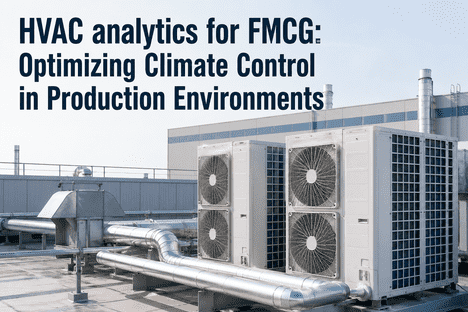
In fast-moving consumer goods (FMCG) manufacturing — including food processing, beverage production, dairy, confectionery, bakery, snacks, and packaged goods — heating, ventilation, and air conditioning (HVAC) systems are not simply comfort utilities; they are critical production assets that directly control product quality, shelf life, food safety compliance, and energy costs. HVAC systems in FMCG plants typically consume 30–40% of total facility energy, making them the single largest energy load in climate-controlled production environments. A temperature excursion of just 2–3°C in a chilled food processing area can accelerate microbial growth, shorten product shelf life by days, and trigger HACCP non-compliance events that require batch quarantines costing $50,000–$200,000 per incident. Humidity drift above 60% RH in dry goods packaging areas causes caking, clumping, and moisture pickup that renders product unfit for sale. Traditional fixed-interval HVAC preventive maintenance — filter changes every 90 days, coil cleaning twice per year, belt replacements on calendar schedule — cannot address the variable loads imposed by seasonal ambient conditions, production heat gain fluctuations, cleanroom pressurization demands, and refrigeration circuit degradation that drive actual HVAC system performance. iFactory's HVAC analytics platform fuses IoT temperature and humidity sensors, duct static pressure transducers, chiller and AHU vibration monitors, compressor current draw telemetry, refrigerant loop pressure sensors, and energy submeters into machine learning models that forecast HVAC equipment degradation, filter loading, coil fouling, refrigerant charge loss, and energy efficiency drift 2–3 weeks in advance, enabling FMCG maintenance teams to intervene before product quality or compliance is at risk. Book a Demo to see how iFactory connects your FMCG plant HVAC systems to predictive analytics intelligence.
HVAC Analytics · FMCG Manufacturing 2026
AI-Powered HVAC Analytics for Climate-Controlled FMCG Production
Temperature and humidity monitoring · Chiller and AHU predictive maintenance · Energy optimization · Cleanroom HVAC compliance · All flowing into iFactory CMMS & PM Scheduling.
Why Calendar-Based HVAC Maintenance Fails in FMCG Production Environments
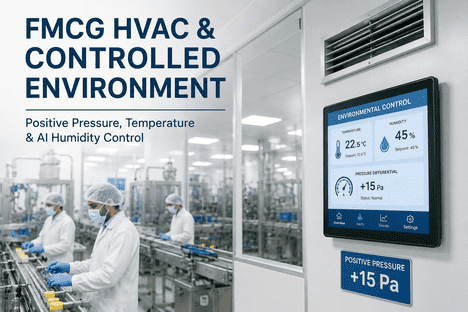
FMCG production facilities operate under dynamic thermal loads that fixed-interval HVAC maintenance schedules cannot accommodate. A bakery's proofing ovens, fryers, and ovens can add 200–400 kW of sensible heat gain during peak production, overwhelming air handling units that were sized for average rather than peak conditions. Cold storage and chilled production areas must maintain 2–8°C for dairy and meat processing, where a 2°C rise for more than 15 minutes can trigger regulatory hold events under FSMA and HACCP protocols. Dry goods packaging areas require 35–50% RH control to prevent moisture absorption in powders, cereals, and confectionery products — humidity spikes during monsoon seasons or summer afternoons can shut down packaging lines for hours. Cleanrooms for aseptic filling and pharmaceutical-grade FMCG production must maintain ISO Class 7 or Class 8 conditions with 20+ air changes per hour and positive pressurization of 12–15 Pa, where any HVAC fault risks sterile corridor contamination and million-dollar batch losses. Fixed-interval maintenance replaces filters on a 90-day calendar rather than when differential pressure exceeds 1.5 in. w.g., cleans coils on a semi-annual schedule rather than when approach temperature rises 3°C above baseline, and replaces belts on elapsed time rather than when vibration velocity exceeds 4.5 mm/s. iFactory's condition-based HVAC analytics platform replaces the static calendar with dynamic, sensor-driven intelligence that adapts to each FMCG plant's unique thermal profile, production schedule, and ambient environment.
COST OF REACTIVE HVAC MANAGEMENT IN FMCG PLANTS
1
Product quality and shelf life risk — uncontrolled temperature and humidity excursions accelerate microbial growth, moisture migration, and texture degradation, shortening product shelf life by 20–40% and increasing customer return rates
2
Regulatory compliance exposure — HACCP, FSMA, and FDA 21 CFR Part 117 require documented temperature control and corrective action records; unmonitored excursions during off-shifts or weekends can result in batch quarantine, recall costs, and regulatory fines
3
Energy waste from degraded HVAC performance — fouled coils increase compressor head pressure by 15–25%, raising chiller kW/ton by 20–35%; clogged filters force fans to consume 30–50% more energy to maintain airflow; a 10–15% HVAC energy reduction in a typical FMCG plant saves $80,000–$150,000 annually
4
Unplanned production downtime — chiller compressor failure, AHU motor burnout, or refrigerant loss can shut down temperature-sensitive production lines for 8–48 hours, costing $20,000–$100,000 per hour in lost throughput and perishable raw material spoilage
Four HVAC Failure Categories iFactory Predicts for FMCG Plants
01
Air Handling Unit and Rooftop Unit Degradation Prediction
AHUs and RTUs are the workhorses of FMCG plant HVAC, responsible for delivering conditioned air to production, packaging, and storage areas. Filter loading increases static pressure and reduces airflow; coil fouling from dust, grease, and process contaminants degrades heat transfer efficiency; fan belt wear and bearing degradation introduce vibration that accelerates motor failure; and drain pan blockages create standing water that becomes a microbiological contamination source for food plants. Each unplanned AHU failure in a temperature-sensitive production zone can idle a packaging line for $30,000–$80,000 per hour in lost output. iFactory ingests differential pressure transmitter data, supply and return air temperatures, fan vibration velocity, motor current draw, and mixed air plenum conditions to train ML models that predict filter change requirements, coil cleaning windows, fan bearing failure, and motor winding degradation 2–3 weeks in advance. FMCG plants running iFactory's AHU analytics report 25–35% fewer unplanned HVAC-related production stoppages. Book a Demo to see iFactory's HVAC analytics models in production FMCG environments.
2-3 week lead timeFilter load prediction25-35% fewer stoppages
02
Chiller, Compressor and Refrigeration Circuit Health Monitoring
Chillers provide chilled water for process cooling, cold storage, and AHU cooling coils in FMCG plants — their compressors, condensers, and refrigerant circuits are the most capital-intensive HVAC assets on site. Refrigerant charge loss, compressor valve wear, condenser fouling, and oil degradation progressively reduce cooling capacity and increase energy consumption by 20–35% before the system fails. A mid-size FMCG plant with 500–1,000 TR of installed chiller capacity can lose $50,000–$120,000 per year in excess energy from degraded chiller performance alone. iFactory monitors compressor discharge and suction pressure, condenser and evaporator approach temperatures, refrigerant subcooling and superheat, compressor motor current signature, and condenser fan vibration. ML models trained on historical chiller performance data predict compressor valve failure, refrigerant charge leakage, condenser cleaning requirements, and oil change intervals 2–4 weeks before performance degradation affects production area temperatures.
Cleanroom and Controlled Environment HVAC Compliance Monitoring
FMCG plants producing aseptic, pharmaceutical-grade, or high-care products must maintain ISO Class 7 or Class 8 cleanroom conditions with strict temperature (±2°C), humidity (±5% RH), pressurization (12–15 Pa positive), and air change rate (20+ ACH) tolerances. HEPA filter differential pressure, room pressurization stability, and supply airflow consistency are critical to sterile zone integrity. Any HVAC fault that compromises these parameters requires immediate corrective action and documented deviation reporting under regulatory frameworks. iFactory's cleanroom HVAC module monitors HEPA filter DP trends, room-to-room pressure differentials, supply and exhaust airflow balance, temperature and humidity at multiple zone points, and particle counts where sensor-integrated. Predictive models forecast HEPA filter loading timelines, fan filter unit (FFU) motor degradation, and pressurization drift 2–3 weeks in advance, enabling maintenance teams to schedule filter changes and component replacements during planned sanitation or changeover windows rather than during production.
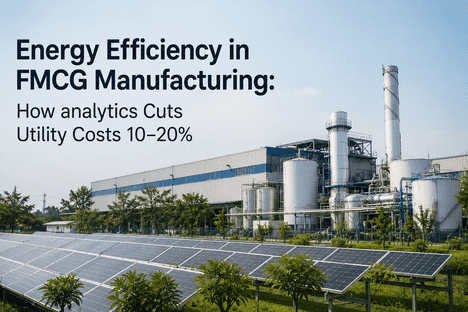
With HVAC consuming 30–40% of total FMCG plant energy, even modest efficiency improvements deliver significant operational cost savings. Chiller kW/ton drift, cooling tower approach temperature degradation, AHU fan efficiency loss, and economizer damper malfunction all contribute to excess energy consumption that goes undetected without continuous analytics. iFactory's energy monitoring module tracks HVAC energy intensity metrics — kW/ton for chillers, kW/CFM for fans, kW/gpm for pumps — and compares real-time performance against baseline models adjusted for ambient conditions and production load. The platform identifies degradation trends 2–3 weeks before they reach threshold levels, enabling proactive condenser tube cleaning, chiller refrigerant optimization, fan speed control tuning, and economizer maintenance that together can reduce HVAC energy consumption by 10–15%. For a mid-size FMCG plant with $500,000–$1,000,000 in annual HVAC energy spend, this translates to $50,000–$150,000 in direct annual savings.
kW/ton trending10-15% energy saving$50K-$150K annual savings
How iFactory Transforms FMCG Plant HVAC Data Into Predictive Intelligence
iFactory is the AI software intelligence layer — not a sensor manufacturer or hardware vendor. The platform integrates with existing FMCG plant HVAC telemetry from BAS and BMS systems (Siemens, Johnson Controls, Honeywell, Schneider, Distech), PLCs, SCADA, chiller plant controllers, cleanroom monitoring systems, IoT temperature and humidity data loggers, energy submeters, refrigerant leak detectors, and ERP (SAP, Oracle) already deployed in your production environment. The Shift Logbook captures operator shift reports, daily inspection findings, filter change records, coil cleaning logs, and maintenance notes alongside the real-time sensor stream, creating a unified data fabric for predictive model training and plant-wide HVAC reliability and energy analytics.
HVAC Asset Class
Telemetry Sources
iFactory Prediction Output
Business Impact
AHUs & RTUs
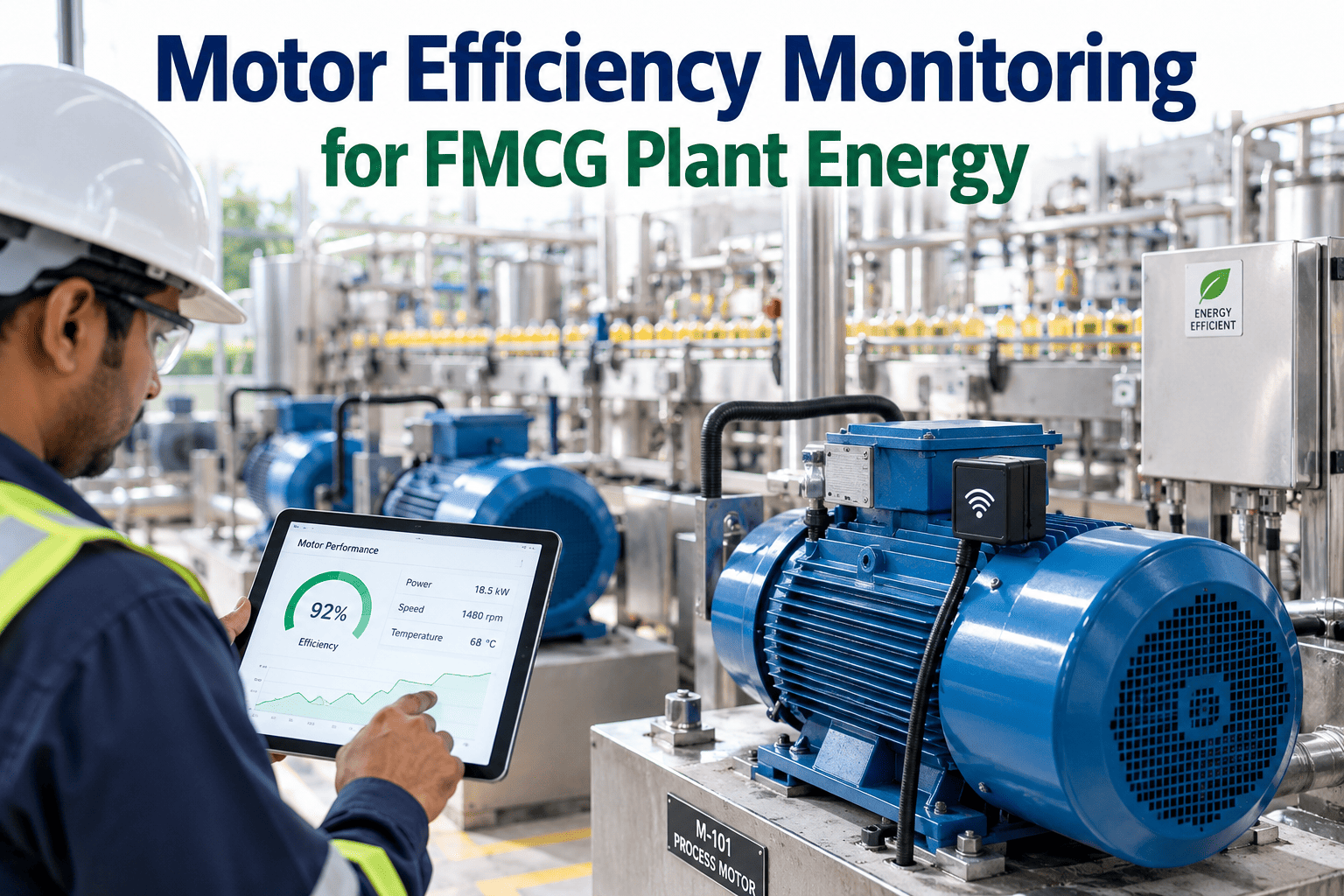
DP · temperature · vibration · motor current · fan speed
Filter load · coil fouling · fan bearing failure forecast
30-50% fewer AHU-related stoppages
Chillers & Condensers
Pressure · temperature · current · vibration · flow
HVAC Predictive Maintenance Use Cases for FMCG Production
Temperature-Controlled Production
AHU and Zone Temperature Control Monitoring
Continuous
AHUs serving temperature-sensitive production zones — chilled food processing, dairy packaging, bakery cooling tunnels — must maintain tight temperature tolerances (±1–2°C) to ensure product quality and regulatory compliance. iFactory monitors supply air temperature, return air temperature, mixed air plenum conditions, cooling coil valve position, and zone temperature at multiple points. ML models trained on historical zone response data predict temperature drift events, coil valve sticking, and mixed air damper malfunctions 2–3 weeks before they cause product temperature excursions. Every prediction event is logged in iFactory's Shift Logbook with full traceability to the sensor data that triggered the alert, supporting HACCP documentation requirements.
Refrigerated storage and freezer areas for raw materials, work-in-progress, and finished FMCG products must maintain 2–8°C (chilled) or -18 to -25°C (frozen) without interruption. Refrigeration compressor failure, evaporator coil frosting, condenser fan malfunction, or refrigerant charge loss can cause temperature alarms within minutes. iFactory detects early-stage refrigeration degradation through compressor suction and discharge pressure trends, evaporator superheat, condenser subcooling, compressor motor current signature, and cold room temperature rate-of-change patterns. Alerts route directly to the maintenance shift in the Shift Logbook with asset location, severity score, and recommended intervention timeline.
Cleanroom HVAC and HEPA Filter Performance Analytics
Continuous
High-care and aseptic FMCG production areas require ISO Class 7 or Class 8 cleanroom conditions with continuous monitoring of HEPA filter differential pressure, room pressurization, temperature, humidity, and air change rates. HEPA filter loading gradually increases DP until airflow drops below the minimum required for cleanroom classification. iFactory applies regression models to HEPA filter DP trends that predict the date when DP will exceed the 2x initial resistance threshold — typically 3–4 weeks in advance — enabling filter replacement during planned sanitation windows. The Shift Logbook captures room classification test results, filter change records, and pressure decay test data alongside the real-time monitoring stream for comprehensive compliance documentation.
kW/ton · filter load · coil fouling · demand control
90%+
HACCP temperature compliance confidence
Continuous monitoring · automated documentation
FAQ
iFactory is the AI software intelligence layer — not a sensor manufacturer or hardware vendor. The platform integrates with existing BMS and BAS platforms (Siemens, Johnson Controls, Honeywell, Schneider, Distech), IoT temperature and humidity data loggers, vibration sensors, differential pressure transmitters, current transducers, energy submeters, refrigerant leak detectors, PLCs, SCADA, and ERP (SAP, Oracle) already deployed in your FMCG plant. Your facility selects the sensor and telemetry hardware; iFactory turns the data into predictive intelligence, maintenance alerts, energy optimization insights, and compliance-ready documentation.
Model tuning typically requires 6–12 months of operation on a specific FMCG plant HVAC fleet to eliminate false positives from variable ambient conditions and production load fluctuations, tune threshold parameters for AHU filter loading and chiller performance monitoring, and build maintenance team confidence. The platform's continuous learning loop improves prediction precision over time as more operating data and maintenance event data accumulate across different HVAC asset types and seasonal conditions. iFactory recommends starting with one HVAC system type and one failure mode — such as AHU filter loading prediction or chiller compressor health monitoring — proving value before expanding to the full HVAC fleet.
Yes. iFactory connects to SAP, Oracle, JDE, Microsoft Dynamics, and major CMMS platforms. The Shift Logbook captures operator defect reports, shift handover notes, filter change and coil cleaning records, and maintenance actions alongside sensor-generated predictions. Every prediction event, sensor reading, and maintenance action is recorded with full traceability for audit, HACCP compliance, and continuous model improvement — enabling your team to move from reactive HVAC repairs to data-driven reliability and energy optimization.
Deploy iFactory for FMCG HVAC Analytics and Climate Control Optimization
AI-powered HVAC analytics platform connecting AHUs, chillers, cleanroom systems, and energy submeters into one unified intelligence layer — with ML-based failure prediction, temperature and humidity compliance monitoring, energy optimization, Shift Logbook integration, CMMS workflow automation, and plant-wide HVAC reliability analytics for FMCG production environments.