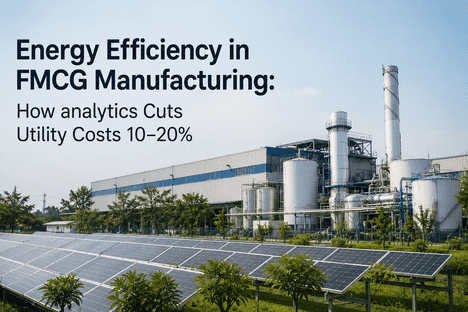
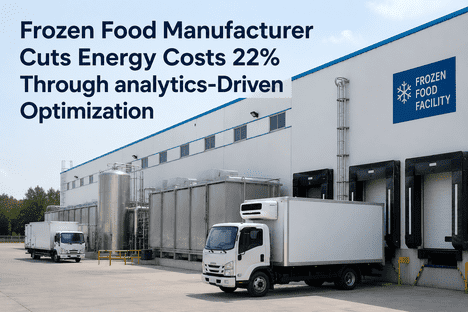
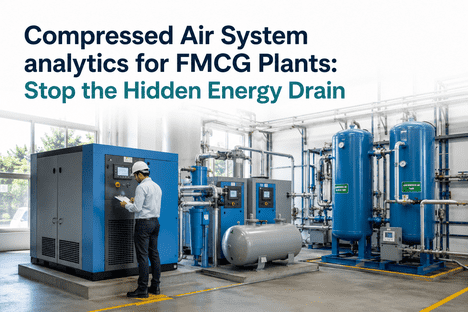
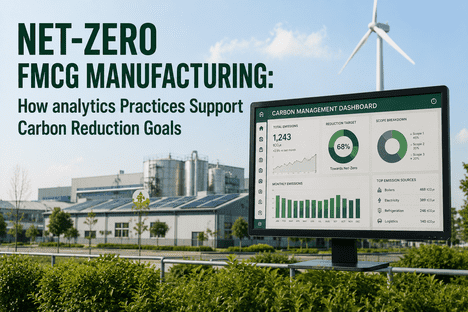
Energy Efficiency in FMCG Manufacturing: How analytics Cuts Utility Costs 10-20%
By Seren on June 15, 2026
Utility costs in FMCG manufacturing are the second-largest operating expense after raw materials — yet most plants manage energy the way they managed maintenance a decade ago: reactively. The HVAC runs at fixed setpoints regardless of production load. The compressed air system leaks 20 to 35 percent of its output. The steam traps fail and nobody knows until the fuel bill arrives. The refrigeration system cycles at full capacity because the control logic was programmed for peak summer load and never adjusted for winter operation. Each of these gaps is small enough to escape notice in a single month's utility bill, but together they represent 10 to 20 percent of total energy spend — margin that flows directly to the bottom line in an industry where a 1 percent cost reduction can swing a quarter's profitability. This guide shows FMCG plant managers how analytics-driven energy monitoring cuts utility costs 10 to 20 percent through continuous tracking of HVAC, compressed air, steam, and refrigeration systems — and how iFactory's Energy & Sustainability Tracking platform turns energy data into cost reduction decisions.
HVAC Analytics · Compressed Air Leak Detection · Steam Trap Monitoring · Refrigeration Optimisation · Energy Benchmarking
FMCG Plants Leave 10-20% of Their Utility Budget on the Floor. Analytics Finds It — and Cuts It Permanently.
iFactory's Energy & Sustainability Tracking platform connects to existing utility meters, sensors, and control systems — providing live energy consumption analytics, automated anomaly detection, and sustainability reporting that turns energy data into cost savings.
Utility cost reduction achievable when FMCG plants deploy analytics-driven energy monitoring across HVAC, compressed air, steam, and refrigeration systems
20-35%
Compressed air leakage that goes undetected without continuous flow monitoring — representing the single largest quick-win energy saving opportunity in most FMCG plants
15-25%
HVAC energy savings when analytics-driven scheduling and zone-level optimisation replace fixed setpoint operation based on production schedules
6-9 mo
Typical payback period for analytics-driven energy monitoring deployment in FMCG manufacturing — driven by avoided utility costs alone
The Four Utility Pockets Where FMCG Plants Lose 10-20% of Energy Spend
Energy waste in FMCG manufacturing is rarely a single catastrophic leak. It is the accumulated inefficiency of four utility systems operating outside their optimal efficiency band — each one losing a percentage point or two of total energy spend, unnoticed because the monthly utility bill only shows the aggregate. Analytics-driven energy monitoring disaggregates the utility bill into system-level consumption, making each waste pocket visible and actionable.
1
HVAC Systems — 15-25% of Total Plant Energy
Most FMCG plants operate HVAC at fixed temperature and humidity setpoints 24/7 regardless of production status. Analytics-driven scheduling matches HVAC operation to actual production zones, occupancy patterns, and seasonal ambient conditions. iFactory's energy monitoring platform tracks HVAC energy consumption by air handling unit, compares it against zone-level production activity, and flags over-cooling or over-ventilating zones in real time.
2
Compressed Air — 10-15% of Total Plant Energy
Compressed air is the most expensive utility in FMCG manufacturing, yet 20-35 percent of it leaks through failed connections, worn seals, and unmaintained fittings. Analytics-driven monitoring tracks flow rate, pressure, and compressor power consumption continuously — detecting leaks as deviations from the baseline consumption-to-production ratio and pinpointing their location through pressure decay analysis.
3
Steam Systems — 8-12% of Total Plant Energy
Failed steam traps, uninsulated piping, and condensate recovery bypasses are invisible to monthly energy audits. Analytics-driven monitoring tracks steam flow, temperature drop across distribution, and condensate return rate — flagging steam trap failures within hours of occurrence and quantifying the energy loss in BTUs and dollars per day.
4
Refrigeration — 10-18% of Total Plant Energy
Refrigeration systems sized for peak summer load run inefficiently for the other nine months of the year. Analytics-driven monitoring tracks compressor cycling frequency, evaporator and condenser temperatures, and refrigeration load against ambient conditions — identifying oversizing, refrigerant charge loss, and control logic inefficiencies that drive excess energy consumption.
How Analytics-Driven Energy Monitoring Cuts Utility Costs: The Four Detection Engines
iFactory's Energy & Sustainability Tracking platform runs four parallel detection engines — each designed to identify a specific class of energy waste that manual auditing and monthly bill analysis systematically miss. Together they provide continuous energy intelligence that drives 10 to 20 percent utility cost reduction without capital-intensive equipment upgrades.
Engine 01
Consumption-to-Production Ratio Anomaly Detection
Flags when energy consumption deviates from the production-normalised baseline
The most powerful energy waste detection method is not a sensor — it is the ratio of energy consumed to product produced. When a plant produces 100 tonnes of product and consumes 500 kWh of electricity, the consumption-to-production ratio is 5 kWh per tonne. When the same plant produces 100 tonnes next week and consumes 580 kWh, something changed — and the analytics engine flags the deviation automatically. The platform tracks this ratio for each utility system — HVAC kWh per production hour, compressed air kWh per tonne, steam BTUs per tonne, refrigeration kWh per tonne — and establishes a rolling baseline with upper and lower control limits. When any ratio breaches the control limit, the system generates an alert with the deviation magnitude and the estimated cost impact. This detection method catches energy waste that no sensor-based alarm can detect because it measures system-level efficiency rather than component-level status.
System-level efficiency tracking
Production-normalised baselines
Automated cost impact calculation
Engine 02
Equipment Scheduling vs. Production Activity Matching
Identifies when HVAC, compressors, and refrigeration run during unoccupied or idle production periods
The second detection engine cross-references equipment runtime against production schedules and zone occupancy data. When an air handling unit serves a production zone that has been idle for three hours but the AHU continues running at full cooling capacity, the system flags the mismatch. When the compressed air system maintains full system pressure during a planned maintenance shutdown, the system logs the idle energy consumption. This detection engine is particularly effective in plants where production schedules change frequently — packaging lines start and stop for changeovers, cleaning cycles require partial area isolation, and seasonal production shifts alter the thermal load. The analytics platform learns the production schedule from the MES or manual shift inputs and continuously compares actual equipment runtime against expected runtime based on the production activity in each zone and the ambient conditions.
Production schedule cross-reference
Zone-level activity matching
Idle runtime cost quantification
Engine 03
Thermal and Pneumatic System Health Monitoring
Detects steam trap failures, compressed air leaks, and insulation degradation from existing sensor data
Steam traps fail gradually — a trap that is blowing live steam for 60 percent of its cycle consumes 30 to 50 percent more energy than a healthy trap, but the failure is invisible to manual inspection until the trap is physically tested. Similarly, a compressed air leak that wastes 15 cfm at 100 psi costs approximately $1,200 per year in electricity — but it makes no noise, produces no visible indicator, and escapes detection until a quarterly walk-through survey catches it. The thermal and pneumatic health engine detects these failures from existing sensor data: steam trap failure is inferred from the temperature profile downstream of the trap compared against steam pressure and condensate return flow; compressed air leaks are detected as baseline flow increases during idle periods when no production equipment is consuming air; insulation degradation is flagged when surface temperature readings diverge from the expected gradient for the steam temperature and ambient conditions.
Inferred steam trap failure detection
Idle-period leak quantification
Insulation degradation alerts
Engine 04
ESG and Sustainability Reporting Automation
Converts energy data into compliance-ready carbon, water, and waste reports without manual compilation
Energy efficiency improvements produce sustainability data as a by-product — every kWh saved is a kg of CO₂ avoided — but most FMCG plants lack the infrastructure to convert operational energy data into compliance-ready ESG reports. The fourth detection engine is not a detection method but a data transformation layer. It takes the metered energy consumption data — electricity, natural gas, steam, water — and applies emission factors, conversion constants, and reporting frameworks to generate monthly, quarterly, and annual sustainability reports aligned with GHG Protocol Scope 1, 2, and 3 requirements, ISO 50001 energy management standards, and regulatory filing formats. The reporting layer eliminates the manual data collection and spreadsheet compilation that consumes 10 to 20 hours per month for sustainability reporting — while ensuring that every efficiency improvement is reflected in the carbon reduction metrics that investors, regulators, and customers increasingly demand.
GHG Protocol Scope 1, 2, 3
ISO 50001 energy management
Automated compliance-ready output
What the Energy Management Dashboard Shows the Plant Manager
The energy management dashboard is designed around the five metrics that determine whether an energy efficiency programme is delivering results: total energy cost year-to-date with monthly trend and budget variance, consumption-to-production ratio by utility system with control limit alerts, anomaly count and severity by detection engine, avoided cost counter from implemented corrective actions, and sustainability metrics with carbon reduction trajectory.
Energy View 01
Total Energy Cost — Live Utility Spend Dashboard
Total energy cost displayed with monthly trend, budget variance, and forecast at current consumption rate. Costs are disaggregated by utility type — electricity, natural gas, steam, water — and by production area. Plant managers see exactly where energy spend is tracking above or below budget, with drill-down to the specific utility system and time period driving the variance.
Plant manager action: Review utility cost breakdown weekly — identify the system with the highest variance and initiate targeted investigation.
Energy View 02
Consumption-to-Production Ratio Trend With Anomaly Log
The consumption-to-production ratio trended daily, weekly, and monthly for each utility system with automated upper and lower control limits. Each anomaly — a day when the ratio exceeded the control limit — is logged with the deviation magnitude, the estimated cost impact, and the root cause if already identified. Plant managers see not only the current ratio but also the trend direction, enabling early detection of efficiency degradation before it becomes a budget overrun.
Plant manager action: Investigate each anomaly within 48 hours — assign root cause analysis to the responsible utility system owner.
Energy View 03
Anomaly Detection Feed — Open and Closed Alerts by Engine
A live feed of all open and recently closed energy anomalies, categorised by the detection engine that identified them and the utility system affected. Each anomaly shows the estimated annualised cost impact at current operating conditions, the time since detection, and the current status — open, assigned under investigation, corrective action in progress, closed with verified saving. The feed is filterable by utility system, detection engine, severity, and time period.
Plant manager action: Review open anomalies daily — ensure corrective actions are assigned and progressing for high-cost items.
Energy View 04
Avoided Cost Counter — Verified Savings From Corrective Actions
A running counter of total energy cost avoided through corrective actions implemented in response to analytics-detected anomalies. Each corrective action — compressed air leak repair, steam trap replacement, HVAC schedule adjustment, refrigeration control logic change — is logged with the pre-intervention and post-intervention consumption-to-production ratio, the calculated annualised saving, and the actual saving verified through 30 days of post-intervention data.
Plant manager action: Present avoided cost counter at monthly management reviews to demonstrate programme ROI and justify expansion.
Energy View 05
Carbon Reduction Tracker — Scope 1, 2, and 3 Trajectory
Carbon emissions calculated from energy consumption data using verified emission factors, displayed as monthly emissions by scope with trajectory trend and projection to end of year. Every energy efficiency improvement that reduces consumption is automatically reflected in the carbon metrics — the plant manager has a single source of truth for both operational cost reduction and sustainability reporting.
Plant manager action: Include carbon reduction trajectory in quarterly ESG reports — data is audit-ready without manual compilation.
Energy View 06
ISO 50001 Energy Management System — Compliance Dashboard
A compliance dashboard showing energy review completion status, energy baseline and EnPI trending, energy performance indicator status by utility system, and corrective action closure rates aligned with ISO 50001 Clause 9.1 and 10.1 requirements. The dashboard generates the evidence trail required for ISO 50001 certification and surveillance audits — energy planning, energy baselines, EnPIs, operational controls, and management review records — all derived from the same energy data that drives cost reduction.
Plant manager action: Use compliance dashboard as the single evidence source for ISO 50001 audit preparation — no additional documentation needed.
"
We had been running energy efficiency projects for three years before deploying analytics-driven monitoring. We installed VFDs on our fans, upgraded our chiller plant, and replaced half our compressed air dryers. Each project had a solid payback on paper. But we never knew whether the savings were actually materialising because we were comparing monthly utility bills against production volume — and the noise in the data was too high to isolate the impact of any single project. iFactory's energy monitoring platform changed that. The consumption-to-production ratio for each utility system showed us exactly where we were saving and where we were not. We discovered that the VFDs on the packaging hall AHUs had been bypassed six months earlier during a controls upgrade and nobody had re-enabled them. The chiller plant upgrade was saving 18 percent, but the compressed air analytics showed we had three leaks totalling 45 cfm that had been there for at least two years. The monthly cost of those three leaks alone was $4,600. We repaired them in one afternoon. In the first year, we reduced total utility cost by 14.2 percent — and half of the savings came from anomalies we had never detected with our manual energy audit process.
— Plant Engineer, Tier 1 FMCG Beverage Manufacturing Plant — 4 Production Lines, 2 Filling Halls, 700,000 sq ft
The Monthly Utility Bill Only Tells You How Much You Spent. Analytics Tells You Where Every Dollar Went — and Which Ones You Can Get Back.
iFactory's Energy & Sustainability Tracking platform for FMCG plant managers — live energy analytics with automated anomaly detection, consumption-to-production ratio tracking, thermal and pneumatic system health monitoring, and compliance-ready ESG reporting — all from the data your utility systems already generate.
Utility costs are the second-largest operating expense in FMCG manufacturing, yet most plants manage energy with tools that were designed for a different era — monthly bill comparison against production volume, periodic energy audits that capture a snapshot of conditions on a single day, and reactive maintenance that fixes steam traps and compressed air leaks only after the efficiency loss has accumulated for months.
Analytics-driven energy monitoring replaces these periodic, aggregated, reactive methods with continuous, system-level, predictive energy intelligence. The consumption-to-production ratio detects efficiency degradation before it appears on the utility bill. The equipment scheduling engine stops HVAC and compressed air systems from running during idle production hours. The thermal and pneumatic health monitors detect steam trap failures and compressed air leaks within hours of occurrence rather than months. And the ESG reporting layer converts every kWh saved into compliance-ready carbon metrics without manual data compilation.
The documented outcomes from FMCG plants that have deployed analytics-driven energy monitoring are clear: 10 to 20 percent utility cost reduction without capital-intensive equipment upgrades, 20 to 35 percent reduction in compressed air energy through systematic leak detection and repair, 15 to 25 percent HVAC energy savings through schedule and zone optimisation, and a 6 to 9 month payback period driven by avoided utility costs alone.
iFactory's Energy & Sustainability Tracking platform is designed for FMCG plant managers who need to reduce utility costs without capital expenditure on equipment replacement. Book a Demo to see the energy monitoring platform configured with your plant's utility data, or talk to an expert about a free energy efficiency opportunity assessment for your FMCG manufacturing operation.
Frequently Asked Questions
Individual submeters tell you how much energy a specific system consumed — they do not tell you whether that consumption was appropriate for the level of production activity. The consumption-to-production ratio solves this by normalising energy consumption against a production metric — tonnes produced, cases packed, machine hours run. When the ratio increases, it means the same level of production is consuming more energy, regardless of whether a submeter shows normal consumption. This detection method catches energy waste that no submeter alarm can trigger: an HVAC system that runs at full capacity while the production zone operates at 50 percent occupancy; a compressed air system that maintains full pressure during a shift when only one of three packaging lines is running; a refrigeration system that cycles more frequently than necessary because the condenser coils are fouled. The ratio approach also eliminates the noise of production volume changes — if production drops by 20 percent and energy consumption drops by 10 percent, the 10 percent gap is captured as a ratio anomaly even though both individual numbers decreased. Book a Demo to see the consumption-to-production ratio dashboard configured for your plant's utility systems.
iFactory's platform connects to existing utility metering infrastructure — utility-grade electricity meters, gas meters, steam flow meters, compressed air flow meters, and water meters — through standard protocols including Modbus, BACnet, MQTT, and OPC-UA. Most FMCG plants already have submetering at the main distribution level and often at the production area level. The platform can ingest data from these existing meters without additional hardware. For plants that have limited submetering, iFactory can recommend a minimal sensor deployment — typically flow meters on the main compressed air header, temperature sensors on steam distribution, and power meters on the largest HVAC and refrigeration equipment — to capture the 80 percent of energy consumption that drives the 20 percent of utility cost. The platform's value does not depend on having a meter on every asset; the consumption-to-production ratio detection engine works effectively with area-level metering, and the anomaly detection algorithms become more precise as additional submetering is added over time. Talk to an expert about a meter gap assessment for your plant's current infrastructure.
The platform uses a statistical process control approach for anomaly detection. For each consumption-to-production ratio, the system establishes a rolling baseline with upper and lower control limits calculated from the standard deviation of recent historical data — typically 30 to 60 days. An anomaly is triggered only when the ratio exceeds the upper control limit by a configurable margin — typically 1.5 to 2.5 sigma — meaning the deviation is statistically significant, not a random fluctuation. The system also incorporates contextual factors: outside air temperature, day of week, shift pattern, and known production events from the MES or manual schedule. For example, a higher HVAC consumption on a day when ambient temperature is 15°F higher than the baseline period is classified as expected variation, not an anomaly. The same consumption increase on a day with normal ambient temperature is flagged for investigation. The plant manager can configure the sensitivity per utility system — tighter limits for compressed air where leaks develop quickly, wider limits for steam where seasonal demand varies more. Book a Demo to see anomaly detection configured for each utility system with live data.
Yes. The platform converts metered energy consumption into compliance-ready ESG reports aligned with the GHG Protocol Corporate Standard for Scope 1 (direct emissions from natural gas, fleet fuel), Scope 2 (purchased electricity, steam), and Scope 3 (upstream fuel and energy-related activities). Emission factors are sourced from the EPA, IEA, and national regulatory databases and are updated automatically when published factors change. The platform generates monthly, quarterly, and annual reports in PDF and Excel formats with the data structure and calculations that auditors expect. For plants operating under ISO 50001, the platform generates the energy baseline, energy performance indicator trends, energy review records, and management review evidence required for certification and surveillance audits. The reporting module eliminates the 10 to 20 hours per month that sustainability managers spend compiling data from utility bills, meter readings, and spreadsheets — replacing manual compilation with automated data flow from the same meters that drive operational cost reduction. Talk to an expert about configuring ESG report templates for your regulatory jurisdiction and reporting framework.
A typical deployment takes three to six weeks from kickoff to live dashboard. The timeline depends on the number of utility meters to connect and the availability of data protocols. The iFactory team works with your plant's facilities and controls engineers to connect to existing meters through standard protocols; most plants have 80 percent of their metering infrastructure accessible within two to three weeks. The consumption-to-production baselines are established automatically as data accumulates — the system starts generating meaningful anomaly detection within two weeks of data collection. Most plants identify their first actionable energy waste anomaly within the first month of deployment. The avoided cost savings accumulate from the first corrective action implemented, and the typical payback period for the platform — driven by avoided utility costs alone — is six to nine months. Book a Demo to see a deployment timeline and savings projection based on your plant's utility spend.
The Monthly Utility Bill Tells You How Much You Spent. Analytics Tells You Where to Get 10-20% of It Back. Get a Free Energy Efficiency Opportunity Assessment.
iFactory's Energy & Sustainability Tracking platform for FMCG plant managers — live consumption-to-production ratio tracking, HVAC and compressed air anomaly detection, steam trap and refrigeration health monitoring, automated ESG reporting, and ISO 50001 compliance documentation — all from the meters your plant already has.