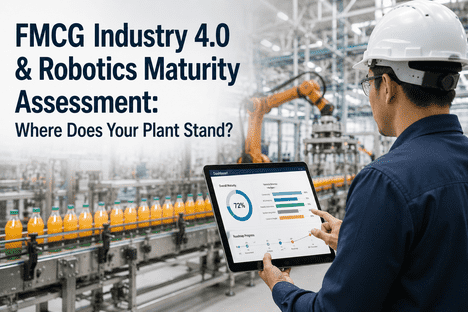
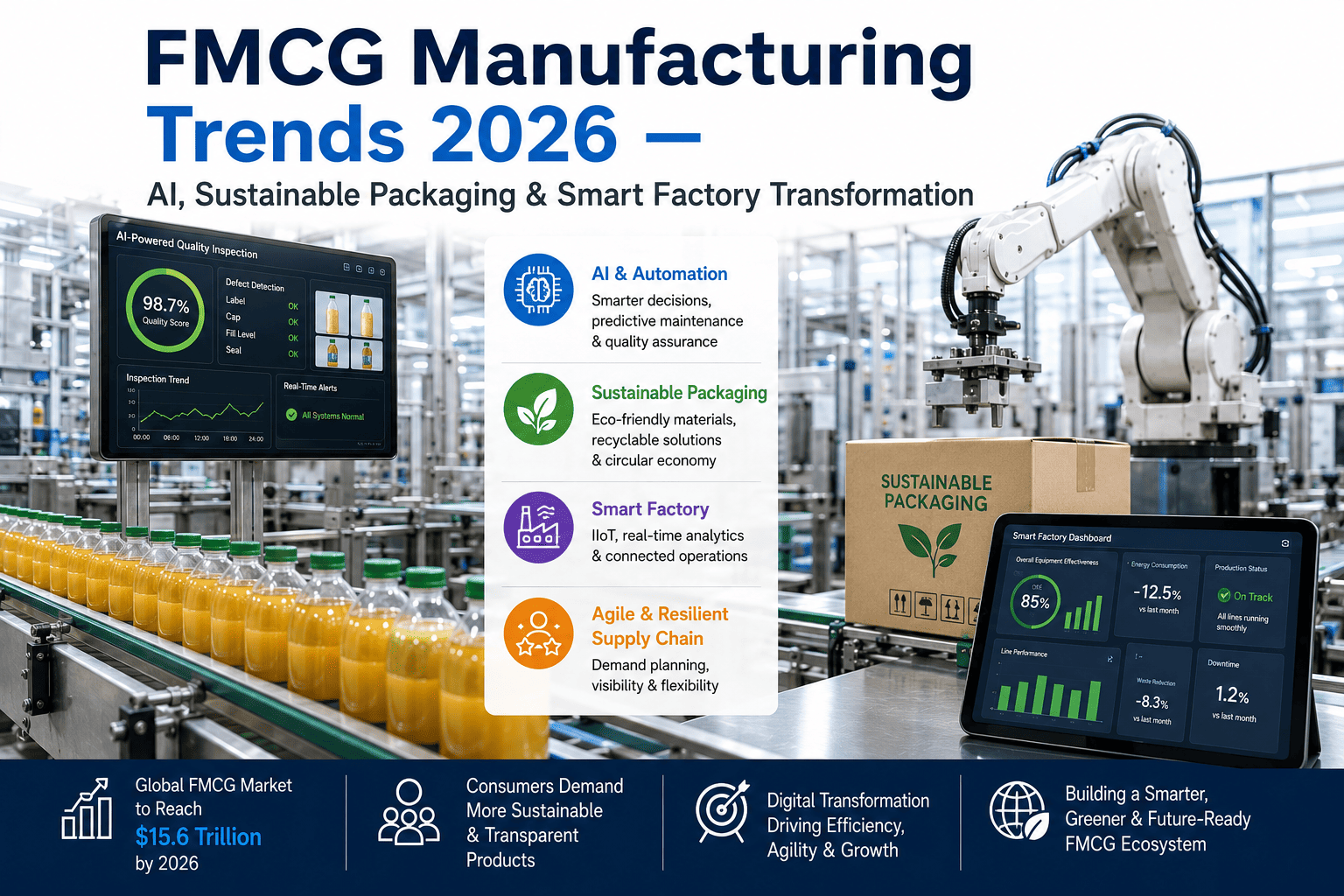
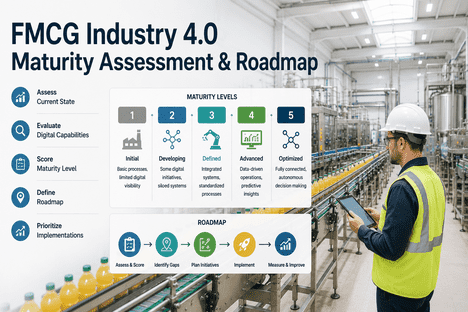
Industry 4.0 maturity in FMCG manufacturing is not a binary state — it is a spectrum that spans five interconnected dimensions: connectivity infrastructure, AI and analytics capability, robotic automation adoption, system integration depth, and workforce digital culture. Most FMCG plants operate at different maturity levels across these dimensions — advanced in connectivity but early in AI analytics, or strong in robotic automation but limited in system integration. The gap between where a plant stands today and where it needs to be for competitive operation in 2028 is precisely measurable, and the path from one level to the next is not the same for every plant. A structured maturity assessment provides the baseline every digital roadmap requires: a clear, dimension-by-dimension picture of current capability, target state, and the specific investments needed to close the gap.
Industry 4.0 · Robotics Maturity · Digital Roadmap · FMCG Assessment
Most FMCG Plants Are Industry 4.0 in One Dimension and Industry 2.0 in Another. An Honest Assessment Is the First Step Toward a Coherent Digital Roadmap.
iFactory's Assessment Tools and Digital Roadmap give FMCG manufacturers a structured maturity framework across connectivity, AI analytics, robotics, integration, and culture — with a prioritised investment plan to advance from current state to target state without wasted spend.
62%
of FMCG manufacturers rate their Industry 4.0 maturity as Level 2 or below across at least three of the five dimensions assessed
4.3×
More likely to achieve digital transformation ROI targets when a structured maturity assessment precedes the technology investment
5
Maturity dimensions that define Industry 4.0 readiness: connectivity, AI analytics, robotics, integration, and workforce culture
12–18
Months needed to advance one full maturity level across all five dimensions with a structured, prioritised digital roadmap
The Five Dimensions of Industry 4.0 Maturity in FMCG
A comprehensive maturity assessment evaluates each dimension independently because progress in one area does not imply progress in another. An FMCG plant with world-class robotic palletising and packaging automation may still operate at Level 1 in AI analytics — collecting production data through manual logbooks and analysing it in spreadsheets. Another plant with advanced AI-driven quality control may have limited system integration, with the AI platform operating as a standalone island that does not feed its insights back into the MES or CMMS. The assessment framework surfaces these asymmetries and identifies which dimension is the binding constraint on the plant's overall digital capability.
iFactory's maturity assessment tool walks plant leadership through each dimension with a structured scoring rubric, producing a radar chart that visualises the plant's capability profile across all five dimensions. The assessment is designed to be completed by a cross-functional team — plant manager, maintenance manager, IT lead, production manager, and quality manager — because each dimension requires a different expertise to evaluate accurately. The output is a prioritised gap analysis that identifies which dimension, if advanced to the next level, would deliver the greatest operational and financial impact for the plant.
Five Dimensions of FMCG Industry 4.0 Maturity — What Each Level Looks Like
Dimension
Level 1 — Initial
Level 3 — Integrated
Level 5 — Autonomous
Connectivity
Limited sensor coverage. Manual data logging from operators. No real-time production visibility. OEE calculated weekly from manual entry.
80%+ machine connectivity. Real-time OEE and production data across all lines. Historian stores process data with 1-minute granularity.
100% sensor coverage with edge analytics. Autonomous data validation and gap filling. Digital twin synchronised in real time.
AI Analytics
Descriptive dashboards only. No predictive models. Root cause analysis performed manually by quality and maintenance engineers.
Predictive models live for OEE, quality, and maintenance. AI copilot assists with root cause analysis. Scrap forecasts generated daily.
Autonomous analytics: AI models self-train, self-calibrate, and generate prescriptive recommendations. Copilot handles 85%+ of routine analytics queries.
Robotic Automation
Fixed automation only (conveyors, wrappers). No robotic cells. Palletising manual or semi-automated. No AMR deployment.
Robotic palletising and packaging cells deployed. AMR fleet for material transport. Robots integrated with MES for recipe-based task assignment.
Autonomous mobile robots with AI navigation. Humanoid assistant pilots on changeover and inspection. Fleet orchestration managed by AI.
System Integration
Standalone systems: separate CMMS, MES, ERP with no real-time data exchange. Manual data transfer via spreadsheets.
Real-time integration between CMMS, MES, and ERP. Quality data feeds into maintenance and production systems automatically.
Full digital thread from sensor to ERP with bidirectional data flow. AI layer integrates across all operational systems.
Workforce Culture
Limited digital literacy among operators. Analytics viewed as specialist function. Resistance to AI-generated recommendations.
Operators and supervisors actively use AI copilot. Analytics literacy training embedded in role progression. Data-driven decisions at line level.
Human-AI collaboration is standard operating practice. Continuous learning culture. Plant-wide digital competency at all levels.
Maturity Assessment · Gap Analysis · Prioritised Roadmap
You Cannot Build a Digital Roadmap Without Knowing Where You Stand. iFactory's Structured Maturity Assessment Gives You the Baseline, the Target, and the Prioritised Path Between Them.
iFactory's Assessment Tools evaluate your FMCG plant across connectivity, AI analytics, robotic automation, system integration, and workforce culture — producing a radar-chart profile, gap analysis, and prioritised investment roadmap calibrated to your plant's operational context and financial targets.
Building Your FMCG Digital Roadmap from Assessment Results
The maturity assessment output is not a scorecard — it is a planning instrument. The radar chart showing current capability across five dimensions reveals the plant's binding constraint: the dimension that limits overall digital performance. For some FMCG plants, the binding constraint is connectivity — they cannot deploy AI analytics because they lack the real-time data infrastructure to feed the models. For others, the binding constraint is workforce culture — the technology is available but operators and supervisors do not trust or use AI-generated insights. The binding constraint is the priority for investment, not the dimension where the plant scores lowest. A plant at Level 1 in connectivity and Level 3 in workforce culture should invest in connectivity first, even though robotics may have more visible impact. Without connectivity, no higher-dimension capability can operate effectively.
iFactory's Digital Roadmap module translates the assessment output into a phased investment plan with 12-month, 24-month, and 36-month horizons. Each phase includes specific technology deployments, capability building, workforce training, and integration milestones — linked to the operational and financial outcomes they are expected to deliver. The roadmap is not a generic template. It is calibrated to the plant's current maturity profile, production volume, product complexity, and financial capacity. Plants that follow a structured roadmap from assessment to deployment are 4.3 times more likely to achieve their digital transformation ROI targets than those that invest in Industry 4.0 technologies without a maturity baseline.
Phase 1 — Foundation (Months 1-12)
Connectivity, Data Infrastructure, and Analytics Baseline
Deploy sensor connectivity on priority lines. Establish real-time OEE and production monitoring. Implement CMMS and MES integration. Initiate analytics literacy training for line managers and supervisors. Deliverable: live production dashboard with 80%+ machine connectivity and baseline OEE visibility across all priority lines.
Foundation phase completes within 12 months regardless of starting maturity level.
Phase 2 — Acceleration (Months 13-24)
AI Analytics, Robotic Automation, and System Integration
Deploy generative AI analytics copilot across all production and quality dashboards. Implement predictive quality and maintenance models. Integrate robotic cells and AMR fleet with MES. Extend real-time integration between CMMS, MES, and ERP. Deliverable: AI copilot live across all plant analytics surfaces, robotic automation integrated with production scheduling.
Acceleration phase targets Level 3 maturity across all five dimensions.
Phase 3 — Optimisation (Months 25-36)
Autonomous Operations and Advanced Robotics
Deploy autonomous AI models that self-train and self-calibrate. Pilot humanoid assistant robots on changeover and inspection tasks. Implement full digital thread with bidirectional data flow. Scale analytics competency to all operator and technician roles. Deliverable: Level 4–5 maturity on priority dimensions with documented ROI on each investment phase.
Optimisation phase delivers autonomous operations capability on select production lines.
Continuous Improvement
Annual Maturity Re-Assessment and Roadmap Update
Re-assess maturity annually to track progress, identify new binding constraints, and update the investment roadmap. Each assessment cycle compares current scores against the baseline and target trajectory, adjusting the roadmap to reflect technology advancements, operational changes, and evolving business priorities.
Annual re-assessment ensures the roadmap stays relevant as technology and operations evolve.
"
We had invested heavily in robotic packaging cells and a modern MES, so our leadership team assumed we were well advanced on Industry 4.0. The maturity assessment revealed something different: we were Level 4 in robotic automation but Level 1 in AI analytics and Level 2 in system integration. Our robots were running efficiently, but we had no predictive quality models and the MES data was not feeding into our maintenance or planning systems. The assessment gave us a roadmap that prioritised closing the analytics and integration gaps before adding more robots. Eighteen months later, our OEE had improved by 14% — not from the robotics, which were already good, but from the AI analytics that showed us why our best-performing lines were inconsistent and the system integration that turned that insight into action.
— Digital Transformation Director, Major FMCG Food Manufacturer, 5 Plants, Annual Revenue £1.2B
Robotics Maturity: A Specialised Assessment Dimension
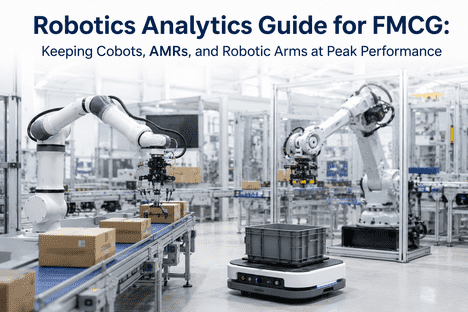
Robotic automation in FMCG spans a wider capability spectrum than most plant leadership teams recognise. At Level 1, robotic automation means fixed-purpose automation cells — palletising robots, case packers, wrappers — that operate on fixed programmes and require engineering support for every recipe change. At Level 3, robots are integrated with the MES and receive recipe-based task assignments automatically. Changeover instructions are pushed to the robot controller when the production schedule changes. Robot performance data — cycle time, downtime, pick accuracy — feeds into the OEE model in real time. At Level 5, autonomous mobile robots navigate the plant floor dynamically, coordinating with each other and with human operators through a central fleet management system that AI optimises continuously.
The robotics maturity assessment evaluates not just the presence of robots but the depth of their integration with the plant's operational systems. A plant with ten robotic cells operating in isolation scores lower on this dimension than a plant with four robotic cells that are fully integrated with the MES, CMMS, and production scheduling systems. iFactory's Robotics AI module supports this integration layer — connecting robot controllers, AMR fleet managers, and humanoid assistant platforms to the plant's analytics and operations pipeline through a standardised data model that works across robot brands and types.
Robotics Maturity Levels in FMCG — From Fixed Automation to Autonomous Fleet Orchestration
Maturity Level
Characteristics
Level 1 — Fixed Automation
Dedicated automation cells with fixed programmes. Manual changeover support required. No robot performance data collection. No integration with production scheduling or MES.
Level 2 — Connected Robotics
Robots connected to plant network. Basic performance data collected (cycle time, downtime). Manual recipe downloads from production schedule.
Level 3 — Integrated Robotics
Robots integrated with MES for automatic recipe-based task assignment. Robot performance data feeds into OEE in real time. AMR fleet deployed for material transport with central fleet management.
Level 4 — Intelligent Robotics
AI-optimised robot task scheduling and routing. Predictive maintenance on robot components. Robot performance analytics drive continuous improvement. Human-robot collaboration enabled on select tasks.
Level 5 — Autonomous Fleet
Full fleet orchestration with AI optimising all robot assignments and routing in real time. Humanoid assistants operating alongside humans on changeover, inspection, and maintenance tasks. Robots self-diagnose and request maintenance autonomously.
Starting Your Assessment
A structured maturity assessment does not require weeks of consultant-led workshops. iFactory's assessment framework is designed to be completed by a cross-functional plant team in a single facilitated session, with the assessment tool guiding each dimension's evaluation through a standardised scoring rubric. The session produces the radar-chart profile, the binding constraint analysis, and a prioritised 12-month action plan — all within a half-day commitment from the plant leadership team.
The assessment is available as a facilitated workshop delivered by iFactory's digital transformation team, or as a self-guided evaluation that the plant team completes independently with the online assessment tool. Both options produce the same output format: a radar chart showing current maturity across all five dimensions, a gap analysis identifying the binding constraint, and a prioritised digital roadmap with phased investment recommendations. The self-guided option is designed for plants that want to establish their baseline independently before engaging with the iFactory team on specific investment priorities. The facilitated workshop is recommended for plants that want the assessment to serve as a leadership alignment exercise as well as a planning tool.
SELF-GUIDED
Online Assessment Tool
Complete at your own pace with the online assessment platform. Each dimension includes a detailed rubric with descriptive anchors at each maturity level. The tool generates a radar chart and gap analysis automatically upon completion. Recommended for plants that want to establish a baseline before engaging with the iFactory team.
FACILITATED
Half-Day Workshop
Facilitated by iFactory's digital transformation team with the plant's cross-functional leadership. Includes the full assessment, binding constraint analysis, and prioritised 12-month action plan. Recommended for plants that want the assessment to build leadership alignment and commitment to the digital roadmap.
Frequently Asked Questions
Where Does Your FMCG Plant Stand? One Half-Day Assessment Gives You the Radar Profile, the Binding Constraint, and the Prioritised Roadmap to Your Target State.
iFactory's Industry 4.0 and Robotics Maturity Assessment — five dimensions evaluated against a structured rubric, a radar-chart baseline, binding constraint analysis, and a prioritised digital roadmap with phased investment recommendations. Self-guided online or facilitated half-day workshop.