The FMCG plant manager's problem is not a shortage of data. It is a shortage of usable data from the right places at the right time. Temperature, vibration, and humidity sensors are plentiful on new packaging lines, but the motor bearings on a 20-year-old flow wrapper have no instrumented connection to the control system. The overhead ammonia condenser on the roof cycles unmonitored until a pressure spike triggers an alarm. The hard-to-reach conveyor drives inside the freezer tunnel are never measured at all. IoT sensors and autonomous mobile robots (AMRs) equipped with sensor arrays close these gaps — deploying wireless vibration and temperature nodes on legacy assets, and sending AMRs on autonomous patrol routes to capture thermal, acoustic, and vibration data from equipment that cannot justify permanent sensors. This implementation guide covers the specific IoT sensor technologies suited to FMCG production environments — IP69K-rated wireless vibration sensors for washdown zones, hygienic temperature probes for process lines, and differential pressure transmitters for HEPA filter monitoring — along with the deployment architecture, data integration strategy, and robotics payload design that turn raw sensor streams into actionable reliability intelligence through iFactory's IoT Integration and Real-Time Monitoring platform. Book a Demo to see how iFactory connects IoT sensor data and robotic inspection feeds into a single real-time monitoring dashboard for your FMCG plant.
A complete implementation guide for deploying wireless IoT sensors and AMR-mounted robotic inspection payloads in food, beverage, and consumer goods production environments — covering sensor selection, network architecture, data integration, and robotic patrol design.
IoT Sensor Types for FMCG Production Environments
FMCG production facilities present a uniquely challenging environment for IoT sensing. Washdown zones with IP69K spray exposure, temperature extremes from -25°C freezers to 200°C ovens, and high-humidity packaging areas require sensor hardware rated for food-grade sanitation, chemical resistance, and thermal cycling. The following sensor types have proven reliable in deployed FMCG IoT programmes.
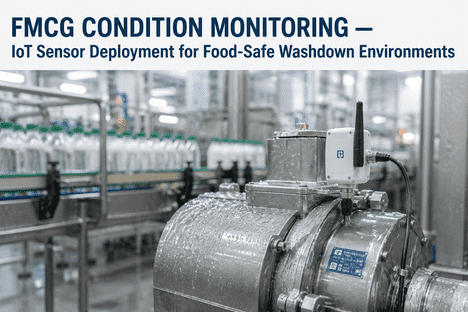
Wireless tri-axial vibration sensors with magnetic or epoxy mounting are the highest-value single sensor type for FMCG rotating equipment. IP69K-rated units from Banner Engineering, ifm, and SICK operate reliably in washdown zones. Sampling rates of 6.4–12.8 kHz capture bearing, imbalance, and misalignment frequencies on motors, pumps, fans, and gearboxes up to 3,600 RPM. Battery life of 3–5 years at 15-minute transmission intervals eliminates cable routing in retrofit applications. iFactory's IoT Integration layer ingests vibration spectra, trend envelopes, and crest factor data for ML-based bearing failure prediction.
Hygienic RTD probes with 3-A or EHEDG certification measure product temperature in process piping, holding tubes, and storage vessels. Wireless variants with integrated LoRaWAN or Bluetooth 5.0 transmitters eliminate wiring in retrofit installations on kettles, cookers, heat exchangers, and cooling tunnels. Measurement accuracy of ±0.1°C at 2–8°C chilled ranges supports HACCP compliance monitoring. iFactory's Real-Time Monitoring dashboard displays zone-level temperature trends with configurable upper and lower control limits mapped to product safety specifications.
Capacitive relative humidity sensors with sintered stainless steel filters measure process air and environmental conditions in packaging halls, dry goods storage, and cleanrooms. Wireless models with 0–100% RH range and ±1.5% accuracy detect the humidity excursions above 60% RH that cause caking in powder filling operations and corrosion in electrical enclosures. Dew point variants monitor compressed air systems for moisture breakthrough that contaminates pneumatic controls and packaging machines. Sensors report to iFactory at 5-minute intervals with automatic alerting when RH exceeds product-specific thresholds.
Differential pressure transmitters with 0–250 Pa and 0–500 Pa ranges monitor HEPA filter loading in cleanrooms, air handling units, and sterile process zones. Wireless LoRaWAN models with IP65 enclosures mount directly to filter housings and transmit DP readings at configurable intervals. iFactory's platform tracks DP rise curves, predicts filter replacement dates 2–3 weeks before the 2x initial resistance threshold, and logs compliance data for GMP and FDA 21 CFR Part 11 audit documentation. Typical payback of under six months from reduced filter inspection labour and extended filter life.
Wireless airborne ultrasonic sensors in the 20–100 kHz range detect compressed air leaks, steam trap blow-through, and bearing lubrication starvation in noisy FMCG plant environments where vibration sensors cannot differentiate machine noise from fault signatures. Battery-powered units with directional horns mount at strategic points along compressed air distribution lines and steam condensate return networks. iFactory integrates ultrasonic RMS and peak-hold data to calculate leak flow rates in CFM, estimate annual energy cost of identified leaks, and prioritise repair work orders by savings potential.
Fixed and AMR-mounted thermal cameras with 160x120 to 640x480 pixel resolution detect surface temperature anomalies in electrical panels, motor terminal boxes, bearing housings, and steam system insulation. AI vision cameras with on-device inference identify packaging defects, fill level deviations, and label misregistration at line speed without sending raw video streams to the cloud. iFactory's platform receives processed inference results — temperature delta values, defect counts, and classification labels — over MQTT, enabling real-time alerting and trend analysis without the bandwidth cost of continuous video transmission.
AMR-Mounted Sensor Arrays for Hard-to-Reach Equipment
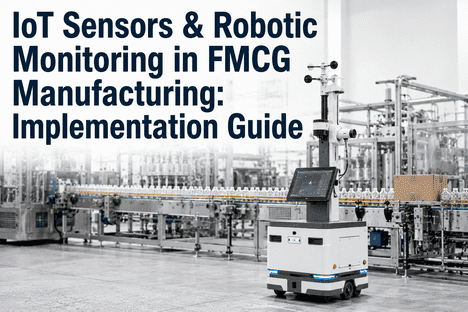
Autonomous Mobile Robots (AMRs) carrying multi-sensor payloads extend IoT coverage to equipment that cannot justify permanent wired or wireless sensors — roof-top HVAC units, overhead conveyors, freezer tunnel drives, elevated water tanks, and remote utility buildings. A single AMR on a programmed patrol route can inspect 80–120 measurement points per shift, capturing vibration spectra, thermal images, ultrasonic readings, and ambient conditions at each stop. The iFactory platform receives AMR patrol data via API, correlates readings against baseline signatures per measurement point, and trends condition changes across consecutive patrol cycles.
The standard AMR inspection payload combines a tri-axial vibration sensor with magnetic probe (for bearing measurements), a radiometric thermal camera (160x120 or 320x240), an airborne ultrasonic microphone (20–100 kHz), and a 360° LiDAR for autonomous navigation. The vibration probe deploys via a linear actuator to contact pre-installed measurement pads at each stop. Total payload cost including mounting bracket, embedded compute module, and API communication link is $8,000–$14,000 per AMR, depending on sensor specification and thermal camera resolution.
Patrol routes are programmed via waypoint-based navigation in the AMR fleet manager, with measurement stops every 8–15 metres along the route. At each stop the AMR halts for 15–30 seconds while the payload captures a vibration spectrum, thermal image, and ultrasonic reading. A 90-minute patrol route covering 800 linear metres of production line can inspect 60–90 motor-pump-bearing sets with zero operator labour. Routes run on programmable intervals — typically one patrol per 8-hour shift for high-criticality areas, daily for medium-criticality, and weekly for low-criticality zones.
Six-Phase IoT Deployment Roadmap for FMCG Plants
Deploying IoT sensors and robotic monitoring across an FMCG plant follows a structured six-phase sequence that minimises production disruption while building momentum through early results. Each phase produces a defined deliverable that validates the business case for the next phase.
Wireless IoT Network Topology for FMCG Facilities
The choice of wireless protocol determines sensor battery life, data transmission frequency, and network coverage across the facility. FMCG plants with metal walls, insulated panels, and high-interference electrical environments require careful network topology planning.
| Protocol | Range | Battery Life | Data Rate | Best For |
|---|---|---|---|---|
| LoRaWAN | 2–15 km | 3–7 years | 0.3–50 kbps | Temperature, humidity, DP sensors with infrequent transmission |
| Bluetooth 5.0/5.2 | 10–200 m | 1–3 years | 125 kbps–2 Mbps | Vibration sensors, acoustic emission sensors, high-frequency data |
| Wi-Fi 6 | 30–100 m | 6–18 months | Up to 9.6 Gbps | Vision cameras, high-bandwidth sensors, AMR communication |
| 5G Private Network | 200–500 m per node | N/A (powered) | Up to 10 Gbps | AMR fleet management, real-time video analytics, edge inferencing |
Connecting IoT Sensor Data to iFactory's Real-Time Monitoring Platform
Raw IoT sensor data delivers no value until it is contextualised with asset metadata, correlated with production data, and routed to the right decision-makers. iFactory's IoT Integration layer ingests sensor data from any wireless protocol, normalises it into a common asset-tagged time-series schema, and feeds it into the Real-Time Monitoring dashboard, predictive maintenance ML models, and automated work order generation engine.
Industry Perspective on IoT and Robotic Monitoring in FMCG
Deployment Example: AMR Patrol on a Beverage Filling Line
A major European beverage bottler deployed an AMR with a vibration-thermal-ultrasonic payload on a 400-ppm PET line running 20 hours per day, six days per week. The line had 47 motor-pump-bearing sets distributed across 220 metres of conveyor, filler, capper, labeller, and palletiser sections. Previously, only 12 of 47 bearing sets had permanent vibration sensors; the remaining 35 were inspected manually on a monthly route requiring 4 technician-hours per inspection.
The AMR patrol route covered all 47 measurement points in 55 minutes per cycle, running twice per shift. Within the first 90 days, the AMR detected three developing bearing faults on unmonitored assets — a filler turret bearing, a conveyor return drum bearing, and a labeller vacuum pump bearing — 2–3 weeks before they would have failed. The estimated cost avoidance from preventing three unplanned stops on a line with $45,000 per hour lost production value was $675,000. The AMR payload cost of $12,500 was recovered on the first detected fault.
iFactory's IoT Integration platform received the patrol data via REST API, trended the vibration velocity and ultrasonic dB values across consecutive cycles, and generated work orders when readings exceeded the 90th percentile of baseline signatures. Book a Demo to see the iFactory Real-Time Monitoring dashboard connected to live AMR patrol data.
IoT Sensor and Robotic Monitoring Cost Model
| Component | Typical Cost | Lifespan / Notes |
|---|---|---|
| Wireless vibration sensor (IP69K) | $350–$600 per node | Battery 3–5 years; sensor life 8–12 years |
| Wireless temp/humidity sensor | $180–$350 per node | Battery 5–7 years; hygienic probe variants available |
| Wireless DP transmitter | $400–$750 per node | Battery 3–5 years; 0–500 Pa range for HEPA filters |
| LoRaWAN gateway | $800–$2,500 per unit | Covers 2–15 km; one gateway per 500–2,000 sensors |
| AMR base platform (e.g. MiR, OTTO) | $35,000–$55,000 | Marks, maps, and recharges autonomously |
| AMR multi-sensor payload | $8,000–$14,000 | Vibration + thermal + ultrasonic + vision |
Deploy IoT Sensors and Robotic Monitoring in Your FMCG Plant
iFactory's IoT Integration and Real-Time Monitoring platform connects wireless sensors, AMR payloads, and existing PLC/SCADA data into a single dashboard. We will help you design the sensor deployment plan, configure the AMR patrol routes, and build the real-time monitoring dashboards that turn your FMCG plant's asset data into a reliability advantage.
Frequently Asked Questions About IoT Sensors and Robotic Monitoring in FMCG
Start Your IoT and Robotic Monitoring Deployment
iFactory integrates IoT sensor data and AMR inspection feeds into a single real-time monitoring platform. Share your facility layout and critical asset list — we will design the sensor deployment plan, AMR patrol routes, and dashboard configuration that turn your data into a reliability advantage.