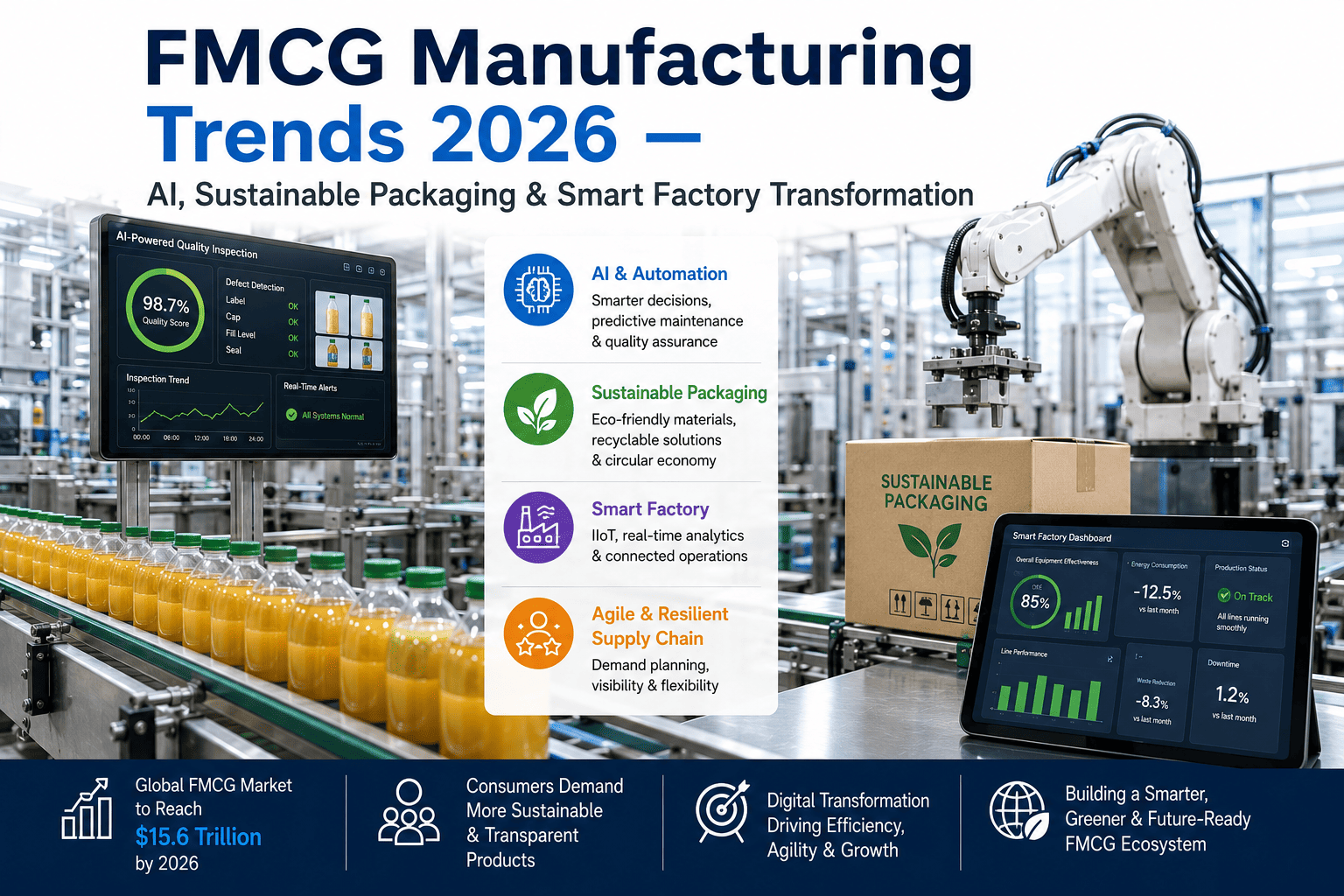
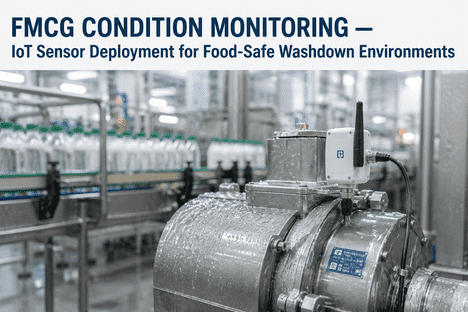
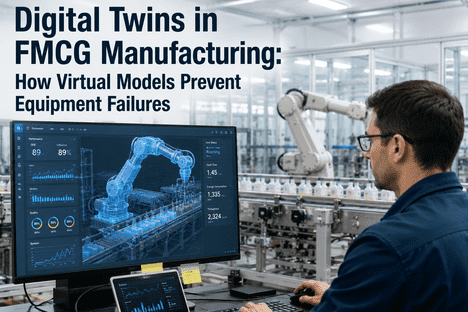
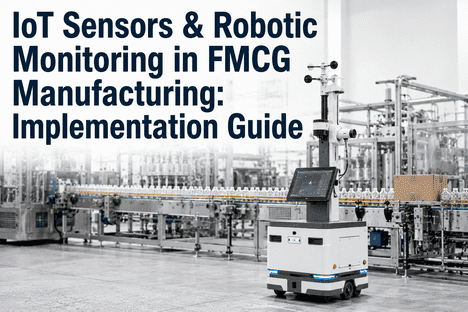
The deployment of advanced IoT sensor networks for FMCG production monitoring has become a prerequisite for maintaining high-throughput operational excellence in modern food and beverage plants. As manufacturing environments become increasingly complex, relying on manual inspections is no longer a viable strategy for preventing unplanned downtime and protecting batch integrity. By integrating a comprehensive IoT FMCG manufacturing sensor network, facility managers gain real-time visibility into the mechanical health of mixers, conveyors, fillers, and packaging lines. If your facility is ready to transition from reactive maintenance to an automated intelligence model, Book a Demo to see how connected sensors transform production reliability.
IOT SENSORS · FMCG PRODUCTION · PREDICTIVE ANALYTICS
Upgrade Your Production Monitoring with IoT
Capture real-time data from every critical motor, pump, and valve across your facility using our industrial-grade sensor network platform.
The Strategic Role of Sensor Networks in Food Manufacturing
In the fast-moving consumer goods sector, even small fluctuations in equipment performance can lead to significant yield losses or safety violations. A smart sensor FMCG network acts as a central nervous system for the factory floor, continuously feeding data into AI-driven analytics engines that detect anomalies weeks before they manifest as equipment failure. This pro-active monitoring is essential for meeting strict HACCP compliance standards and ensuring constant product quality. Leading manufacturers that Book a Demo frequently identify operational bottlenecks that were previously invisible to their legacy SCADA systems.
Vibration and Acoustic Monitoring
Multi-axis vibration sensors detect bearing wear, imbalance, and misalignment in high-speed rotating equipment. High-frequency acoustic sensors identify early-stage lubrication issues and pressure leaks in fluid systems.
Thermal Drift Analytics
Non-contact infrared sensors monitor surface temperatures of motors and electrical panels. AI models distinguish between normal thermal cycles and overheating patterns caused by electrical resistance or winding failure.
Flow and Pressure Intelligence
Connected flow meters and pressure transducers ensure that clean-in-place (CIP) cycles meet regulatory velocity requirements and that filling lines operate within precise volumetric tolerances.
Environmental Condition Tracking
Humidity and ambient temperature sensors protect sensitive ingredients and finished goods from degradation, ensuring that the production environment remains within the strict parameters required for shelf-life stability.
Phased Roadmap for FMCG Sensor Deployment
Most top-tier FMCG sensor deployment programs follow a structured three-phase roadmap to ensure scalability and immediate ROI realization. Starting with critical asset clusters allows teams to prove the financial benefit of condition-based monitoring before rolling it out across the entire facility. Book a Demo to review our specific implementation templates for bottling, canning, and dry-goods processing lines.
Phase 1
Criticality Analysis and Gateway Placement
Identify high-impact assets where failure would stop the entire line. Install industrial LoRaWAN or 5G gateways to establish the secure communication backbone for the upcoming sensor node deployment.
Phase 2
Wireless Sensor Node Integration
Mount battery-powered vibration, temperature, and current sensors to the identified assets using non-destructive magnetic or adhesive mounts. Calibrate baseline performance data during peak production hours.
Phase 3
Analytics Platform Scaling
Connect the raw data stream to the iFactory AI platform. Enable automated alerting for maintenance teams and integrate sensor health dashboards into the control room's primary display network.
Phase 4
Predictive Automation and AI Loops
Transition from monitoring to autonomous optimization. Implement AI loops that automatically adjust machine parameters based on sensor telemetry to prevent quality drift and maximize energy efficiency across the line.
Comparing Industrial Sensors for FMCG Production
Selecting the right hardware for your FMCG connected sensors depends on the washdown requirements and environmental stressors of your specific production area. Sanitary-grade sensors with IP69K ratings are required for wet-processing zones, while standard industrial enclosures are sufficient for dry-packaging areas. Book a Demo to see our rated hardware catalog for food-safe manufacturing environments.
| Sensor Technology |
Measured Variable |
Data Frequency |
Washdown Rating |
Optimal FMCG Asset |
| Piezoelectric Accelerometer |
Vibration / Velocity |
Continuous |
IP69K (Stainless) |
Centrifuges, Mixers, High-Speed Fillers |
| NTC Laser-Precision |
Surface Temp |
10 mins |
Standard (Shielded) |
Electric Motors, Conveyor Hubs |
| MEMS Acoustic Emission |
Ultrasonic Friction |
60 mins |
Splash-Proof |
Steam Traps, Bearing Housings, Valving |
| Non-Contact Hall Effect |
Motor Load (Amps) |
Real-Time |
Integrated (NEMA 4X) |
Heavy Load Conveyors, Case Packers |
| Capacitive Proximity |
Fluid Level / Flow |
15 mins |
Sanitary Threaded |
Holding Tanks, Bottling Vats |
| Optical Laser Lidar |
Position / Alignment |
Real-Time |
IP67 Sealed |
Palletizing Robots, Shrink Tunels |
Architectural Options: Edge Intelligence vs. Cloud Analytics
FMCG manufacturers must choose between edge-heavy or cloud-heavy architectures when deploying their production monitoring sensor networks. Edge computing allows for immediate anomaly detection directly at the sensor gateway, which is critical for safety-stop triggers on high-speed lines. Conversely, cloud analytics provide a centralized repository for long-term trend analysis across multiple factory locations, enabling global benchmarking of asset health. If your leadership team is debating the merits of hybrid architectures, Book a Demo to see our comparative architecture performance data.
Key KPIs for Automated Production Monitoring
Determining the success of your IoT monitoring food plant initiative requires tracking KPIs that connect sensor activity to financial outcomes. A well-designed system should move the needle on every major reliability metric within the first two quarters of operation. Book a Demo to explore our automated reporting modules for executive leadership.
24/7
Continuous equipment visibility with zero manual inspection time required.
4-8 wks
Average lead time provided for impending bearing failure detection.
30%
Reduction in emergency repair costs within the first year of IoT deployment.
99.9%
Data transmission reliability for critical sensor nodes in food-safe environments.
Frequently Asked Questions: IoT Sensor Networks in FMCG
Do IoT sensors interfere with existing plant Wi-Fi or PLC networks?
Modern industrial sensor networks typically utilize LoRaWAN or 5G sub-GHz frequencies that operate independently of industrial Wi-Fi networks. This prevents bandwidth congestion and ensures that critical sensor data does not interfere with real-time PLC logic or SCADA communications.
Book a Demo to see our signal isolation testing reports.
How long do the batteries last on wireless production monitoring sensors?
Depending on data transmission frequency, industrial IoT battery life ranges from 3 to 10 years. Low-latency edge processing significantly extends battery life by only transmitting high-bandwidth data when an anomaly is detected on-site.
Can sensors handle the high-temperature washdown cycles in food plants?
Yes. Sanitary-rated sensors are encased in 316L stainless steel with IP69K sealing, allowing them to withstand high-pressure water jets and chemical sanitization cycles common in food and dairy processing facilities.
What is the typical ROI timeline for an FMCG sensor deployment?
Most facilities achieve full ROI within 6 to 9 months by preventing a single secondary catastrophic failure of a critical asset. The reduction in planned parts replacement also provides an immediate 15-20% boost to the maintenance budget within the first fiscal year.
How is data security handled for proprietary production information?
Data is encrypted via AES-128 or AES-256 both in transit and at rest. iFactory employs enterprise-grade security protocols, ensuring that your production metrics, recipe-specific parameters, and machine health data remain strictly within your sovereign data environment.
Book a Demo to review our security whitepaper.
Can the system integrate with my existing SAP or Oracle EAM?
Yes. Through robust API endpoints and middleware connectors, iFactory pushes real-time health alerts into your CMMS or ERP system of record, automatically triggering work orders based on actual sensor-detected condition thresholds.
Transform Your Food Plant into a Smart Facility
Join the world's leading FMCG manufacturers scaling their predictive maintenance programs with iFactory's unified IoT sensor and AI analytics platform.