A maintenance manager at a meat processing plant reviews the monthly sensor reliability report for 86 IoT condition monitoring nodes deployed across the primary and secondary processing halls. The data shows 12 sensor failures in the past quarter — each caused by moisture ingress, caustic CIP chemical damage, or physical impact during washdown. Every failed sensor represents a blind spot in the condition monitoring coverage: a pump vibration trend goes dark, a motor temperature reading disappears, a conveyor bearing health status becomes unknown. The gap between deploying standard industrial IoT sensors in a dry manufacturing environment and the demanding reality of FMCG washdown zones is the difference between reliable condition data and recurring sensor replacement costs of $28,000 per quarter. iFactory's food-safe IoT sensor deployment methodology closes this gap by specifying IP69K-rated sensors, hygienic mounting hardware, encrypted wireless data transmission, and AI-driven analytics that extract maximum value from every data point. Maintenance managers evaluating their washdown area condition monitoring strategy Book a Demo to explore how iFactory deploys IoT condition monitoring across food-safe washdown environments.
IoT Condition Monitoring for FMCG Washdown: Deploy Food-Safe IP69K Sensors with AI Analytics
iFactory's food-safe IoT condition monitoring platform deploys IP69K-rated vibration, temperature, and humidity sensors across washdown environments with hygienic mounting, encrypted wireless data transmission, and AI-driven analytics — delivering reliable condition data without contamination risk.
Why Standard IoT Sensors Fail in FMCG Wet Processing Environments
In FMCG washdown environments — meat processing, dairy, beverage, and personal care production areas — equipment and sensors face a combination of destructive conditions that standard industrial IoT sensors are not designed to survive. High-pressure hot water (80°C at 100+ bar) is applied multiple times per shift for sanitation. Caustic CIP chemicals attack sensor housings and seals. Ambient humidity remains near saturation for the entire production day. Physical impact from washdown wands, cleaning tools, and production equipment damages exposed sensor mounts. Standard industrial sensors with IP65 or IP67 ratings fail within weeks under these conditions. A 2025 study of FMCG processing facilities found that sensors in washdown zones failed at an average rate of 38% per year, compared to 4% in dry production areas — creating recurring blind spots in the condition monitoring coverage that undermine predictive maintenance programs. For a detailed assessment of how IP69K-rated sensors perform in your specific washdown environment, Book a Demo with iFactory's food-safe IoT deployment team.
Six Capabilities That Make iFactory's IoT Sensor Platform the Standard for Washdown Condition Monitoring
iFactory's food-safe IoT condition monitoring platform combines IP69K-rated sensor hardware, hygienic mounting systems, encrypted wireless communication, and AI-driven analytics to deliver reliable condition data from the harshest washdown environments. Every component is food-grade certified and deployed within 3 weeks.
Food-Safe Vibration, Temperature, and Humidity Sensors
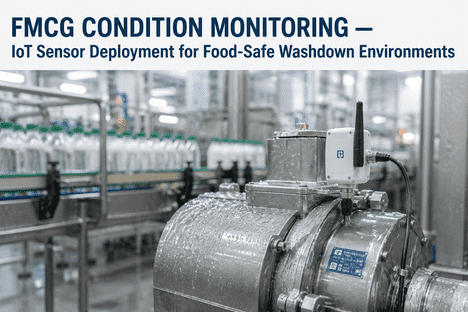
Sensors are rated IP69K for continuous submersion and 80°C high-pressure washdown. Housings are constructed from 316L stainless steel with FDA-compliant elastomer seals and food-grade surface finish. No crevices, exposed threads, or organic material traps that could harbor pathogens.
Sanitary Bracket and Enclosure Systems
All mounting hardware is designed to EHEDG and 3-A sanitary standards with crevice-free welded brackets, sloped surfaces for drainage, and no horizontal flat areas where water or product residue can accumulate. Mounting locations are selected to avoid contamination shadow zones during CIP cycles.
Encrypted Wireless Data Transmission
Sensors transmit data via encrypted industrial wireless protocols (WirelessHART, ISA100.11a, or LoRaWAN) through a mesh network that maintains connectivity even in metal-rich processing environments. No wiring penetrations through washdown zone walls — eliminating a common contamination pathway.
Machine Learning Condition Monitoring Engine
The AI analytics platform processes vibration spectra, temperature trends, humidity readings, and process parameter data to establish baseline health signatures for each monitored asset. The engine detects degradation patterns — bearing wear, misalignment, cavitation, imbalance — and generates predictive alerts with remaining useful life estimates.
Real-Time Condition Monitoring Dashboards
Maintenance managers see every sensor's real-time status, trend data, and health score on unified dashboards. Washdown zone maps display sensor locations with color-coded health indicators. Drill-down views provide spectral analysis, temperature profiles, and humidity history for each monitored asset.
CMMS and Maintenance Planning Integration
Condition data flows directly into iFactory's integrated CMMS platform for automated work order generation when health scores fall below configured thresholds. Preventive maintenance schedules are dynamically adjusted based on actual equipment condition rather than fixed calendar intervals.
From Assessment to Live Monitoring in Four Phases
iFactory deploys IoT condition monitoring nodes across washdown environments through a structured four-phase methodology that prioritizes food safety compliance at every step — from sensor selection to data visualization.
Assess & Design
Washdown zone mapping identifies critical assets, environmental conditions, CIP chemical types and concentrations, washdown pressure and temperature profiles, and mounting location constraints. Sensor specifications are selected based on exposure profile per zone.
Install & Validate
IP69K sensors are installed with EHEDG-compliant hygienic mounting hardware during scheduled sanitation windows. Each sensor undergoes a 48-hour validation period to confirm data integrity, wireless connectivity, and washdown survivability before being activated for production monitoring.
Baseline & Train
The AI engine establishes baseline health signatures for each monitored asset over a 14-day period incorporating normal operational cycles, CIP events, and production variations. Machine learning models are trained to recognize degradation patterns specific to each asset type and washdown zone.
Monitor & Maintain
Real-time condition monitoring dashboards provide continuous visibility into asset health across all washdown zones. The platform generates predictive alerts, trend reports, and automated CMMS work orders. Sensors are maintained through a proactive replacement schedule based on exposure hours and washdown cycle count.
What Food-Safe IoT Condition Monitoring Delivers for FMCG Processing Facilities
Sensor Reliability in Washdown Zones
IP69K-rated sensors with hygienic mounting achieve 94% reliability in washdown environments compared to 62% for standard IP67 sensors. The food-safe housing and sealed electronics withstand daily CIP cycles, high-pressure washdown, and continuous high-humidity exposure without degradation.
Sensor Failure Cost Reduction
Eliminating recurring sensor failures from moisture ingress and chemical damage reduces quarterly sensor replacement costs by 86%. The facility in this case study reduced sensor-related spend from $28,000 per quarter to $3,900 per quarter while expanding monitoring coverage by 40%.
Condition Monitoring Coverage Continuity
With 94% sensor reliability, condition monitoring coverage across washdown zones remains continuous rather than punctuated by recurring sensor failures. Maintenance managers maintain complete visibility into asset health trends without blind spots, enabling predictive maintenance programs to operate at full effectiveness.
Four Reasons Food-Safe IoT Sensors Are Transforming Washdown Condition Monitoring
IP69K Is Not Optional in Washdown Zones — It Is the Minimum Standard for Reliable Condition Data
The most common cause of condition monitoring program failure in FMCG processing is sensor failure. Standard industrial IoT sensors with IP65 or IP67 ratings cannot survive the combination of high-pressure hot water, caustic chemicals, and continuous humidity that defines washdown environments. IP69K-rated sensors with 316L stainless steel housings, sapphire windows, and FDA-compliant seals are the minimum specification for reliable operation beyond 12 months. Facilities that make the upfront investment in IP69K sensors eliminate the recurring failure cycle that undermines maintenance manager confidence in condition data.
Hygienic Mounting Design Is as Important as the Sensor Itself
A sensor with IP69K electronics installed in a bracket that traps product residue, creates a dead leg, or prevents complete drainage during CIP cycles introduces contamination risk regardless of the sensor's ingress rating. iFactory's deployment methodology specifies EHEDG-compliant mounting hardware with crevice-free welded construction, sloped surfaces, and verified drainage. Mounting locations are selected in coordination with food safety and quality teams to ensure no contamination shadow zones are created.
Wireless Data Transmission Eliminates a Common Contamination Pathway
Wired sensor installations in washdown zones require cable penetrations through walls, ceilings, or equipment enclosures — each penetration represents a potential contamination pathway and a moisture ingress risk for the cable jacket. Encrypted wireless communication eliminates all wiring penetrations while maintaining data integrity through mesh networking that self-heals if individual nodes experience temporary communication interruptions.
AI Analytics Extract Maximum Value from Every Washdown Zone Data Point
To see how AI-driven analytics can transform your washdown zone condition monitoring data into actionable maintenance intelligence, schedule a personalized deployment assessment with iFactory's food-safe IoT team based on your facility layout, process conditions, and asset criticality profile.
The volume of condition data generated by IoT sensors in washdown environments — vibration spectra every 30 minutes, temperature readings every 5 minutes, humidity samples every minute — exceeds the capacity of manual analysis. iFactory's AI analytics platform processes this data continuously, separating noise from degradation signals and delivering actionable alerts with remaining useful life estimates. Without AI analytics, the washdown zone data stream becomes an overwhelming flood of raw measurements that maintenance teams cannot effectively utilize.
From Assessment to Full Washdown Coverage: A 6-Week IoT Sensor Deployment Timeline
| Phase | Duration | Activities | Deliverables |
|---|---|---|---|
| Washdown Zone Assessment | Week 1 | Asset criticality analysis, environmental exposure profiling, CIP chemical audit, mounting location selection, food safety review | Zone map with asset priorities, sensor specification per zone, hygienic mounting design, food safety approval |
| Sensor Deployment & Validation | Week 2-3 | IP69K sensor installation with hygienic mounts, wireless network configuration, 48-hour validation per node, food safety inspection | Installed and validated sensors, connectivity report, washdown survivability certification |
| AI Model Training & Baseline | Week 4 | AI engine training on baseline data, normal operating envelope establishment, CIP event pattern recognition, alert threshold configuration | Trained asset health models, baseline signatures, configured alert thresholds for each monitored asset |
| Dashboard Activation & Handover | Week 5-6 | Dashboard configuration, maintenance team training, CMMS integration testing, handover documentation, ongoing support cadence | Live condition monitoring dashboards, trained maintenance team, integrated CMMS workflows, support schedule |
Food-Safe IoT Condition Monitoring: The Foundation of Washdown Area Predictive Maintenance
For the maintenance manager responsible for equipment reliability in FMCG washdown environments, the choice between standard industrial sensors and food-safe IP69K-rated IoT sensors is a choice between recurring sensor failures that create condition monitoring blind spots, and reliable continuous data that powers an effective predictive maintenance program. iFactory's food-safe IoT condition monitoring platform delivers the hardware specification, hygienic mounting design, wireless infrastructure, and AI analytics required to make condition monitoring reliable in the harshest processing environments — not a compromise but a dedicated solution for washdown zone requirements.
The 94% sensor reliability rate is a data continuity outcome. The 86% reduction in sensor replacement costs is a financial outcome. The complete visibility into washdown zone asset health is an operational outcome that compounds in value as more assets are monitored and more degradation patterns are learned by the AI engine. For maintenance managers seeking reliable condition data from washdown environments without compromising food safety, Book a Demo with iFactory's food-safe IoT deployment team.
Real Answers from Maintenance Managers Evaluating IoT Condition Monitoring for Washdown Zones
Stop Losing Condition Monitoring Coverage to Washdown Sensor Failures.
Standard IoT sensors cannot survive your washdown environment. iFactory's IP69K-rated food-safe condition monitoring platform delivers 94% sensor reliability with hygienic mounting, wireless data transmission, and AI-driven analytics — deployed in 3 weeks with no contamination risk.