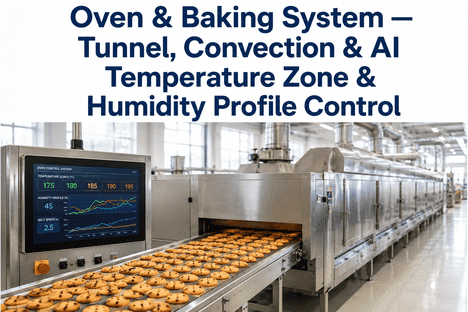
Oven & Baking System Tunnel, Convection & AI Temperature Zone & Humidity Profile Control
By Seren on June 23, 2026
The industrial baking market is projected to reach USD 52.8 billion by 2030, driven by demand for consistent quality across high-volume production lines — cookies, crackers, bread, and specialty bakery products. Yet the single largest variable affecting bake quality, yield, and energy consumption is the oven. Tunnel ovens exceeding 100 metres in length, multi-zone convection systems, and humidity-controlled baking chambers all introduce complex thermal dynamics that manual operator adjustments cannot consistently manage. Process engineers responsible for oven performance face a persistent challenge: how to maintain uniform bake colour, texture, and moisture content across every lane, every zone, and every shift — while simultaneously reducing energy cost and unplanned downtime. AI-powered temperature zone management, humidity profiling, and belt speed control have emerged as the most effective response. This guide examines how AI-driven oven control systems give process engineers the capability to monitor, simulate, and optimise every thermal variable in real time, converting the oven from a black-box process into a precisely managed baking instrument.
Oven AI · Temperature Zones · Humidity Profiling · Belt Speed Control · Bake Quality
Stop Guessing Your Oven Profile. Start Baking Every Product With Precision Across Every Zone.
iFactory's AI oven management platform combines real-time temperature zone monitoring, humidity profiling, and belt speed optimisation — giving process engineers the tools to achieve consistent bake quality and reduce energy waste across every production run.
Energy reduction achieved by AI-driven temperature zone optimisation in multi-zone tunnel ovens (Department of Energy industrial studies)
92%
Bake colour consistency achieved by facilities using AI humidity profiling — compared to 74% for manual PID-only control regimes
30-40%
Reduction in unplanned oven downtime when AI predictive models detect burner, fan, and belt drift before line supervisors notice
3-5%
Yield improvement from AI belt speed optimisation that dynamically adjusts bake time based on real-time product temperature and moisture readings
Why Conventional Oven Control Falls Short — Three Gaps That AI Temperature Zone Management Closes
Most industrial ovens are controlled by a combination of PID loops, manual operator adjustments, and post-bake quality checks. This control architecture leaves three critical gaps that directly affect product quality and production cost. An AI-driven temperature zone management system closes each gap by replacing reactive adjustments with predictive, real-time optimisation across the entire thermal profile of the oven.
Temperature Zone Drift
PID controllers maintain set-point temperature at the sensor location, but they cannot compensate for cross-zone thermal interference, belt loading variations, or ambient air infiltration. An AI temperature zone management system models the thermal behaviour of each zone as a coupled system — when the loading zone temperature drops because 200 kg of cold dough enters the oven, the AI anticipates the downstream effect on zone two and three and adjusts burner output pre-emptively rather than waiting for the thermocouple to report the deviation. This predictive coupling reduces zone-to-zone temperature variance by up to 60 percent compared to independent PID loops.
Humidity Profile Variability
Oven humidity directly affects crust formation, crumb structure, and moisture retention — yet most baking lines measure humidity only at the exhaust stack, if at all. AI humidity profiling deploys distributed sensor arrays across the baking chamber and models the vapour pressure gradient from inlet to outlet. When the profile deviates from the optimal curve for the current product, the AI adjusts damper positions, steam injection rates, and exhaust fan speed autonomously. Facilities using this approach have reported a 22 percent reduction in crust cracking defects and a 15 percent improvement in moisture content consistency across the product batch.
Belt Speed Disconnection
Belt speed is typically set based on a fixed product recipe and adjusted only when quality issues are detected at the exit. This reactive approach means that every variation in dough temperature, ambient humidity, or ingredient batch consistency translates directly into bake quality variation. AI belt speed control integrates real-time product temperature sensors, moisture probes, and colour cameras at the oven exit to create a closed feedback loop. When the AI detects that product core temperature is running 2°C above target, it slows the belt incrementally — without operator intervention — ensuring every product receives the correct thermal history regardless of upstream variability.
The iFactory AI Oven Optimisation Stack — Three Layers That Convert Heat Into Precision
iFactory's oven management platform is built on three integrated layers that together give process engineers end-to-end visibility and control over the baking process — from thermal sensing at the burner to quality data at the product exit. Each layer is designed to operate independently or as part of a unified optimisation loop.
L1
Sensing
Real-Time Thermal & Humidity Sensor Network
Distributed temperature sensors across every zone, combined with humidity probes, belt speed encoders, and product colour cameras at the exit. IoT-enabled sensors stream data to the AI engine at sub-second intervals. The sensing layer creates a continuous thermal fingerprint of the oven that captures zone coupling effects, heat distribution uniformity, and vapour pressure gradients — the raw data that makes AI optimisation possible.
L2
Modelling
AI Thermal Profile Simulation Engine
A machine learning model trained on historical zone temperature data, belt speed records, and product quality outcomes creates a digital twin of the oven. The simulation engine predicts how changes in any variable — zone set point, damper position, belt speed, or product loading rate — will affect temperature distribution, humidity profile, and product bake colour across the entire oven length. Process engineers can run what-if scenarios before adjusting production parameters.
L3
Control
Autonomous Oven Optimisation Loop
The AI control layer closes the loop between sensing and actuation. It compares real-time thermal and humidity data against the optimal profile for the current product, calculates the adjustments needed to bring the profile back to target, and sends commands to burner valves, damper actuators, steam injectors, and belt drives — all without manual intervention. The autonomous loop runs continuously, making micro-adjustments every 60 seconds to maintain zone temperature within ±1.5°C of target.
L4
Analytics
Bake Quality & Energy Performance Dashboard
A unified dashboard presents process engineers with real-time bake quality metrics — colour uniformity, moisture content distribution, crust thickness — alongside energy consumption per zone and per product run. Trend analytics identify drift in oven performance over weeks and months, enabling predictive maintenance scheduling for burners, fans, and belt components before they cause a quality deviation or line stoppage.
Temperature Zones · Humidity Profile · Belt Speed · Bake Quality · Oven AI
Your Oven Generates Terabytes of Thermal Data. iFactory Turns It Into Consistent Bake Quality, Every Product, Every Shift.
From distributed temperature sensing to autonomous zone control and energy analytics — iFactory's oven optimisation platform gives process engineers the precision layer that turns a tunnel of burners into a repeatable baking instrument.
AI Temperature Zone Management — How It Works Across Oven Types
Different oven configurations require different AI modelling approaches. The table below maps five common industrial oven types to the AI temperature zone management strategy that delivers the highest quality and energy efficiency improvement for each — so process engineers can prioritise which oven optimisation approach will generate the greatest ROI in their specific production environment.
Oven Type
AI Temperature Zone Strategy
Primary Quality Outcome
Direct Gas-Fired Tunnel
Cookies, crackers, biscuits
Coupled zone modelling with burner modulation. AI predicts cross-zone thermal interference and pre-adjusts downstream burners when loading rate changes. Humidity sensors at three points along the tunnel enable vapour pressure gradient control.
Colour uniformity across all lanes within ±1.5 L*a*b* units from target
Convection Band Oven
Bread, rolls, artisan loaves
Air velocity and temperature profile optimisation across upper and lower impingement zones. AI models the heat transfer coefficient at each nozzle bank and adjusts fan speed and damper position to maintain uniform crust development and crumb structure.
Crust colour consistency and crumb moisture content within ±0.5% of target
Indirect Radiant Oven
Cakes, muffins, pastries
Radiant heat flux modelling with product surface temperature feedback. AI adjusts tube temperature and zone dwell time to control the rate of radiant heat transfer, preventing surface over-browning before the core is fully baked.
Elimination of surface cracking with core temperature variance below ±1°C
Hybrid Steam-Convection
Bagels, pretzels, crusty bread
Integrated steam injection and convection temperature control. AI models the phase change dynamics at the product surface, adjusting steam dwell time and convection temperature to create the desired crust thickness and gloss while maintaining internal moisture.
Crust gloss uniformity and moisture retention within ±1% of specification
Multi-Zone Electric
Specialty bakery, gluten-free
Zone-by-zone PID parameter autotuning using reinforcement learning. AI learns the thermal response characteristics of each zone and continuously optimises PID coefficients to maintain stability despite product loading and ambient temperature changes.
Temperature recovery time after loading reduced by 40% with zero overshoot
Process Engineer KPI Framework — Measuring Oven Optimisation Impact
The value of AI-driven oven optimisation is not measured in algorithm complexity or dashboard visualisations — it is measured in whether the system improves bake quality consistency, reduces energy consumption, and increases production uptime. The KPIs below are designed for process engineers who need to track whether their oven management investment is delivering measurable operational and quality returns.
Bake Quality
Colour uniformity index — L*a*b* variance across all lanes and positions, measured every 30 seconds at oven exit, with AI-driven corrective actions triggered when variance exceeds threshold
Moisture content consistency — standard deviation of product moisture content across the batch, compared before and after AI humidity profiling deployment
Defect rate trend — percentage of product rejected for bake defects (cracking, under-bake, over-bake, blistering), tracked as a rolling 8-hour average
Energy Efficiency
Energy per kilogram of product — zone-level energy consumption divided by throughput, tracked in real time to identify thermal efficiency drift at the zone or burner level
Temperature recovery time — the time each zone takes to return to set point after a product loading event, benchmarked against AI-optimised performance
Heat distribution uniformity — coefficient of variation across all temperature sensors in each zone, with target variance below 2% for optimal bake consistency
Oven Reliability
Unplanned downtime per oven — hours lost to burner, fan, belt, or control system failures, tracked monthly with AI predictive alerts compared to historical baseline
Mean time between failures — rolling 90-day MTBF calculated for each oven subsystem, with AI-identified failure precursors tracked as leading indicators
Predictive alert accuracy — percentage of AI-generated oven component alerts that preceded an actual failure or quality deviation within the forecast window
Production Efficiency
OEE contribution from baking — the oven's contribution to overall equipment effectiveness, measuring availability, performance, and quality across the baking operation
Changeover time per product — time required to transition the oven from one product thermal profile to another, tracked in minutes with AI-assisted recipe recall reducing changeover duration
Throughput per shift — kilograms or units produced per shift with the oven as the constraint, tracking AI-enabled throughput improvements from optimised belt speed and zone temperature balance
"
We run seven tunnel ovens across three production facilities, baking everything from sandwich crackers to high-end butter cookies. Before deploying iFactory's AI temperature zone management, every oven had its own personality — the night shift knew to add 3°C to zone four on oven three because the burner drifted after midnight. We were running a baking operation on folklore. The AI platform changed that completely. It modelled the thermal coupling between zones in a way that our PID system never could, and within 90 days we had reduced zone-to-zone temperature variance by 54 percent and energy consumption by 16 percent. The most valuable outcome was quality consistency — our on-line colour camera was rejecting 6.2 percent of product for colour deviation before the AI deployment. That rate dropped to 1.8 percent and has stayed there for nine months. When the board asks about digital transformation ROI, I show them that chart.
— Senior Process Engineer, Global Bakery Manufacturer — 18 Years Baking Operations
Conclusion
The industrial oven has historically been the most difficult asset to optimise in a baking line — a complex thermal system where temperature, humidity, belt speed, and product loading interact in ways that exceed manual control capability. AI-driven temperature zone management, humidity profiling, and belt speed control have transformed the oven from a black-box process into a precisely managed baking instrument. With energy consumption reductions of 18 to 25 percent, bake colour consistency improvements from 74 to 92 percent, and unplanned downtime reductions of 30 to 40 percent, the case for AI oven optimisation is no longer theoretical — it is a proven operational improvement that process engineers can deploy across tunnel, convection, radiant, hybrid, and electric oven configurations.
iFactory's oven management platform gives process engineers the ability to monitor every thermal zone, profile oven humidity in real time, and control belt speed dynamically — all within a single AI-powered system that learns your oven's unique thermal behaviour and optimises it continuously. Book a Demo to see how iFactory's temperature zone modelling predicts and prevents bake quality deviation, or Talk to an Expert to discuss which oven in your production line will deliver the highest ROI from AI optimisation.
Frequently Asked Questions
The minimum sensor configuration for AI oven optimisation is one temperature sensor per zone plus one belt speed encoder and one product temperature sensor at the exit. iFactory's AI engine can begin generating value with this baseline configuration by modelling zone-to-zone thermal coupling and detecting drift patterns that human operators miss. For humidity profiling, a minimum of two humidity probes — one in the loading zone and one in the baking chamber mid-point — is recommended. If your oven does not currently have distributed sensors, iFactory can recommend a sensor deployment plan based on your oven length, product types, and quality targets. Most installations achieve measurable quality improvement within 30 days of sensor deployment. Talk to an Expert to review your current oven instrumentation and determine the fastest path to AI zone management.
iFactory's platform connects to existing PLC and SCADA systems via OPC UA, Modbus TCP, or REST API — the three most common industrial communication protocols. The AI engine reads live zone temperature data, belt speed, damper positions, and burner status from your control system and writes optimised set points back to the PLC at configurable intervals. The platform operates in advisory mode initially — displaying AI-recommended zone temperature adjustments to the operator — and can be switched to autonomous mode after the process engineer validates the AI's recommendations against actual quality outcomes. Integration does not require replacing or reconfiguring the existing PLC code. Most installations complete integration in two to three days with remote support from the iFactory engineering team. Talk to an Expert to see how the integration process works with your specific control system architecture.
Yes. iFactory's AI platform stores the complete thermal profile for every product that runs through the oven — including zone temperature set points, humidity target curves, belt speed profiles, and damper positions — and recalls them automatically when the product is selected for production. The AI also adapts the stored profile to current conditions, adjusting zone set points to compensate for ambient temperature differences between summer and winter production runs or for changes in dough temperature from one batch to the next. Over time, the AI learns the optimal thermal profile for each product and refines it based on actual quality outcomes, so the profile becomes more accurate with every production run rather than requiring manual recalibration. Process engineers report that changeover time is reduced by 30 to 50 percent with AI-assisted recipe recall and adaptation. Talk to an Expert to discuss how AI profile management would work for your specific product range.
Humidity profiling does not require steam injection hardware. In ovens without active humidity control, iFactory's AI models the natural vapour pressure gradient created by product moisture evaporation and exhaust airflow, then optimises damper position and exhaust fan speed to shape the profile within the constraints of the existing hardware. Even without steam injection, this passive humidity optimisation typically delivers a 12 to 18 percent improvement in moisture content consistency. For ovens where active humidity control would add value, iFactory can model the expected ROI of retrofitting steam injection or humidity control dampers — showing the process engineer what quality improvement each investment level would deliver before any capital is committed. Book a Demo to see how our humidity profiling models work across different oven configurations and product types.
The typical timeline from sensor deployment to measurable improvement is 60 to 90 days. The first 30 days are focused on sensor installation, PLC integration, and the AI model learning your oven's baseline thermal behaviour. During this period, the platform operates in monitoring and advisory mode, and process engineers can already see the temperature zone coupling patterns and humidity gradients that were previously invisible. By day 60, the AI model has sufficient data to begin making autonomous zone temperature adjustments, and most installations show measurable improvement in colour uniformity and energy consumption within this window. By day 90, the full optimisation loop — including belt speed and humidity profile control — is operational, and the process engineer has a complete dashboard of bake quality, energy, and reliability KPIs that provide continuous visibility into oven performance. Talk to an Expert to see deployment timelines and case studies from similar baking operations.
Every Oven Has a Unique Thermal Personality. iFactory Helps You Master Yours.
From temperature zone AI to humidity profiling to belt speed optimisation — iFactory's oven management platform gives process engineers the precision layer that turns thermal complexity into consistent product quality, shift after shift.