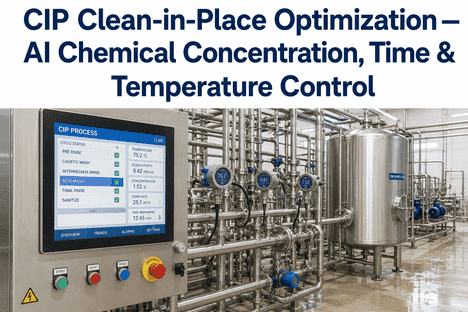
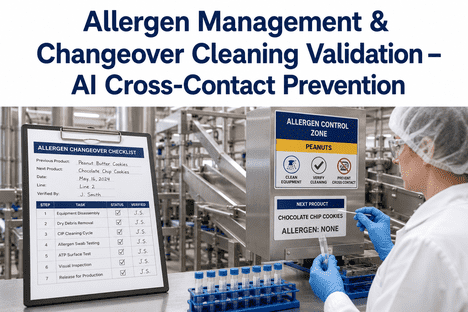
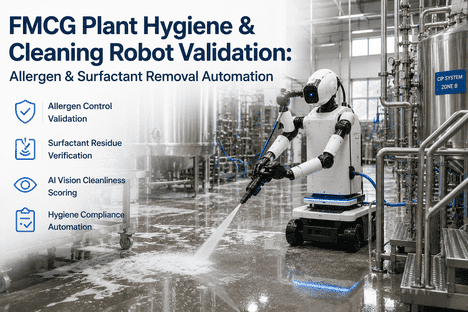
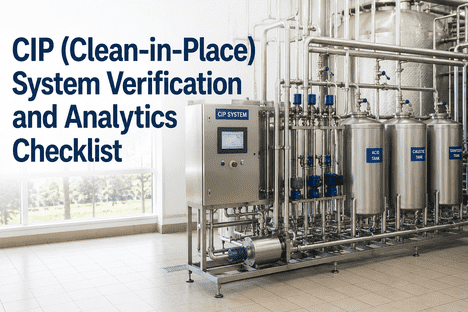
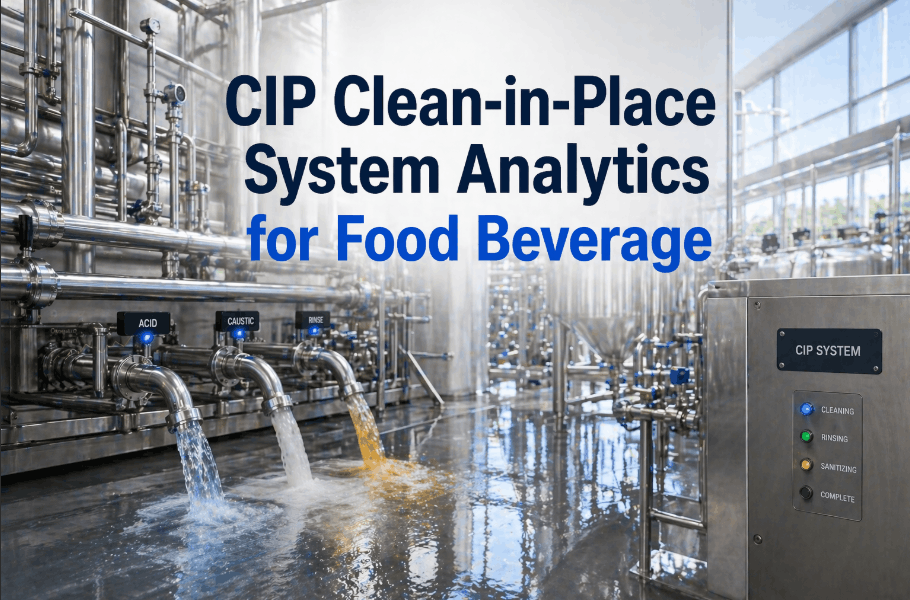
In food, beverage, pharmaceutical, and dairy manufacturing, Clean-in-Place (CIP) systems are the backbone of hygienic equipment design — eliminating manual disassembly for cleaning while ensuring validated sanitation across tanks, pipes, heat exchangers, fillers, and homogenisers. Every CIP cycle consumes measured volumes of water, caustic, acid, and sanitiser at controlled temperatures and flow rates, and every parameter deviation — under-concentrated chemical, insufficient contact time, low temperature, or inadequate flow velocity — risks incomplete cleaning that can produce microbial contamination, allergen carryover, biofilm formation, and costly product hold or recall events. AI-driven CIP optimisation platforms ingest real-time sensor data from conductivity meters, temperature probes, flow transmitters, and pressure sensors to dynamically adjust chemical dosing, contact time, temperature setpoints, and flow velocity — reducing water consumption by 20–35 %, chemical usage by 15–25 %, and energy demand by 20–30 % while maintaining validated cleaning effectiveness. iFactory AI's platform, including its Shift Logbook and process monitoring engine, is architected to support CIP optimisation in regulated hygienic environments — with configurable dashboards, sensor integration, automated shift reporting, and real-time parameter control that align with 3-A SSI, EHEDG, FDA, and USDA sanitation standards. Book a Demo to see how iFactory delivers AI-driven CIP optimisation for hygienic manufacturing operations.
CIP Optimisation · AI-Driven · 2026
CIP Clean-in-Place Optimisation — AI Chemical Concentration, Time & Temperature Control
Reduce water, chemical, and energy consumption by 20–35 % while maintaining validated cleaning effectiveness with AI-managed CIP parameters — all captured in iFactory Shift Logbook for full sanitation traceability.
◈
Chemical Optimisation
AI-dosed caustic, acid & sanitiser concentration
◉
Contact Time
Dynamic hold-time adjustment per soil load
▤
Temperature Control
Precise thermal profile management
⟐
Flow Velocity
Turbulent-flow assurance & energy reduction
Why AI-Driven CIP Optimisation Matters for Hygienic Manufacturing
Hygienic manufacturing operations in dairy, beverage, pharmaceutical, and food processing rely on CIP systems to clean process equipment without disassembly — but traditional CIP programs operate on fixed-time, fixed-concentration recipes that waste resources and leave cleaning effectiveness unverified between quarterly validation swabs. Fixed CIP schedules cannot adapt to changing soil loads, product changeovers, or equipment fouling state — resulting in either over-cleaning (excess water, chemical, and energy consumption) or under-cleaning (sanitation risk, allergen cross-contact, microbial harbourage). AI-driven CIP optimisation closes this gap by ingesting real-time sensor data — conductivity, temperature, flow rate, pH, turbidity — and adjusting each CIP phase dynamically to match actual soil load and equipment condition. The result is validated cleaning effectiveness with measurably lower resource consumption, shorter cycle times, and full electronic traceability for regulatory audit. The 2026 trend in hygienic manufacturing confirms that AI-managed CIP programmes reduce total cost of sanitation by 20–35 % while improving audit readiness through continuous, data-backed cleaning validation evidence.
FOUR PILLARS OF AI CIP OPTIMISATION
1
Chemical Concentration Management — Conductivity and pH sensors feed real-time concentration data to AI models that adjust caustic, acid, and sanitiser dosing with precision. Over-dosing is eliminated, under-dosing triggers immediate correction, and chemical consumption drops 15–25 % without compromising cleaning efficacy.
2
Contact Time Optimisation — AI models analyse soil type, product residue, equipment geometry, and fouling history to recommend the minimum effective contact time for each CIP phase. Cycles shortened by 20–35 % increase production uptime while validated swab results confirm cleaning effectiveness.
3
Temperature Profile Control — Precise thermal management ensures sanitiser activation temperatures are reached and held for the required duration without wasting energy on excessive heating. AI models optimise heating ramp rates and hold profiles based on soil thermal conductivity and equipment thermal mass.
4
Flow Velocity & Turbulent Flow Assurance — Maintaining Reynolds numbers above the turbulent threshold (Re > 10 000) is critical for effective CIP. AI-driven flow management adjusts pump speed and valve position to maintain turbulent flow while minimising pump energy consumption, reducing total CIP energy demand by 20–30 %.
Three CIP Challenges AI Solves in Hygienic Manufacturing
01
Fixed-Recipe Over-Cleaning and Resource Waste
Traditional CIP programmes use fixed-time, fixed-concentration recipes designed for worst-case soil loads — meaning every cycle uses more water, chemical, and energy than necessary for 80 % of runs. A dairy pasteuriser processing whole milk after a skim milk changeover receives the same CIP recipe despite vastly different soil loads. iFactory's AI models analyse historical soil-load patterns, product schedule, and real-time sensor data to adapt each CIP phase dynamically — dosing only the chemical concentration needed, heating only to the temperature required, and holding only as long as the actual soil load demands. Every cycle adjustment is logged in the Shift Logbook with full audit trail for sanitation validation review.
Book a Demo to see iFactory's dynamic CIP recipe optimisation for hygienic lines.
20-35 % water reduction15-25 % chemical reductionDynamic recipes
02
Incomplete Cleaning & Sanitation Risk from Parameter Drift
CIP parameter drift — pump wear reducing flow velocity, steam valve fouling lowering temperature, conductivity sensor calibration drift misrepresenting chemical concentration — can produce incomplete cleaning that goes undetected until the next quarterly validation swab or, worse, until a product contamination event triggers a recall. A 2°C temperature drop at the return line or a 0.5 mS/cm conductivity deviation can render a CIP cycle ineffective against thermophilic spores or biofilm. iFactory monitors every CIP parameter in real time, detects drift trends 1–2 weeks before they compromise cleaning effectiveness, and triggers alerts with documented audit trail evidence. The Shift Logbook captures operator observations — visible residue, odour, foam appearance — alongside automated sensor data to create a complete sanitation record for each CIP cycle.
Real-time drift detection1-2 week lead timeFull audit trail
03
Validation Evidence & Regulatory Audit Readiness
Regulatory inspectors — FDA, USDA, 3-A SSI, EHEDG — expect documented evidence that CIP systems are validated and consistently perform within established parameters. Traditional CIP validation relies on quarterly swab-and-rinse sampling, paper logbooks, and periodic temperature chart review — providing point-in-time evidence that does not demonstrate continuous control. iFactory's platform captures every CIP cycle electronically — pre-rinse conductivity, caustic concentration vs time curve, acid concentration vs time curve, final rinse conductivity, temperature profile, flow rate, and return turbidity — creating a complete electronic record for each cycle that demonstrates validated cleaning performance continuously. The Shift Logbook links CIP cycle data to specific product campaigns, enabling investigators to trace sanitation evidence from raw material receipt through finished product release.
Continuous validationElectronic CIP recordsInspection-ready
How iFactory Delivers AI-Driven CIP Optimisation
iFactory is the AI software intelligence layer for hygienic manufacturing — not a sensor manufacturer, chemical supplier, or CIP skid builder. The platform integrates with existing CIP skid PLCs, conductivity meters, temperature probes, flow transmitters, pH sensors, turbidity sensors, and pump VFDs already deployed on hygienic lines. The Shift Logbook captures operator CIP reports, daily sanitation checks, sensor calibration records, and maintenance notes alongside the real-time CIP parameter stream — creating a unified sanitation data fabric for hygienic manufacturing. iFactory provides CIP cycle analytics dashboards, automated exception reporting, trend analysis for parameter drift detection, and configurable alerting for out-of-spec CIP conditions — enabling process engineers to optimise CIP programmes without replacing validated CIP skid hardware or control systems.
Caustic Concentration
Fixed 2.0 % setpoint, over-dosed for worst case
Dynamic 0.8–2.0 % based on soil load & conductivity
−20 % chemical use
Contact Time
Fixed 30 min per phase regardless of soil
AI-recommended 18–30 min per soil type & fouling state
−30 % cycle time
Temperature
Fixed 75 °C setpoint, full heating every cycle
Optimised 65–80 °C profiles based on soil thermal properties
−25 % energy use
Flow Velocity
Fixed pump speed, often over-pumping
VSD-controlled to maintain Re > 10 000 minimum
−20 % pump energy
Final Rinse Volume
Fixed time, often over-rinsing
Conductivity-triggered endpoint at < 50 µS/cm
−35 % water use
Hygienic Equipment Types Where AI CIP Optimisation Delivers Highest Value
Plate heat exchangers, tubular heat exchangers, and pasteurisers in dairy and liquid processing accumulate protein scale, mineral fouling, and fat deposits that require aggressive CIP — but the required chemical concentration, temperature, and contact time vary significantly with product type (whole milk, skim, cream, whey), run duration, and equipment age. iFactory monitors differential pressure across heat exchanger sections, return conductivity, temperature approach, and flow rate to detect fouling state and adjust CIP parameters dynamically. AI models trained on historical soil-load patterns predict the minimum effective caustic concentration and contact time for each product changeover — reducing CIP water use by 30 % and extending heat exchanger runtime between mechanical cleaning interventions.
DetectionFouling state · protein scale
Saving30 % water reduction
Talk to an Expert
Beverage fillers, carbonation towers, and blending tanks require CIP between SKU changes to eliminate flavour carryover, microbial cross-contamination, and allergen transfer. A juice-to-soda changeover has vastly different soil-load characteristics than a soda-to-water changeover, yet traditional CIP applies the same recipe to every change. iFactory monitors return turbidity, conductivity, and pH during each CIP phase and uses AI pattern recognition to detect when the equipment is clean — terminating the rinse phase at the precise moment return conductivity reaches the target threshold. The Shift Logbook captures each CIP cycle with full parameter traceability, SKU changeover history, and operator sign-off — providing continuous validation evidence for food safety auditors.
DetectionCleaning endpoint · turbidity
Saving35 % water · 20 % chemical
Talk to an Expert
Pharmaceutical and biotech bioreactors, fermenters, and storage vessels require validated CIP cycles that satisfy GMP requirements for cleaning validation (21 CFR 211.67). Traditional pharmaceutical CIP uses fixed over-engineered recipes to guarantee cleaning across all potential soil states — consuming large volumes of WFI (water for injection) and aggressive cleaning agents. iFactory monitors vessel return conductivity, temperature profile, flow rate, and spray ball coverage in real time. AI models detect soil removal completion and recommend the minimum effective CIP duration for each vessel and batch type — reducing WFI consumption by 25 % and CIP cycle time by 20 % while maintaining validated cleaning effectiveness with full electronic batch record traceability.
MonitoringSpray ball · return conductivity
ComplianceFull GMP batch record
Talk to an Expert
The Data-Driven CIP Validation Framework
Regulatory standards for CIP validation — 3-A Accepted Practice 605, EHEDG Doc 46, FDA 21 CFR 117 (FSMA), and USP <1059> — require documented evidence that CIP systems consistently deliver clean equipment surfaces. Traditional validation relies on quarterly swab sampling (ATP, protein, allergen), visual inspection, and periodic temperature chart review — providing point-in-time evidence with multi-week gaps between sampling events. AI-driven CIP optimisation replaces point-in-time validation with continuous validation — every CIP cycle generates a complete electronic record that demonstrates all critical parameters were within validated ranges for the entire cycle duration. iFactory's platform produces CIP cycle records that satisfy the ALCOA+ data integrity framework — attributable, legible, contemporaneous, original, accurate, complete, consistent, enduring, and available — providing regulatory investigators with immediate traceability from any CIP cycle back to the sensor readings, setpoints, and operator actions that defined it.
A
Attributable
Every CIP record identifies operator, system, and shift
L
Legible
Human-readable CIP cycle reports & trend charts
C
Contemporaneous
Real-time sensor capture at point of measurement
O
Original
Primary sensor record with full provenance trail
A
Accurate
Calibrated sensors · verified against standards
+
Complete · Consistent · Enduring · Available
Full cycle metadata · cross-cycle correlated · retained · inspection-ready
CIP Optimisation Vendor Evaluation — Eight Questions for Process Engineers
Generic CIP monitoring platforms may claim dashboard and logging capabilities, but hygienic manufacturing CIP optimisation requires demonstrated capability in dynamic recipe adjustment, real-time sensor integration with existing CIP skids, soil-load pattern recognition, parameter drift detection, and full electronic record generation for regulatory audit. Eight criteria separate CIP optimisation vendors who understand hygienic manufacturing from those selling generic process monitoring with a CIP label.
01
Dynamic CIP recipe adjustment engine
Ask:
"Does your platform dynamically adjust CIP chemical concentration, contact time, temperature, and flow velocity in real time based on soil-load sensor feedback — or does it only log static setpoints?"
Dynamic recipe adjustment — not static setpoint logging — is the core value of AI CIP optimisation. The platform must close the loop from sensor feedback to CIP parameter adjustment without operator intervention for each cycle.
02
Existing CIP skid integration without rip-and-replace
Ask:
"Does your platform integrate with our existing CIP skid PLC (Allen-Bradley, Siemens, Rockwell) and sensors without requiring skid controller replacement?"
The platform must read from and write to existing CIP skid controllers through standard OPC-UA, Modbus TCP, or API connectors. CIP optimisation that requires rip-and-replace of validated CIP hardware is not viable for regulated hygienic manufacturing.
03
Soil-load pattern recognition and adaptive learning
Ask:
"Does your AI model recognise soil-load patterns from product changeovers, fouling state, and equipment geometry — and does it improve its CIP recommendations over time?"
The AI model must learn from each CIP cycle outcome — validated swab results, return conductivity curves, turbidity profiles — and continuously improve its recipe recommendations. Static rule-based systems cannot capture the complexity of soil variation across product SKUs and equipment configurations.
04
Real-time parameter drift detection and alerting
Ask:
"Does your platform detect CIP parameter drift — flow decay, temperature droop, concentration drift — before it compromises cleaning effectiveness?"
Parameter drift detection must identify trends 1–2 weeks before they produce out-of-spec CIP conditions. The platform should alert operators, maintenance, and quality teams with documented audit trail evidence of the drift event and recommended corrective actions.
05
CIP cycle electronic record for regulatory audit
Ask:
"Does your platform generate a complete electronic CIP cycle record with all critical parameters — pre-rinse conductivity, caustic concentration curve, acid concentration curve, temperature profile, flow rate, return turbidity, final rinse endpoint — suitable for FDA, USDA, 3-A, or EHEDG audit?"
Each CIP cycle record must include all critical parameters with time-series data, setpoint vs actual comparison, operator identification, equipment identification, product changeover context, and validated cleaning effectiveness evidence.
06
Water, chemical, and energy savings quantification
Ask:
"Does your platform provide quantified water, chemical, and energy savings per CIP cycle, per line, and per facility with baseline comparison?"
Savings quantification must be granular — per cycle, per phase, per SKU, per equipment type — with baseline comparison against pre-optimisation CIP performance. Cost savings should be expressed in both resource units (litres, kg, kWh) and financial terms.
07
Shift Logbook integration for operator CIP documentation
Ask:
"Does your platform integrate operator CIP observations — visual inspection findings, swab results, odour detection, foam appearance — with automated CIP cycle data in a single sanitation record?"
Operator observations are critical context for CIP validation. The platform must capture operator CIP notes, daily sanitation checks, swab results, and sensor calibration records alongside the automated CIP parameter stream in a unified shift logbook.
08
Multi-site CIP performance benchmarking
Ask:
"Does your platform benchmark CIP performance across multiple production lines and facilities — enabling us to identify best practices and replicate optimised recipes across sites?"
Multi-site CIP benchmarking enables process engineers to identify the most efficient CIP recipes, standardise best practices, and replicate proven optimisations across the entire manufacturing network. The platform must support cross-facility CIP performance comparison with standardised metrics.
Want to benchmark your current CIP programme against this 8-criterion optimisation framework? Run a CIP optimisation assessment with our process engineering team and get a structured scorecard with quantified savings potential mapped to your specific hygienic equipment classes, product portfolio, and regulatory environment.
The Business Case for AI CIP Optimisation
The business case for AI-driven CIP optimisation in hygienic manufacturing extends beyond resource savings — it includes sanitation risk reduction, production uptime improvement, regulatory audit readiness, and sustainability programme contribution. Hygienic manufacturers deploying AI-managed CIP programmes report measurable improvements in the first two quarters of operation.
−20–35 %
Total water consumption per CIP cycle
AI-optimised rinse endpoints and dynamic phase durations eliminate over-rinsing. Conductivity-triggered rinse termination saves 20–35 % of water per cycle without compromising cleaning effectiveness.
−15–25 %
Chemical usage per CIP cycle
Dynamic chemical dosing based on actual soil load eliminates over-dosing. AI models maintain effective concentration at the lowest chemical consumption point for each product changeover.
−20–30 %
Energy demand per CIP cycle
Optimised temperature profiles, reduced heating duration, and VSD-controlled pump flow reduce total CIP energy demand. Shorter cycles mean less heat loss to the environment.
6–9 mo
Typical payback period
Full investment recovery through water, chemical, energy savings, and reduced CIP cycle time — with validated cleaning effectiveness maintained throughout the optimisation deployment.
Expert Perspective
"The most expensive CIP cycle in hygienic manufacturing is the one that looks right on paper but leaves equipment microbiologically compromised. Traditional CIP validation — quarterly swabs, paper logbooks, periodic temperature chart review — provides false confidence between sampling events. I have investigated sanitation failures across dairy, beverage, and pharmaceutical facilities where fixed CIP recipes appeared to satisfy validated parameters on the control screen but actual equipment condition — fouled heat exchanger plates, worn spray balls, partially blocked return lines — prevented the cleaning solution from contacting all product-contact surfaces. The facilities that deploy AI-managed CIP with continuous parameter monitoring, dynamic recipe adjustment, and full electronic cycle records are the ones that catch drift before it causes contamination. Continuous validation is the only validation that matters."
— Hygienic Manufacturing Process Engineering Practice, 2026 industry insight
4–6 wk
to deploy AI CIP optimisation on one hygienic line
Zero rip
of existing CIP skid, sensors, or control systems
100 %
of CIP cycles generate audit-ready electronic records
Conclusion: AI CIP Optimisation Is a Process Engineering Imperative, Not a Sustainability Add-On
Hygienic manufacturing operations evaluating AI-driven CIP optimisation face a clear strategic choice: deploy dynamic, sensor-driven CIP management that reduces water, chemical, and energy consumption by 20–35 % while providing continuous validated cleaning evidence — or continue operating fixed-recipe CIP programmes that waste resources, leave cleaning effectiveness unverified between quarterly swab events, and create regulatory exposure. Platforms designed for AI CIP optimisation from the ground up — with dynamic recipe adjustment, real-time sensor integration with existing CIP skid controllers, soil-load pattern recognition, parameter drift detection, and full electronic cycle record generation — enable process engineers to optimise sanitation operations without compromising cleaning effectiveness or regulatory compliance. iFactory AI's platform, including its Shift Logbook and process monitoring engine, delivers AI-driven CIP optimisation within a unified sanitation data architecture that integrates with existing PLCs, sensors, and CMMS systems — without requiring CIP skid replacement or control system rip-and-replace. Walk through your specific hygienic equipment classes, product portfolio, CIP programme configuration, and regulatory context with our process engineering team.
Run the AI CIP Optimisation Assessment Built for Your Hygienic Line
iFactory's hygienic manufacturing process engineering practice runs a focused assessment against your specific equipment classes, product portfolio, CIP skid configuration, and regulatory environment. You leave with a defended CIP optimisation roadmap, a 6-week deployment plan, and a quantified savings projection grounded in your site's specific operational context.
Frequently Asked Questions