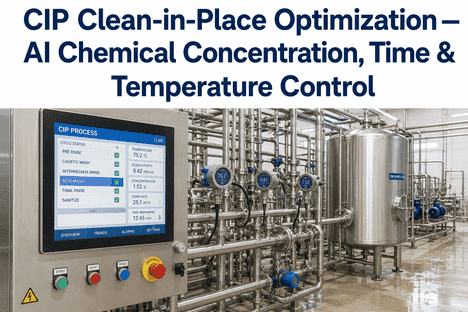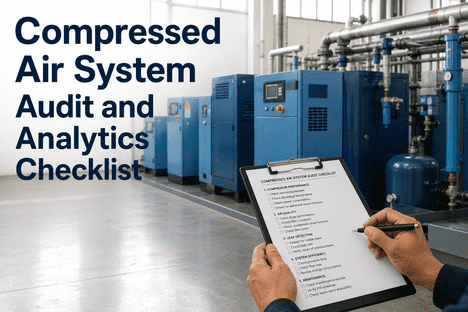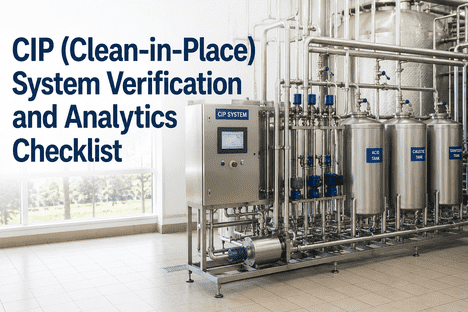
Clean-in-Place systems are the backbone of sanitation in food, beverage, dairy, and pharmaceutical processing facilities. The 3-A Sanitary Standards and the FDA Food Safety Modernization Act require that CIP systems be designed, operated, validated, and documented to consistently achieve a defined level of cleanliness on product contact surfaces without disassembly of the processing equipment. A systematic CIP verification and analytics checklist — covering chemical concentration, flow rate, temperature, contact time, mechanical action, return solution conductivity, equipment integrity, and documentation — provides the audit framework that sanitation supervisors, quality assurance teams, and maintenance engineers use to verify that every CIP cycle delivers the specified cleaning result. Facilities that implement this checklist and act on the analytical findings consistently achieve 99.5 percent or higher microbiological cleaning validation passes, reduce chemical and water consumption by 15 to 30 percent, extend CIP circuit equipment life by 3 to 5 years, and maintain a complete audit trail for every cleaning cycle that satisfies regulatory and third-party certification requirements.
Why CIP Verification and Analytics Matter for Food Safety
Clean-in-Place systems are the most critical sanitation asset in any liquid or wet food processing facility. A CIP system that fails to deliver the specified chemical concentration, temperature, flow rate, or contact time for even a single cycle can leave microbiological residues on product contact surfaces that contaminate the next production run. The financial impact of a single CIP failure in a dairy, beverage, or liquid food plant includes product recall costs that can exceed $10 million, regulatory fines, production downtime of 24 to 72 hours for manual cleaning and re-validation, and brand reputation damage that persists for years. The FDA Food Safety Modernization Act Preventive Controls rule mandates that sanitation procedures — including CIP cycle parameters — be validated, monitored, and documented as part of the facility's food safety plan. CIP verification analytics transforms the sanitation process from a time-based procedure that is assumed to be effective into a data-driven process that is proven to be effective for every cycle, every day, every year.
The economics of CIP optimization are equally compelling. A typical food processing plant with 20 to 50 CIP circuits operating 1 to 3 cycles per day consumes 500,000 to 2 million gallons of water and 50,000 to 200,000 pounds of caustic and acid cleaning chemicals annually. A 20 percent reduction in water and chemical consumption through analytics-based cycle optimization saves $50,000 to $250,000 per year in direct material costs, plus additional savings in wastewater treatment, heating energy, and labor. The CIP verification checklist provides the measurement framework that identifies every over-engineered cycle, every under-performing cleaning event, and every equipment degradation that compromises cleaning effectiveness or wastes resources.
The CIP Verification Checklist: Eight Audit Domains
The complete CIP system verification and analytics checklist covers eight domains. Each domain contains specific checklist items with measurement criteria, acceptance thresholds, and corrective action guidelines. The checklist is designed to be executed by sanitation supervisors and maintenance technicians, with data captured automatically through CIP system sensors and manually through inspection and sampling where sensor data is not available.
When we implemented CIP analytics across 42 circuits in our dairy processing plant, the first month of data revealed that 12 percent of our caustic wash cycles were running at concentrations below the validated minimum, and 18 percent of our final rinse cycles were terminating before the return conductivity had stabilized within 10 percent of incoming water. We were operating under the assumption that our CIP system was validated and reliable, but the analytics showed that we had systemic issues with chemical dosing pump calibration drift and conductivity sensor response time. Correcting those two issues alone increased our first-pass cleaning validation rate from 94 percent to 99.2 percent, reduced chemical consumption by 22 percent, and eliminated three product hold events per year that had been costing us an average of $180,000 per event in lab testing, production delay, and finished product disposal.
— Director of Quality and Food Safety, Regional Dairy Processing Cooperative — 42-Circuit CIP Analytics Implementation ResultsCommon CIP Verification Failures Identified by Analytics
The CIP verification analytics checklist routinely identifies six categories of failures that compromise cleaning effectiveness or waste resources. Each category has a characteristic signature in the analytics data that the checklist is designed to detect.
Dosing pump calibration drifts over time, causing caustic or acid concentration to fall below the validated minimum for cleaning effectiveness. Analytics detects low concentration through conductivity sensor trending and comparison against the concentration setpoint. Corrective action: recalibrate dosing pumps per manufacturer schedule (typically quarterly). Install online conductivity sensors with automated concentration verification that alerts the sanitation team when concentration deviates by more than 0.3 percent from target. iFactory's compliance platform tracks concentration trends by circuit and generates recalibration work orders automatically based on calibration due date or concentration drift rate.
CIP supply pump wear, partially closed valves, or fouling in the circuit piping reduces flow rate below the turbulent flow threshold (5 ft/sec supply, 3 ft/sec return). Reduced flow decreases the mechanical scrubbing action of the cleaning solution on product contact surfaces. Analytics detects flow degradation through supply and return flow meter trending and pump motor amp draw monitoring. Corrective action: inspect pump impeller and wear rings, verify valve position, and perform circuit pressure drop test to identify restricted sections. iFactory's analytics platform generates a circuit resistance trend and alerts maintenance when flow rate drops below 95% of baseline.
Excessive temperature drop between the supply header and the return sensor indicates inadequate insulation, heat loss through uninsulated piping sections, or a heat exchanger that is not maintaining setpoint. Temperature drop above 15 F can reduce the chemical reaction rate of the cleaning solution, compromising soil removal effectiveness on protein, fat, and carbohydrate residues. Analytics detects temperature loss through continuous comparison of supply and return temperature trends. Corrective action: insulate uninsulated piping, inspect heat exchanger for fouling, verify steam supply pressure and temperature to the CIP heat exchanger. iFactory tracks temperature differential by circuit and alerts when the drop exceeds the acceptance threshold.
Return conductivity that fails to stabilize within the expected time window indicates that detergent is not reaching all parts of the circuit, that there is excessive soil load diluting the detergent, or that the rinse is not fully removing chemical residue. Analytics detects conductivity deviation through comparison of the actual conductivity curve against the validated baseline curve for each circuit. Corrective action: verify circuit valve alignment, inspect spray devices for blockage, and confirm that all circuit branches are receiving flow. iFactory's platform models the expected conductivity curve for each CIP circuit and flags any cycle where the curve deviates by more than two standard deviations from the validated baseline.
Implementing CIP Verification Analytics with iFactory
iFactory's compliance and audit trail management platform provides the integrated data capture, analytics, and documentation infrastructure that transforms CIP verification from a manual checklist into an automated, continuous verification system. The platform integrates with CIP system PLCs, conductivity sensors, flow meters, temperature probes, and chemical dosing controllers to capture every cycle parameter at 30-second to 1-minute intervals. The analytics engine compares each cycle against the validated baseline for the specific CIP circuit and product type, automatically flagging any deviation from the accepted parameter range and generating a deviation report with root cause analysis and corrective action tracking.
The platform's compliance module automatically generates the complete audit trail required for FDA FSMA, 3-A Sanitary Standards, SQF, BRC, and GFSI certification audits. Every CIP cycle is documented with time-stamped parameter data, deviation flags, corrective action records, and operator sign-off in a format that satisfies regulatory requirements. The shift logbook feature enables sanitation operators to document pre-CIP equipment inspections, chemical tank inventory checks, and post-CIP visual inspections during their rounds, creating a permanent, tamper-evident record of sanitation verification that is directly accessible from the compliance dashboard. Book a demo to see how iFactory's CIP verification platform integrates with your existing CIP control system, or talk to an expert about implementing automated CIP analytics and compliance documentation for your food, beverage, or pharmaceutical processing facility.
Frequently Asked Questions
Conclusion
Clean-in-Place system verification is not optional in food, beverage, dairy, and pharmaceutical processing. The financial, regulatory, and brand reputation consequences of a single CIP failure — measured in product recall costs, regulatory fines, production downtime, and consumer health risk — far exceed the investment required to implement comprehensive CIP verification analytics. The eight-domain verification checklist described in this guide provides the audit framework that sanitation supervisors, quality assurance teams, and maintenance engineers need to verify that every CIP cycle delivers the specified cleaning result, every day, for every circuit.
The facilities that implement CIP verification analytics with automated data capture, continuous parameter monitoring, deviation detection, and compliance documentation consistently achieve 99.5 percent or higher first-pass cleaning validation rates, 15 to 30 percent reduction in chemical and water consumption, and a complete, audit-ready compliance record for every cycle.
iFactory provides the integrated CIP verification platform that turns the eight-domain checklist from a manual inspection form into an automated, continuously verifying, and compliance-ready sanitation management system. Book a demo to see how iFactory can help your facility implement CIP verification analytics, or talk to an expert about starting your CIP analytics program today.