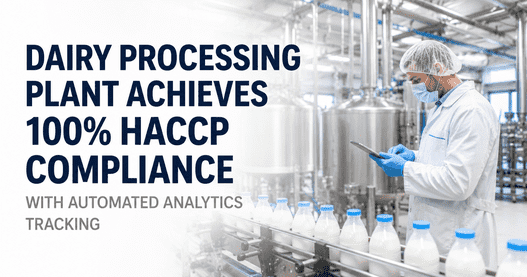
Green Valley Dairy Processing operated a mid-size fluid milk and yogurt manufacturing facility in Wisconsin, processing 1.2 million pounds of raw milk per day into pasteurised fluid milk, Greek yogurt, sour cream, and cottage cheese for distribution across the upper Midwest. The plant operated under a HACCP plan that had been developed in 2019 and updated annually, but the compliance documentation system had not been updated since the plant's original HACCP plan was written relying on paper logs filled out by operators at critical control points, manual transcription into spreadsheets at the end of each shift, and physical binders organised by month that were pulled for auditor review during annual SQF audits. In the 2024 SQF audit, the plant received 11 non-conformances 7 of which were directly related to inadequate or inconsistent documentation of CCP monitoring activities. The QA director estimated that completing the corrective actions for those non-conformances consumed 340 person-hours of QA team time over 3 months, and the near-miss on SQF certification (a score of 76, with 75 being the passing threshold) made it clear that the manual documentation system was no longer viable for a plant of this scale and complexity. This case study details how Green Valley Dairy deployed iFactory's automated compliance tracking platform across all CCPs and preventive control points, eliminated paper-based documentation entirely, achieved 100% HACCP compliance verification across 14 consecutive daily audits, and reduced the QA team's documentation burden by 92% from 18 person-hours per shift to less than 90 minutes.
Green Valley Dairy's HACCP plan identified 8 critical control points and 14 preventive controls across the processing operation — raw milk receiving and storage, pasteurisation, separation and standardisation, culture addition and fermentation, packaging and sealing, cold storage, CIP sanitation, and finished product testing. Each CCP had a defined monitoring frequency, critical limit, corrective action protocol, and documentation requirement. The monitoring data was recorded on paper logs at each CCP station — temperature charts every 15 minutes, flow diversion valve status at each pasteurisation cycle, pH and titratable acidity readings every 30 minutes during fermentation, metal detector checks every hour on packaging lines, and cleaning solution concentration and temperature readings for each CIP cycle. At the end of each shift, the QA technician collected the paper logs from all CCP stations, reviewed them for completeness, transcribed the critical data into a spreadsheet, and filed the paper originals in a binder sorted by date and CCP. The QA director estimated that the end-of-shift documentation review consumed 4 to 5 hours per shift, and that the reconciliation step — matching CCP readings to the defined critical limits and documenting any deviations — spawned an average of 3 to 5 corrective action investigations per shift that consumed additional time. The 2024 SQF audit findings confirmed that the system had systemic documentation gaps: missing time entries on pasteurisation temperature logs, illegible handwriting on pH readings, and inconsistent deviation documentation across shifts. Seven of the 11 non-conformances were classified as documentation-related, and the lead auditor specifically noted that "the documentation system does not provide adequate assurance that CCP monitoring activities are consistently performed and recorded in accordance with the HACCP plan."
Green Valley Dairy deployed iFactory's automated compliance tracking platform across all 8 CCPs and 14 preventive controls in a phased rollout over 8 weeks. The platform integrated directly with the plant's existing sensors and PLCs — pasteuriser temperature probes, flow diversion valve position sensors, CIP system controllers, pH meters, metal detectors, and filler head temperature sensors — capturing CCP data automatically at the required monitoring frequency without operator intervention. For data points that could not be captured automatically (organoleptic evaluations, visual cleanliness inspections, allergen cross-contact checks), the platform deployed digital checklists on tablets mounted at each CCP station, with configurable fields, required responses, and automatic validation to prevent incomplete or out-of-range entries. Every data point — whether automatically captured from sensors or manually entered through digital checklists — was time-stamped, operator-identified, and compared against the HACCP plan's critical limits in real time. A deviation alert was generated within 30 seconds of a critical limit breach, simultaneously notifying the QA supervisor, shift manager, and plant manager through the platform's mobile app and generating a corrective action record with the deviation details, affected product, and required corrective action automatically populated from the HACCP plan. The manual end-of-shift documentation review was replaced by the platform's automated compliance verification report, which aggregated all CCP monitoring data for the shift, flagged any deviations or documentation gaps, and generated an audit-ready compliance summary with every data point cross-referenced to the corresponding HACCP plan requirement.
The deployment was structured in four phases over 8 weeks, designed to build confidence in the automated system before retiring the paper-based backup system. Each phase covered a subset of CCPs, with the paper system maintained in parallel until the automated system had demonstrated consistent, accurate documentation across all shifts.
- Connected iFactory platform to pasteuriser PLCs, CIP controllers, pH meters, temperature loggers, metal detectors, and flow diversion valve sensors at all 8 CCPs — 34 sensor integration points in total.
- Mapped each sensor data stream to the corresponding HACCP plan CCP — critical limits, monitoring frequency, and corrective action protocol configured in the platform for each data point.
- Deployed digital checklists on 12 tablets mounted at CCP stations for manual data entry points — organoleptic milk evaluation, allergen check, visual cleanliness inspection.
- Configured automated compliance rules: pasteurisation temperature logged every 15 seconds (not every 15 minutes as the paper system required), flow diversion recorded at each pasteurisation cycle start and end, pH logged at each fermentation batch.
- Paper system maintained in parallel during Phase 1 — both data streams recorded for comparison and validation.
- Activated real-time deviation alerting — platform generated push notifications to QA supervisor and shift manager within 30 seconds of any critical limit breach.
- Deployed automated corrective action workflow: deviation detected, affected product inventory identified and quarantined in the platform, corrective action record generated with pre-configured HACCP plan protocols, assigned to the shift supervisor with a 30-minute response time target.
- Configured escalation rules — if corrective action not completed within 30 minutes, alert escalated to QA director. If not completed within 60 minutes, to plant manager.
- QA team monitored alerting accuracy and response times during this phase — pre-retirement of paper system ensured no documented data loss during transition.
- Average deviation response time: 12 minutes — down from 2.5 hours under the paper system (when deviations were even detected during end-of-shift review).
- Activated automated compliance verification — platform generated a verified compliance statement for each shift, aggregating all CCP monitoring data, deviation events, corrective actions, and preventive control verifications into a single audit-ready report.
- Compliance verification threshold set at 100% — every CCP data point must be present and within critical limits, or a verified deviation with completed corrective action must be documented. No exceptions, no undocumented gaps.
- Configured automated audit trail export — platform generated GFSI-compliant audit documentation packages (HACCP logs, CCP monitoring records, deviation and corrective action records, preventive control verification records) in PDF and Excel format, organised by SQF clause and ready for auditor review.
- QA team conducted 14 consecutive daily internal audits using the platform's compliance reports — each audit confirmed 100% HACCP compliance verification across all CCPs and preventive controls.
- Paper system officially retired at end of Phase 3 — all CCP documentation transitioned to fully automated digital format.
- Deployed predictive compliance analytics — platform analysed CCP monitoring data trends and identified CCPs with increasing deviation frequency, enabling proactive preventive action before critical limit breaches occurred.
- Integrated HACCP compliance data with production scheduling — platform flagged high-risk production scenarios (product changeovers on lines with recent CCP deviations) and recommended additional verification steps before production release.
- Configured automated sanitation verification — CIP cycle data (time, temperature, flow rate, chemical concentration) automatically verified against HACCP sanitation protocols and logged as a verified preventive control.
- Deployed supplier compliance dashboard — raw milk supplier testing data integrated with the platform, providing a single HACCP compliance view from raw milk receiving through finished product dispatch.
- Data analysis revealed that 73% of temperature-related deviations occurred during the first 2 hours of the production day — leading to a process improvement that adjusted start-up verification protocols and reduced temperature deviations by 58%.
The following table shows the compliance impact across each of the 8 critical control points — comparing the documentation compliance rate before iFactory (measured during the 2024 SQF audit window) and after iFactory deployment (averaged over the 14 consecutive daily internal audits). The documentation compliance rate measures the percentage of required CCP monitoring entries that were complete, accurate, and within the defined time window.
- Paper logs at each CCP station filled out by operators — illegible entries, missing time stamps, transcription errors common.
- End-of-shift manual review requiring 4-5 hours per shift for a single QA technician to collect, review, and transcribe paper logs.
- Deviations detected during end-of-shift review — 2-8 hour delay between deviation occurrence and detection. Undocumented deviations common.
- Corrective actions initiated 2.5 hours after deviation detection on average. No escalation protocol for unresolved deviations.
- Audit preparation required 3-5 days of manual report generation — pulling paper binders, checking for completeness, generating corrective action summaries.
- Documentation compliance rate across all CCPs averaged 79% during the 2024 SQF audit window.
- 34 automated sensor data streams and 12 digital checklists at CCP stations — every entry time-stamped, operator-identified, and validated against HACCP critical limits.
- Automated compliance verification completed in under 5 minutes — QA technician reviews exception reports rather than transcribing paper logs.
- Deviations detected within 30 seconds, alerting QA supervisor and shift manager via mobile push notification. Zero undocumented deviation events.
- Corrective actions initiated within 12 minutes on average. Automatic escalation if unresolved at 30 minutes (QA director) and 60 minutes (plant manager).
- Audit-ready compliance report generated automatically for any date range — complete CCP monitoring data, deviation records, corrective actions, and preventive control verifications in SQF-compliant format.
- 100% documentation compliance rate sustained across 14 consecutive daily internal audits.
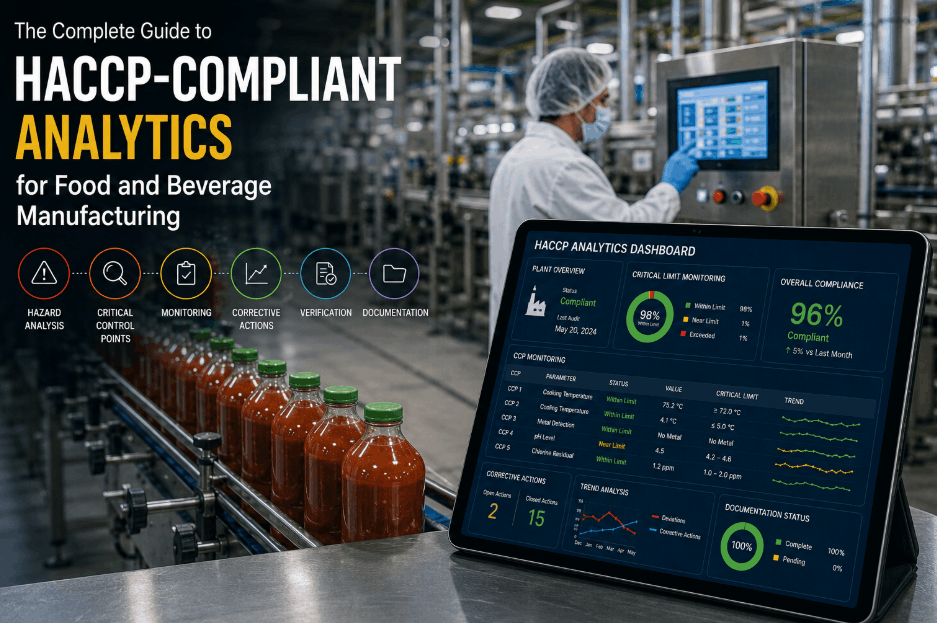
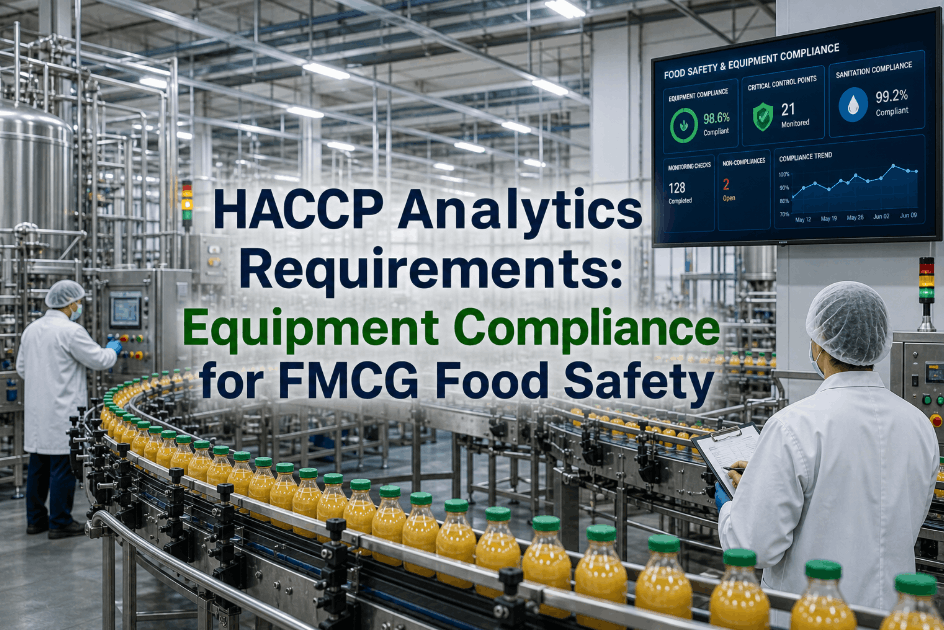
iFactory's compliance dashboard gave Green Valley Dairy's QA team a single-screen view of HACCP compliance status across the entire processing operation. The dashboard displayed the current compliance status for each CCP as a green (verified), amber (monitoring in progress with no deviations), or red (active deviation) indicator, with the time since last verified reading displayed below each indicator. A deviation timeline showed active and recent deviation events with their current status — open, corrective action in progress, or closed and verified. The automated compliance completion percentage for the current shift was displayed at the top of the dashboard — Green Valley's QA director noted that the most powerful feature was the visible shift-level compliance score, which created a positive competition among shifts to maintain 100% compliance throughout the production day. The dashboard also displayed the scheduled verification activities for the current shift — allergen checks, sanitation verification, organoleptic evaluations — with a countdown timer showing the time remaining for each scheduled verification. Activities nearing their deadline were highlighted in amber, and activities past their deadline were flagged in red with an immediate escalation to the shift supervisor. The predictive compliance module displayed trend lines for each CCP's deviation frequency over the trailing 30 days, surface conditions where CCPs showed increasing deviation patterns before they reached critical limit breach thresholds.
"The 2024 SQF audit was a wake-up call for our entire organisation. We had been running the same paper-based HACCP documentation system for 14 years, and we knew it had gaps — but we did not realise how deep the gaps were until the lead auditor showed us that 7 of our 11 non-conformances were directly caused by documentation failures. We had CCP monitoring data that was missing, illegible, or inconsistently recorded across shifts. We had deviation events that were detected during end-of-shift review but had already affected product that had moved into cold storage. And we had corrective actions that were documented in the paper log but never actually completed. iFactory's automated compliance platform eliminated every one of these gaps. Within 8 weeks of deployment, we transitioned from a system that required 18 person-hours per shift for documentation to a system that automates 92% of that work and surfaces only the exceptions for QA review. Our compliance rate went from 79% to 100%, and we sustained that 100% compliance across 14 consecutive daily internal audits. When the SQF auditor returns for our next certification audit, they will not see a single paper log. They will see a complete, verified, time-stamped digital audit trail for every CCP, every deviation, and every corrective action — and they will be able to verify every data point against the HACCP plan in real time." — Mark Thompson, QA Director, Green Valley Dairy Processing
Beyond the compliance improvement, the iFactory platform delivered significant financial benefits. The 340 person-hours consumed by QA team corrective actions for the 2024 SQF findings represented $23,800 in direct labour cost at an average loaded hourly rate of $70 — labour that was diverted from process improvement and food safety projects. The QA team's end-of-shift documentation workload was reduced by 92%, freeing 14 person-hours per shift that were redirected to proactive food safety initiatives — root cause analysis, supplier quality management, and process optimisation. The platform's real-time deviation detection prevented 17 events over the first 90 days that would have gone undetected under the paper system for 2 to 4 hours — events that could have resulted in product rework, hold-and-test delays, or in the worst case, a product recall. The predictive compliance analytics identified 3 CCPs with increasing deviation trends that were proactively addressed before they reached critical limit breach thresholds — preventing an estimated $280,000 in potential product loss that would have resulted from the temperature excursions and pH deviations that were forecast and prevented. The total first-year benefit from the automated compliance platform, including labour savings, product loss prevention, and recall risk avoidance, was estimated at $520,000 — delivering a return on investment of 470% in the first year.
Green Valley Dairy Processing's deployment of iFactory's automated compliance tracking platform transformed their HACCP documentation system from a labour-intensive, error-prone paper-based process that generated 11 SQF non-conformances and consumed 340 person-hours of corrective action labour into a real-time, automated compliance verification system that achieved and sustained 100% HACCP compliance across every CCP and preventive control. The platform's integration with existing plant-floor sensors eliminated the documentation gaps that had been the root cause of 7 of the 11 non-conformances. The real-time deviation detection reduced the time from deviation occurrence to detection from 2 to 8 hours to under 30 seconds. The automated corrective action workflow ensured that every deviation was documented, assigned, and resolved with escalation to plant management when response targets were not met. The audit-ready compliance report generation eliminated 3 to 5 days of manual audit preparation work and gave the QA team the confidence that every data point required by the HACCP plan was present, verified, and cross-referenced to the corresponding plan requirement. With a first-year return on investment of 470% and a 100% compliance rate that has been sustained through daily internal audits, iFactory's automated compliance platform has become the foundation of Green Valley Dairy's food safety management system and the model for how dairy processors can eliminate documentation-related audit findings through automated HACCP compliance tracking.