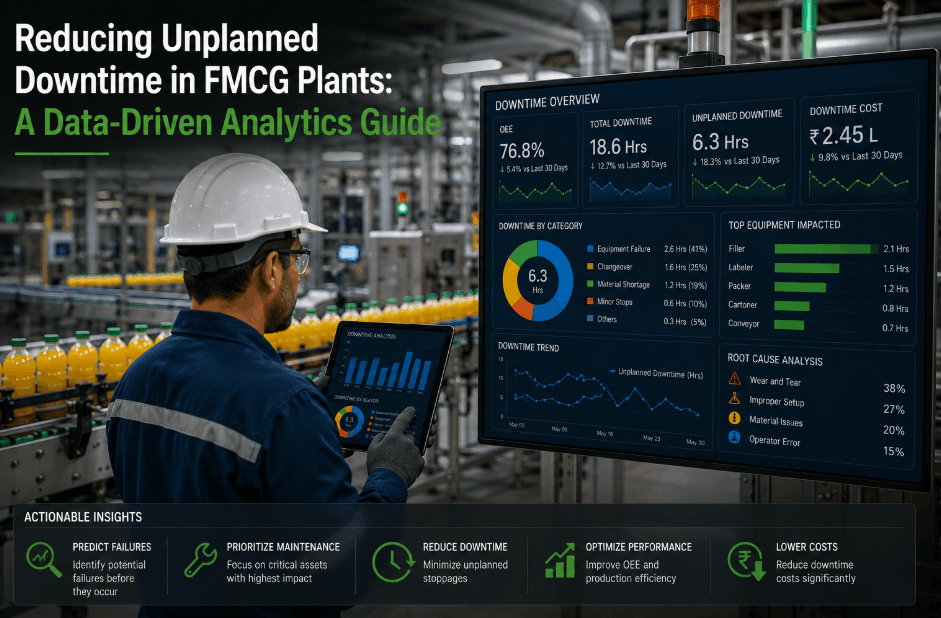
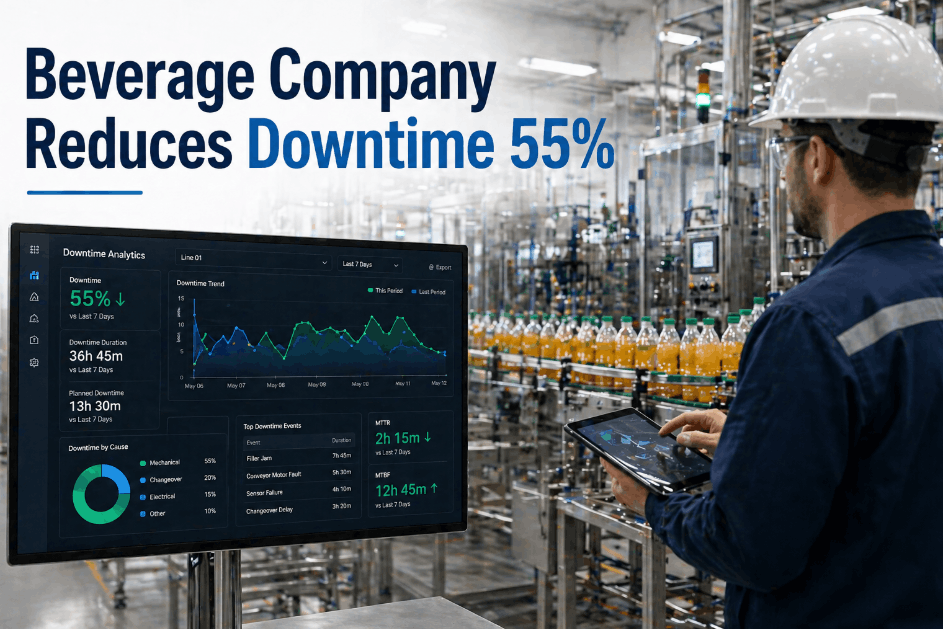
Global Beverage Company Reduces Unplanned Downtime by 55% Across 8 Plants
By Seren on June 19, 2026
GlobalBevCo operated 8 high-speed beverage production plants across three continents, producing carbonated soft drinks, bottled water, juices, and energy drinks for distribution in 40 countries. The company's 32 production lines filled over 2.5 billion units per year each line running at speeds up to 72,000 bottles per hour on the fastest carbonated soft drink lines. The vice president of manufacturing oversaw a network where each plant operated as an independent production unit with its own maintenance team, its own spare parts inventory, and its own approach to downtime tracking. Across the network, unplanned downtime averaged 14.8% of available production time ranging from 9.2% at the best-performing plant to 22.1% at the worst. The direct cost of unplanned downtime lost production volume, wasted raw materials, idle labour, and emergency maintenance was estimated at $7.6 million annually, but the VP suspected the real figure was higher because no plant had a systematic method for capturing the full cost of a downtime event. This case study details how GlobalBevCo deployed iFactory's AI-powered predictive analytics platform across all 8 plants, reduced unplanned downtime by 55% from 14.8% to 6.7%, and generated $4.2 million in annual cost savings with every plant using a standardised downtime classification system, predictive maintenance models deployed on a common asset taxonomy, and a network-wide OEE dashboard that gave the VP real-time visibility into every line's performance from a single screen.
8 Plants. 32 Lines. 3 Continents. One Platform. 55% Less Unplanned Downtime and $4.2M in Annual Savings.
iFactory's AI-powered predictive analytics platform gave GlobalBevCo standardised downtime visibility across every plant, predictive maintenance models deployed on a common asset taxonomy, and a network-wide dashboard that turned unplanned downtime from an accepted cost into a measurable, reducible metric.
Network-wide unplanned downtime baseline — ranging from 9.2% at the best plant to 22.1% at the worst — representing $7.6M in estimated annual production losses
6.7%
Network-wide unplanned downtime after iFactory deployment — a 55% relative reduction achieved within 14 months across all 8 plants with consistent methodology
$4.2M
Annual cost savings from reduced downtime — including recovered production volume, reduced emergency maintenance spend, and lower raw material waste
92%
Of plants extended their iFactory deployment beyond the initial scope within 6 months — adding additional lines, new predictive models, and integration with plant-level MES and ERP systems
The Baseline: What 14.8% Unplanned Downtime Looked Like Across the Network
Before iFactory, each plant tracked downtime using its own methods. Some plants used paper logs filled out by line operators. Others used spreadsheets that were reconciled at the end of each shift. Only two plants had automatic downtime tracking through their SCADA systems — and those plants categorised downtime differently from each other. The VP of manufacturing received a monthly report that showed total downtime hours by plant, but the numbers could not be compared across plants because the classification systems were different. Worse, the root causes of downtime were not systematically captured at any plant — a filler jam that stopped a line for 15 minutes was recorded in three different categories depending on which operator filled out the log and how they interpreted the downtime classification. The first phase of the iFactory deployment addressed this data standardisation problem before any predictive model was deployed.
01
Filler & Capper
34% of Downtime
Filler valve failures, capper head jams, and CIP-related delays dominated this category. iFactory's downtime decomposition revealed that 60% of filler-related downtime was caused by just three recurring failure modes across all 8 plants — filler valve seal wear, capper head alignment drift, and CIP cycle timing variability. These failure modes were predictable and preventable with standardised maintenance protocols.
Predictive models deployed
02
Labelling & Packaging
27% of Downtime
Labeller misalignment, sleeve applicator jams, shrink tunnel temperature drift, and case packer changeover issues. This category showed the widest variation between plants — the best plant averaged 45 minutes per shift while the worst averaged 2.3 hours. iFactory's standardised classification revealed that 40% of this downtime was attributable to format changeover procedures that differed significantly between plants.
Standardised procedures
03
Conveyor & Transfer
18% of Downtime
Conveyor jams at transfer points, bottle back-ups, air conveyor blockages, and chain wear causing tracking issues. This category was the least consistently tracked across plants — some plants classified conveyor jams as filler downtime because the filler was the bottleneck machine. iFactory's automated classification using PLC signal patterns removed the interpretation variable.
Automated classification
04
Utilities & Services
13% of Downtime
Compressed air pressure drops, chilled water temperature excursions, and CO2 supply interruptions. These events were recorded as utility downtime only when the line stopped — partial pressure drops that slowed production without stopping the line were invisible to the manual tracking system. iFactory's continuous PLC monitoring captured all speed losses that the manual system missed.
Continuous monitoring
Of the 14.8% total unplanned downtime, the iFactory baseline analysis revealed that 55% was attributable to failure modes that were common across multiple plants — meaning a predictive model developed at one plant could be deployed at all 8 plants with minimal customisation.
55% of downtime from common failure modes across all plants.
Standardised Classification · Cross-Plant Benchmarking · Root Cause Analysis · Predictive Model Scaling
Before iFactory, the VP Could Not Compare Downtime Between Two Plants Because Each Plant Used a Different Classification System. After 30 Days, Every Minute of Downtime Across 8 Plants Was Categorised, Measured, and Ranked.
iFactory's standardised downtime classification and cross-plant benchmarking gave GlobalBevCo the first apples-to-apples comparison of downtime across their entire manufacturing network — enabling the VP to identify best practices and deploy them across all 8 plants.
The Deployment Approach: Phased Rollout Across 8 Plants with Standardised Methodology
GlobalBevCo deployed iFactory using a phased approach across all 8 plants over 14 months. The deployment was structured in four phases — starting with data standardisation and visibility, then moving to predictive maintenance, then to cross-plant optimisation, and finally to sustained governance. Each phase built on the previous one, and each plant progressed through the phases at its own pace based on its current data infrastructure and team readiness.
Phase 1 — Months 1-4
Standardise, Connect, and Baseline
Deployed standardised downtime taxonomy across all 8 plants — 12 root cause categories, 48 sub-categories — replacing 8 different plant-level classification systems.
Connected iFactory to PLC networks at all 8 plants via OPC-UA and MQTT bridges. Average connection time per plant: 5 days.
Established network-wide baseline: 14.8% unplanned downtime, ranging from 9.2% to 22.1% across plants.
First apples-to-apples downtime comparison across the network — revealed that the best plant's downtime was 60% lower than the worst plant for the same equipment types.
Identified 17 common failure modes that accounted for 55% of total network-wide downtime.
Outcome: Network-wide downtime visibility with standardised classification. Cross-plant benchmarking established.
Phase 2 — Months 3-8
Predictive Maintenance Deployment
Deployed predictive models for the 17 common failure modes: filler valve seal wear, capper head alignment, conveyor bearing wear, labeller servo drift, air compressor health, and 12 others.
Models trained on 18+ months of historical PLC data from all 8 plants — enabling cross-plant model training that improved prediction accuracy at smaller plants with limited local data.
Average prediction accuracy: 84% within a 48-hour window. Best-performing models (filler valve seal wear, conveyor bearing) achieved 91% accuracy.
Integrated predictive alerts with each plant's existing CMMS — work orders auto-generated with predicted failure mode, recommended intervention, and parts list.
Predictive maintenance reduced unplanned downtime from the 17 targeted failure modes by 68% within 3 months of deployment.
Outcome: 68% reduction in targeted downtime. Predictive models scaled across all 8 plants.
Phase 3 — Months 6-12
Cross-Plant Optimisation & Standardisation
Benchmarked best-practice changeover procedures from the three fastest plants and standardised across all 8 — reducing average format changeover time by 28% network-wide.
Standardised preventive maintenance task frequencies based on predictive model insights — moving from fixed-interval to condition-based PM schedules.
Deployed network-wide OEE dashboard: real-time visibility into line-by-line and plant-by-plant performance for the VP and regional directors.
Implemented automated root cause analysis — the platform correlated downtime events with upstream conditions (raw material batch, line speed, operator shift) to identify hidden cause-effect relationships.
Cross-plant analysis revealed that 4 of the 8 plants had significantly lower conveyor-related downtime — their conveyor maintenance practices were documented and deployed network-wide.
Outcome: Network-wide unplanned downtime reduced to 8.1%. Best practices deployed across all plants.
Phase 4 — Months 10-14
Sustain, Govern, and Expand
Established network-wide downtime governance: each plant's monthly downtime review follows a standard agenda — review top 5 losses by category, verify predictive model accuracy, review open corrective actions, update action plan.
Implemented automated downtime reporting: VP receives a weekly network downtime summary with plant rankings, trend charts, and exception alerts for plants exceeding monthly downtime targets.
Expanded iFactory deployment beyond the initial 32 lines to include 18 additional packaging lines, 2 PET blow-moulding operations, and 3 water treatment facilities.
Rolled out predictive maintenance models for 8 additional equipment types: compressors, chillers, boilers, and wastewater treatment equipment.
Network-wide unplanned downtime stabilised at 6.7% and remained at or below this level through month 14 and beyond.
Network-Wide Results: Plant-by-Plant Downtime Reduction and Savings
The results varied by plant based on starting downtime level, equipment age, and team readiness — but every plant achieved a measurable reduction. The following table shows the baseline downtime, post-deployment downtime, reduction percentage, and annual savings for each of the 8 plants.
Plant
Baseline Downtime
Post-Deployment
Reduction
Annual Savings
Plant A
9.2%
4.8%
48%
$390,000
Plant B
12.5%
5.9%
53%
$510,000
Plant C
14.1%
6.2%
56%
$480,000
Plant D
15.8%
7.1%
55%
$560,000
Plant E
16.3%
7.5%
54%
$530,000
Plant F
18.7%
8.2%
56%
$620,000
Plant G
20.4%
8.9%
56%
$580,000
Plant H
22.1%
9.1%
59%
$530,000
Network
14.8%
6.7%
55%
$4.2M
The iFactory Platform Capabilities That Enabled the Transformation
The platform capabilities that enabled this transformation are designed for multi-plant enterprises that need standardised visibility, scalable predictive models, and cross-plant benchmarking. Five core capabilities powered the GlobalBevCo deployment.
Capability 01
Standardised Downtime Taxonomy — One Language Across Every Plant
The platform enforces a single downtime classification system across all connected plants. Every downtime event is automatically categorised using PLC signal patterns, machine state data, and configurable rules — eliminating the variability that made cross-plant comparison impossible with manual tracking. The taxonomy is hierarchical: 12 root cause categories at the top level, 48 sub-categories for detailed root cause tracking, and equipment-specific failure modes at the third level. Plants can add local sub-categories within the standard framework, ensuring that local specificity is preserved without breaking cross-plant comparability.
One taxonomy across all plants. Automated classification. Cross-plant comparison enabled.
Capability 02
Cross-Plant Predictive Models — Trained on Network Data, Deployed at Every Plant
Predictive models are trained on the combined dataset from all plants — not on each plant's data in isolation. This cross-plant training approach is particularly valuable for smaller plants that have limited historical failure data: the model learns failure patterns from plants with more data and applies that learning to predict failures at plants where the same equipment has not yet failed. The platform monitors model accuracy at each plant individually and automatically adjusts model parameters if a plant's equipment behaves differently from the network average. At GlobalBevCo, cross-plant model training improved prediction accuracy at the three smallest plants by an average of 18 percentage points compared to plant-specific models.
Cross-plant model training. 18-point accuracy improvement at smaller plants. Scalable deployment.
Capability 03
Network-Wide Dashboard — Real-Time Visibility for the VP
The VP-level dashboard displays every plant's downtime performance on a single screen — with drill-down to individual line, shift, and failure mode. Plants are ranked by downtime percentage with colour-coded status against target. Trend charts show each plant's 4-week rolling average. Exception alerts notify the VP when any plant's downtime exceeds its monthly target by more than 20%. The dashboard also displays cross-plant benchmarks — the best-performing plant for each downtime category is highlighted, and the platform identifies which other plants have the same equipment type and could adopt the best plant's maintenance practices. Book a Demo to see the network-wide dashboard configured for your enterprise.
Standardised Root Cause Analysis — Automated Correlation Across the Network
The platform automatically correlates downtime events with upstream conditions — raw material batch, line speed, operator shift, ambient temperature, and preventive maintenance history — to identify hidden cause-effect relationships that would not be visible when analysing a single plant's data in isolation. When a specific downtime pattern appears at multiple plants within a short time window, the platform flags a potential systemic issue — such as a raw material quality problem affecting filler performance across the entire network. At GlobalBevCo, this feature identified that a change in PET preform supplier at 3 plants was correlated with a 23% increase in blow-moulder downtime at those plants — a correlation that no single plant team had spotted.
Multi-Plant Governance Workflow — Standardised Reviews and Accountability
The platform supports a standardised monthly downtime governance process across all plants. Each plant team reviews their top 5 downtime losses by category, verifies predictive model accuracy, reviews open corrective actions, and updates their action plan — all within the iFactory interface. The VP reviews a consolidated governance report that shows each plant's compliance with the governance process, the status of cross-plant corrective actions, and the network-wide trend. The governance workflow ensures that the initial improvement achieved through predictive maintenance and standardisation is sustained through ongoing management attention and accountability.
Standardised governance workflow. Cross-plant accountability. Sustained improvement through management process.
What the VP's Network Dashboard Shows — Six Views for Enterprise-Wide Visibility
The VP's network dashboard is designed for a single purpose: providing enterprise-wide visibility into downtime performance across all plants, enabling the VP to identify which plants need support, which practices should be replicated, and whether the network is improving or degrading. Six dashboard views deliver this information at a glance.
View 01
Network Downtime Heat Map — Plants Ranked by Performance
Each plant displayed as a colour-coded tile: green (downtime below 7%), amber (7-10%), red (above 10%). Plants are ranked by downtime performance with the current month's percentage and the 4-week rolling trend indicator. Tiles are clickable to drill into plant-level detail — lines, downtime categories, and top failure modes. The VP sees the network status in 5 seconds: how many plants are green, how many are red, and which direction each plant is trending.
VP action: Green plants — maintain. Red plants — schedule call with plant manager.
View 02
Network-Wide Pareto — Top Downtime Categories Across All Plants
A network-level Pareto chart ranks downtime categories by total hours lost across all 8 plants. The VP sees whether the network's downtime is concentrated in a few dominant categories (filler, packaging, conveyor) or distributed across many. A Pareto that shifts over time shows whether improvement initiatives are working: if filler-related downtime drops from first to third place, the predictive maintenance programme for filler valves is delivering results.
VP action: Top network-wide categories determine corporate improvement initiative priorities.
View 03
Cross-Plant Benchmark — Best vs Worst by Downtime Category
For each downtime category, the dashboard displays which plant has the lowest downtime and which has the highest. The VP can see at a glance that Plant A has the lowest filler downtime (best practice) while Plant H has the highest (improvement opportunity). The platform recommends which specific maintenance practices from the best plant could be adopted at the worst plant — based on equipment type, line configuration, and product category match.
VP action: Direct best-practice transfer from top-performing to bottom-performing plants.
View 04
Predictive Model Accuracy — Network-Wide Model Performance
Every predictive model deployed across the network is displayed with its current accuracy score, the number of predictions made, and the number of confirmed hits. Models that fall below the 75% accuracy threshold are flagged for retraining or parameter adjustment. The VP sees whether the predictive maintenance programme is maintaining its effectiveness across all plants.
VP action: Flag models below 75% accuracy for retraining. Allocate data science resources to struggling models.
View 05
Savings Tracker — Cost Avoidance from Downtime Reduction
The savings tracker converts downtime reduction into financial impact — displaying cumulative savings to date, monthly savings rate, and savings by plant. The calculation uses each plant's standard cost per hour of downtime, which includes lost production margin, raw material waste, labour cost during downtime, and average emergency maintenance premium. The VP uses this view to quantify the ROI of the iFactory deployment and justify the investment to the CFO.
VP action: Present savings tracker to CFO for programme funding justification.
View 06
Action Item Tracker — Open Corrective Actions by Plant
Every corrective action generated from downtime root cause analysis, predictive model findings, or governance reviews is tracked in the platform with owner, due date, status, and expected impact. The VP sees the total number of open actions across the network, actions past due, and actions by plant. This view ensures that the improvement programme does not lose momentum — actions that remain open past their due date are escalated automatically.
VP action: Review past-due actions weekly. Escalate to plant manager for overdue items.
"
Before iFactory, I could not tell you which plant had the lowest downtime, why their downtime was lower, or how to replicate their practices at the other plants. Each plant had its own way of tracking downtime, its own classification system, and its own set of maintenance practices — and there was no way to compare them. The iFactory platform gave us a single version of the truth across all 8 plants. For the first time, I could see on a single screen which plants were winning and which were losing, what was driving their downtime, and which best practices I should deploy across the network. Within 14 months, every plant had improved. The best plant went from 9.2% to 4.8% downtime. The worst plant went from 22.1% to 9.1% — a 59% improvement. The total savings of $4.2 million per year exceeded our initial business case by 40%. But the real value is strategic: we now have a platform that scales as we acquire new plants. When we bring a new plant into the network, we connect it to iFactory, apply the standardised taxonomy, deploy the predictive models, and start benchmarking within weeks — not years.
— Vice President of Manufacturing, Global Beverage Company — 8 Plants, 32 Production Lines, 2.5 Billion Units Per Year
Conclusion
The GlobalBevCo case study demonstrates a principle that applies across multi-plant manufacturing enterprises: unplanned downtime cannot be reduced systematically if it cannot be measured consistently. The 55% reduction achieved across 8 plants was not the result of a single technology deployment — it was the result of a standardised management system enabled by a platform that gave every plant the same downtime classification system, the same predictive maintenance tools, and the same performance benchmarks.
The economics of multi-plant downtime reduction compound because the same investment in predictive model development, standardised taxonomy design, and dashboard configuration is deployed across multiple plants with incremental deployment cost at each additional plant. At GlobalBevCo, the pilot plant's deployment cost was recovered within the first 4 months of operation. Each additional plant was connected at approximately 60% of the pilot cost because the standardised taxonomy, predictive models, and dashboard templates were already developed. The total programme investment was recovered within 9 months of network-wide deployment.
iFactory's AI-powered predictive analytics platform is designed for manufacturing leaders who need to reduce unplanned downtime across multiple plants with consistent methodology, scalable technology, and measurable results. Book a Demo to see the multi-plant downtime reduction platform configured for your manufacturing network, or talk to an expert about a free downtime baseline analysis for up to three plants in your network.
Frequently Asked Questions
The pilot plant deployment typically takes 4 to 6 weeks from kickoff to live dashboards, including PLC connection, taxonomy configuration, baseline analysis, and dashboard setup. Each additional plant takes 2 to 4 weeks for connection and configuration — significantly faster than the pilot because the standardised taxonomy, predictive model templates, and dashboard formats are already developed. The variance depends on the plant's existing PLC and SCADA infrastructure, the availability of network connectivity, and the plant team's capacity to participate in the deployment activities. For a network of 5 to 10 plants, the full deployment is typically completed within 8 to 14 months when deploying in phased batches of 2 to 3 plants. The cross-plant model training approach means that predictive model accuracy at later plants benefits from the data collected at earlier plants — so the incremental value increases with each additional plant connected. Talk to an expert about a deployment timeline assessment for your plant network.
The taxonomy is designed with a standardised top-level structure — the 12 root cause categories apply to any manufacturing environment — and configurable lower-level categories that accommodate equipment-specific and process-specific failure modes. A carbonated soft drink filler and a bottling line for still water share the same top-level category (Filler & Capper) but have different sub-categories for the specific failure modes relevant to each equipment type. This approach ensures that cross-plant benchmarking at the category level is valid across all plants — you can compare filler downtime between a CSD plant and a water plant — while preserving the specificity needed for root cause analysis at each individual plant. The platform also supports product-family and packaging-format tagging, so downtime can be analysed by format category across plants. Book a Demo to see how the taxonomy is configured for plants with mixed product and packaging types.
iFactory is designed for heterogeneous enterprise environments — plants may use different CMMS platforms, different MES systems, and different ERP instances, and the platform connects to all of them through standard APIs and integration adapters. The platform acts as a unification layer: it reads downtime data from the plant-floor PLCs (which are common across plants regardless of the higher-level systems), applies the standardised taxonomy, and writes predictive alerts and downtime reports to each plant's existing CMMS. The VP-level dashboard aggregates data from all plants regardless of which higher-level systems each plant uses. For plants that do not have a CMMS or prefer to use iFactory's built-in maintenance workflow, the platform includes work order creation, assignment, scheduling, and completion tracking — with mobile app access for technicians. Most multi-plant enterprises use the hybrid approach: plants with existing CMMS keep their system and receive iFactory data through integration, while plants without a CMMS use iFactory's built-in maintenance module. Talk to an expert about integration architecture for your specific enterprise system landscape.
Based on documented results across multi-plant deployments, the typical unplanned downtime reduction in the first 12 months ranges from 40% to 55%, with GlobalBevCo at 55% representing the upper end of the range. The three key success factors that determine the reduction rate are: (1) executive commitment — networks where the VP or director of manufacturing personally reviews the cross-plant dashboard weekly and holds plant managers accountable for their downtime performance achieve 2-3x the reduction of networks where the platform is managed at the plant level only; (2) data infrastructure quality — plants with well-instrumented PLCs and reliable network connectivity achieve faster deployment and more accurate predictive models; (3) maintenance team adoption — plants where maintenance teams are trained to trust and act on predictive alerts achieve faster downtime reduction than plants where alerts are treated as advisory rather than actionable. The cross-plant approach itself is a success factor — networks that deploy the standardised taxonomy and benchmarking capability across all plants simultaneously achieve faster overall improvement because best practices are identified and transferred more quickly. Book a Demo to get a site-specific downtime reduction projection for your manufacturing network.
You Cannot Reduce Unplanned Downtime Across Your Network If You Cannot Measure It Consistently Across Every Plant. Get a Free Downtime Baseline Analysis for Up to Three Plants.
iFactory's AI-powered predictive analytics platform gives multi-plant enterprises standardised downtime visibility, cross-plant predictive models, and network-wide benchmarking — enabling 40-55% unplanned downtime reduction and millions in annual cost savings. Designed for heterogeneous enterprise environments with different CMMS, MES, and ERP systems at each plant.