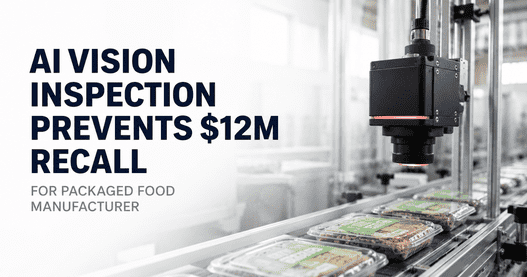
FreshPak Foods operated a high-speed packaged food manufacturing facility in the Midwest United States, producing 12 million units per month of ready-to-eat meal kits, salad bowls, and protein packs across 8 packaging lines. Each line ran at speeds up to 300 units per minute, using heat-sealed film lids on PET and PP trays with a target seal integrity specification of 0.3mm maximum allowable defect width. In early 2025, the company's quality team identified a recurring seal integrity issue on their highest-volume line line 4, which produced 2.8 million units per month of a flagship salad bowl product distributed through 3,000 retail locations across 18 states. Manual quality checks conducted every 2 hours caught some seal defects, but the sampling rate of 0.04% meant that the vast majority of units shipped without any inspection. When the quality team simulated a recall scenario based on the defect pattern they had observed, the estimated cost including product retrieval, destruction, retailer chargebacks, brand damage, and potential regulatory fines exceeded $12 million. This case study details how FreshPak Foods deployed iFactory's AI Vision Inspection system on line 4, achieved 100% inline inspection at full line speed, detected every seal defect down to 0.3mm, and prevented what would have been the largest product recall in the company's history.
FreshPak Foods' quality system relied on a manual sampling protocol that had been in place for 14 years. Every two hours, a quality technician walked to line 4, pulled 12 units from the conveyor, transferred them to the quality lab, and performed a manual seal peel test using a digital torque gauge. The test took 8 minutes per batch. In an 18-hour production day, the technician inspected 108 units out of 324,000 produced — a sampling rate of 0.033% that the company's internal audit had flagged as insufficient two years earlier, but no cost-justified alternative had been identified. The seal integrity issue that triggered the recall simulation was first detected when a retailer returned 47 units from a single pallet with visible seal separation. The quality team traced the pallet to a 4-hour production window on line 4 where a heat-seal head temperature controller had drifted 11 degrees C above the set point of 165 degrees C. During those 4 hours, 72,000 units were produced. Manual sampling during that window had inspected 108 units and found no defects — the temperature drift caused intermittent seal weakness that appeared as gaps of 0.2mm to 0.5mm on approximately 3.2% of units, but the defect distribution was clustered in patterns that the random sampling did not capture. The quality team estimated that 2,300 defective units shipped to retail during that window. A recall of this scope — covering 2,300 potentially compromised units distributed across 3,000 retail locations in 18 states — would have cost an estimated $12 million when including retrieval logistics, product destruction, retailer chargebacks, FDA notification costs, legal liability reserves, and brand rehabilitation marketing.
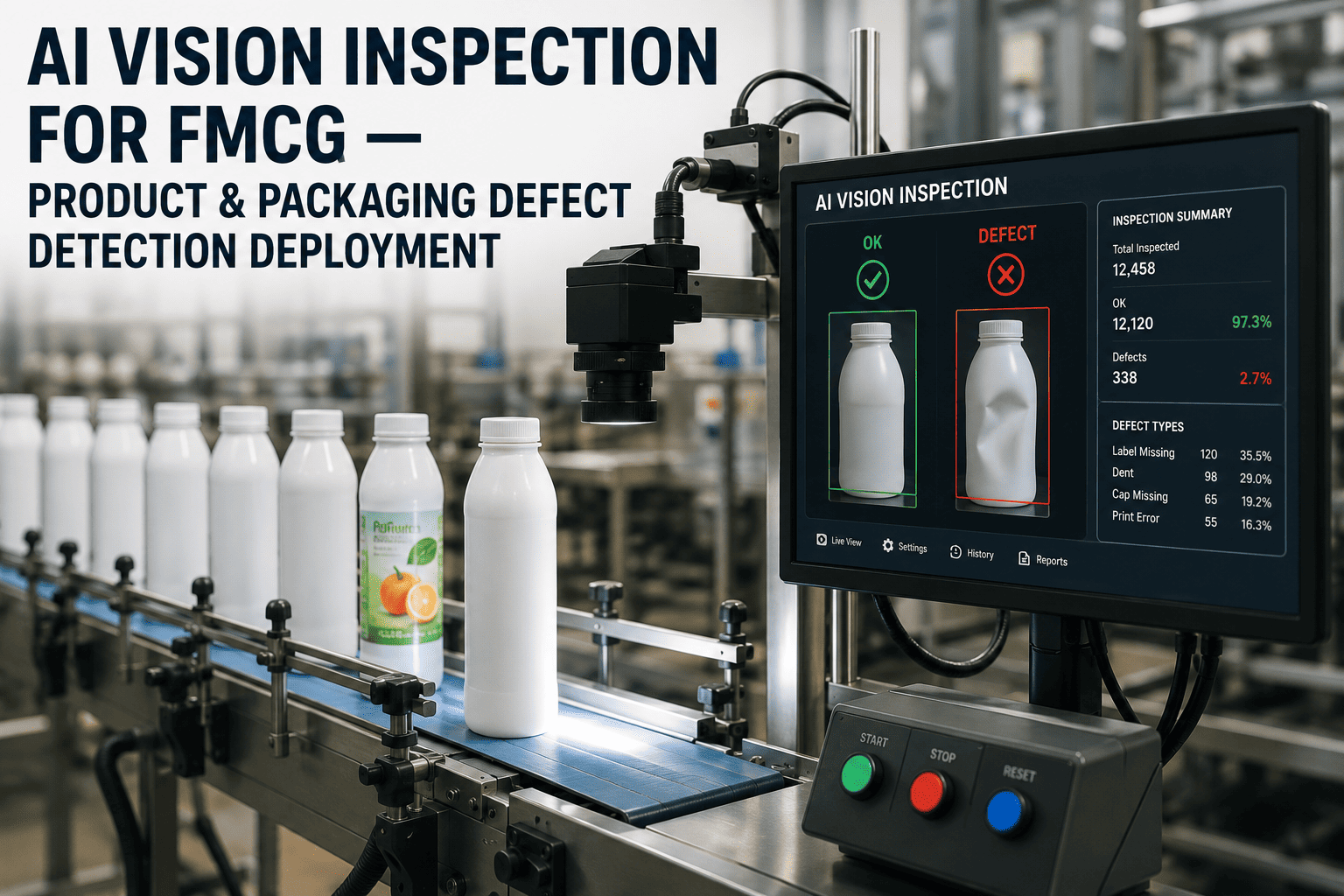
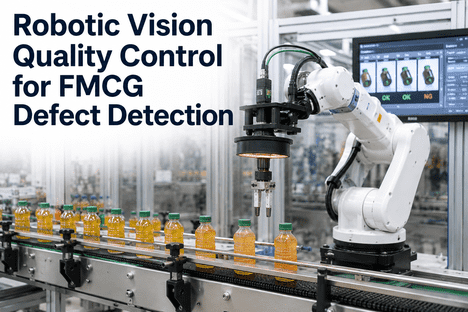
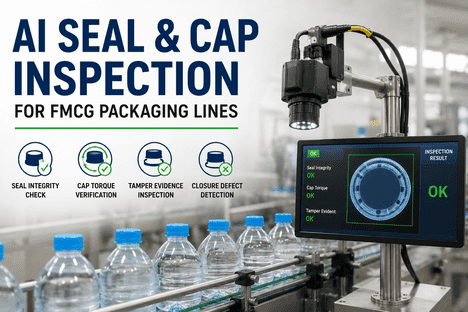
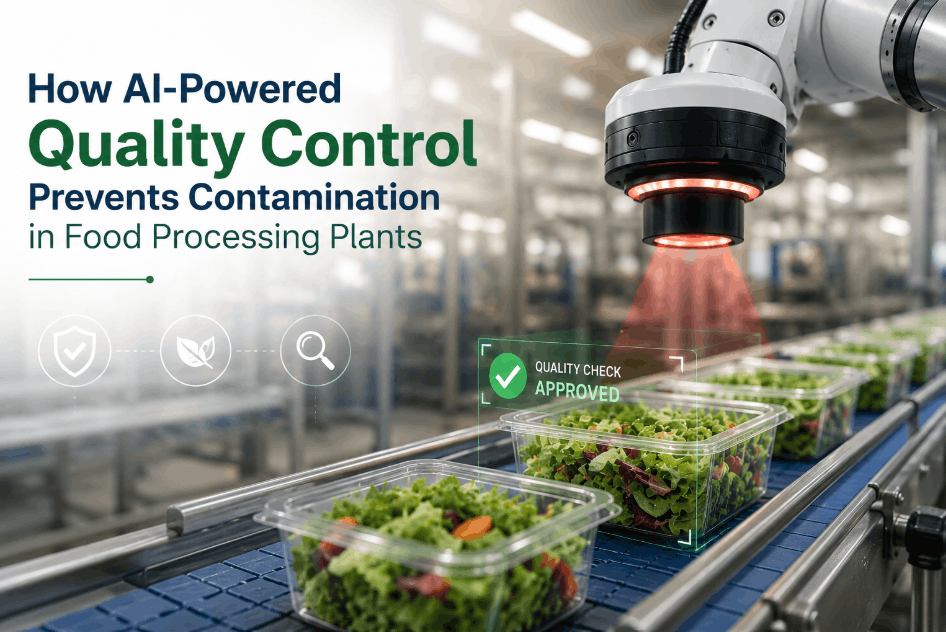
FreshPak Foods deployed iFactory's AI Vision Inspection system on line 4 in a 3-week phased installation that required only 2 days of production downtime. The system consisted of 5 high-speed industrial cameras positioned around the sealing station, each capturing a dedicated view of a critical seal zone at a resolution of 12 megapixels per image. The cameras fed images to a local inference server running iFactory's deep learning inspection models on an NVIDIA GPU cluster, processing each image in under 8 milliseconds. The system inspected 100% of units at full line speed of 300 units per minute — 5 images per unit, 1,500 images per minute, 25 images per second — with zero impact on line throughput. When the AI model detected a defect exceeding the user-defined threshold (0.3mm seal gap, 0.5mm seal width deviation, or any visual seal discontinuity), the system triggered a pneumatic rejection gate within 200 milliseconds, diverting the defective unit to a locked rejection bin. The rejection event was simultaneously recorded in iFactory's quality dashboard with a timestamp, camera view, defect category, and a high-resolution image of the defect — creating a complete digital trace for every rejected unit.
The deployment was structured in four phases over 21 calendar days, designed to minimise production disruption while building confidence in the AI model's accuracy before it was trusted to autonomously reject product.
- Installed 5 Basler ace 12MP cameras with 25mm lenses around the heat-seal station — top view of seal perimeter, four angled views of corner seal integrity.
- Mounted custom LED diffused ring lights operating at 850nm to eliminate ambient light interference and motion blur at 300 units/min.
- Collected 48,000 labelled images over 4 production days — covering good seals, known defect types (gaps, wrinkles, burns, incomplete seals), and edge cases.
- Each image tagged with seal condition, tray material type (PET vs PP), film lid lot number, and heat-seal head temperature at time of capture.
- Baseline defect rate: 1.8% of units had at least one seal anomaly — significantly higher than the manual sampling data had suggested.
- Trained iFactory's deep learning inspection model on the 48,000-image dataset using transfer learning from a pre-trained vision transformer architecture.
- Deployed model in shadow mode — predictions recorded but no product rejected — running alongside manual sampling for 7 production days.
- Model evaluated against 29,000 new images collected during shadow mode: 98.9% recall for seal defects greater than or equal to 0.3mm, 99.3% specificity for good seals.
- False positive analysis: 72% of false positives occurred on units with condensation or tray surface scratches — addressed by adding a pre-processing filter.
- Model iteration improved recall to 99.7% and reduced false positive rate to 0.12% after three retraining cycles.
- Activated pneumatic rejection gate and locked-bin diverter — defective units automatically removed from the production flow within 200ms of detection.
- Integrated rejected-unit images with iFactory's quality dashboard — each rejection event automatically logged with camera view, defect classification, tray type, and line speed at time of rejection.
- Configured real-time SPC charts on the dashboard tracking defect rate by defect type, seal head temperature, film lot, and operator shift.
- Quality team conducted daily review of rejected units to confirm AI model decisions and fine-tune rejection thresholds.
- Generated first full-shift production report showing 100% inspection coverage, 0.16% defect rate, and 312 units rejected across 324,000 produced.
- Correlated real-time defect data with heat-seal head temperature readings — identified that defect rate increased by 0.4% for every 1 degree C drift beyond +/-3 degrees C of set point.
- Configured iFactory to generate preventive maintenance alerts when seal head temperature variance exceeded +/-2 degrees C for more than 15 minutes — addressing the root cause of the original temperature drift event.
- Deployed predictive quality model that used temperature, pressure, line speed, and film lot parameters to forecast defect rate 30 minutes ahead — enabling proactive intervention before defects occurred.
- Developed film lot quality scoring based on AI vision defect data — enabling FreshPak to work with film suppliers to improve incoming material quality.
- Documented standard operating procedure for AI Vision model retraining — scheduled monthly retraining with new defect images to continuously improve model accuracy.
Over the first 90 days of full production operation, the iFactory AI Vision system inspected 25.9 million units across 86 production days, detected and rejected 41,500 defective units, and achieved a sustained defect detection accuracy of 99.7% for seal integrity defects down to 0.3mm. The following breakdown shows the performance by defect category and the volume of each defect type detected.
- 0.04% manual sampling rate — only 108 units inspected per 18-hour production day out of 324,000 produced.
- 2-hour delay between defect occurrence and detection — minimum 36,000 units could ship with defects before any quality alert.
- Single defect metric: manual peel force measured in Newtons. No data on defect type, location on seal, or spatial distribution.
- No correlation between seal quality and process parameters (temperature, pressure, line speed).
- Quality team spent 85% of time performing manual inspections and 15% on data analysis and process improvement.
- Customer complaint rate: 7.3 per month for seal integrity issues on line 4 products.
- 100% inline inspection at 300 units/min — every unit inspected across 5 camera views with zero additional labour.
- Real-time defect detection and rejection — defective units removed from production flow within 200ms. Zero defective units shipped.
- Five defect categories with high-resolution images for every rejection event. Complete digital traceability for all 41,500 rejected units.
- Real-time SPC correlation between seal quality and process parameters. Predictive quality alerts 30 minutes before defects occur.
- Quality team spent 20% of time monitoring the dashboard and investigating root causes, 80% on data-driven process improvement.
- Customer complaint rate: 0.4 per month — a 94% reduction within 90 days.
iFactory's quality dashboard gave FreshPak Foods real-time visibility into line 4's seal integrity performance across every shift. The dashboard aggregated data from all 5 camera views and displayed the current defect rate by category, a running count of inspected vs rejected units, SPC control charts for seal quality parameters, and a heat map showing defect distribution by seal zone (corners vs straight edges). The quality manager could drill into any rejection event to view the original image, the AI model's defect classification, and the process parameters at the time of rejection. The dashboard also generated automated daily quality reports that were emailed to the plant manager, quality director, and production supervisor — eliminating the manual report preparation that previously consumed 2 hours per day. The predictive quality module displayed a 30-minute forecast of defect rate based on current process parameter trends, enabling the production team to proactively adjust seal head temperature or pressure before defects occurred. Within 30 days of deployment, the predictive quality alerts had prevented 3 temperature drift events that would have produced seal defects — events that the previous manual sampling system would have detected only after thousands of defective units had already shipped.
"Before iFactory AI Vision, we were flying blind. We had a quality system that we knew was inadequate — a 0.04% sampling rate on lines running at 300 units per minute — but we could not justify the cost of a traditional machine vision system that would have required a dedicated engineer to programme and maintain. iFactory's AI Vision changed everything. The system was installed in 3 weeks, trained on our actual products and defect types within 5 days, and achieved 99.7% detection accuracy in shadow mode before we even turned on the rejection gate. In the first 90 days, the system inspected 25.9 million units and rejected 41,500 defective units — every single one of which would have shipped to a customer under our old sampling system. The $12 million recall that we simulated in early 2025 would have been a company-ending event. iFactory AI Vision turned that risk into a historical footnote. Today, we are deploying the system on 4 additional lines, and we have reduced customer complaints by 94%." — Sarah Chen, Director of Quality, FreshPak Foods
While the $12 million recall avoidance was the headline figure, the iFactory AI Vision system delivered additional financial benefits that transformed the business case from risk mitigation to direct cost savings. The reduction in customer complaints from 7.3 to 0.4 per month eliminated $186,000 per year in complaint handling, retailer credit requests, and customer service labour. The elimination of manual seal peel testing saved $94,000 per year in technician labour and consumable materials. The reduction in rework and repackaging of returned product saved $68,000 per year. The predictive quality module's early warnings on seal head temperature drift reduced heat-seal head maintenance costs by 41% — from scheduled bi-weekly replacement to condition-based replacement — saving $112,000 per year across the line. The total annual recurring benefit from the AI Vision system, excluding the recall avoidance, was $460,000 — delivering a return on investment of 340% in the first year when including the recall risk elimination.
Based on the results from line 4, FreshPak Foods approved a network-wide deployment of iFactory AI Vision across 7 additional packaging lines within 6 months. The expansion roadmap included line 7 (tray seal salad kits), line 2 (protein pack flow-wrap), line 3 (multi-compartment meal tray seal), line 1 (large-format salad bowl seal), line 5 (sous-vide pouch seal), line 6 (snack cup lidding), and line 8 (bulk pack tray seal). Each line deployment followed the same 21-day phased approach established on line 4, with the model training phase accelerated by transfer learning from the line 4 model — reducing the image collection requirement from 48,000 to 18,000 images per line and compressing the deployment timeline from 21 to 14 days. The network-wide deployment was projected to deliver $3.2 million in annual recurring benefits across all 8 lines, with a total recall risk avoidance exceeding $40 million for the company's entire packaged product portfolio. FreshPak Foods also initiated a partnership with iFactory to develop a centralised AI Vision model repository that would enable real-time model updates across all lines whenever a new defect type was identified at any single line — creating a self-improving quality network that became more accurate with every production day.
FreshPak Foods' deployment of iFactory AI Vision Inspection on line 4 transformed their quality control capability from a 0.04% manual sampling system that would have missed a $12 million recall to a 100% inline inspection system that has inspected 25.9 million units, detected and rejected 41,500 defective units, and reduced customer complaints by 94%. The system's 99.7% detection accuracy at full line speed of 300 units per minute, with a false rejection rate of just 0.12%, demonstrated that AI-powered vision inspection can replace traditional sampling-based quality control with comprehensive, real-time inspection at no additional labour cost and with zero impact on production throughput. The predictive quality integration — which forecasts defect rates 30 minutes before they occur — shifted the quality paradigm from reactive defect detection to proactive defect prevention. With a first-year return on investment of 340% and a network-wide expansion underway that will protect over $40 million in recall risk across the entire product portfolio, the iFactory AI Vision system has become a core component of FreshPak Foods' quality strategy and a model for how packaged food manufacturers can eliminate recall risk through AI-powered inline inspection.