AI vision inspection has rapidly become the most consequential quality control technology in FMCG packaging operations — yet the majority of fast-moving consumer goods manufacturers still rely on manual visual checks that miss between 20 and 40% of packaging defects at modern line speeds. The financial consequences are severe: a single mislabeled allergen panel, a faulty seal, or an unreadable barcode costs the average FMCG company $10 million per recall event, with total impact routinely reaching $30–50 million when brand damage, retailer chargebacks, and litigation are included. AI vision inspection systems are engineered to eliminate this entire failure category — inspecting every package against label registration, fill level, seal integrity, barcode legibility, date code accuracy, and print quality at production speeds up to 1,200 units per minute with 99.8% defect detection accuracy. Book a demo to see how iFactory's AI vision inspection platform automates packaging quality control across high-speed FMCG lines.
AI VISION INSPECTION
PACKAGING QUALITY CONTROL
FMCG MANUFACTURING
Stop Letting Packaging Defects Become $10M Recall Events
iFactory delivers AI-powered packaging inspection systems built for FMCG line speeds — combining machine vision, deep learning defect detection, label verification, seal integrity monitoring, and quality control analytics into a single decision-grade platform.
The FMCG Packaging Inspection Crisis — Why Manual Quality Control Fails at Modern Line Speeds
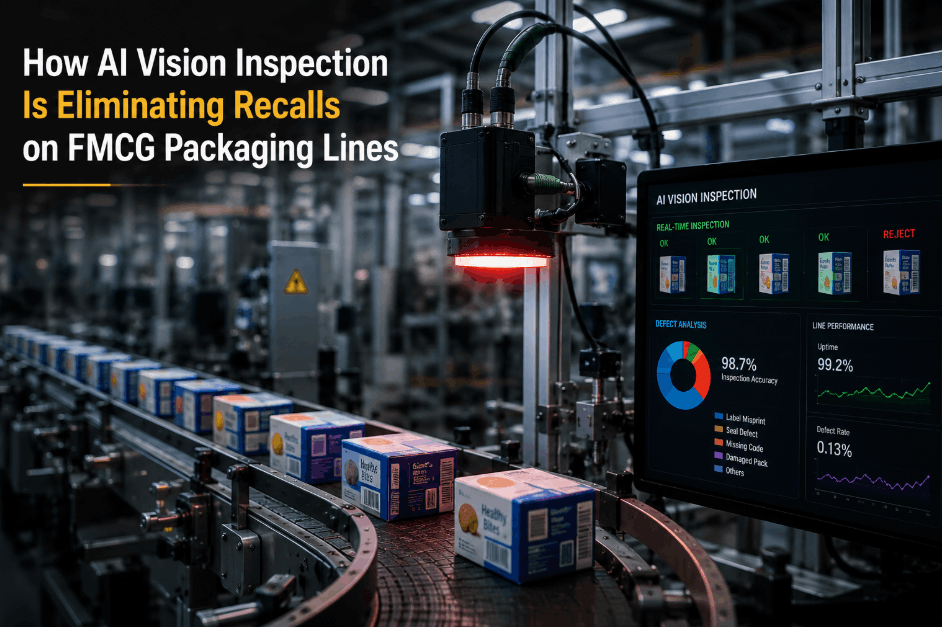
Modern FMCG packaging lines run at 800 to 1,200 units per minute, giving a human inspector roughly 50 milliseconds per unit to verify label registration, fill level, seal integrity, barcode quality, allergen accuracy, and date code legibility — simultaneously, every shift, without fatigue. The task is physically impossible. Research from the FDA shows that 42% of all FMCG recalls stem from labeling errors alone, and labeling and packaging inconsistencies account for 40% of product rejections in major Western markets. The economics get worse at scale: a typical packaging line shipping 3.2% defective units past manual inspectors will produce more than 30,000 defective consumer units per shift, every one of them a potential recall trigger, retailer chargeback, or regulatory enforcement event. AI vision inspection systems eliminate this gap by inspecting every package at full production speed with consistency that does not degrade across an 8-hour shift.
99.8%
defect detection accuracy with AI vision inspection at full FMCG line speed
75%
reduction in recall events for manufacturers deploying automated visual inspection
$10M
average direct cost per FMCG recall event before brand damage and litigation
6-9
months typical payback period on AI vision inspection deployment
Capability Map
Six Core Capabilities of AI Vision Inspection Systems for FMCG Packaging Quality Control
Modern AI vision inspection is not a single feature — it is a coordinated set of capabilities that together replace every category of manual packaging quality check on a high-speed FMCG line. Each capability uses dedicated imaging hardware, lighting configuration, and deep learning models trained on millions of FMCG packaging samples. Manufacturers evaluating packaging inspection systems can book a demo to see each of these capabilities running on live production samples.
Capability 01
Label Inspection & OCR Verification
High-resolution cameras combined with OCR and OCV models verify label position within 0.5mm tolerance, validate allergen declarations against the master SKU database, confirm nutrition panels, and detect wrinkles, bubbles, and SKU mismatches in real time during line operation.
Prevents the #1 category of FMCG recalls
Capability 02
Seal Integrity Monitoring
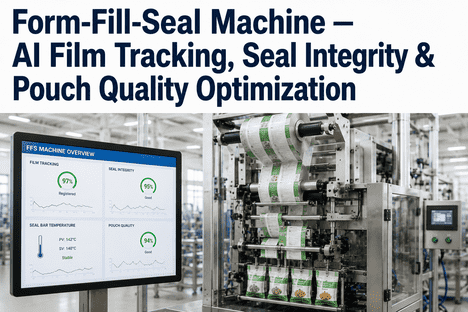
Infrared and high-resolution imaging identify micro-leaks, channel defects, contamination in seal areas, and incomplete heat seals across the full package perimeter to ±0.3mm tolerance — protecting product safety and shelf life on flexible pouch and rigid container lines.
Prevents contamination and shelf-life recalls
Capability 03
Fill Level Inspection
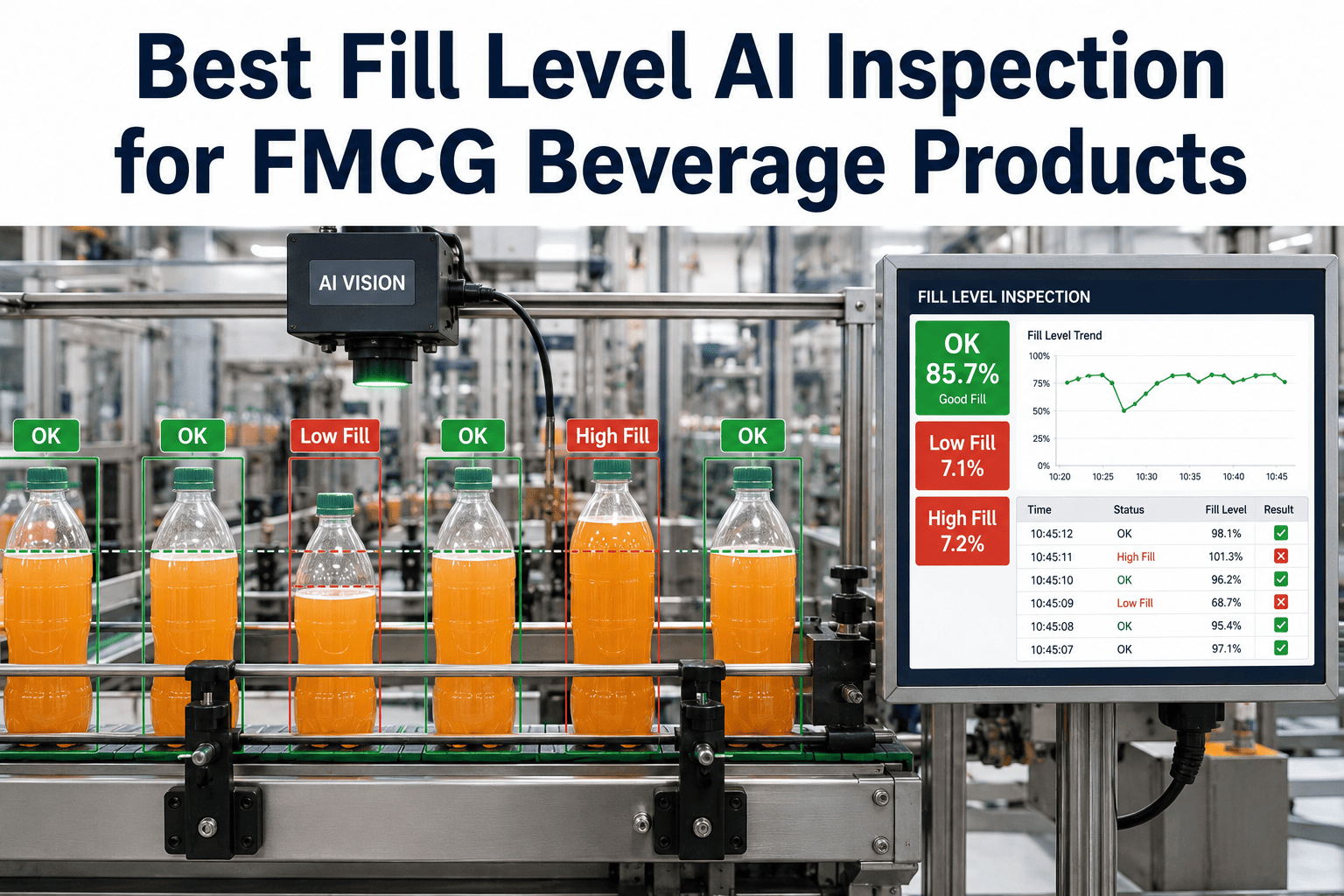
3D vision sensors and X-ray-aware imaging measure liquid and particulate fill levels within 1mm tolerance across transparent and opaque containers — eliminating underfill compliance violations and overfill yield losses on bottling and pouch lines.
Protects compliance and material yield
Capability 04
Print & Date Code Inspection
Print inspection systems verify date code legibility, lot number accuracy, and print quality against the active SKU specification — catching smudged, skewed, or low-contrast codes that downstream OCR scanners and retailer systems will reject.
Eliminates traceability and compliance failures
Capability 05
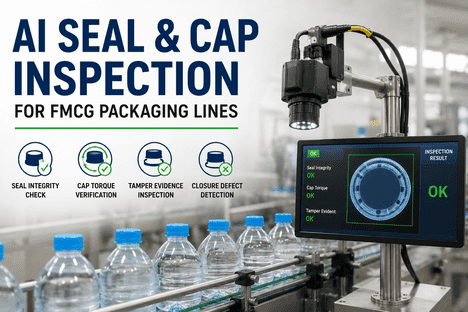
Cap, Closure & Tamper-Evidence
Vision models confirm cap presence, orientation, torque indicator alignment, and tamper-evident band integrity across bottle, jar, and rigid container lines — catching closure failures that produce both safety risks and consumer-visible quality complaints.
Protects product safety and shelf appearance
Capability 06
Foreign Object & Defect Detection
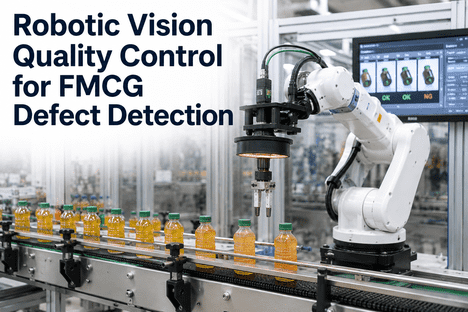
Deep learning models trained on millions of defective and good-unit samples identify foreign particulates, surface cracks, contour anomalies, color deviation, and packaging deformation that rule-based machine vision cannot reliably classify across product variations.
Prevents contamination escapes to retail
Architecture Reality
The AI Vision Inspection Architecture Stack — Four Layers That Determine Deployment Success
A genuinely effective AI vision inspection system on an FMCG packaging line is a layered architecture, not a single piece of camera hardware. Each layer must function correctly for the inspection system to deliver decision-grade outputs, integrate with downstream maintenance and quality workflows, and survive the relentless throughput demands of a 24/7 packaging operation. You can book a demo to see this stack instrumented against your specific packaging line topology.
Quality Control Analytics & Closed-Loop Layer
Defect trending by SKU, line, shift, and equipment — feeding root cause analysis, predictive maintenance triggers, and process control adjustments back into the production line automatically.
Common Failure: Defects flagged but never converted into corrective work orders or process changes.
Deep Learning Inspection Engine
Convolutional neural networks and defect classification models trained on millions of FMCG packaging images — adapting to product variations, lighting drift, and emerging defect patterns without manual reprogramming.
Common Failure: Rule-based vision systems require reprogramming for every SKU change and miss novel defects.
Imaging & Lighting Layer
High-resolution area-scan and line-scan cameras, multi-spectral imaging, controlled illumination, and edge computing hardware delivering sub-100ms inference at line speeds up to 1,200 units per minute.
Common Failure: Underspecified cameras miss defects between frames at high line speeds.
Master Data & SKU Reference Layer
Reference image libraries, SKU master data, allergen specifications, label artwork versions, and defect taxonomy — enforced as the single source of truth that the inspection engine validates against.
Common Failure: Stale reference images cause both false rejects and missed defects after artwork changes.
Performance Comparison
AI Vision Inspection vs Manual Quality Control — The Performance Differential on FMCG Packaging Lines
The performance gap between automated visual inspection systems and manual packaging quality control is not incremental — it is categorical. Every metric that matters for FMCG quality, throughput, and recall risk shifts dramatically when AI vision inspection replaces or augments manual checks on a high-speed packaging line.
AI Vision Inspection vs Manual Quality Control — Performance Benchmark
Industry Reality Check
A multi-site North American food and beverage manufacturer running 14 packaging lines across three plants experienced four major label-error recall events in 24 months — including a single allergen mislabeling event that cost $11.4 million in direct recall response and an additional $18 million in retailer delisting and lost contracts. Internal investigation traced every event to a wrong-SKU changeover that manual inspectors failed to catch within the first 3 minutes of production. After deploying AI vision inspection across all 14 lines with OCR-based allergen verification, SKU mismatch detection, and automated changeover lockout, the operation eliminated wrong-SKU label escapes entirely, reduced overall packaging defect escape rates from 2.7% to 0.04%, and recovered the full deployment investment within 7 months on operational savings alone — before counting any prevented recall value.
Book a demo to see how iFactory delivers similar outcomes on FMCG packaging lines.
Strategic Framework
Five Pillars of AI Vision Inspection Implementation Success in FMCG Packaging
Building an AI vision inspection program that genuinely transforms FMCG packaging quality control requires structured discipline across hardware specification, model training, master data integrity, workflow integration, and continuous learning. These are the five pillars that distinguish vision inspection deployments that deliver documented ROI from those that become stranded technology investments on the IT roadmap.
01
Hardware Specification Matched to Line Realities
Camera resolution, frame rate, lighting configuration, and edge compute capacity must be specified for actual line speeds, packaging variations, and inspection points — not generic vendor reference architectures that fail under FMCG throughput.
Outcome: Inspection performance survives full production load
02
Master SKU Data & Reference Image Governance
Every label artwork version, allergen specification, fill range, and defect tolerance must be governed through versioned master data that the inspection engine validates against — preventing both false rejects and missed defects after SKU changes.
Outcome: Inspection accuracy survives SKU and artwork churn
03
Deep Learning Model Training With Real Defect Data
Models must be trained on production-line defect samples — not synthetic data or generic vendor libraries — capturing the specific failure modes of your sealing equipment, label applicators, fillers, and coders to deliver real-world detection accuracy.
Outcome: 99%+ recall on defect categories that actually occur
04
Closed-Loop Integration With Maintenance & Quality Workflows
Defect detection must trigger downstream actions automatically — work orders for the maintenance team when seal jaw degradation is signaled, quality holds when defect rates spike, and root cause records linked to the responsible equipment asset.
Outcome: Vision data converts into operational corrective action
05
Continuous Learning & False Reject Reduction
Mature deployments include drift monitoring, automated retraining workflows, and human-in-the-loop labeling for edge cases — driving false reject rates down from typical 5–10% on poorly tuned systems to below 1% on production-grade platforms.
Outcome: 30–50% reduction in false rejects after first production quarter
PACKAGING ANALYTICS
DEFECT INTELLIGENCE
FMCG ENTERPRISE
Deploy AI Vision Inspection Across Every FMCG Packaging Line in Your Network
iFactory's AI quality inspection platform delivers automated visual inspection, label verification, seal integrity monitoring, and quality control analytics — purpose-built for FMCG manufacturers running multi-site, multi-line, multi-SKU packaging operations.
Implementation Roadmap
Deploying AI Vision Inspection on FMCG Packaging Lines — A 90-Day Production Framework
FMCG manufacturers do not need to commit to an enterprise-wide transformation to see measurable ROI from packaging inspection systems. The proven path starts with a single high-impact line, proves operational ROI within the first production quarter, and scales from there. Manufacturers can book a demo to walk through this framework against a specific packaging line.
Phase 01Days 1 – 20
Line Audit & Inspection Point Specification
Comprehensive audit of packaging line topology, defect history, and current quality control gaps. Cameras, lighting, and edge compute hardware specified and positioned at high-impact inspection points — typically post-label, post-fill, post-seal, and post-coding stations.
Deliverable: Hardware specification & mounting plan
Phase 02Days 21 – 50
Model Training & Reference Image Library
Capture of 500–2,000 production samples spanning good units, marginal cases, and known defects. Deep learning models trained on real defect data with active learning workflows to minimize labeling effort while maximizing classification accuracy.
Deliverable: Trained inspection models per SKU family
Phase 03Days 51 – 75
Shadow-Run & Workflow Integration
AI vision inspection runs in parallel with existing manual checks for a structured validation period. Defect detection feeds maintenance work orders, quality holds, and root cause records — proving operational integration before full handover.
Deliverable: Validated closed-loop quality workflow
Phase 04Days 76 – 90
Production Cutover & ROI Validation
AI vision becomes the primary inspection authority. Performance benchmarked against pre-deployment defect escape rates, recall events, manual inspection labor, and false reject losses — producing documented ROI for scale-up across additional lines.
Deliverable: Documented ROI & multi-line scale plan
Frequently Asked Questions — AI Vision Inspection & FMCG Packaging Quality Control
How does AI vision inspection differ from traditional rule-based machine vision?
Traditional machine vision relies on pre-programmed thresholds and requires reprogramming for every SKU or artwork change. AI vision inspection uses deep learning models that adapt to product variations, lighting drift, and emerging defect patterns — detecting subtle defects that fixed-rule systems consistently miss.
Can AI vision inspection keep pace with high-speed FMCG packaging lines?
Yes. Modern AI vision systems inspect at production speeds up to 1,200 units per minute with sub-100ms inference latency at the edge. Reject mechanisms are triggered in real time, with no throughput penalty compared to manual sampling-based inspection.
What packaging defects can AI vision systems detect on FMCG lines?
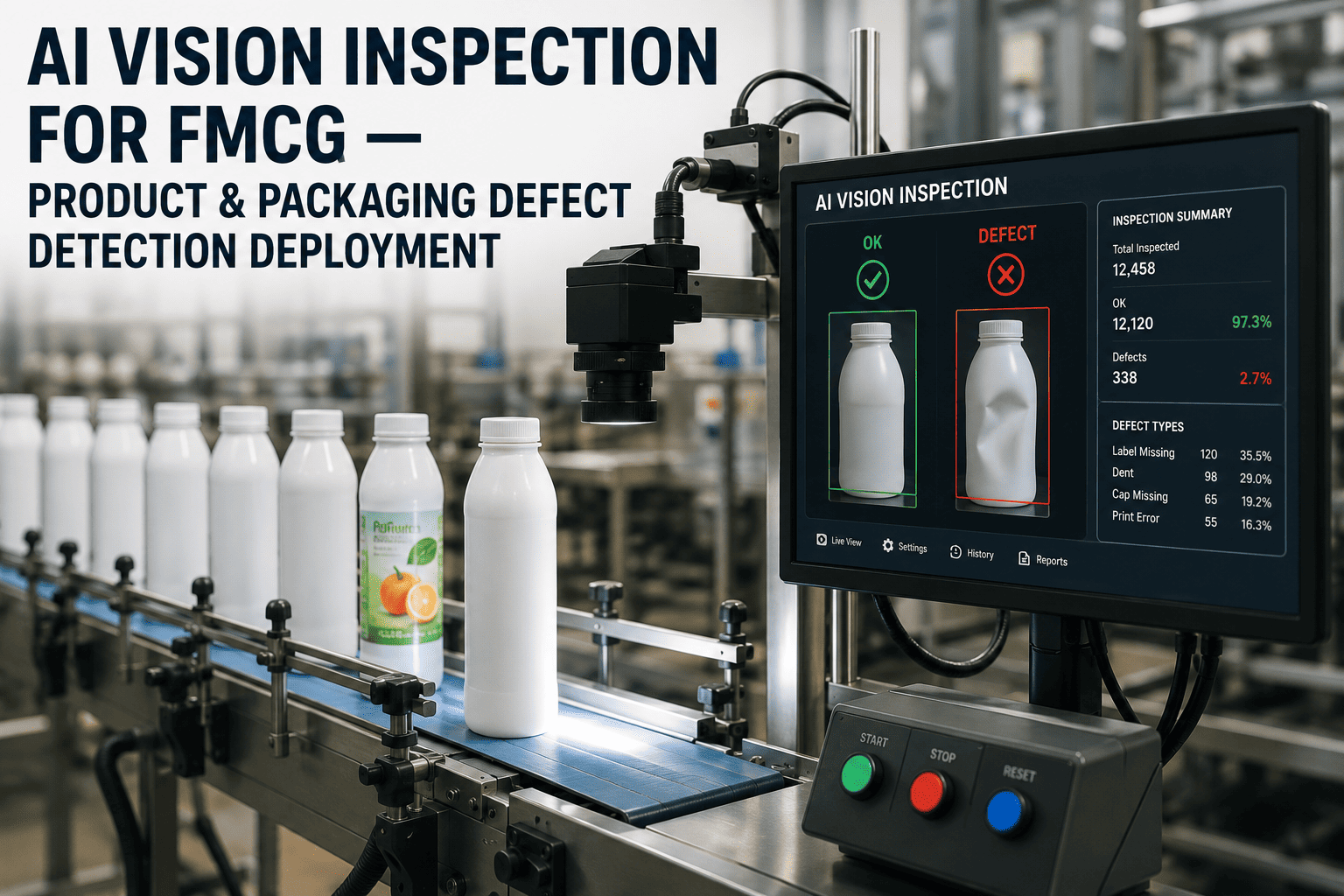
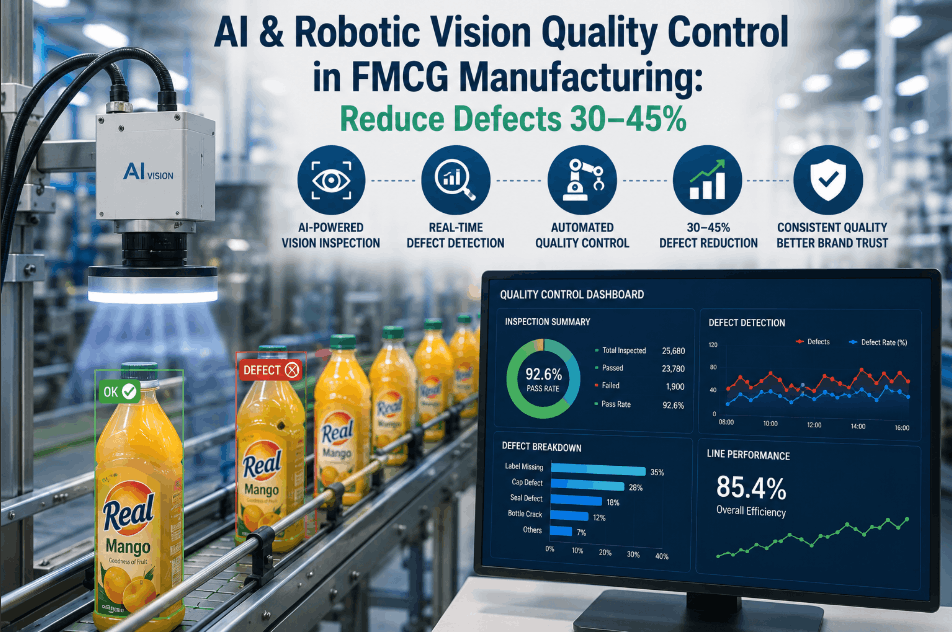
Modern systems detect label misalignment, wrinkles, missing labels, wrong-SKU mismatches, allergen errors, fill level deviations, seal defects, channel leaks, cap and closure failures, illegible date codes, barcode quality issues, foreign objects, and surface defects — all simultaneously, all at full line speed.
What ROI should FMCG manufacturers expect from AI vision inspection deployment?
Typical FMCG operations realize payback within 6–9 months on operational savings alone — labor reallocation, reduced rework, lower scrap, and false reject reduction. A single prevented recall event delivers multi-year ROI on top of operational savings.
Does AI vision inspection require replacing existing packaging line equipment?
No. AI vision inspection systems are non-invasive — cameras, lighting, and edge compute hardware are added at existing inspection points without modifying the underlying packaging machinery. Integration with current MES, ERP, and CMMS platforms is achieved through standard APIs.
How does AI vision inspection handle frequent SKU changeovers on FMCG lines?
Modern AI vision platforms maintain versioned reference image libraries linked to the master SKU database. When a changeover is initiated, the inspection engine automatically loads the correct artwork, allergen specifications, fill ranges, and defect tolerances — catching wrong-SKU label errors within the first 3 units of a new run before mislabeled cases can reach the pallet.
What is the typical false reject rate for AI vision inspection systems?
Poorly tuned vision systems can hit false reject rates of 5–10%, eroding material yield and operator trust. Production-grade AI vision platforms with continuous learning workflows drive false rejects below 1% within the first production quarter — typically delivering 30–50% false reject reductions compared to legacy rule-based machine vision.
Can AI vision inspection integrate with our existing CMMS and quality management systems?
Yes. iFactory's AI vision platform integrates with leading CMMS, MES, ERP, and QMS systems through OPC-UA, MQTT, and REST APIs — automatically generating maintenance work orders when defect patterns signal equipment degradation, triggering quality holds when escape thresholds are breached, and linking every defect record to the responsible packaging line asset for closed-loop root cause analysis.
How does iFactory's AI vision inspection differ from generic computer vision platforms?
iFactory is purpose-built for FMCG packaging operations — pre-trained defect models for label, seal, fill, and code inspection, native integration with maintenance and quality workflows, and deployment patterns proven across multi-line, multi-SKU manufacturing networks.
90-DAY DEPLOYMENT
DOCUMENTED ROI
FMCG PACKAGING
Replace Manual Packaging Inspection With AI Vision That Catches Every Defect
iFactory's AI vision inspection platform delivers 99.8% defect detection accuracy at full FMCG line speed — automating label verification, seal integrity monitoring, fill level inspection, and quality control analytics on a single decision-grade platform.