CNN AI vs Human Inspectors in FMCG Quality Control
By Riley Quinn on March 20, 2026
Your best quality inspector arrives Monday morning, alert and focused. By 10:30 AM, their detection accuracy has already dropped 15%. By Friday afternoon, they're missing one in four defects. This isn't a training problem — it's biology. Human visual processing peaks at 10-12 images per second. Your high-speed FMCG line produces 20. The math doesn't work. Convolutional neural networks trained on millions of labeled defect images now see what humans physically cannot — surface flaws measuring 0.1mm, seal gaps invisible to the naked eye, label misalignments within 0.5mm tolerance. At 99.8% accuracy, CNN vision detects 37% more critical defects than expert human inspectors working under optimal conditions.
99.8%
CNN Detection Accuracy
0.1mm
Smallest Defect Detected
37%
More Defects vs Humans
1,200+
Units/Min Inspected
The Detection Face-Off: Human vs CNN
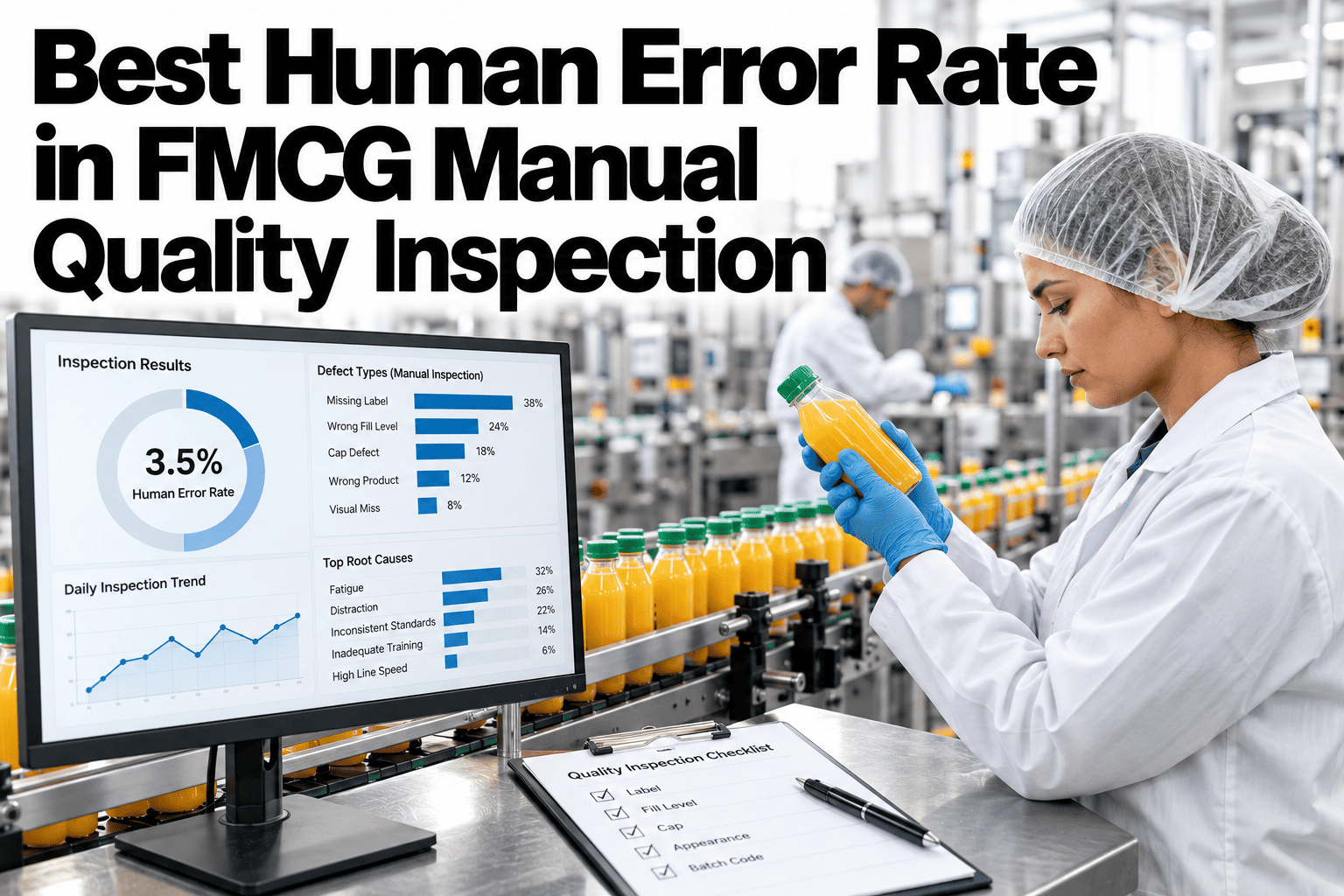
Research from Sandia National Laboratories analyzed decades of inspection data and found a consistent pattern: even highly trained inspectors miss 20-30% of defects across virtually all task types. In controlled experiments where known-defective products were planted intentionally, human inspectors caught only 56%. Deep learning changes the equation entirely.
Human Inspector
Processing Speed
10-12/sec
Detection Rate
80%
Consistency
Variable
Min Defect Size
~3mm
Misses 20-30%of defects at production speed
VS
CNN Deep Learning
Processing Speed
1,000+/sec
Detection Rate
99.8%
Consistency
24/7 Same
Min Defect Size
0.1mm
Catches 99.8%every unit, every time
Why Human Inspection Hits a Ceiling
The limitations aren't about training or motivation — they're biological. After 20-30 minutes of continuous visual monitoring, fatigue measurably degrades performance. Human eyes process 10-12 images per second while high-speed lines produce 20+ units per second. Different inspectors classify identical defects differently, and studies document 35% false alarm rates that waste good product.
01
Fatigue Onset
20-30 min
Visual vigilance degrades within half an hour of continuous monitoring
02
Speed Limit
10-12/sec
Human eyes process 10-12 images/second — lines produce 20+
03
Subjectivity
35% false+
Different inspectors classify identical defects differently
04
Resolution
~3mm min
At production speed, humans detect only defects larger than ~3mm
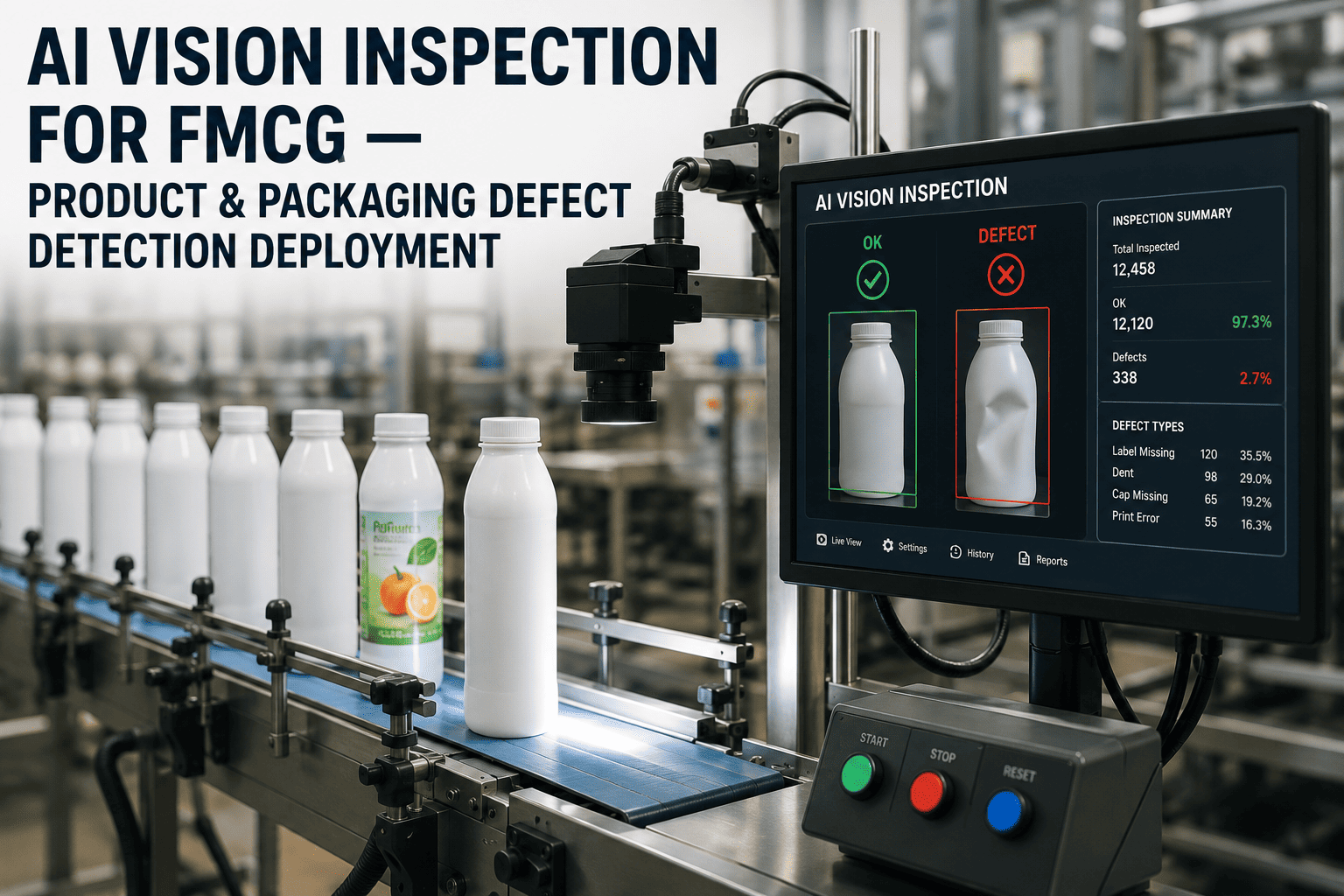
A convolutional neural network doesn't look at packages the way humans do. It processes raw pixel data through multiple specialized layers — each extracting increasingly sophisticated features. Early layers detect basic edges and color gradients. Middle layers recognize textures and shapes. Deep layers identify complex defect signatures that humans cannot consciously perceive.
1
Image Capture
1,000+ fps cameras
2
Convolution
Extract patterns
3
Pooling
Compress features
4
Classification
Neural network
5
Output
Pass/Fail <10ms
Millionsof training images
<10msdecision latency
Continuouslearning improvement
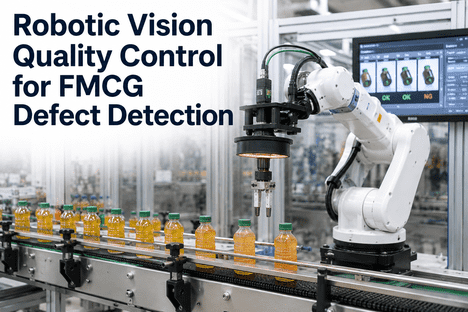
See CNN Vision Detect What Your Inspectors Miss
Watch our AI detect label errors, seal defects, fill-level variations, and surface flaws at full production speed.
Traditional machine vision uses programmed rules — if pixel brightness falls below threshold X, flag as defect. These systems work until the first variation appears. Deep learning operates fundamentally differently: it learns what defects look like from examples, then generalizes to variations never seen before.
Swipe to compare
Capability
Rule-Based Vision
CNN Deep Learning
Handling Variation
Breaks with any change
Learns patterns, handles variation
New Defect Types
Requires manual programming
Improves with new examples
Lighting Changes
Complete recalibration needed
Robust to environment changes
Novel Anomalies
Cannot detect unforeseen
Generalizes automatically
Performance Over Time
Static without updates
Continuous improvement
Accuracy Improvement:60%+ when switching to deep learning
"The most frequent and consistent observation in visual inspection research is the imperfection of human inspectors. For most inspection tasks, missed defects typically range from 20% to 30%."
— Sandia National Laboratories, Visual Inspection Research Review
20-30%
Human miss rate across industries
97-99%
CNN accuracy on trained defects
100%
Units inspected vs sampling
Deploy CNN Vision on Your FMCG Lines
iFactory's deep learning vision detects what humans miss — at full speed, 24/7, with 99.8% accuracy. Every package inspected. Every defect logged.
How accurate is CNN-based defect detection compared to human inspectors?
Research shows CNN vision systems achieve 99.8% detection accuracy for trained defect types, compared to the industry-average 80% for human inspectors. Studies document that AI detects 37% more critical defects than expert human inspectors working under optimal conditions. Human miss rates of 20-30% are consistently observed across decades of inspection research.
What's the difference between rule-based machine vision and deep learning?
Rule-based systems use programmed thresholds that break with any variation in lighting, texture, or product appearance. Deep learning CNNs learn what defects look like from millions of labeled examples, then generalize to variations never seen before. When manufacturers replace rule-based with deep learning, accuracy improvements of 60% or more are typical.
What defect sizes can AI vision detect on FMCG packaging lines?
Modern CNN vision systems detect defects as small as 0.1mm — far below human visual perception limits at production speed. This includes micro-scratches, hairline seal gaps, subtle print quality degradation, and label misalignment within 0.5mm tolerance. Systems inspect at speeds up to 1,500 units per minute while maintaining consistent accuracy.
How quickly does AI vision inspection pay back its investment?
Typical ROI payback is 8-14 months. Primary value drivers include recall prevention (average FMCG recall costs $10M-$100M), 75% reduction in quality escapes, 45% reduction in label-error-driven recalls, and labor reallocation. A single prevented recall often justifies the entire system investment.
Can AI vision work with our existing cameras and production lines?
Yes — deep learning models can often run on existing camera infrastructure with software upgrades. The AI processes image feeds from current cameras, though resolution and lighting may need optimization. Integration with existing line controls, reject mechanisms, and MES/ERP systems is standard.