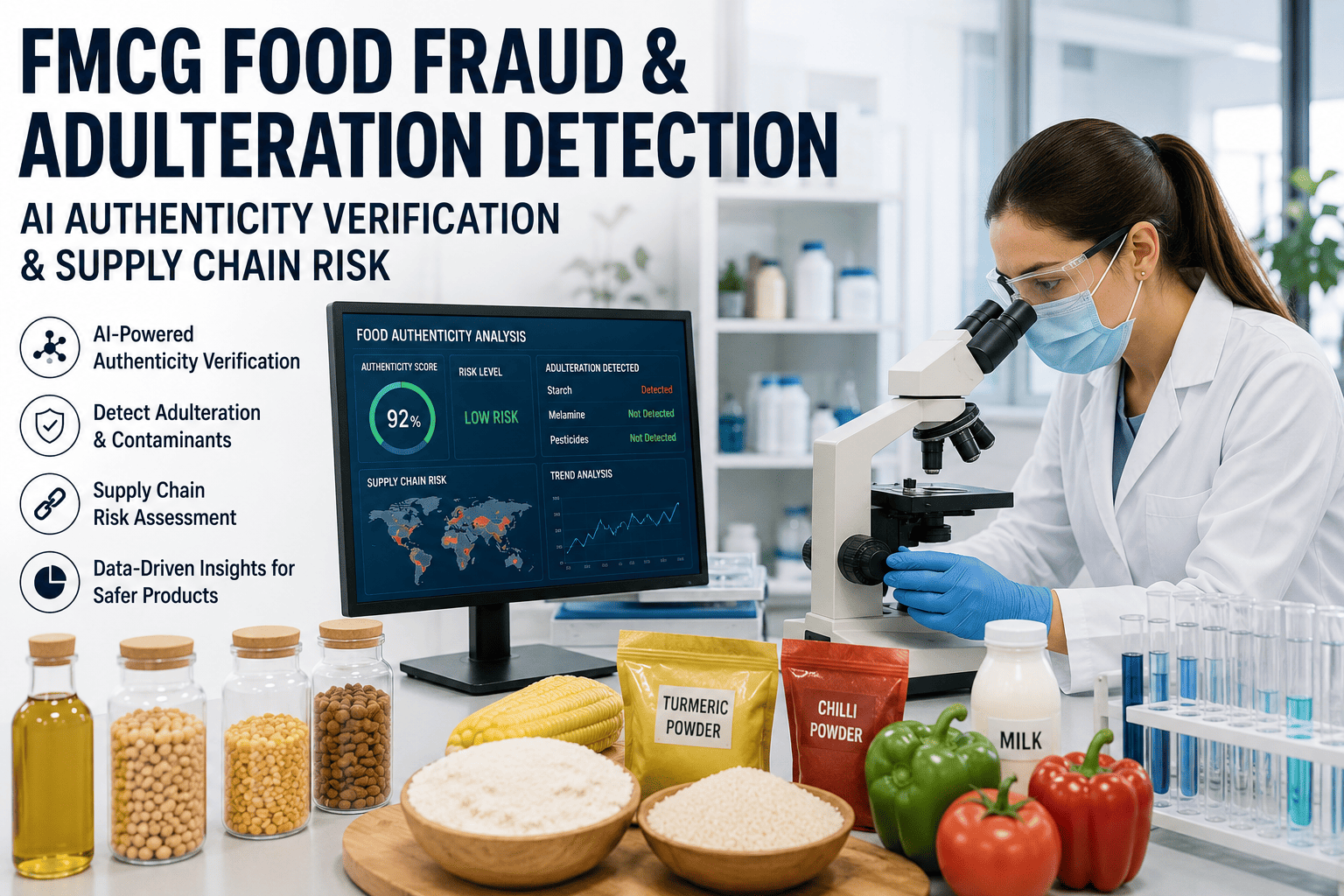
Economically motivated adulteration is designed specifically to pass a standard incoming quality check — that's what makes it fraud rather than an honest supply chain mistake. Diluted honey, mislabeled olive oil blends, and substituted spices have all made it through conventional testing regimes for years precisely because whoever introduced the adulterant knew exactly which tests a batch would face and formulated around them. A quality manager checking raw materials against a fixed specification sheet is fighting an adversary who has already read that same specification sheet. See how AI-based authenticity verification and supply chain risk scoring catches adulteration patterns that fixed specification testing was never designed to detect.
Quality & Compliance · Food Fraud
Food Fraud Is Built to Pass Your Standard Test. That's the Whole Point.
AI adulteration detection, authenticity verification, and supply chain vulnerability scoring built to catch economically motivated fraud that conventional specification testing is designed around and engineered to pass.
Why Fraud Beats Fixed Testing
The Difference Between an Honest Defect and a Fraud Attempt
Conventional raw material quality testing is built to catch honest variation and honest mistakes — a supplier's process drifted, a batch got contaminated, a specification wasn't met due to normal agricultural or manufacturing variability. Economically motivated adulteration is a fundamentally different problem because it isn't accidental. Someone deliberately formulated a diluted or substituted product to pass exactly the tests a buyer is known to run, at exactly the concentration that clears a specification threshold without triggering a flag. A test built to catch honest failure is structurally the wrong tool for catching a deliberate attempt to defeat that same test.
Honest Quality Failure
Random, unpredictable deviation from specification caused by process variability, contamination, or supply chain handling issues — the pattern a standard spec test is designed to catch.
Deliberate Adulteration
Calculated substitution or dilution formulated specifically to clear known specification thresholds, often at a concentration just below the detection limit of whatever test the buyer routinely runs.
What Authenticity Verification Adds
Detecting the Pattern, Not Just the Specification Breach
1
Compositional fingerprinting compares incoming material against a learned authentic profile for that specific origin and supplier, not just a pass/fail threshold on individual specification parameters.
2
Supplier pattern analysis tracks whether a supplier's material composition is drifting gradually over time in a way consistent with incremental adulteration rather than a one-time anomaly.
3
Price-quality correlation flags raw material lots priced significantly below market rate for their claimed origin and grade, a classic early indicator of economically motivated substitution.
4
Cross-supplier consistency checks compare a given supplier's material against other suppliers of the same claimed origin, surfacing outliers that a single-supplier specification check would never reveal.
Verify Authenticity, Not Just Specification
Catch the Fraud That Was Formulated to Pass Your Test
iFactory builds a compositional profile for every raw material source and flags deviations that indicate deliberate adulteration rather than honest variability.
High-Risk Categories
Raw Materials With the Longest History of Adulteration
| Raw Material | Common Adulteration Type | Why It's Historically Vulnerable |
|---|
| Honey | Sugar syrup dilution | Difficult to distinguish visually or by basic taste |
| Olive Oil | Blending with cheaper oils | High price differential between grades incentivizes substitution |
| Spices (Saffron, Paprika) | Filler substitution or coloring | High per-unit value with wide global supply chain variance |
| Fruit Juice Concentrates | Undisclosed water/sugar addition | Concentration levels hard to verify without specific testing |
What Quality Managers Get
What Changes Once Authenticity Verification Is Live
01
Earlier Fraud Detection
Compositional drift and price-quality anomalies get flagged before a fraudulent lot reaches production, rather than being discovered after finished product testing or a customer complaint.
02
Ranked Supplier Risk
Suppliers are scored on ongoing authenticity risk rather than treated as uniformly trusted once they've passed an initial qualification audit, giving quality teams a living risk picture.
03
Stronger Brand Protection
Catching adulteration before it reaches finished goods protects brand integrity from a category of risk that a recall alone can't fully repair once consumer trust is affected.
04
Documented Vulnerability Assessment
Ongoing authenticity monitoring feeds directly into the food fraud vulnerability assessment documentation increasingly expected under GFSI-aligned food safety programs.
Getting Started
Building an Authenticity Baseline for Your Supply Chain
Authenticity verification starts by establishing a compositional baseline for each raw material and supplier combination a plant currently sources from, using existing incoming quality test results and, where available, additional analytical data specific to the material category — spectroscopic profiles for oils and spices, or sugar profile analysis for honey and syrups, as examples. This baseline becomes the reference point against which future incoming lots are compared, rather than relying solely on a generic industry specification that every supplier already knows how to formulate around.
Once a baseline is established for the highest-risk raw material categories in a plant's supply chain, the system extends to lower-risk materials over time, with priority typically given to ingredients that carry both a documented history of adulteration and significant cost or brand exposure if compromised. Quality teams retain full control over how flagged lots are handled — the system surfaces the risk signal and supporting data, but decisions to reject, quarantine, or further test a flagged lot remain a quality management decision informed by better evidence, not an automated rejection.
Common Questions
Frequently Asked Questions
Does this replace our existing incoming quality testing?
No — existing specification testing continues as the primary quality gate. Authenticity verification adds a layer that specifically looks for the compositional patterns associated with deliberate adulteration, which a standard specification test isn't designed to catch, rather than replacing the quality checks already in place.
Talk to support about which of your raw material categories carry the highest fraud risk.
How much historical data is needed to build a reliable baseline?
A baseline can typically be established from several months of existing incoming quality data for a given supplier and material combination, though the model becomes more precise as it accumulates data across seasonal variation and multiple supplier lots for the same claimed origin and grade.
Can this detect fraud from a supplier we've worked with for years?
Yes — long-standing supplier relationships are not treated as immune from risk, since supplier pattern analysis specifically watches for gradual compositional drift over time, which is a common signature of incremental adulteration introduced by a supplier under cost pressure even after years of consistent quality.
Does a flagged lot get automatically rejected?
No — a flagged lot is surfaced with the supporting compositional data for a quality manager to review and decide on further testing, quarantine, or rejection, keeping the final decision with the quality team rather than automating a reject action that might need additional context.
Book a demo to see how flagged results are presented for review.
Which raw material categories should we prioritize first?
Categories with both a documented history of adulteration and meaningful cost or brand exposure if compromised are typically prioritized first, which commonly includes high-value ingredients like honey, olive oil, and specialty spices, though the right starting list depends on a plant's specific formulation and sourcing footprint.
Verify Authenticity, Not Just Compliance
Catch Adulteration Before It Reaches Your Production Line
iFactory builds a compositional authenticity profile for your supply chain, flagging fraud patterns that fixed specification testing was never designed to catch.