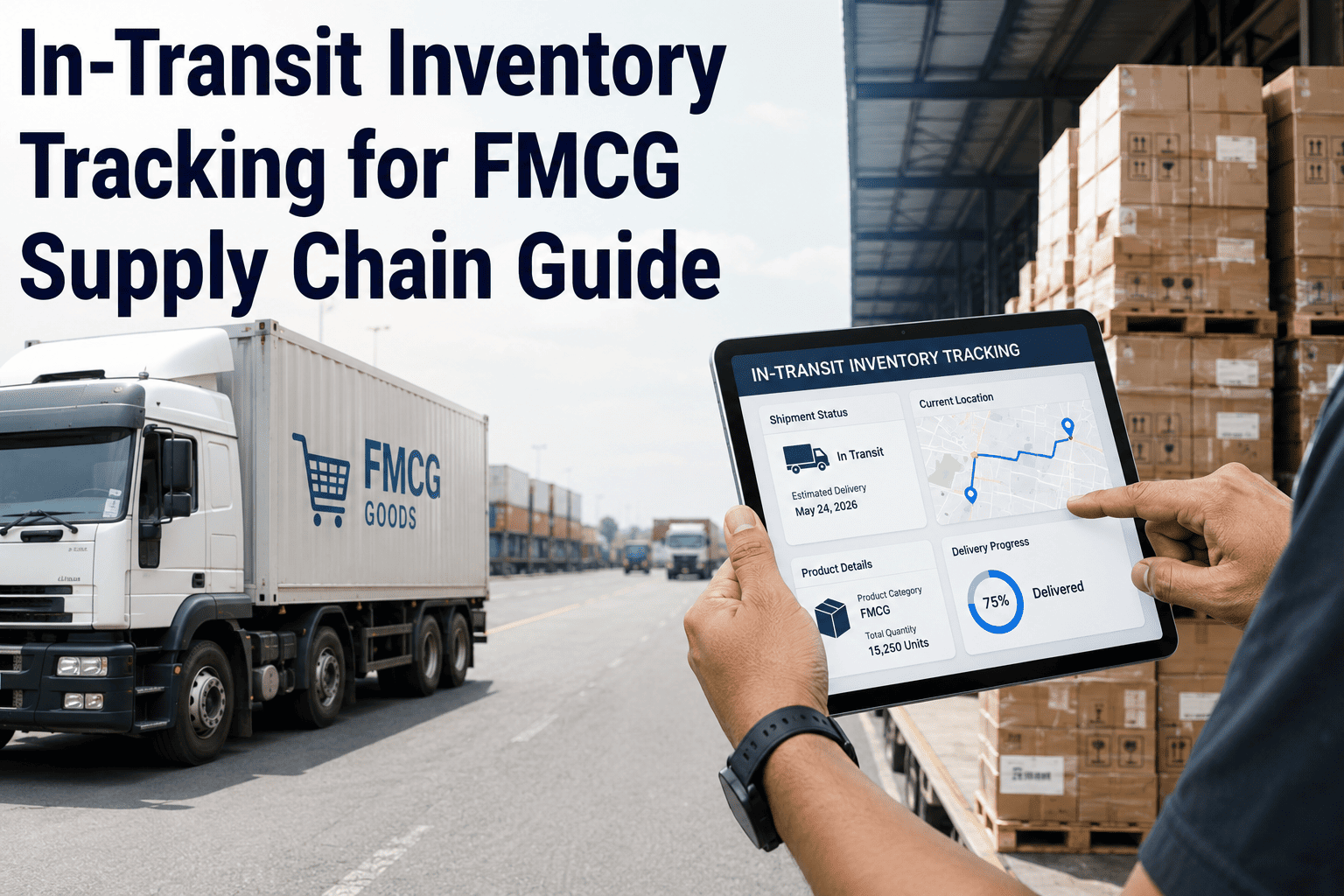
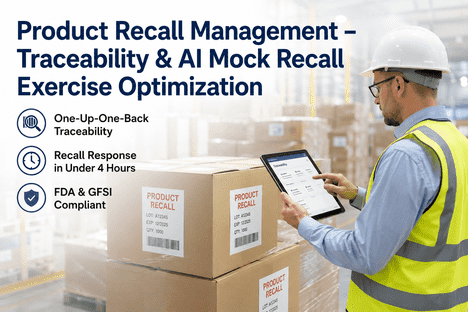
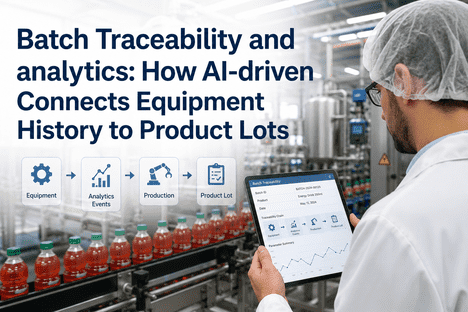
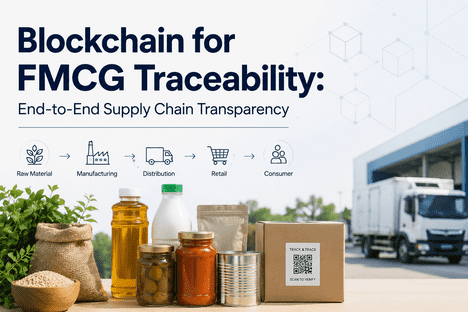
FMCG supply chains operate at a scale where a single contamination event or mislabeled batch can affect millions of consumers within hours. Without end-to-end traceability — spanning raw material receipt through production, packaging, warehousing, and distribution — manufacturers face unacceptably long recall response times, regulatory noncompliance penalties, and irreversible brand damage. Barcode and RFID technologies, when deployed as part of a unified traceability architecture, close the visibility gap that has historically prevented FMCG manufacturers from achieving true lot-level and serial-level traceability. iFactory AI's traceability platform combines barcode scanning, RFID interrogation, and AI-powered analytics to deliver real-time batch tracking, automated serialization, and predictive recall readiness across the entire FMCG supply chain. Book a Demo to see how iFactory AI transforms your FMCG traceability from compliance burden into competitive advantage.
TRACEABILITY · BARCODE & RFID · FMCG · 2026
End-to-End Traceability for FMCG Supply Chain with Barcode and RFID
AI-powered traceability platform combining barcode scanning, RFID interrogation, and real-time analytics — delivering lot-level serialization, 90%+ faster recall response, and full FSMA/FSSC 22000 compliance across your entire FMCG operation.
90%+
Faster Recall Response
60%
Less Traceability Labor
5:1–8:1
ROI Within 9–15 Months
01 / The Traceability Challenge
Why FMCG Supply Chains Need Modern Barcode and RFID Traceability
The FMCG industry faces a traceability paradox: products move faster and through more channels than ever before, yet regulatory requirements demand deeper visibility into every batch, lot, and serialized unit. FSMA Section 204 in the United States, EU FIC Regulation 1169/2011, FSSC 22000, and the Global Food Safety Initiative all mandate Food Traceability that extends from primary production through retail sale. Traditional paper-based lot tracking and manual data entry cannot keep pace with the speed and volume of modern FMCG production — a single high-speed packaging line can produce 600+ units per minute, each requiring unique or batch-level traceability data. Barcode and RFID technologies solve this by capturing traceability data automatically at every touchpoint, eliminating manual data entry errors and providing the real-time visibility that regulatory compliance and effective recall management demand.
72 hrs
Average Recall Initiation Time Without Digital Traceability
FMCG manufacturers relying on paper-based or disconnected digital lot tracking take an average of 72 hours from contamination notification to recall initiation. During that window, affected product continues moving through distribution channels, reaching more consumers and expanding the scope of the recall. iFactory AI's barcode and RFID traceability platform reduces recall initiation time to under 4 hours — a 90%+ improvement that directly limits consumer exposure and recall cost.
$10M
Average Cost of a Food Recall in the FMCG Sector
The average food recall costs FMCG manufacturers $10 million in direct expenses — product destruction, logistics reversal, regulatory fines, and legal liability — before accounting for brand damage and lost future revenue. Every hour of delay in recall initiation adds approximately $140,000 in cost. Digital traceability with barcode and RFID is the single most effective investment for reducing recall cost exposure.
35%
Of FMCG Manufacturers Lack Lot-Level Traceability
Despite regulatory mandates, an estimated 35% of FMCG manufacturers still lack true lot-level traceability across their entire supply chain. Most have partial systems — barcode scanning at receiving but not at production, or batch records in an ERP but no serialization at the unit level. These gaps create blind spots where contamination events can hide, expanding the scope of recalls and increasing regulatory exposure.
48%
Of Recalls Expand Due to Inadequate Traceability Data
When a contamination event is detected and traceability data is incomplete, regulators and manufacturers default to expanding the recall scope — recalling every product produced within a broad time window rather than only the affected lots. Inadequate batch tracking and lot traceability data caused 48% of FMCG recalls to expand beyond the originally affected product scope, multiplying recall cost and consumer impact.
"Before iFactory AI, our traceability system was a patchwork of paper logs, spreadsheets, and disconnected barcode scans that took 48 hours to trace a single lot. Now with RFID and AI-powered analytics, we can trace any batch from raw material to retail shelf in under 10 minutes. That capability transformed our recall readiness from a liability into a competitive advantage."
02 / The Technology Solution
Barcode and RFID Traceability: How iFactory AI Delivers End-to-End Visibility
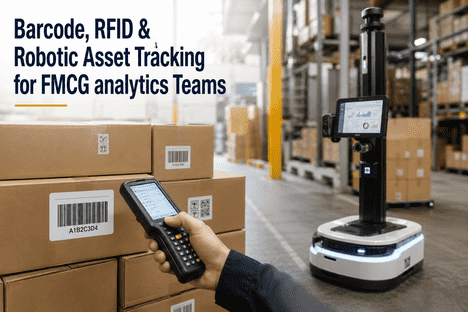
iFactory AI's traceability platform integrates barcode scanning, RFID interrogation, and AI analytics into a unified system that captures, stores, and analyzes traceability data across every stage of the FMCG supply chain. The platform supports GS1-128 barcodes, GS1 DataMatrix, EPC Gen2 RFID tags, and custom serialization formats, ensuring compatibility with existing labeling and packaging infrastructure while enabling future-ready traceability capabilities. Book a Demo to see which traceability technologies deliver the fastest ROI in your FMCG operation.
BARCODE
GS1-compliant barcode traceability — 99.9% read rate at production line speeds. High-speed barcode scanning stations at receiving, production, packaging, and shipping capture lot numbers, expiration dates, and serial numbers automatically. GS1-128 and GS1 DataMatrix encoding ensures global supply chain compatibility. Barcode traceability delivers 99.9% read rates at line speeds up to 800 units per minute, with real-time validation against production orders and batch records.
RFID
UHF RFID portal and handheld interrogation — 300+ tags read per second without line of sight. Fixed RFID portals at dock doors, pallet staging areas, and production zone boundaries automatically capture every tagged item, case, and pallet moving through the facility. Handheld RFID readers enable spot-checking, cycle counting, and recall verification. RFID eliminates the line-of-sight requirement of barcode scanning, enabling bulk pallet reads and automated inventory verification that reduce traceability labor by 60%.
SERIALIZATION
Unit-level and batch-level serialization — complete genealogy from raw material to consumer. iFactory AI assigns unique serial numbers at the unit, case, pallet, and batch level, creating a complete digital genealogy that traces every product through every supply chain touchpoint. Serialization supports FSMA Section 204 Traceability Lot Codes and EU FIC batch numbering requirements, enabling precise recall targeting that affects only the specific lots implicated in a contamination event.
ANALYTICS
AI-powered traceability analytics — predictive recall readiness and compliance reporting. Machine learning models analyze traceability data patterns to identify gaps, inconsistencies, and compliance risks before they trigger regulatory findings. Automated FSMA 204 Traceability Plan reports, FSSC 22000 traceability exercise documentation, and EU FIC compliance evidence generated with one click. Predictive analytics flag lot-tracking anomalies that human reviewers would miss, enabling corrective action before a contamination event occurs.
INTEGRATION
ERP, WMS, and MES integration — traceability data flows automatically. iFactory AI's traceability platform integrates with SAP, Oracle, Microsoft Dynamics, Blue Yonder, Manhattan Associates, and 200+ operational systems. Traceability data captured by barcode and RFID systems flows automatically into ERP lot tracking, WMS inventory records, and MES production data — eliminating duplicate data entry and ensuring traceability data is always current and consistent across all systems.
03 / The Cost of Poor Traceability
What Inadequate Lot Tracking and Serialization Actually Costs FMCG Manufacturers
The financial impact of inadequate traceability extends far beyond recall costs. Missing or incomplete traceability data affects production efficiency, inventory accuracy, regulatory compliance, and brand equity across four measurable dimensions.
$280K
Average Annual Traceability Labor Cost per Facility
FMCG facilities relying on manual data entry and paper-based lot tracking employ an average of 3.5 FTE equivalents per shift for traceability data collection, verification, and reporting. At a fully loaded cost of $55,000 per FTE across three shifts, the annual traceability labor cost exceeds $280,000 per facility before accounting for error correction and regulatory audit preparation time.
2.4%
Inventory Shrinkage from Traceability Gaps
FMCG manufacturers with inadequate lot-level traceability experience 2.4% higher inventory shrinkage than those with comprehensive barcode or RFID traceability systems. The primary driver is unreconciled inventory movements — product that moves between locations or statuses without corresponding traceability data updates, resulting in lost inventory that cannot be located or verified.
68%
More Regulatory Findings for Manufacturers Without Digital Traceability
FDA Form 483 observations and FSSC 22000 nonconformances related to traceability are 68% more frequent at facilities relying on paper-based or partially digitized traceability systems. Common findings include incomplete lot records, inability to complete mock recall exercises within required timeframes, and lack of supplier-to-customer traceability data linkage.
3×
Broader Recall Scope Without Serialized Traceability
Without unit-level or batch-level serialization, a contamination event involving a single production shift forces recall of every product produced during that shift — and often every product produced within a multi-day window. Serialized traceability enables recall precision that limits scope to the specific serial numbers or lots affected, reducing recall volume by an average of 67% compared to non-serialized operations.
04 / Real-World Results
Barcode and RFID Traceability Deployments: Measurable Outcomes Across FMCG Operations
Actual FMCG manufacturing and distribution operations that deployed iFactory AI's barcode and RFID traceability platform with documented, measurable outcomes.
Beverage Manufacturer (North America)Deployed GS1-128 barcode traceability across 14 production lines and 3 distribution centers serving 12,000+ retail locations. RFID pallet tags at all dock door portals enabled automatic inbound and outbound lot tracking without manual scanning. Integration with SAP EWM for real-time lot status updates. Results: recall initiation time reduced from 48 hours to 3.5 hours. Traceability labor reduced 62%. Lot-level inventory accuracy improved from 94% to 99.7%. FSMA 204 compliance achieved with zero findings. ROI achieved in 11 months.
Snack Food Manufacturer (Europe)iFactory AI traceability platform deployed across 6 production facilities producing 200+ SKUs with 15,000+ batch lots annually. UHF RFID portals at production-to-warehouse transfer points and case-level DataMatrix barcodes on all finished goods. AI-powered traceability analytics for mock recall exercises and compliance reporting. Results: mock recall completion time reduced from 8 hours to 22 minutes. FSSC 22000 traceability audit nonconformances eliminated. Annual traceability labor savings of $340,000. Recall insurance premium reduced 18% following certification of digital traceability system.
Dairy Processor (Global)End-to-end barcode and RFID traceability deployed across raw milk receiving, pasteurization, culturing, packaging, and cold chain distribution. Temperature-monitoring RFID tags enabled simultaneous traceability and cold chain compliance verification. GS1 DataMatrix serialization at the consumer unit level. Results: contamination-to-recall-initiation time reduced from 36 hours to 2.1 hours. Precision recall capability limited product destruction to 0.03% of affected production volume. Regulatory findings reduced 85%. Annual recall-related cost avoidance of $2.1 million.
"The RFID traceability system from iFactory AI gave us something we never had before — the ability to trace any finished good back to the specific cow, tank, and processing batch it came from. When a retailer questioned a lot code last quarter, we had the complete genealogy on their screen in 12 minutes. That level of traceability transparency is now a requirement for our largest retail customers."
05 / Compliance Connection
How Barcode and RFID Traceability Drives Regulatory Compliance and Recall Readiness
The linkage between barcode/RFID traceability and regulatory compliance is direct and measurable. Every major food safety regulation — FSMA Section 204, FSSC 22000, EU FIC, GFSI, SQF, BRCGS — requires FMCG manufacturers to demonstrate traceability from raw material receipt through finished good delivery. Digital traceability with barcode and RFID is not just a compliance enabler; it is the most cost-effective path to achieving and sustaining compliance across multiple regulatory frameworks simultaneously.
01
FSMA Section 204 Traceability Lot Code compliance is automated with barcode and RFID. The FDA's Food Traceability Rule requires manufacturers to maintain Key Data Elements (KDEs) at six Critical Tracking Events (CTEs) — receiving, transforming, creating, shipping, and more. iFactory AI's platform automatically captures and stores all required KDEs at each CTE using barcode and RFID data capture, generating FSMA-compliant Traceability Plan reports and enabling mock recall completion within the FDA's 24-hour target — versus the 72-hour average for paper-based systems.
02
FSSC 22000 traceability exercise requirements become a 20-minute automated process. FSSC 22000 requires certified facilities to conduct traceability exercises at defined frequencies — typically quarterly for forward tracing and annual for full chain traceability. Manual traceability exercises require hours of searching through paper records or disconnected digital systems. iFactory AI's barcode and RFID traceability platform completes any forward or backward traceability exercise in under 20 minutes, with documented evidence generated automatically for audit presentation.
03
EU FIC batch numbering and traceability requirements are satisfied with GS1 standards. EU Food Information to Consumers Regulation requires batch or lot identification on all pre-packaged foods, with traceability data maintained for the shelf life of the product plus five years. GS1-128 and GS1 DataMatrix barcodes encode batch/lot numbers in the globally accepted format, while iFactory AI's platform maintains the associated traceability data for the required retention period with automated archival and retrieval capabilities.
04
Mock recall readiness becomes a continuous operational capability rather than a periodic exercise. Most FMCG manufacturers treat mock recalls as quarterly events — preparing for days, executing for hours, and hoping for passing results. iFactory AI's traceability platform makes recall readiness a continuous capability: any lot can be traced forward or backward at any moment with complete, audit-ready documentation. This continuous readiness eliminates the stress and cost of periodic mock recall preparation while ensuring the organization can respond instantly when a real contamination event occurs.
Transform Your FMCG Traceability from a Compliance Burden Into a Competitive Advantage
Barcode and RFID traceability. Real-time lot tracking. Automated FSMA/FSSC 22000 compliance. AI-powered recall readiness. Full ERP integration. Live within 6–8 weeks.
06 / Implementation
Barcode and RFID Traceability Deployment Timeline: From Assessment to Live Operation in 8–10 Weeks
Weeks 1–2
Traceability Maturity Assessment and Technology Selection
Current traceability processes audited — lot tracking methods, barcode/RFID infrastructure, data capture points, system integrations, and regulatory gaps documented. Material flow mapped from receiving through production, packaging, warehousing, and shipping. Technology selection completed: barcode only, RFID only, or hybrid deployment based on facility layout, product characteristics, and volume requirements. Current traceability performance baselines established for recall initiation time, traceability labor, and compliance status.
Weeks 3–5
Infrastructure Deployment and System Integration
Barcode scanners, RFID portals, and handheld readers installed at identified data capture points. RFID tag selection completed based on product composition (metal interference, liquid absorption) and read range requirements. iFactory AI traceability platform configured with lot tracking rules, serialization schemas, and compliance reporting templates. Integration with ERP, WMS, and MES systems completed for automatic traceability data flow.
Weeks 6–7
Pilot Deployment and System Calibration
Barcode and RFID traceability deployed on one production line and one warehouse zone. Read rate validation completed — 99.9%+ target confirmed. Lot tracking data flow verified from scan event through ERP lot record update. Mock recall executed on pilot line to validate system capability. Operator training completed with mobile app and dashboard familiarization. Calibration adjustments made based on pilot results.
Weeks 8–10
Full Deployment and Compliance Validation
Barcode and RFID traceability deployed across all remaining production lines and warehouse zones. Full chain traceability exercise completed — raw material lot traced forward to finished good and finished good traced backward to raw material. FSMA 204 Traceability Plan generated and validated. FSSC 22000 mock traceability exercise documented. Operator and supervisor training completed with exception response workflows. Continuous improvement cadence established with weekly traceability analytics review.