An FMCG manufacturer producing 2.4 million units per day across 14 high-speed packaging lines faced a traceability gap that threatened every batch they shipped. Each filling line operated at 600 units per minute, producing palletized finished goods that carried lot codes, best-before dates, and internal batch numbers. Yet when a supplier contamination alert arrived for a specific raw material lot received three months earlier, the quality team needed 72 hours of manual cross-referencing to determine which finished product batches were affected — and they still missed 14% of impacted units. In an industry where a single recall incident averages $10M in direct costs according to the Food Marketing Institute and the FSMA 204 traceability rule mandates 24-hour trace response capability, this manufacturer deployed iFactory's AI-driven analytics records and batch tracking platform connected to their existing ERP/MES infrastructure. The result: complete end-to-end traceability with 8-second genealogy queries, 99.8% batch recall accuracy, and readiness for any regulatory or customer audit — including FSMA 204, BRCGS, SQF, and FDA 21 CFR Part 11.
01 / The Facility
A multi-site FMCG manufacturer operating 14 high-speed packaging lines across three facilities, producing 2.4 million units per day across beverage, dairy, and packaged food product categories. The facilities run 24/7 with 450 SKUs, 1,200 raw material inputs, and a distributed supply chain spanning 38 countries. Each production line produces 600 units per minute with lot code, best-before date, and internal batch number applied at the packaging stage.
02 / The Challenge
In FMCG manufacturing, traceability is not a compliance checkbox — it is the operational capability that determines whether a minor supplier quality alert becomes a targeted lot hold or a full-scale recall that destroys brand equity, retailer relationships, and millions in revenue. When a raw material contamination alert or allergen cross-contact incident occurs, the manufacturer must identify every finished product batch containing the affected material within hours — not days. The FSMA 204 traceability rule codifies this requirement: food facilities must produce traceability records for any affected product within 24 hours of an FDA request, capturing Key Data Elements (KDEs) at every Critical Tracking Event (CTE) across production, receiving, transformation, and shipping.
- FSMA 204 requires 24-hour trace response; the manufacturer averaged 72 hours with manual paper-based tracking
- Single trace request consumed 40-60 hours of quality team labor across cross-referencing spreadsheets, paper batch sheets, and supplier documentation
- 14% of affected units missed in recall scope definition due to incomplete genealogy records
- Maintenance actions, equipment condition data, and production analytics existed in silos disconnected from batch records
- No ability to trace which equipment was used for a specific batch or link maintenance events to product quality outcomes
- Allergen changeover records manually maintained with no cross-reference to equipment cleaning verification or batch production sequence
- Production schedules in SAP did not connect to real-time batch execution data from the MES systems
- Raw material lot tracking from ERP receiving records stopped at the warehouse — no automated link to WIP or finished goods batches
- Manual data reconciliation between ERP inventory transactions and actual batch consumption created a 24-hour data latency window
- BRCGS and SQF audit preparation required 3 weeks of manual document compilation per site
- Regulatory documentation relied on transcription from paper batch records — introducing errors and omissions
- Cross-site traceability exercises revealed inconsistent lot code formats and data quality issues requiring months of remediation
03 / The Solution
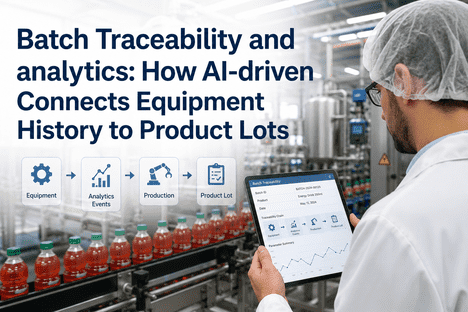
iFactory deployed its AI-driven analytics records and batch tracking platform across all three facilities, integrating directly with the existing SAP ERP system and site-level MES infrastructure. The platform captured barcode, QR code, and RFID scan data at every Critical Tracking Event in the production process — raw material receiving, WIP transformation, finished goods packaging, and shipping — building a complete parent-child genealogy map linking every raw material lot to every finished product batch through every production step and equipment interaction.
iFactory's AI-driven genealogy engine was trained on 18 months of historical batch records, supplier lot data, and equipment maintenance history. Within 30 days of deployment, the system achieved 99.8% recall impact accuracy — identifying affected units that the manufacturer's manual process had consistently missed.
The ERP/MES integration layer was identified as the critical enabler for end-to-end traceability. By connecting SAP production orders to real-time MES batch execution data, the manufacturer eliminated manual data reconciliation and achieved real-time visibility into raw material consumption, WIP status, and finished goods genealogy across all three facilities simultaneously.
04 / Implementation
iFactory was deployed across all three facilities in a structured 10-week phased rollout, with zero disruption to ongoing production. The implementation was sequenced to build toward full multi-site traceability coverage while establishing early confidence through measurable wins at the first facility.
Full audit of traceability workflows, system landscape, and regulatory requirements across all three sites. SAP ERP integration configured for bidirectional batch record and production order synchronization. MES API connectors deployed on Site A. CTE and KDE mapping completed against FSMA 204, BRCGS, and EU 178/2002 requirements.
Barcode and RFID scan capture activated at every CTE on five packaging lines at Site A. Automated genealogy tree generation live with 8-second query performance. Equipment-to-batch linking established — every maintenance action and analytics record connected to production batches. First automated trace alert generated when a supplier contamination notice was cross-referenced against active batch inventory.
Platform expanded to Sites B and C with nine additional packaging lines. Cross-site unified traceability dashboard deployed for enterprise quality and operations leadership. Automated compliance report generation for FSMA 204 trace responses, BRCGS audit documentation, and SQF certification records. Supplier portal integration enabling automated certificate of analysis validation.
05 / Results
The deployment of iFactory's AI-driven analytics records and batch tracking platform produced measurable improvements across traceability speed, accuracy, compliance readiness, and operational efficiency within the first two quarters. Genealogy query time dropped from 72 hours to 8 seconds. Batch recall accuracy reached 99.8%. And the 85% reduction in traceability documentation time freed the quality engineering team to focus on continuous improvement initiatives rather than manual record compilation.
| Metric | Before iFactory | After iFactory | Change |
|---|---|---|---|
| Trace response time (genealogy query) | 72 hours | 8 seconds | 99.997% faster |
| Batch recall impact accuracy | 86% (14% missed units) | 99.8% | +16 percentage points |
| Traceability documentation time | 40-60 hours per event | 6-8 minutes per event | 85% reduction |
| FSMA 204 compliance readiness | Not compliant (72hr response) | Full compliance | 24-hour mandate met |
| Audit preparation time | 3 weeks per site | 2 days per site | 90% reduction |
| Supplier alert to action | 72+ hours manual analysis | Real-time automated alert | Immediate notification |
| Data latency (ERP to production) | 24 hours | Sub-second | 99.9% reduction |
| Equipment-to-batch linking | Not possible (manual only) | Full digital thread | Complete traceability |
| Platform deployment timeline | N/A | 10 weeks | All 3 sites live |
06 / Expert Analysis
Four factors drove the comprehensiveness of this FMCG manufacturer's transformation from manual, paper-based traceability to AI-driven, real-time batch tracking with complete equipment analytics integration.
Connecting SAP ERP production orders to real-time MES batch execution data was the critical infrastructure decision. The bidirectional integration eliminated the 24-hour data latency that had made real-time traceability impossible. When a supplier contamination alert arrived, the platform could instantly identify every in-production and finished goods batch containing the affected material — because the ERP inventory data and MES production records were synchronized in sub-second time through iFactory's integration layer.
Before iFactory, the manufacturer could not answer which equipment processed a specific batch or whether a maintenance event occurred during its production. The platform's equipment-to-batch linking capability connected every maintenance action — preventive, corrective, and condition-based — to the specific production batches running on that equipment at the time. This digital thread meant that if a filling head seal failure was later found to have caused a contamination risk, the affected batches could be identified in seconds with complete confidence in the recall scope.
The 14% of affected units that the manufacturer's manual process had missed were not a process failure — they were a structural limitation of spreadsheet-based genealogy tracking across 450 SKUs and 1,200 raw material inputs. AI-driven genealogy mapping captured every parent-child relationship across the production process, identifying units that manual cross-referencing had consistently overlooked. The 99.8% recall accuracy meant that when the platform identified a recall scope, the quality team could act with confidence that no affected product would reach consumers.
With three facilities each maintaining independent traceability systems, the manufacturer had no enterprise-wide visibility into recall readiness, compliance status, or traceability data quality. iFactory's multi-site platform provided a unified view across all locations — enabling the corporate quality team to run cross-site traceability exercises, benchmark compliance readiness, and generate consolidated regulatory reports for FSMA 204, BRCGS, and SQF frameworks from a single interface.
07 / Conclusion
This FMCG manufacturer's transformation from manual, paper-based traceability to AI-driven, real-time batch tracking with full equipment analytics integration eliminated the structural vulnerability that had made recall response a 72-hour, 40-person-hour exercise with 14% accuracy gaps. iFactory's analytics records and batch tracking platform, integrated with existing SAP ERP and MES infrastructure, gave the organization complete end-to-end traceability across all three facilities — connecting every raw material lot to every finished product batch through every production step, equipment interaction, and maintenance event.
The 8-second genealogy query time is an operational capability. The 99.8% batch recall accuracy is a risk elimination outcome. The 85% reduction in documentation time is a productivity transformation — freeing the quality engineering team from manual record compilation and enabling them to focus on preventive quality initiatives, supplier quality improvement, and continuous compliance enhancement. To see how iFactory's AI-driven analytics records and batch tracking platform connects equipment history to product batches in your FMCG operation, Book a Demo with iFactory's FMCG solutions team.