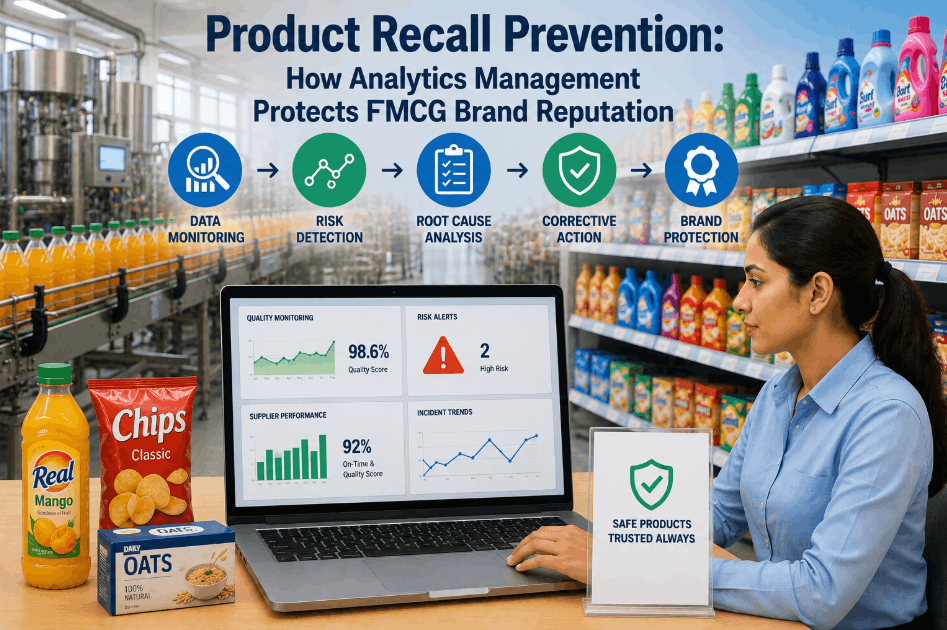
Product recalls in food and beverage manufacturing cost the industry over $10 billion annually, yet up to 68% of recalls are preventable through advanced quality analytics and real-time risk monitoring. The difference between manufacturers that successfully prevent recalls and those that don't lies not in compliance audits or manual inspection protocols — it lies in the integration of predictive quality analytics, supplier traceability systems, and AI-driven contamination detection embedded into production operations. Most food manufacturers rely on reactive quality management software that identifies issues after contamination has occurred, when the only option remaining is a costly recall. Book a demo to see how iFactory's predictive quality intelligence prevents recalls before they reach distribution.
RECALL PREVENTION
QUALITY ANALYTICS
FOOD SAFETY AI
Stop Product Recalls Before They Happen With Predictive Quality Intelligence
iFactory delivers real-time quality analytics, supplier risk monitoring, and contamination detection intelligence that catches recall risks in production — not in the marketplace.
The Hidden Cost of Product Recalls in Food Manufacturing — Why Prevention Fails
The average food product recall costs between $10 million and $30 million when direct costs, brand damage, and lost sales are combined — yet 68% of these recalls stem from preventable quality failures that existing monitoring systems miss. The pattern is consistent across the industry: contamination events, allergen cross-contact, equipment failures, and supplier quality deviations that bypass traditional quality management software until the product has already shipped. A recall prevention system without predictive analytics is reactive compliance documentation — not proactive risk elimination. It can record what happened after the contamination occurred, but it cannot predict where the next quality failure will emerge, identify supplier batch anomalies before they enter production, or correlate equipment condition changes with quality drift patterns.
68%
of food recalls are preventable with advanced quality analytics and monitoring
$10M–$30M
average total cost per food product recall including brand damage and lost revenue
82%
of manufacturers using predictive quality analytics avoid recalls entirely
15-20x
ROI from recall prevention versus recall response costs
Failure Analysis
Seven Critical Gaps in Traditional Quality Management That Allow Recalls to Occur
Product recalls happen when quality management systems fail to detect, correlate, or predict the conditions that lead to contamination, allergen cross-contact, or specification deviations. Food manufacturers evaluating recall prevention software can book a demo to see how each gap is addressed by analytics-first quality intelligence architecture.
Gap 01
Fragmented Quality Data Sources
Quality lab results exist separately from production sensor data, supplier certificates, environmental monitoring, and equipment maintenance records. Contamination patterns that span multiple data sources remain invisible until the recall investigation begins.
Impact: Cross-source contamination events missed entirely
Gap 02
Reactive Instead of Predictive Detection
Traditional quality control software flags deviations after they occur — when the contaminated batch has already been produced, packaged, and often shipped. Predictive analytics identifies quality drift before it reaches specification limits.
Impact: Recalls discovered after distribution has occurred
Gap 03
Weak Supplier Quality Visibility
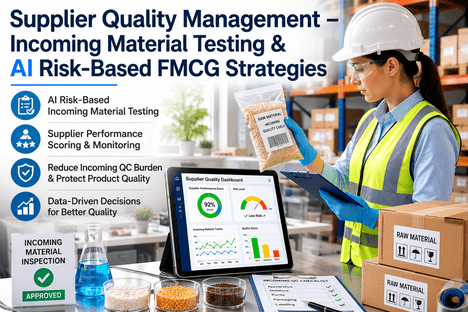
Incoming ingredient quality is verified through batch certificates and periodic testing — not real-time supplier performance analytics. Supplier quality failures enter production before any warning signal is triggered.
Impact: 42% of recalls trace to supplier ingredient contamination
Gap 04
Incomplete Traceability Coverage
Traceability systems track batch-to-batch movements but fail to capture the environmental conditions, equipment state, and process parameters that influenced product quality during production — making root cause analysis incomplete.
Impact: Recall scope uncertainty and over-withdrawal
Gap 05
Equipment Failure Blind Spots
Quality systems rarely integrate equipment condition monitoring. Equipment failures that create contamination pathways — seal degradation, temperature control drift, cleaning system ineffectiveness — go undetected until quality failures appear downstream.
Impact: Equipment-caused contamination discovered too late
Gap 06
Manual Root Cause Analysis Delays
When quality issues are detected, root cause analysis requires manual correlation across production logs, lab results, supplier data, and maintenance records — a process that takes days or weeks while contaminated product continues shipping.
Impact: 5–10 day investigation delays expand recall scope
Gap 07
Allergen Cross-Contact Risk Monitoring
Allergen control programs rely on visual inspections and cleaning verification tests — not continuous cross-contact risk monitoring. Allergen migration from equipment, shared lines, or ingredient handling errors remains invisible until consumer complaints occur.
Impact: Allergen recalls account for 28% of all food recalls
Analytics Architecture
The Product Recall Prevention Stack — Quality Intelligence Layers That Stop Contamination
Effective product recall prevention in food manufacturing is not a single software platform — it is a layered quality intelligence architecture where real-time monitoring, predictive analytics, supplier risk management, and traceability systems work together to catch contamination risks before they reach finished product. Most failed prevention strategies have one or more layers either missing entirely or disconnected from production decision workflows. You can book a demo to see this stack deployed against your specific quality control environment.
Automated Corrective Action Workflows
Automatic hold notifications, supplier alerts, equipment service triggers, and production line stops based on quality risk thresholds — eliminating human decision delays.
Common Gap: Quality alerts require manual interpretation and action approval, allowing contaminated batches to continue processing.
Predictive Quality Analytics Engine
Machine learning models that predict quality failures before they occur based on equipment condition changes, environmental drift, supplier performance trends, and process parameter correlations.
Common Gap: Quality systems are reactive — they detect problems after contamination has already occurred.
Real-Time Quality Monitoring Layer
Continuous monitoring of production parameters, environmental conditions, equipment performance, and in-process quality measurements with automated anomaly detection and deviation alerts.
Common Gap: Quality monitoring happens at discrete checkpoints, not continuously across the entire production process.
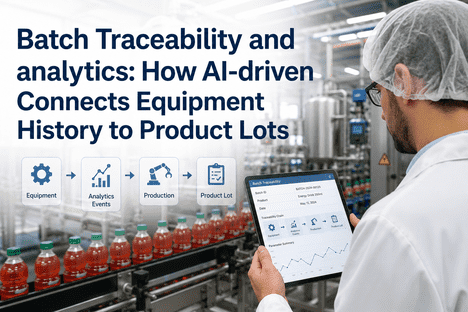
End-to-End Traceability Platform
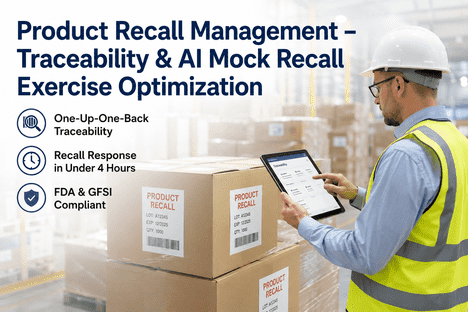
Complete genealogy tracking from supplier raw materials through production, packaging, and distribution — capturing not just batch movements but the conditions that influenced product quality at every step.
Common Gap: Traceability tracks batch flow but not the environmental and equipment conditions that caused quality deviations.
Unified Quality Data Foundation
Integration of all quality-relevant data sources — production sensors, LIMS, supplier certifications, equipment CMMS, environmental monitoring, customer complaints — into a single validated database.
Common Gap: Quality data remains siloed across disconnected systems, preventing cross-source contamination pattern detection.
Performance Comparison
Predictive Quality Analytics vs. Reactive Quality Control — The Recall Prevention Reality
The difference between food manufacturers that prevent recalls and those that respond to them is the presence of predictive quality analytics integrated into production operations. This is not a marginal improvement in detection speed — it is the difference between catching contamination risks before they reach finished product and discovering quality failures after distribution has occurred.
Recall Prevention Performance — Predictive Analytics vs Reactive Quality Control
Scroll to view full comparison →
Case Study — Recall Prevention
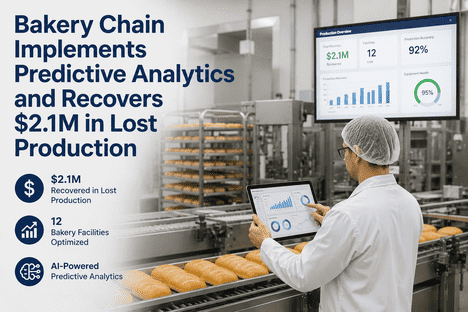
A major bakery manufacturer experienced two product recalls within 18 months — one for allergen cross-contact and one for foreign material contamination — with combined costs exceeding $23 million in direct recall expenses, brand damage, and lost retail shelf space. After deploying iFactory's predictive quality analytics platform with integrated supplier risk monitoring and equipment condition tracking, the operation prevented six potential recall events in the following 24 months. The system detected supplier ingredient quality drift patterns, equipment seal degradation leading to contamination pathways, and allergen migration risks — all before any contaminated product reached finished goods inventory. The prevention interventions cost $340,000 total across all six incidents, delivering a documented 68:1 ROI compared to the cost of even a single recall.
Book a demo to see how iFactory prevents recalls through real-time quality intelligence.
Prevention Framework
Five Pillars of Proactive Product Recall Prevention in Food Manufacturing
Preventing product recalls requires a systematic approach that addresses quality data integration, predictive analytics deployment, supplier risk management, equipment monitoring, and traceability coverage simultaneously. These are the five pillars that separate manufacturers with industry-leading recall prevention from those that remain stuck in reactive quality control cycles.
01
Unified Quality Data Integration
Every quality-relevant data source — production sensors, laboratory LIMS, environmental monitoring, supplier certifications, equipment CMMS, customer complaints, and regulatory compliance records — must feed into a single validated quality intelligence platform with enforced data quality rules and timestamp synchronization.
Outcome: Cross-source contamination pattern detection before recall events occur
02
Predictive Quality Analytics Deployment
Machine learning models trained on historical quality data, equipment performance patterns, supplier batch variability, and environmental conditions to predict where the next quality failure will emerge — before contamination occurs or specifications are violated.
Outcome: 82–91% recall avoidance rate through proactive intervention
03
Supplier Quality Risk Monitoring
Continuous supplier performance analytics tracking batch-to-batch quality consistency, certificate compliance trends, delivery condition monitoring, and historical deviation patterns — with automated supplier qualification scoring and incoming material hold triggers based on risk thresholds.
Outcome: Zero supplier-caused contamination batches entering production
04
Equipment-Quality Correlation Intelligence
Integration of equipment condition monitoring with quality performance tracking to identify when equipment degradation, cleaning effectiveness decline, or temperature control drift begins impacting product quality — triggering maintenance interventions before contamination pathways develop.
Outcome: Equipment failures prevented before quality impact occurs
05
Complete Traceability Coverage
End-to-end genealogy tracking that captures not just batch-to-batch movements but the complete environmental conditions, equipment state, process parameters, and quality test results that influenced every production lot — enabling precise recall scope determination and rapid root cause identification.
Outcome: Recall scope precision and 99% faster root cause discovery
Top Recall Drivers
The Six Most Common Product Recall Triggers — And How Analytics Prevents Each One
Food product recalls stem from a predictable set of contamination sources, quality failures, and compliance violations. Advanced quality analytics and real-time monitoring systems can detect and prevent each category before contaminated product reaches distribution.
01
Microbial Contamination
Pathogen introduction through equipment failures, environmental contamination, or process control breakdowns. Represents 31% of all food recalls.
Prevention Method: Real-time environmental monitoring, equipment sanitation effectiveness tracking, and process parameter correlation analytics that detect contamination pathway development before pathogen presence occurs.
02
Undeclared Allergens
Allergen cross-contact from shared equipment, cleaning failures, or ingredient mislabeling. Accounts for 28% of food product recalls.
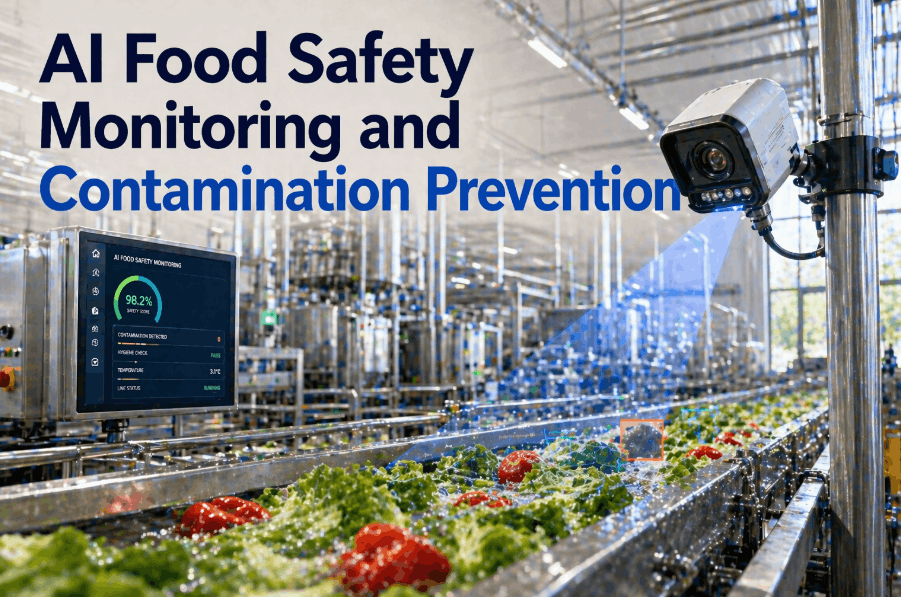
Prevention Method: Continuous allergen risk monitoring across production lines, automated cleaning verification analytics, and supplier ingredient label validation with AI-powered error detection.
03
Foreign Material Contamination
Metal, plastic, glass, or other foreign objects entering product through equipment degradation or process failures. Represents 18% of recalls.
Prevention Method: Equipment condition monitoring that predicts seal failures, wear patterns, and component degradation before foreign material shedding occurs, combined with detection system performance analytics.
04
Supplier Quality Failures
Contaminated ingredients, specification deviations, or certificate fraud from suppliers. Causes 42% of ingredient-related recalls.
Prevention Method: Supplier risk scoring analytics tracking batch-to-batch consistency, certificate compliance trends, and historical performance — with automated incoming material holds for high-risk batches before release to production.
05
Process Control Deviations
Temperature, pH, time, or other critical control point failures that create food safety risks. Accounts for 14% of recalls.
Prevention Method: Predictive process analytics that identify drift patterns before critical limits are violated, with automated corrective action triggers and equipment service alerts based on performance degradation trends.
06
Labeling and Packaging Errors
Incorrect labels, missing allergen warnings, or wrong product-package combinations. Represents 11% of food recalls.
Prevention Method: Computer vision verification of label content, automated product-label matching validation, and packaging line changeover monitoring with AI-powered error detection before distribution.
QUALITY INTELLIGENCE
SUPPLIER RISK
TRACEABILITY
Deploy AI-Powered Recall Prevention Across Your Food Manufacturing Operations
iFactory's predictive quality analytics platform delivers real-time contamination risk monitoring, supplier quality intelligence, and automated corrective action workflows — purpose-built for food and beverage recall prevention.
Implementation Roadmap
Deploying Predictive Recall Prevention Intelligence — A 90-Day Implementation Framework
Food manufacturers can deploy comprehensive recall prevention intelligence without disrupting current operations through a structured 90-day implementation that integrates quality data sources, activates predictive analytics, and establishes automated intervention workflows progressively across production lines.
Phase 01Days 1 – 25
Quality Data Integration & Baseline Audit
Comprehensive audit of existing quality management systems, data sources, and historical recall incidents. Deployment of unified quality data foundation integrating production sensors, LIMS, supplier records, equipment CMMS, environmental monitoring, and customer complaint systems with validated data quality controls.
Deliverable: Unified quality intelligence database with historical baseline
Phase 02Days 26 – 55
Predictive Analytics Activation & Model Training
Activation of predictive quality analytics models trained on facility-specific contamination patterns, equipment failure signatures, supplier batch variability, and environmental condition correlations. Deployment of real-time anomaly detection, supplier risk scoring, and equipment-quality correlation analytics tuned to food manufacturing process signatures.
Deliverable: Active predictive quality intelligence with recall risk scoring
Phase 03Days 56 – 75
Automated Intervention Workflows & Alert Configuration
Configuration of automated corrective action workflows including batch holds, supplier alerts, equipment service triggers, and production line stops based on recall risk thresholds. Integration with existing quality team workflows, CAPA systems, and notification platforms to ensure immediate action on high-risk predictions.
Deliverable: Automated recall prevention intervention infrastructure
Phase 04Days 76 – 90
Validation Testing & Continuous Learning Activation
Performance validation against historical recall incidents and near-miss events to verify prediction accuracy and intervention effectiveness. Activation of continuous model learning workflows including drift detection, retraining triggers, and prediction accuracy monitoring to maintain recall prevention performance as operations evolve.
Deliverable: Validated recall prevention platform with documented ROI
Frequently Asked Questions — Product Recall Prevention Software and Quality Analytics
What percentage of food product recalls are actually preventable with advanced quality analytics?
Studies show that 68% of food recalls stem from preventable quality failures that predictive analytics can detect before contamination occurs. This includes supplier quality deviations, equipment failures causing contamination pathways, allergen cross-contact risks, and process control drift patterns — all of which leave detectable signatures before reaching finished product.
How does predictive quality analytics differ from traditional quality management software?
Traditional quality management systems are reactive — they document deviations after they occur and manage corrective actions after contamination has happened. Predictive quality analytics uses machine learning to identify the conditions that precede quality failures, enabling intervention before contamination occurs rather than response after distribution.
What data sources must be integrated for effective recall prevention analytics?
Comprehensive recall prevention requires integration of production sensor data, laboratory LIMS results, supplier quality certifications, equipment maintenance records (CMMS), environmental monitoring systems, customer complaint data, and packaging line verification systems. Without these unified sources, cross-domain contamination patterns remain invisible until recalls occur.
How quickly can manufacturers see ROI from recall prevention software deployment?
The first prevented recall typically delivers 15-20x ROI compared to deployment costs. Since the average food recall costs $10M–$30M and prevention interventions cost $50K–$200K per incident, preventing even a single recall within the first 12 months produces significant positive ROI. Most food manufacturers document their first prevention event within 3-6 months of deployment.
Can recall prevention analytics identify supplier quality issues before ingredients enter production?
Yes. Advanced supplier risk analytics track batch-to-batch quality consistency, certificate compliance trends, and historical performance patterns to generate supplier risk scores. High-risk incoming batches trigger automated holds and additional testing before release to production — preventing 42% of supplier-caused recalls that traditional receiving inspection misses.
How does equipment condition monitoring prevent contamination-based recalls?
Equipment degradation — seal failures, cleaning system effectiveness decline, temperature control drift — creates contamination pathways before quality test results show deviations. Predictive maintenance analytics identify equipment condition changes that correlate with quality performance, enabling maintenance intervention before contamination occurs rather than after.
What makes iFactory's recall prevention platform different from generic quality management systems?
iFactory is purpose-built for food and beverage manufacturing with pre-configured analytics models, contamination pattern libraries, and intervention workflows specific to food safety risks. The platform delivers predictive recall prevention within the first production quarter rather than requiring years of custom development like generic quality systems.
PREVENT RECALLS
PROTECT YOUR BRAND
90-DAY DEPLOYMENT
Transform Your Quality Management From Reactive to Predictive
Don't wait for the next recall to expose gaps in your quality management system. iFactory's predictive analytics platform detects contamination risks, supplier quality failures, and equipment degradation before they reach your customers — delivering documented ROI within the first production quarter.