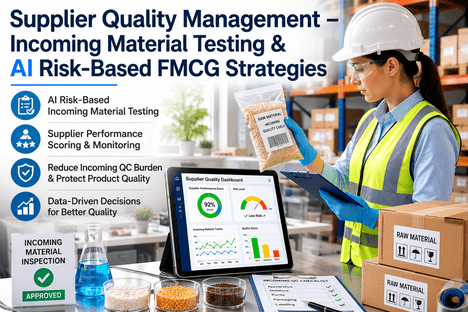
FMCG manufacturers operate under a persistent tension: every incoming raw material lot must be quality-verified before it enters production, but the volume, velocity, and variability of supplier deliveries make 100% inspection economically impossible. A mid-size food and beverage plant receiving 40 to 60 supplier shipments per day across ingredients, packaging materials, and indirect supplies faces a choice between under-inspecting and accepting latent quality risk or over-inspecting and burning through QC capacity at a rate that destroys the department's productivity targets. The industry average for incoming material inspection in FMCG hovers between 15% and 30% of received lots, which means 70% to 85% of material enters production with no quality verification at all — a gap that directly explains the 8% to 12% of finished product quality incidents traced back to raw material variability in every root-cause analysis. iFactory's AI risk-based supplier quality management platform changes the equation by scoring every supplier, every material category, and every incoming lot on historical performance data, then recommending an inspection protocol — full inspection, reduced sampling, skip-lot acceptance, or rejection — that dynamically adjusts as supplier performance changes, so the QC team focuses its有限 resources where the risk is highest.
Supplier Quality · AI Risk-Based Testing · Incoming Material · FMCG · Supplier Scoring
70% of FMCG Incoming Materials Enter Production Uninspected. iFactory's AI Risk Scoring Closes That Gap Without Doubling Your QC Headcount.
iFactory's AI-powered supplier quality platform scores every supplier and material lot on risk, dynamically adjusts inspection protocols, and reduces QC workload on high-performing suppliers while catching quality drift on underperformers before it reaches finished product.
70-85%
Of incoming material lots in FMCG enter production without quality inspection — the inspection gap directly correlates with 8-12% of finished product defects traced to raw material variability
40-60%
Reduction in QC inspection workload on high-performing suppliers using AI risk-based skip-lot and reduced sampling protocols — without increasing material quality risk
3-5x
Faster detection of supplier quality drift with AI-powered trend analysis compared to traditional QC data review — enabling corrective action before non-conforming material reaches production
18-24%
Average reduction in finished product quality incidents reported by FMCG manufacturers after implementing AI risk-based incoming material testing with dynamic supplier scoring
The FMCG Incoming Material Quality Problem — Why Traditional Supplier Quality Management Cannot Keep Pace with Modern FMCG Production
The incoming material quality challenge in FMCG manufacturing is structurally different from the supplier quality problem in other industries. An FMCG plant's raw material portfolio changes constantly — seasonal ingredients are substituted by approved alternatives, packaging specifications shift with brand refreshes, co-packers are brought in and out based on capacity requirements. A fixed supplier qualification and inspection programme that worked for last year's material portfolio is already misaligned with this year's risk profile. The root cause is not supplier incompetence — most FMCG suppliers deliver conforming material the vast majority of the time — but the statistical reality that when a plant receives thousands of lots per year from dozens of suppliers, even a 2% non-conformance rate produces dozens of quality events that reach the production line. Traditional supplier management relies on periodic audits and static approved-supplier lists. AI risk-based management uses every incoming inspection result, every production quality feedback loop, and every supplier corrective action response to continuously update a dynamic risk score that drives the next inspection decision.
01
Material Portfolio Volatility Outpaces Static Supplier Qualification
FMCG material portfolios are not static. Seasonal ingredient changes, supplier substitutions due to crop yield variability, packaging redesign cycles, and co-manufacturer rotations mean the set of active supplier-material combinations shifts by 20% to 35% annually. A supplier qualification performed 18 months ago does not reflect current capability, especially when the supplier's own raw material sources, production equipment, or quality staff have changed. Traditional supplier management treats qualification as a periodic event — annual audit, certificate of analysis review, approved-supplier list update. AI risk-based management ingests every data point from every lot, every inspection, and every production feedback event to maintain a real-time risk score that reflects current supplier performance, not historical reputation.
02
The Inspection Volume-Risk Trade-off Cannot Be Optimised Without AI
Every incoming material lot that goes uninspected carries quality risk. Every lot that is inspected consumes QC labour and laboratory capacity. The optimal inspection rate is not a fixed percentage — it depends on each supplier's historical conformance rate, the criticality of the material to finished product quality, the severity of failure if a non-conforming lot reaches production, and the supplier's corrective action responsiveness. Manual inspection planning treats all suppliers and materials with the same sampling rate, or at best segments suppliers into three or four static risk tiers that are updated annually. AI risk-based testing dynamically assigns each incoming lot to one of four inspection protocols — full inspection, reduced sampling, skip-lot acceptance, or rejection — based on a real-time risk score that incorporates the supplier's trailing 12-month performance, material criticality category, and any recent quality incidents.
03
Quality Feedback Loops Are Too Slow to Prevent Recurrence
In the traditional model, an incoming material quality issue is detected during inspection, the lot is quarantined, a non-conformance report is raised, the supplier is notified, a corrective action request is sent, and the supplier responds with a root-cause analysis and a corrective action plan — all before the next lot from that supplier arrives. The problem is timeline: the average cycle from detection to corrective action implementation in FMCG supplier quality is 18 to 25 business days. During that window, the supplier has likely shipped two to four additional lots under the same uncorrected condition. AI risk-based management detects quality drift not from individual lot failures but from statistical shifts in inspection parameters across multiple lots — a rising trend in moisture content across three consecutive shipments of a dry ingredient, for example — and escalates a warning before any single lot falls outside specification.
Dynamic Supplier Scoring · Skip-Lot Protocol · AI Inspection · Material Risk · FMCG Quality
Stop Treating All Suppliers the Same. AI Dynamic Scoring Assigns the Right Inspection Protocol to Every Lot.
iFactory's AI platform scores every supplier in real time across trailing performance, material criticality, and corrective action responsiveness — then recommends full inspection, reduced sampling, skip-lot, or rejection for every incoming lot. QC resources concentrate where risk is highest.
The iFactory AI Supplier Quality Platform — Four Capabilities That Transform FMCG Incoming Material Management
iFactory's supplier quality management platform is purpose-built for the FMCG incoming material environment, where lot volumes are high, material categories are diverse, supplier turnover is constant, and the cost of a quality failure includes not just material replacement but production downtime, finished product rework, and potential customer complaints or regulatory findings. The platform delivers four integrated capabilities that together replace the static supplier management model with a dynamic, AI-driven risk management system that continuously improves as more data is collected.
Dynamic Supplier Risk Scoring
Every supplier is scored on a 0-100 risk index that updates with every inspection result, every certificate of analysis variance, every corrective action response, and every production feedback event. The score incorporates trailing performance weighted by recency — a failure six months ago has less impact than a failure last week — material criticality category, audit results, and corrective action effectiveness. Suppliers with scores above 80 receive skip-lot or reduced sampling protocols. Suppliers with scores below 40 are flagged for full inspection or quarantine pending quality review.
AI Inspection Protocol Recommendation
When an incoming lot is received, the platform recommends one of four inspection protocols based on the supplier's current risk score and the material's criticality tier: full inspection for high-risk suppliers of critical materials, reduced sampling for moderate-risk suppliers of standard materials, skip-lot acceptance for high-performing suppliers of low-criticality materials, and rejection for suppliers below the minimum score threshold. The QC team sees the recommendation with supporting rationale and can override based on sensory evaluation or physical condition at receipt.
Early Warning Quality Drift Detection
The platform continuously monitors inspection parameter trends across consecutive lots from each supplier — not just pass-fail status but measured values for critical parameters. A gradual drift in viscosity, particle size distribution, moisture content, or microbial load is detected as a statistical trend before any individual lot falls outside specification. The early warning triggers a supplier notification at the trend detection threshold rather than at the specification limit, giving the supplier time to investigate and correct before non-conforming material is produced.
Finished Product Quality Feedback Integration
Quality data from finished product testing — off-specification results, customer complaint trends, process loss measurements — is fed back into the supplier risk scoring model. When a finished product quality issue is traced to a raw material attribute, the originating supplier's risk score is adjusted immediately. This closed-loop integration ensures that supplier risk scoring is driven not only by incoming inspection results but by the actual downstream impact of material variability on finished product quality and production efficiency.
Implementation — Deploying AI Risk-Based Supplier Quality Management in Your FMCG Plant Within 90 Days
iFactory's supplier quality management implementation follows a structured three-phase deployment designed to deliver measurable improvements within a single quarter. The platform integrates with existing ERP systems, laboratory information management systems, and production quality databases — no rip-and-replace of current infrastructure is required.
Phase 1 · Days 1-30
Data Integration, Supplier Baseline, and Risk Model Configuration
The first phase establishes the data foundation. Existing supplier master data, incoming inspection results, supplier audit records, and finished product quality data are integrated from your ERP, LIMS, and QMS systems. A trailing 12-month baseline is calculated for each supplier-material combination. The risk scoring model is configured with your material criticality tiers, acceptable quality levels, and inspection protocol definitions. The platform's AI model begins learning your supplier performance patterns from historical data during this phase.
ERP and LIMS integration
12-month baseline calculation
Risk model configuration
Criticality tier definition
Phase 2 · Days 31-60
Live Pilot on Top-Tier Suppliers and Critical Materials
The platform goes live on a controlled pilot scope covering your highest-volume suppliers and most critical material categories. QC inspectors use the platform's inspection protocol recommendations alongside their existing procedures for a parallel-run validation period. Daily feedback sessions between the iFactory deployment team and QC supervisors calibrate the risk model thresholds. The early warning drift detection module begins monitoring incoming inspection parameter trends across the pilot supplier base, flagging any statistical shifts for management review.
Live platform pilot deployment
Parallel-run protocol validation
Risk threshold calibration
Drift detection model go-live
Phase 3 · Days 61-90
Full Supplier Portfolio Rollout and Continuous Optimisation
Based on pilot validation results, the platform is rolled out across the full supplier portfolio. All incoming lots are processed through the AI risk scoring and protocol recommendation engine. The QC team's workload on high-performing suppliers is reduced by 40% to 60% as skip-lot and reduced sampling protocols are activated. The finished product quality feedback loop is fully integrated, so supplier risk scores adjust automatically when downstream quality events are traced to raw material attributes. Monthly performance reviews track inspection efficiency, supplier quality trends, and finished product quality incident reduction.
Full portfolio deployment
QC workload redistribution
Quality feedback loop activation
Monthly performance review
"
We were inspecting 22% of our incoming ingredient and packaging lots — the industry average — and still seeing 9% of our finished product quality deviations traced back to raw material issues. The QC team was working overtime, suppliers were frustrated with inconsistent inspection requirements, and I knew there had to be a smarter approach. iFactory's AI risk-based platform scored our 47 active suppliers across six material categories and immediately showed us what our manual system had missed: three suppliers accounting for 65% of our quality deviations were being inspected at the same rate as suppliers with zero deviations in 18 months. Within 60 days of deploying the risk-based inspection protocols, we reduced overall inspection workload by 34%, increased inspection coverage on high-risk supplier lots to 100%, and saw a 22% drop in finished product quality incidents traced to incoming materials. The platform paid for itself in the first quarter.
— Quality Manager, Multi-Category FMCG Manufacturer — 15 Plants Across Three Continents
Conclusion
The FMCG industry's incoming material quality challenge is not going to be solved by hiring more QC inspectors or demanding more certificates of analysis from suppliers. The volume and velocity of incoming materials in a modern FMCG plant makes 100% inspection economically unfeasible, and supplier quality performance is too dynamic for static risk tiers or annual audit cycles. The solution is a fundamental shift from inspection-as-process to risk-management-as-system — where every incoming lot is scored by an AI model that learns from every data point across the entire supplier-material-quality ecosystem and recommends an inspection protocol that is proportional to the actual risk that lot represents to finished product quality.
iFactory's AI-powered supplier quality management platform delivers this shift in a structured, 90-day deployment that integrates with your existing systems, establishes a data-driven supplier risk baseline, and begins optimising inspection resource allocation from day one. With typical results including a 40% to 60% reduction in inspection workload on high-performing suppliers, an 18% to 24% reduction in finished product quality incidents, and 3x to 5x faster detection of supplier quality drift, the question for FMCG quality leaders is not whether AI risk-based supplier management works — it is whether their organisation is ready to stop inspecting every lot the same way and start managing supplier quality as a dynamic, data-driven risk function. Book a Demo to see how iFactory's supplier quality platform would score your current supplier portfolio and recommend risk-based inspection protocols for your highest-volume incoming materials.
Frequently Asked Questions
70-85% of Incoming Lots Enter Production Uninspected. iFactory's AI Risk Scoring Closes the Gap Without Doubling QC Headcount.
iFactory's AI-powered supplier quality platform dynamically scores every supplier and every lot, recommends risk-proportional inspection protocols, detects quality drift before non-conforming material is shipped, and integrates finished product feedback into supplier risk scoring — all in a 90-day deployment that works with your existing ERP and LIMS infrastructure.