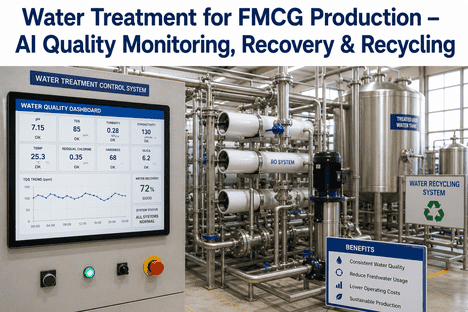
Water Treatment for FMCG Production AI Quality Monitoring, Recovery & Recycling
By Seren on June 24, 2026
In FMCG food and beverage production, water is not a utility input — it is a critical process ingredient that directly touches product, determines CIP effectiveness, and drives sustainability metrics. Process water must meet food-grade specifications for product contact, CIP water must maintain consistent temperature and flow parameters for cleaning validation, and wastewater must comply with discharge permits while minimising freshwater consumption. Traditional water treatment management relies on manual sampling, laboratory analysis with 24–48 hour turnaround, and paper-based logbooks that produce retrospective snapshots of water quality rather than real-time process control. AI-driven water treatment quality monitoring and recycling optimisation platforms ingest continuous sensor data from every water loop — incoming feed water, softened water, deionised water, CIP rinse water, boiler feed water, and treated effluent — to detect quality deviations before they affect production, optimise chemical dosing and membrane performance, and maximise water recovery and recycling rates across the entire FMCG facility. iFactory AI's platform, including its Shift Logbook and water analytics engine, enables process engineers to manage water treatment quality across multiple production lines, track water consumption and recycling performance, and demonstrate regulatory compliance from a single dashboard — without replacing existing treatment equipment, control systems, or laboratory workflows. Book a Demo to see how iFactory delivers AI-driven water treatment quality monitoring and recycling optimisation for FMCG production operations.
WATER TREATMENT · QUALITY MONITORING · RECYCLING · CIP WATER · FMCG PRODUCTION
Every Drop of Water in Your FMCG Facility Has a Quality Specification. iFactory Monitors All of Them in Real Time.
iFactory's water treatment platform gives process engineers continuous AI-driven quality monitoring across every water loop, real-time deviation detection, chemical dosing optimisation, and recycling performance analytics — connecting water management to production quality in a single system.
Potential reduction in freshwater consumption through AI-optimised water recycling and reuse strategies across FMCG production operations
85%
Reduction in water quality deviation detection time — from 24–48 hour lab turnaround to real-time sensor-based alerts within seconds
20–35%
Improvement in water recycling rates through AI-driven membrane performance monitoring, cleaning optimisation, and recovery loop management
$0.50–$2
Cost savings per 1,000 gallons of water through reduced chemical dosing, energy consumption, and wastewater treatment volumes
Why Traditional Water Treatment Management Cannot Meet FMCG Production Demands
The gap between the water quality requirements of modern FMCG production and the capability of traditional water treatment management is widening. Process engineers responsible for water quality across multiple production lines face a structural disadvantage: their visibility into water quality is limited to the frequency of manual sampling, while production runs continuously and water quality drifts between samples. Four structural limitations explain why traditional approaches continue to produce quality gaps, compliance risks, and water efficiency losses.
01
Manual Sampling Creates Blind Spots Between Lab Results
Typical FMCG facilities sample process water, CIP water, and wastewater at scheduled intervals ranging from once per shift to once per day. Between samples, water quality can drift outside specification due to feed water changes, treatment system degradation, or upstream process upsets — and the facility will not know until the next lab result arrives 24–48 hours later. By the time a deviation is detected, non-conforming product may have been produced, CIP effectiveness may have been compromised, or a discharge permit limit may have been exceeded. AI-driven continuous quality monitoring replaces intermittent sampling with real-time sensor analysis across every water loop — detecting conductivity shifts, pH excursions, turbidity increases, and chemical concentration changes within seconds of occurrence. Process engineers evaluating their water quality monitoring strategy Book a Demo to see how iFactory closes the gap between lab results with continuous sensor analytics.
02
Chemical Dosing Is Based on Fixed Setpoints, Not Real-Time Demand
Water treatment chemical dosing — coagulants, flocculants, biocides, corrosion inhibitors, antiscalants — is typically set at fixed rates based on design conditions or seasonal averages. When feed water quality changes, production throughput fluctuates, or water temperature shifts, fixed dosing rates become either insufficient (risking quality and equipment protection) or excessive (wasting chemicals and increasing operating cost). AI-driven adaptive dosing uses real-time water quality sensor data, flow rates, and production schedules to calculate optimal chemical injection rates continuously — reducing chemical consumption by 15–25% while maintaining or improving water quality compliance. The platform's learning models improve dosing accuracy over time by correlating chemical rates with downstream water quality outcomes and equipment performance indicators such as membrane fouling rates and heat exchanger scaling.
03
Water Recycling Is Managed as an Afterthought, Not a Process Variable
Most FMCG facilities have water recycling capability — condensate return, RO reject recovery, CIP rinse water reclamation — but these streams are often managed at fixed recovery rates that do not adjust to actual water quality conditions or production demand. The result is either underutilisation of recycling capacity (wasting recoverable water) or overloading of recycling systems (causing membrane fouling, breakthrough events, and maintenance downtime). AI-driven recycling optimisation continuously assesses the quality of each reclaimable water stream against the quality requirements of each potential reuse application — CIP pre-rinse, cooling tower makeup, boiler feed, equipment washdown — and dynamically routes water to the highest-value reuse destination that meets quality specifications. This adaptive routing approach typically increases overall facility water recycling rates by 20–35% without capital investment in additional treatment capacity.
04
Regulatory Compliance Documentation Is Manual, Fragmented, and Time-Consuming
FMCG facilities must maintain compliance with a complex web of water quality regulations — Safe Drinking Water Act standards for potable water, FDA food-contact water requirements, NPDES discharge permits, local sewer authority pretreatment limits, and increasingly stringent sustainability reporting mandates. Compliance documentation is typically assembled manually from laboratory reports, logbook entries, and discharge monitoring reports — consuming engineering time that should be spent on process improvement. AI-driven compliance documentation captures every water quality measurement, every deviation event, every chemical dosing adjustment, and every recycling decision in an auditable digital trail with automated report generation for regulatory submissions, sustainability disclosures, and third-party certifications such as Alliance for Water Stewardship. Process engineers managing water compliance across multiple production lines Book a Demo to see iFactory's automated compliance documentation capabilities.
The AI-Powered Water Treatment Framework — Four Capabilities That Define Modern FMCG Water Management
Water management in FMCG production is not simply a utility cost centre — it is a process variable that directly affects product quality, production efficiency, regulatory compliance, and sustainability performance. The following four-capability framework defines the technology and process layers that distinguish facilities capable of optimised, compliant, and efficient water management from those that remain exposed to quality deviations, compliance findings, and water efficiency losses.
Capability 01
Continuous Water Quality Monitoring — Every Loop, Every Parameter, Every Second
Real-Time
Traditional water quality monitoring in FMCG facilities relies on grab samples analysed in an on-site or off-site laboratory — providing discrete data points separated by hours or days. AI-driven continuous monitoring deploys online sensors for conductivity, pH, turbidity, dissolved oxygen, temperature, flow, and chemical-specific parameters across every water loop in the facility: incoming municipal or well water, softened water, deionised water, RO permeate, CIP supply and return water, boiler feed water, cooling tower water, and final effluent. Each sensor stream feeds into a real-time analytics engine that detects deviations from specification within seconds, correlates quality shifts with upstream process events, and generates alerts with root cause context — enabling process engineers to intervene before off-spec water reaches a production application. iFactory's monitoring platform integrates with existing sensor infrastructure and laboratory information management systems to create a unified water quality data layer that replaces fragmented logbooks and delayed lab reports with continuous, actionable intelligence. For a technical review of sensor integration requirements for your facility's water loops Talk to an Expert.
Capability 02
Adaptive Chemical Dosing Optimisation — Treat What the Water Actually Needs
Optimisation
Chemical dosing for water treatment — coagulants, flocculants, pH adjustment chemicals, biocides, corrosion inhibitors, antiscalants, and boiler treatment chemicals — represents a significant operating cost and a direct influence on water quality outcomes. Traditional dosing at fixed rates based on average conditions wastes chemicals when demand is low and risks quality when demand spikes. AI-driven adaptive dosing continuously calculates optimal chemical injection rates from real-time water quality sensor data, flow rates, temperature, and production activity signals. When feed water turbidity increases after a storm event, the coagulant dose adjusts upward within minutes. When production slows and water demand drops, the dose scales back proportionally. The platform's machine learning models correlate dosing rates with downstream water quality and equipment condition indicators — membrane differential pressure, heat exchanger fouling factors, boiler blowdown frequency — to continuously refine the dosing algorithm. Facilities deploying adaptive dosing report 15–25% reduction in chemical consumption with measurable improvements in water quality consistency and equipment protection.
Capability 03
Intelligent Water Recycling and Reuse Routing — Every Drop to Its Highest-Value Destination
Recycling
FMCG facilities generate multiple reclaimable water streams: CIP final rinse water, RO reject water, condensate from evaporation and drying processes, cooling tower blowdown, and equipment washdown water. Each stream has a different quality profile, and each reuse application — pre-rinse water, cooling tower makeup, boiler feed, equipment washdown, irrigation — has different quality requirements. Traditional recycling routes these streams to fixed destinations at fixed rates, regardless of actual quality or demand. AI-driven intelligent routing continuously assesses the real-time quality of each reclaimable stream against the specification requirements of each potential reuse application and dynamically assigns each stream to the highest-value destination that its quality supports. When CIP rinse water quality is high enough for boiler feed, it is routed there — displacing freshwater. When quality degrades, it is redirected to a lower-spec application such as cooling tower makeup or equipment washdown. The routing engine learns from historical quality patterns and production schedules to anticipate recycling opportunities before they arise, maximising water recovery without compromising process quality. Process engineers targeting water reduction goals Book a Demo to see how iFactory's intelligent routing platform maps to your facility's water loops.
Capability 04
Automated Compliance and Sustainability Reporting — From Sensor to Submission
Reporting
Water compliance reporting in FMCG production spans multiple regulatory frameworks and sustainability standards: Safe Drinking Water Act monitoring for potable water systems, FDA food-contact water quality documentation, NPDES discharge monitoring reports, local sewer authority pretreatment compliance, and voluntary sustainability reporting frameworks such as CDP Water Security, Alliance for Water Stewardship, and corporate ESG commitments. Each framework requires different data, different formats, and different submission schedules — creating an administrative burden that diverts engineering resources from water quality improvement work. iFactory's automated compliance documentation module captures every water quality measurement, deviation event, chemical dosing adjustment, and recycling routing decision in an auditable data layer with configurable report templates for each regulatory framework and sustainability standard. Report generation that previously required 8–16 hours of manual data compilation per reporting period is reduced to minutes of template review and approval. The platform's sustainability analytics module tracks water intensity (gallons per unit of production), recycling rate, freshwater reduction, and wastewater discharge metrics against targets — with automated variance analysis and corrective action tracking for continuous improvement.
The Water-Energy-Quality Nexus — Why Integrated Water Management Is a Competitive Advantage
Water management in FMCG production does not operate in isolation. Every water treatment decision affects energy consumption (pumping, heating, cooling, membrane operation), chemical consumption, waste generation, and production quality. The EPA estimates that industrial water and wastewater energy use accounts for approximately 4% of total U.S. electricity consumption. For FMCG facilities operating in water-stressed regions, regulatory pressure on water withdrawals is intensifying — the SEC's climate disclosure rules and emerging state-level water disclosure requirements are making water management a board-level reporting issue. For process engineers, the business case for AI-driven water treatment optimisation is clear: reduced freshwater consumption (30–50%), lower chemical costs (15–25%), improved water quality consistency (85% faster deviation detection), enhanced recycling rates (20–35% improvement), and automated compliance documentation that eliminates manual reporting overhead. iFactory's platform connects water quality monitoring, chemical dosing optimisation, recycling routing, and compliance reporting in a single system — because water management is not a utility function. It is a process that touches every part of production.
QUALITY MONITORING · CHEMICAL OPTIMISATION · RECYCLING · COMPLIANCE · FMCG WATER
Your Facility's Water Quality Should Be Under Continuous Control — Not Confirmed After the Fact. iFactory Makes It Continuous.
iFactory unifies continuous water quality monitoring, adaptive chemical dosing, intelligent recycling routing, and automated compliance reporting — giving process engineers the capability to manage water as a process variable, not a utility cost.
The Water Treatment Maturity Model — Where Does Your Facility Stand?
Every FMCG facility operates somewhere on the water treatment management maturity curve. The following model helps process engineers assess their current capability level and identify the specific investments needed to reach the next stage — from reactive manual sampling to predictive AI-driven optimisation across every water loop.
Water Treatment Management Maturity Model
Stage
Water Quality Approach
Monitoring Characteristics
Priority for Advancement
Stage 1
Reactive
Water quality verified by lab samples taken after production runs. Deviations detected when product quality is affected or discharge permit limits are exceeded.
Manual grab samples, paper logbooks, lab reports with 24–48 hour turnaround. No continuous monitoring. Fixed chemical dosing rates.
Install online sensors for critical water quality parameters (conductivity, pH, turbidity) on the main production water loop. Establish digital data logging.
Stage 2
Monitored
Online sensors installed on key water loops. Alarms set at fixed thresholds. Data logged digitally but reviewed periodically. Chemical dosing still at fixed rates.
Digital dashboards with real-time sensor data. Threshold-based alarms. Manual data export for compliance reporting. Recycling operated at fixed rates.
Deploy unified water data platform. Implement trend analysis and deviation prediction. Begin adaptive dosing pilot on highest-chemical-volume loop.
Stage 3
Optimised
Real-time continuous monitoring across all water loops. AI-driven deviation detection with predictive alerts. Adaptive chemical dosing active on major loops.
Unified water quality dashboard. Predictive analytics for quality deviation. Automated chemical dose adjustment. Recycling routing optimisation active.
Extend adaptive dosing to all chemical injection points. Automate recycling routing across all reclaimable streams. Integrate compliance report generation.
Stage 4
Predictive
AI predicts quality deviations 24–48 hours before they occur. Dosing and recycling routing self-optimise continuously. Compliance documentation is fully automated.
Self-learning water quality models. Closed-loop chemical optimisation. Dynamic recycling routing. Automated multi-framework compliance reporting. Water intensity continuously improving.
Benchmark water intensity against industry peers. Use predictive analytics for capital water investment decisions. Drive continuous improvement from quality and efficiency data.
Conclusion
The gap between intermittent manual water quality sampling and continuous AI-driven monitoring is the source of most water-related quality deviations, chemical waste, recycling underperformance, and compliance documentation overhead in FMCG production. AI-driven water treatment quality monitoring and recycling optimisation closes that gap by ensuring every water loop is under continuous analytical surveillance, every chemical dose is calculated for current conditions, every reclaimable drop is routed to its highest-value application, and every compliance report is generated automatically from live process data. Process engineers evaluating their water treatment technology roadmap Book a Demo to review the iFactory water treatment platform deployment plan for your FMCG operations.
iFactory's water treatment platform gives process engineers the capability to monitor every water loop continuously, optimise chemical dosing adaptively, maximise recycling rates intelligently, and automate compliance documentation completely — turning water management from a reactive utility function into a proactive process optimisation capability. Book a Demo to see how the platform maps to your facility's water treatment infrastructure, or Talk to an Expert to begin building your connected water management capability with iFactory today.
30–50% Less Freshwater. 15–25% Less Chemicals. 85% Faster Deviation Detection. Start Building Your Optimised Water Future Today.
iFactory gives process engineers the continuous water quality monitoring, adaptive chemical dosing, intelligent recycling routing, and automated compliance reporting to manage water as a process variable — reducing consumption, improving quality, and eliminating manual compliance overhead.
The platform monitors a comprehensive set of water quality parameters across every water loop in the FMCG facility. Standard monitored parameters include conductivity, pH, turbidity, temperature, flow rate, dissolved oxygen, oxidation-reduction potential, total dissolved solids, hardness, chlorine residual, and chemical-specific parameters such as coagulant concentration and biocide residual. The platform also integrates with online analysers for more complex parameters including total organic carbon, chemical oxygen demand, and specific ion concentrations. Parameter selection is configurable per water loop based on the quality requirements of each application — potable water, process water, CIP water, boiler feed, cooling water, and wastewater discharge. For a detailed parameter mapping to your facility's water loops Talk to an Expert.
iFactory's adaptive dosing module integrates with existing chemical feed pumps, flow meters, and control systems through standard communication protocols including 4–20 mA, Modbus, Profibus, and OPC-UA. The platform reads real-time water quality sensor data and calculates optimal dosing rates for each chemical injection point, then writes setpoint adjustments to the existing chemical feed controllers. No replacement of existing chemical feed equipment is required — the platform layers adaptive intelligence on top of the current dosing infrastructure. For facilities with manual chemical dosing, the platform provides dosing recommendations displayed on operator dashboards and mobile devices, with automated logging of recommended versus actual dose rates for compliance documentation. Book a Demo to see how the adaptive dosing module connects to your facility's existing chemical feed infrastructure.
The recycling optimisation engine continuously evaluates each reclaimable water stream against a quality requirements matrix for every potential reuse application in the facility. For each stream-destination pair, the platform assesses conductivity, pH, turbidity, hardness, chemical residuals, and microbial quality against the application's specification limits. Streams that meet the highest-quality application requirements are routed there first; streams that fall below that threshold are cascaded to progressively lower-spec applications. The routing engine accounts for demand signals — if the cooling tower is at full capacity, the platform routes reclaimable water to the next available application such as equipment washdown or irrigation. The system also factors in treatment cost: if a stream requires minimal additional treatment to meet boiler feed quality but significant treatment to meet process water quality, the platform evaluates the net value of each routing option including treatment energy, chemical, and maintenance costs. Process engineers evaluating recycling optimisation for their facility Book a Demo to see a routing simulation based on your facility's water quality data.
The initial deployment timeline depends on the number of water loops being monitored and the availability of existing sensor infrastructure. Facilities with existing online sensors on major water loops typically complete the continuous monitoring configuration and dashboard deployment within two to three weeks. The adaptive chemical dosing integration requires additional time for pump and controller connectivity verification — typically three to five weeks for the first dosing loop, with subsequent loops deploying faster as the integration pattern is established. The recycling routing optimisation module requires a water balance study and quality characterisation of reclaimable streams — typically four to six weeks for a single facility. Measurable improvement in deviation detection time is immediate upon sensor connection — 85% faster than lab-based detection. Chemical consumption reductions of 15–25% are typically observed within the first four to eight weeks of adaptive dosing operation as the AI models calibrate to the facility's water quality patterns. Recycling rate improvements of 20–35% materialise over the first full production cycle after routing optimisation deployment. A personalised deployment timeline aligned with your facility's water treatment infrastructure is provided during the Book a Demo consultation with iFactory's FMCG water treatment team.