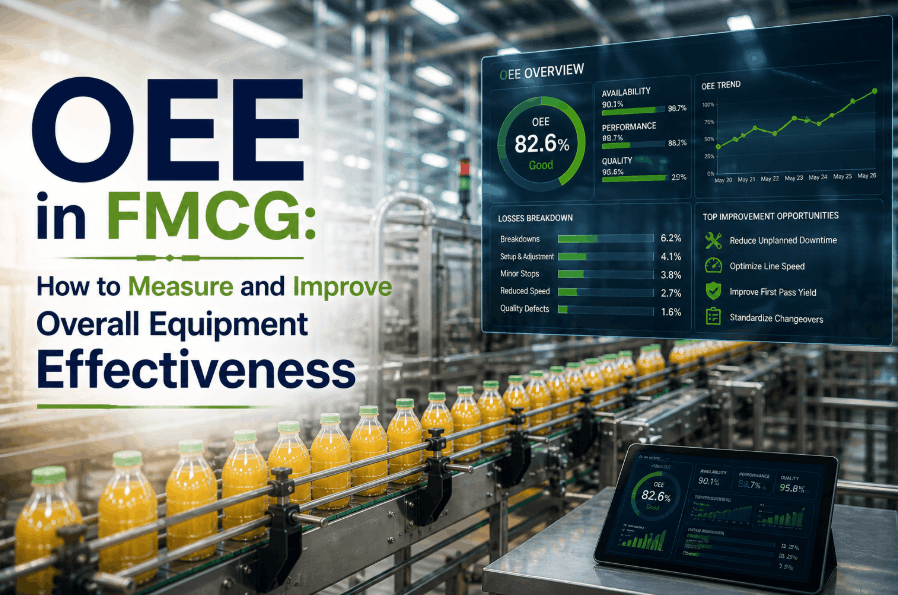
Your packaging line just ran an entire shift at 62% OEE. That is not a dashboard problem — that is $180,000 in hidden losses every single month. The top 10% of FMCG manufacturers operate above 85% OEE, reduce scrap by 40–75%, and cut changeover time in half. The gap between average and world-class is not luck — it is measurement. Book a free demo to see how iFactory turns your production data into benchmark-beating performance.
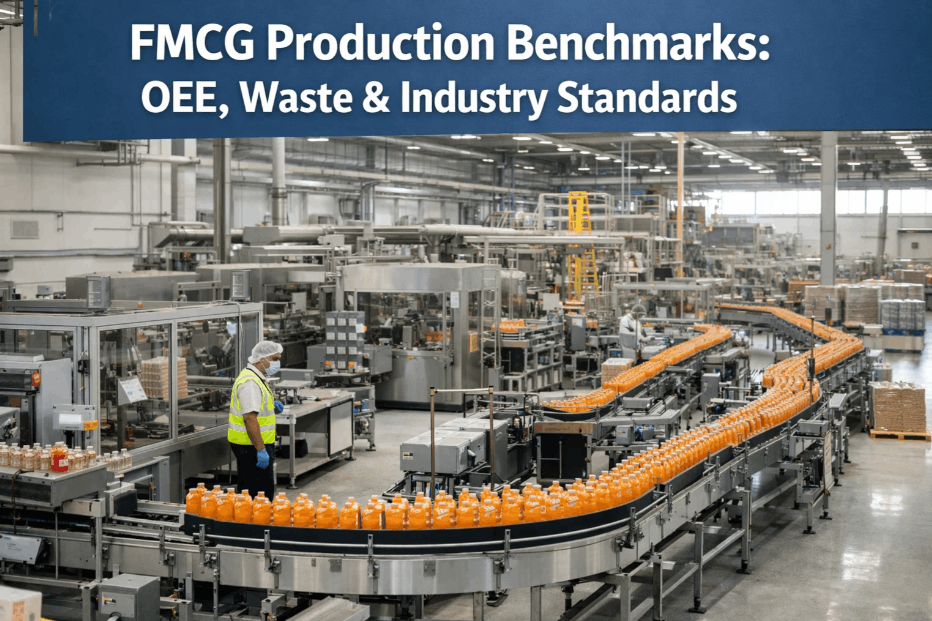
FMCG Production Benchmarks Guide 2026
OEE Targets, Waste Reduction Metrics, and Efficiency KPIs to Maximize Output and Cut Losses
85%
World-Class OEE Target for FMCG Manufacturers
27–47%
Hidden Capacity Losses in Average FMCG Facilities
$14.5T
Global Manufacturing Market Value Per Year
What Is OEE and Why Does It Rule FMCG?
Overall Equipment Effectiveness multiplies three factors that determine whether your production line is making money or burning it.
90% in each component sounds impressive — until you multiply them. That is the compounding trap most FMCG plants fall into. Every 1% gain in any factor lifts the entire equation.
FMCG OEE Benchmarks by Sub-Sector
Not all FMCG is created equal. Your target depends on what you manufacture.
Food & Beverage
65%
80–85%
Sanitation cycles consume 15–20% of available time
Consumer Packaged Goods
68%
85–88%
High SKU variety drives frequent changeovers
Pharma & Personal Care
37–55%
60–75%
30% of worker time spent on batch documentation
The 3 OEE Components Decoded for FMCG
Each component faces unique FMCG pressures. Here is what drags each one down — and what top performers do differently.
Top Killers in FMCG
✗ Changeover between SKUs
✗ Mandatory CIP/sanitation cycles
✗ Unplanned breakdowns & material shortages
✗ Shift handover delays
How Top Performers Win
✓ SMED changeovers under 10 minutes
✓ Predictive maintenance cutting breakdowns by 30%
✓ Automated scheduling through CMMS platforms
Top Killers in FMCG
✗ Micro-stops accounting for 25% of lost time
✗ Speed reductions from variable raw materials
✗ Operator inefficiency
✗ Equipment running below rated speed
How Top Performers Win
✓ Real-time dashboards flagging micro-stops instantly
✓ Automated production tracking
✓ IoT-based speed optimization tied to material quality
Top Killers in FMCG
✗ Startup rejects after changeover
✗ Fill weight variation & labeling errors
✗ Packaging defects
✗ Contamination from inadequate cleaning
How Top Performers Win
✓ In-line quality sensors & AI anomaly detection
✓ First-pass yield tracking per batch
✓ Automated reject analysis for root cause resolution
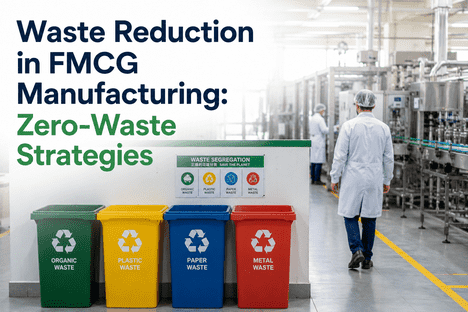
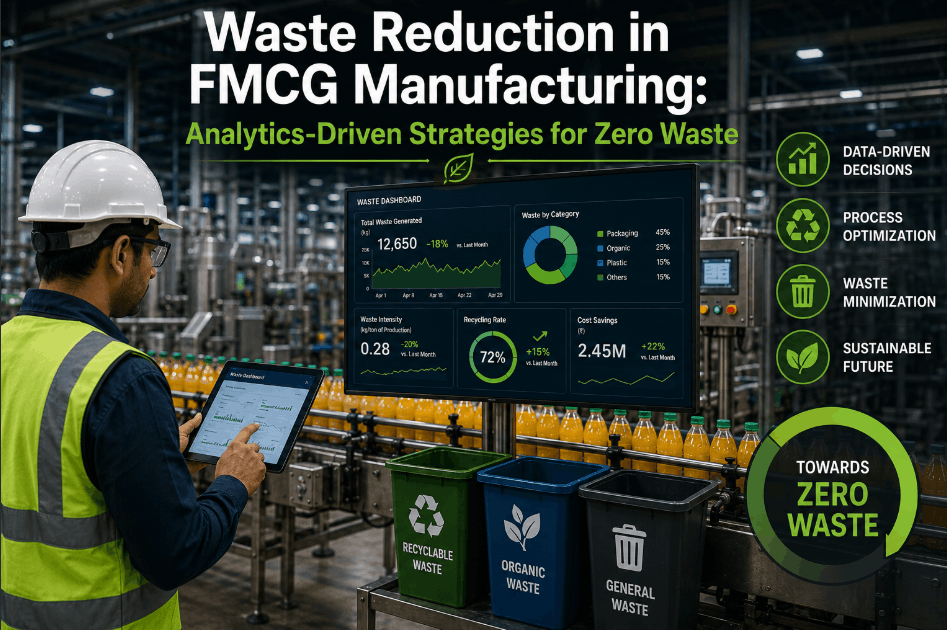
The Real Cost of FMCG Production Waste
Material waste is not just an environmental issue — it is direct margin erosion that compounds across every shift.
Typical FMCG Plant — Monthly Waste
Raw materials input
10,000 kg
Scrap rate
8%
Discarded before revenue
800 kg
Cost per kg
$5/kg
Pure Monthly Loss Per Line
$4,000
×8
Scaled Across Facility
Production lines
8 lines
Shifts per day
3 shifts
Monthly waste (all lines)
$32,000
Annual Facility Waste
$384,000
Average FMCG: 5–8%
World-Class: < 2%
Average FMCG: 92–95%
World-Class: > 99%
Average FMCG: 88–92%
World-Class: > 97%
How Far Is Your Plant from World-Class?
iFactory CMMS tracks OEE, scrap rate, changeover time, MTTR, and every critical KPI in real time — turning raw production data into automated maintenance actions that close the performance gap.
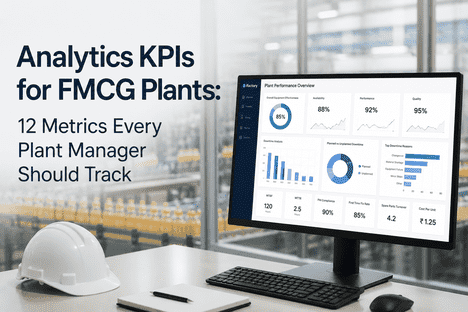
7 Efficiency KPIs Every FMCG Plant Must Track
Beyond OEE — these are the metrics that separate high-performing FMCG operations from the rest.
Average operating hours before equipment fails. Higher is better. Rising MTBF confirms your preventive maintenance strategy is working.
Benchmark: Continuously increasing trend
Average time to restore equipment after failure. Every hour of MTTR is lost production. Plants using CMMS reduce MTTR by 20–30%.
World-Class: Under 2 hours
Duration to switch from one product to another. In FMCG, frequent SKU changes make this a top OEE killer. SMED methodology targets under 10 minutes.
Target: Single-digit minutes (SMED)
Ratio of planned to total maintenance hours. Higher means fewer emergencies. World-class operations exceed 85% planned work.
World-Class: > 85% planned
Actual output versus scheduled target. Measures how consistently your lines hit plan. Directly tied to delivery performance and revenue.
Target: > 95%
Percentage of scheduled production time lost to unexpected failures. Every point of downtime hits throughput and revenue directly.
World-Class: < 2%
Takt Time Adherence
How closely production pace matches customer demand. Overproduction wastes resources; underproduction loses orders. Balance is everything. Target: Within ±5% of takt.
From Average to World-Class: The OEE Improvement Curve
Realistic timelines and ROI at each stage of your FMCG improvement journey.
Measure and Baseline
Deploy sensors, connect your CMMS, and establish accurate OEE baselines per line, shift, and product
Most plants discover 10–15 percentage points of hidden improvement opportunity in the first diagnostic assessment
Typical Gain:
+3–5 OEE points
Quick Wins and Automation
Attack the biggest loss categories first. Automate preventive maintenance workflows.
Reduce changeover with SMED. This is the steepest part of the improvement curve where low-hanging fruit delivers fast results.
Typical Gain:
+5–8 OEE points
Predictive and Optimize
Layer in predictive maintenance, product mix optimization, and full digitalization
AI models learn equipment patterns and catch degradation weeks before failure — delivering sustained gains toward world-class
Typical Gain:
+5–7 OEE points
Total Potential Improvement
+13 to +20 OEE Points
Over 24 months, a structured approach moves average FMCG facilities from 55–65% OEE to 75–85%+ — unlocking six-figure annual savings per production line.
Rate Your FMCG Production Maturity
Where does your plant sit today? Be honest — each gap is recoverable margin.
Current OEE Score
Below 60%
60–74%
75–85%+
Maintenance Approach
Reactive Only
Calendar-Based PM
Condition-Based
Changeover Efficiency
30+ Minutes
15–30 Minutes
Under 10 Min
Scrap Tracking
Manual / Monthly
Shift-Level Reports
Real-Time Digital
KPI Visibility
Spreadsheets
Weekly Reports
Live Dashboards
If most of your answers land in the red or orange zones, you are leaving six-figure annual savings on the table. The good news — every gap here is closable with the right system in place.
Frequently Asked Questions
What is a good OEE score for FMCG manufacturing?
World-class OEE for FMCG is 85% or higher, though this varies by sub-sector. Food and beverage plants face structural constraints like mandatory sanitation that make 80–85% excellent. Many FMCG facilities start at 55–65% and can reach 80%+ within 12 months of implementing real-time OEE tracking connected to maintenance management.
How quickly can a CMMS improve our production KPIs?
Initial data collection and baselining takes 30–60 days. Measurable improvements typically appear within 90–120 days as preventive maintenance workflows reduce unplanned downtime. Most facilities see 5–8 OEE points in the first six months, with another 5–7 points over the following 12 months as the system learns your patterns.
Which KPI should we prioritize first?
Start with whatever is causing the most pain. If downtime is your issue, focus on MTBF and MTTR. If waste is the concern, prioritize first pass yield and scrap rate. OEE is the best single comprehensive metric because it captures availability, performance, and quality together — so start tracking it immediately.
Can legacy FMCG equipment be monitored for OEE?
Yes. Older machines without built-in connectivity can be retrofitted with clamp-on IoT sensors for vibration, temperature, and current monitoring. These connect to edge gateways that feed data into your CMMS without modifying the equipment itself — making even decades-old lines trackable and optimizable.
Your Production Data Has the Answers. Start Reading It.
iFactory CMMS tracks OEE, waste, changeover, MTTR, and every efficiency KPI in real time — automating maintenance workflows and turning raw data into measurable performance gains.