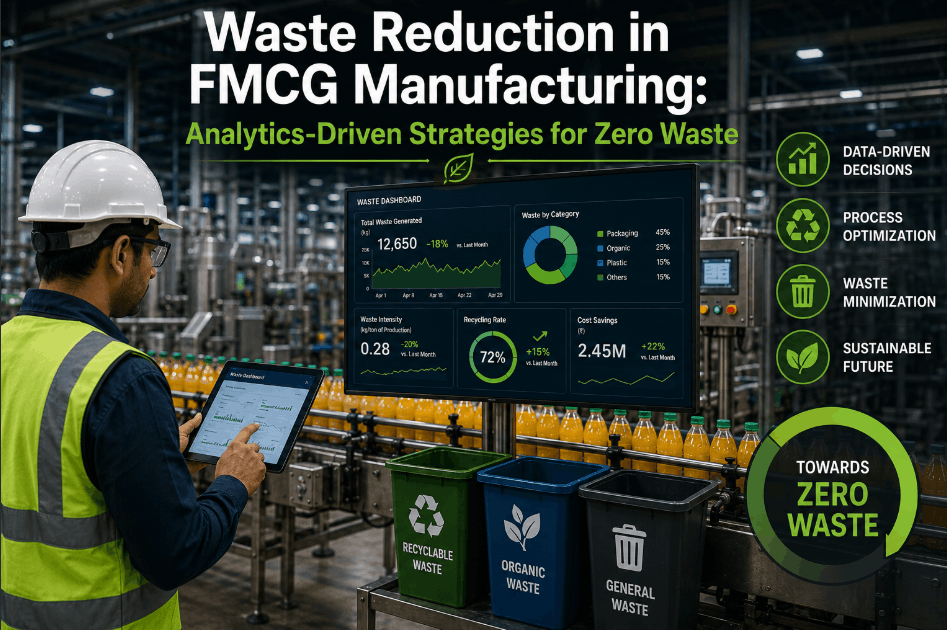
Waste Reduction in FMCG Manufacturing Zero Waste Strategies
By Seren on June 2, 2026
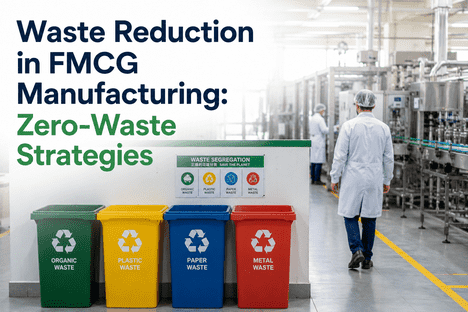
FMCG manufacturing plants lose an estimated 5–12% of total material input to production waste overfills, packaging scrap, changeover losses, rejected product, and raw material spoilage. With the FMCG sector contributing nearly 40% of global plastic packaging waste and significant organic material loss, the financial pressure to optimize material yield has never been higher. Traditional waste management relies on end-of-shift scrap weighing and manual logs approaches that identify losses but cannot pinpoint the precise machine, operator, or process condition causing them. AI-driven waste analytics flips this model: real-time sensor data from filler heads, packaging lines, and quality checkpoints feeds machine learning models that detect waste patterns at the moment they occur. When integrated with a manufacturing execution platform that auto-generates waste alerts, creates corrective work orders, and tracks material yield by SKU and shift, manufacturers consistently report 40–65% reduction in total material waste and $400K–$1.9M annual savings. iFactory AI provides this integration layer connecting filler data, packaging line sensors, checkweigher outputs, and shift logbook observations into a single zero-waste analytics platform purpose-built for FMCG production. Book a Demo
Zero-Waste FMCG Manufacturing 2026
Waste Reduction in FMCG: AI-Driven Zero-Waste Strategies
Real-time waste analytics · Fill optimization · Robotic vision QC · Changeover scrap reduction · Raw material spoilage prevention · Circular packaging · Sustainability reporting · Purpose-built for food, beverage & CPG plants.
Total material waste reduction with AI-driven analytics
$400K–$1.9M
Annual savings from recovered material at mid-size FMCG plants
4–8 Mo
Average payback period on zero-waste platform deployment
30–50%
Faster changeover scrap reduction through AI-optimized sequences
Why Material Waste Is the Largest Hidden Profit Leak in FMCG Plants
In FMCG manufacturing, waste is rarely a single catastrophic event — it is thousands of small, undetected losses accumulating across every production line. A filler head drifting 0.3% above target weight loses tons of product annually. A misaligned label applicator crushes cartons at 600 units per minute before an operator notices. A temperature sensor drifting in a raw material silo sends ingredients past shelf life before the batch is scheduled. Industry benchmarks place total FMCG waste at 5–12% of material input, with overfill "giveaway" alone accounting for 2–5% of liquid and dry ingredient volume. Beyond direct material cost, waste drives higher disposal fees, increased regulatory scrutiny under Extended Producer Responsibility (EPR) frameworks, and lost revenue from saleable product that never reaches the customer. AI-driven waste reduction addresses these cascading losses by monitoring every process variable on every line simultaneously — correlating each waste event with the equipment condition, process parameter, and operator action that caused it.
Three Operational Problems iFactory Solves for FMCG Manufacturers
01
PROBLEM
Invisible Waste Streams Hidden in High-Speed Production
Most FMCG plants operate with a "hidden factory" — a parallel production stream generating scrap, overfills, and wasted energy that mass-balance reconciliations detect only at end-of-shift. By then, the specific machine, shift, and condition that caused the loss are impossible to isolate. iFactory's AI waste analytics engine ingests real-time data from filler valve timing, checkweigher outputs, packaging vision systems, and PLC telemetry to classify every gram of material loss by source, cause, and financial impact. The platform identifies six critical waste patterns — overfill giveaway, packaging defects, changeover stabilization scrap, raw material spoilage, utility overconsumption, and energy waste — assigning each to specific equipment and process conditions. Maintenance and production teams receive waste alerts within seconds, not hours, with the root cause data needed to intervene before the next unit of waste is produced.
Real-time waste classificationPer-source financial impactInstant root cause alerts
02
PROBLEM
Manual Changeover Procedures That Generate Predictable Scrap
Product changeovers are the highest-risk period for waste generation in FMCG production. Inadequate machine calibration during startups, operator-dependent adjustment sequences, and inconsistent purge protocols produce "stabilization scrap" that varies 30–50% between shifts — even on identical product transitions. iFactory's Shift Logbook and changeover optimization module capture every changeover event with digital procedure tracking, recording material consumption, time to steady-state, and quality stabilization metrics. The platform analyzes historical changeover data to identify best-run sequences and guides technicians through machine adjustments using "Best Run" parameters, ensuring the first unit after changeover is within specification. FMCG plants using iFactory's guided changeover workflows reach steady-state production 30% faster and eliminate 40–60% of stabilization scrap within the first quarter of deployment.
Guided changeover workflowsBest Run parameter recall40–60% less stabilization scrap
03
PROBLEM
Disconnected Data That Hides the Waste-to-Equipment Link
Waste data lives in disconnected systems — checkweigher data on the packaging line display, quality reject counts in a spreadsheet, scrap weights on a scale ticket, and shift observations in a paper logbook. No single view connects material loss to the equipment degradation or process drift that caused it. iFactory centralizes waste data from any source: filler performance metrics, vision inspection results, checkweigher statistics, PLC process parameters, and operator observations captured through the Shift Logbook mobile app. Cross-correlation between data types reveals composite failure signatures — such as a filling head seal degrading 12% that increases overfill by 0.8%, or a sealing jaw temperature drift that elevates package rejection rates 90 minutes before visible failure. The platform generates corrective work orders with waste impact quantification attached, so maintenance teams address the highest-value issues first.
Cross-correlated waste signalsEquipment degradation linkageWaste-quantified work orders
How Zero-Waste Analytics Maps to FMCG Production Stages
Predictive shelf-life alerts reduce raw material spoilage by over 25% through proactive scheduling
CIP & Utility Systems
2–3x overuse
CIP flow rate & turbidity monitoring · chemical dosing optimization · energy tracking per machine
Closed-loop CIP optimization reduces water/chemical waste 30–50%; energy waste eliminated
FMCG Use Cases: What iFactory Delivers on the Plant Floor
Filling & Portioning
AI-Driven Fill Optimization for Giveaway Elimination
Monitoring: Continuous
Product overfill — filling above label weight to avoid underweight regulatory penalties — costs FMCG manufacturers 2–5% of total liquid and dry ingredient volume annually. A cereal facility losing $2.3M in raw material waste discovered 3.2% overfill on every box alone. iFactory's fill optimization module monitors each filler valve head individually, correlating fill weight with checkweigher data in real time. When a piston seal degrades or valve timing drifts, the platform identifies the specific head, quantifies the waste impact, and generates a work order with the replacement part number from your spare parts catalogue. Over eight months, a mid-size facility reduced total material waste to 2.1% — recovering $1.6M annually from the same raw materials without any capital equipment investment.
Robotic Vision Packaging Defect Prevention at High Speed
Monitoring: Continuous
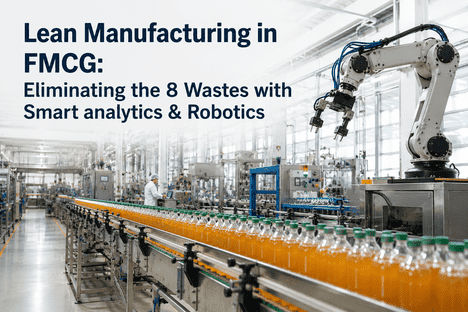
Packaging waste — misaligned labels, crushed cartons, faulty heat seals, and incorrect film tension — accounts for the majority of visible scrap in FMCG plants and directly impacts EPR compliance costs. iFactory's AI vision inspection system monitors 100% of production at 600+ units per minute, detecting seal integrity issues, label skew, cap misalignment, and carton damage before product leaves the packaging node. When the system detects a defect pattern, it correlates the issue with specific equipment conditions — a sealing jaw temperature drift, a label applicator position shift, or a film tension roller bearing degrading. The platform generates a corrective action and work order with the specific PM task and spare part required, stopping the defect cascade before a batch of thousands is ruined. Talk to an Expert about packaging line vision deployment.
Inspection rate600+ units/min · 100% production coverage
Guided Changeover Optimization for Stabilization Scrap Elimination
Monitoring: Per Event
Product changeovers in high-speed FMCG lines generate stabilization scrap every time a line transitions between SKUs — purge material, out-of-spec product during startup, and packaging adjustments. The waste volume varies 30–50% between shifts due to operator-dependent adjustment sequences. iFactory's digital changeover module captures procedure execution data from the Shift Logbook, recording each step duration, material consumption, and time-to-quality for every transition. The platform analyzes historical data across all shifts to identify the "Best Run" parameters for each product combination and guides the next technician through the optimized sequence with real-time feedback. FMCG plants implementing guided changeovers report 40–60% less stabilization scrap, 30% faster time to steady-state production, and consistent first-time quality across all shifts and operators. Book a Demo
Waste elimination40–60% less stabilization scrap per changeover
Speed gain30% faster time to steady-state production
What iFactory Delivers for FMCG Operations
40–65%
Less total material waste on monitored production lines
Real-time waste classification with per-source root cause and financial impact
$400K–$1.9M
Annual savings from recovered material at mid-size FMCG plants
Fill optimization, packaging waste reduction, changeover scrap elimination
4–8 Mo
Average payback period on zero-waste platform deployment
Most facilities achieve full ROI within 4–8 months of initial deployment
2–4 Wk
Platform deployment with pre-built FMCG production templates
iFactory is sensor-agnostic and integrates with any data source already in your plant — checkweigher outputs, filler valve telemetry, PLC process data via Modbus or OPC-UA, vision inspection systems, temperature and humidity sensors, flow meters, and energy meters. The platform also supports manual data entry through the Shift Logbook mobile app for waste observations, scrap weights, and quality inspection results. Pre-built FMCG production templates map the recommended data points for each equipment type — fillers, packaging machines, conveyors, thermal processors, and CIP skids — enabling a phased deployment starting with your highest-waste lines. Talk to iFactory's team to discuss your current data infrastructure and priority waste streams.
iFactory classifies waste into six categories — overfill giveaway, packaging defects, changeover stabilization scrap, raw material spoilage, utility overconsumption, and energy waste — using a multi-parameter correlation engine. For each waste event, the platform analyzes equipment condition data (vibration, temperature, current draw), process parameters (pressure, flow, speed, timing), and operator observations from the Shift Logbook. Cross-correlation identifies composite signatures: a filling head overfilling 0.8% linked to a specific piston seal degradation, or a packaging rejection spike correlated with a sealing jaw temperature drift. The platform assigns a root cause confidence score and generates a corrective work order with waste impact quantification. During the first 90 days, the model establishes baselines and the validation team tunes waste classification thresholds to your specific product mix and equipment population.
iFactory can begin generating value with checkweigher or filler data from as few as 5–10 production lines, combined with existing scrap weight records and shift logs. The AI models use transfer learning from iFactory's FMCG equipment population baselines, so you do not need years of waste data to start seeing reduction opportunities. Most FMCG plants see measurable improvements within 6–10 weeks — initial gains come from fill optimization (reduced giveaway) and changeover scrap reduction, as these require the least baseline data and address the highest-value waste streams. Full AI waste analytics across all production stages typically reach steady-state performance within 4–6 months as models accumulate sufficient data to identify subtler equipment drift patterns.
Yes. iFactory's platform bi-directionally integrates with leading ERP and CMMS systems — SAP, Oracle, Infor, Microsoft Dynamics, and others via REST API, flat file, or database connector. Waste alerts and corrective work orders can auto-create maintenance tasks in your existing CMMS, with waste impact quantification and suspected root cause attached. For sustainability reporting, the platform generates automated ESG reports with the verified data trail required for Zero Waste to Landfill certifications and EPR compliance declarations. The integration layer resolves duplicate material codes, synchronizes equipment hierarchies, and maps iFactory's waste categories to your reporting taxonomies. A standard integration is completed during the first week of deployment with no rip-and-replace of existing systems required.
iFactory deploys in 2–4 weeks against pre-built FMCG production templates. The full zero-waste program — assessment, data source integration, platform configuration, pilot on 5–10 lines, plant-wide rollout, validation, and training — runs 10–12 weeks end-to-end. Most FMCG facilities achieve positive ROI within 4–8 months of go-live on the pilot group, driven by reduced giveaway, lower packaging scrap, fewer changeover losses, and decreased raw material spoilage. Typical 12-month results on monitored lines are 40–65% less total material waste and $400K–$1.9M in annual savings. The program includes 90-day implementation support from a dedicated industry specialist with FMCG manufacturing domain expertise.
Deploy Zero-Waste Analytics for Your FMCG Plant
iFactory AI connects filler data, packaging line sensors, checkweigher outputs, shift observations, and process parameters into a single zero-waste analytics platform — purpose-built for food, beverage, and CPG manufacturing. Pre-built FMCG production templates for fillers, packaging lines, conveyors, thermal processors, and CIP systems. 2–4 week deployment with 90-day implementation support. Positive ROI within 4–8 months.