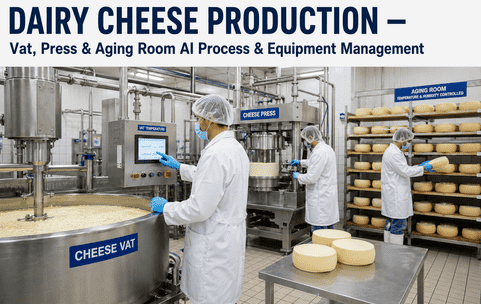
Dairy Cheese Production Vat, Press & Aging Room AI Process & Equipment Management
By Seren on June 27, 2026
A process engineer walks through a cheese production floor checking three things in sequence: the starter culture activity in the vat, the pressure curve on the cheese press, and the temperature-humidity balance in the aging room. Each parameter is recorded on a paper log sheet, entered into a spreadsheet at shift change, and reviewed by the production manager three days later — when the cheese is already in the aging room and the vat temperature that drifted 2°C during the night shift is nothing more than a historical note. For dairy processors producing cheddar, mozzarella, gouda, or artisan varieties, this delay between parameter deviation and corrective action is the difference between consistent premium cheese and a batch that gets downgraded to commodity pricing. iFactory AI brings real-time monitoring, predictive process control, and unified equipment management to every stage of cheese production — from the vat floor to the aging shelf.
Vat Temperature, Press Pressure, Aging Room Humidity — Three Critical Parameters, One Unified AI Process Platform for Dairy Cheese Production.
iFactory AI monitors every stage of cheese making — from starter culture addition in the vat through pressing, brining, and affinage — giving process engineers real-time visibility and predictive alerts that protect cheese quality and reduce downgrade risk.
Metric tons of cheese produced annually worldwide — every batch dependent on precise vat, press, and aging room conditions
Downgrade Losses
$2B+
Annual losses from cheese quality downgrades caused by uncontrolled vat temperature, press pressure, and curing environment deviations
Vat Temperature Drift
2-4°C
Typical unmonitored temperature drift during multi-hour vat cycles — directly affecting curd formation, whey expulsion, and final cheese yield
Affinage Duration
60-365
Days of aging for many hard and semi-hard cheeses — months of environmental monitoring where a single humidity deviation can compromise the entire batch
The Three Critical Control Points in Cheese Production — and Why Manual Monitoring Falls Short
Cheese making is a sequence of biological, chemical, and physical transformations that must be controlled within narrow parameter windows — and those windows are different for every cheese variety. A mozzarella stretch curve cannot tolerate the same vat temperature profile as a cheddar cook cycle. A brie aging room operates at a different humidity than a gouda cave. Yet most dairy plants monitor these three critical stages — vat processing, cheese pressing, and aging room affinage — with manual log sheets, periodic spot checks, and operator-dependent adjustments that introduce variability into every batch.
The Three Critical Control Points — Each with Distinct Monitoring Challenges That iFactory AI Solves
Vat & Starter Culture — The Biological Foundation
Vat temperature, pH decline rate, starter culture activity, coagulation timing, and curd cutting decisions — all interdependent variables that define cheese yield and quality.
The vat stage is where cheese quality is determined. Starter culture conversion of lactose to lactic acid drives the pH decline that controls curd firmness, moisture retention, and final cheese texture. A temperature deviation of just 1°C during the cook cycle can accelerate or slow the pH curve by 30-45 minutes, causing the curd to be cut at the wrong firmness. When the curd is cut too early, fine curd particles (fines) are lost in the whey, reducing yield by 1-3%. When cut too late, the curd retains excess moisture, producing a soft, pasty texture that may not meet grade standards. iFactory AI monitors vat temperature, pH, and coagulation status in real time, alerting the process engineer the moment a parameter drifts outside the make procedure specification — not three days later when the cheese reaches the aging room.
Real-time vat monitoring1°C drift = 30-45 min pH shift
Cheese Press — The Physical Transformation
Press pressure, press duration, drainage efficiency, and curd fusion — mechanical parameters that determine cheese body, texture, and whey removal completeness.
The pressing stage transforms loose curd into a cohesive cheese block by applying controlled pressure that fuses curd particles, expels residual whey, and shapes the cheese. Different cheese types require different pressure profiles: cheddar may start at 10 psi and increase gradually over 6-18 hours, while mozzarella is pressed at minimal pressure to retain moisture. Inconsistent press pressure produces uneven curd fusion, leaving mechanical openings (mechanical eyes) where whey was trapped, creating visible defects that reduce grade. Over-pressing can close the cheese structure too tightly, inhibiting the moisture and gas exchange needed for proper aging. iFactory AI connects to press pressure sensors, tracking pressure curves against the make procedure specification for each cheese type and alerting when the actual curve deviates from the target — in time to adjust pressure before the pressing cycle ends.
Temperature, humidity, air circulation, cheese turnover schedule, and surface mold development — environmental parameters that must be sustained for weeks or months.
The aging room is where cheese develops its final flavour, texture, and appearance — and where the most expensive quality failures occur because the invested time, milk, and labour are maximised. A hard cheese aged for 12 months represents a significant capital commitment. A single humidity spike during that aging period can cause surface cracking in parmesan, excessive mold growth on washed-rind cheeses, or moisture loss that hardens the cheese past the desired texture specification. Temperature fluctuations accelerate or slow the enzymatic and microbial activity that drives flavour development, producing inconsistent ageing across a single batch. iFactory AI monitors every aging room's temperature, humidity, and air circulation continuously, creating an environmental log that spans the entire affinage period — and alerting the affineur the moment a parameter leaves the acceptable range for that specific cheese variety.
Standardised recipes, batch records, HACCP compliance, traceability, and audit trails — the documentation that regulatory agencies and customers require.
Every dairy processor operates under regulatory frameworks — FDA, USDA, state dairy divisions, and third-party certifications — that require documented proof of process control. The make procedure for each cheese variety specifies target temperatures, pH ranges, pressure profiles, and aging conditions. When a batch deviates from the make procedure, the process engineer must document the deviation, assess its impact on cheese quality, and determine whether the batch can be reclassified or must be downgraded. Manual documentation of make procedure compliance is labour-intensive, error-prone, and creates gaps in the audit trail. iFactory AI captures every process parameter automatically, links it to the make procedure specification for each batch, and generates compliance reports that satisfy regulatory requirements without manual data entry — freeing the process engineer to focus on cheese quality rather than paperwork.
Auto-compliance reportingManual docs = audit gaps
Vat AI · Press AI · Aging Room AI · Make Procedure Automation · Real-Time Alerts
Manual Log Sheets Cannot Keep Up with the Speed of Curd Formation, Press Pressure Changes, or Months-Long Affinage Cycles.
iFactory AI connects to vat sensors, press pressure transducers, and aging room environmental monitors — giving process engineers real-time visibility, predictive alerts, and documented compliance across every stage of cheese production.
How iFactory AI Monitors, Controls, and Documents Every Stage of Cheese Production
iFactory AI is not a replacement for the cheese maker's craft — it is a digital layer that gives the process engineer real-time visibility into every parameter that affects cheese quality, from the moment starter culture enters the vat to the day the aged cheese is cleared for packaging. The platform integrates with existing sensors, PLCs, and environmental controllers, adding no additional hardware burden while providing a unified dashboard that shows vat temperature trends, press pressure curves, aging room conditions, and make procedure compliance — all in one view.
Step 01
Real-Time Vat Monitoring — Temperature, pH, and Coagulation Status on One Dashboard
Vat Intelligence
iFactory AI ingests data from vat temperature sensors, pH probes, and in-line coagulation monitors, displaying each vat's status on a single screen that the process engineer views from the production floor or remotely. The platform compares current vat conditions against the make procedure specification for the cheese type being produced — cheddar, mozzarella, gouda, swiss, or any variety — and highlights deviations in real time. When vat temperature drifts 0.5°C above the cook curve target, the system alerts the operator and logs the deviation with a timestamp, duration, and the operator's corrective action. The pH decline rate is plotted against the target curve, so the process engineer sees at a glance whether the starter culture is performing within specification or whether the next batch requires culture adjustment. Curd cutting timing recommendations are calculated from the actual coagulation curve, not a fixed recipe time, reducing fines loss and improving yield consistency across every batch.
Live vat parameter dashboard
Make procedure comparison
Automated deviation logging
Step 02
Press Pressure Monitoring — Real-Time Curve Tracking Against Make Procedure Specifications
Press Intelligence
iFactory AI connects to press pressure sensors, tracking the actual pressure curve against the target profile defined in the make procedure for each cheese type. The platform displays a live pressure graph showing the target curve, the actual curve, and the upper and lower control limits — giving the process engineer immediate visibility into whether curd fusion and whey drainage are proceeding as expected. When actual pressure deviates from the target curve, the system issues an alert before the pressing cycle completes, allowing the operator to adjust press pressure or duration while the cheese is still in the press — rather than discovering the defect during grading days or weeks later. The platform also tracks press cycle completion, recording the total time at target pressure, the whey drainage volume, and the final cheese block weight. Historical press data is stored per batch, per cheese type, creating a dataset that supports process improvement and troubleshooting across production runs.
Live pressure curve tracking
In-cycle deviation alerts
Per-batch historical records
Step 03
Aging Room Environmental Control — Continuous Monitoring Across the Full Affinage Cycle
Aging Room Intelligence
iFactory AI monitors every aging room and curing cave with temperature, humidity, and air circulation sensors that report conditions at configurable intervals — from every minute to every hour depending on the cheese variety and sensitivity. The platform displays a timeline view for each aging room, showing the full environmental history across the current affinage cycle with temperature and humidity plotted against the acceptable range for the specific cheese type stored in that room. When temperature or humidity leaves the acceptable band, the system sends an immediate alert to the affineur and the process engineer, including the duration of the excursion and the projected impact on cheese maturity. The platform also tracks cheese inventory by aging room, recording entry dates, scheduled turnover dates, and projected release dates based on the affinage schedule defined in the make procedure. This gives the production planner visibility into aging room capacity and cheese readiness without walking the racks with a clipboard.
24/7 environment timeline
Variety-specific alert thresholds
Affinage inventory tracking
Step 04
Make Procedure Management & Automated Compliance Documentation
Compliance Automation
iFactory AI stores the complete make procedure for every cheese variety — including vat temperature profiles, pH targets, pressure curves, aging room specifications, and affinage schedules — and compares actual production data against these specifications automatically for every batch. The platform generates batch records that include the full parameter history, deviation logs, operator actions, and quality assessment results, producing a complete audit trail that satisfies FDA, USDA, and third-party certification requirements. When a batch deviates from the make procedure, iFactory AI flags the deviation, assesses its severity against the impact on cheese quality, and recommends corrective actions — reclassification, reworking, or downgrading — based on historical data from similar deviations. The compliance dashboard shows regulatory submission readiness for every batch, so the quality manager knows at a glance which batches are fully documented and which require additional review before release.
Automated batch records
Deviation severity assessment
Regulatory submission readiness
How Different Roles Use the Same iFactory AI Cheese Production Dashboard
The Process Engineer
Sees every vat, press, and aging room on one dashboard. Monitors real-time parameters against make procedure specs and responds to alerts before quality is affected.
The process engineer uses the dashboard to monitor all active batches across the production floor and aging rooms, reviewing vat temperature trends, press pressure curves, and aging room conditions in a single view. When an alert fires — vat temperature drift, press pressure deviation, or aging room humidity spike — the engineer assesses the severity, dispatches corrective action to the operator, and logs the resolution — all from the dashboard. The real-time visibility eliminates the delay between parameter deviation and corrective action that produces quality downgrades in manual monitoring environments. The historical trend view helps the engineer identify recurring issues — a specific vat that consistently runs hot, a press with inconsistent pressure application, or an aging room with humidity control problems — supporting targeted equipment maintenance and process improvement initiatives.
Real-time process control + trend analysis
The Production Manager
Tracks batch yield, throughput, and quality metrics across all cheese lines. Reviews make procedure compliance and deviation reports for production planning.
The production manager uses iFactory AI to view production summary metrics — total vats completed, cheese blocks pressed, aging room inventory, and batch release status — across all production lines. The platform aggregates quality data per batch, per cheese type, and per shift, showing yield trends, downgrade rates, and compliance scores that the production manager uses to plan production schedules and allocate resources. When a make procedure deviation affects batch quality, the production manager reviews the automated deviation report, assesses the financial impact of reclassification or downgrade, and adjusts production plans accordingly. The forecasting module uses historical production data and current aging room inventory to predict future release volumes, supporting customer order fulfilment and inventory management decisions.
Production summary + yield trend analysis
The Quality Manager
Uses the compliance dashboard to verify batch documentation completeness, deviation management, and regulatory submission readiness.
The quality manager relies on iFactory AI's compliance dashboard to manage the documentation requirements that accompany every batch of cheese. The dashboard shows the documentation status of every active and completed batch: which batches have complete parameter records, which have unresolved deviations, and which require additional quality review before release. When a deviation occurs, the quality manager reviews the automated severity assessment, approves or modifies the recommended corrective action, and closes the deviation record with full traceability. The reporting module generates regulatory submission packages that include batch records, deviation logs, corrective action documentation, and quality assessment results — formatted for FDA, USDA, and third-party certification audits. The quality manager also uses the platform's trend analysis to identify recurring quality issues — a specific cheese type with higher-than-expected downgrade rates, a vat that produces inconsistent curd firmness, or an aging room with frequent temperature excursions — supporting targeted quality improvement projects.
Compliance verification + audit readiness
The Equipment Maintenance Team
Receives predictive maintenance alerts from vat temperature sensors, press hydraulics, and aging room HVAC systems before equipment failures cause production stoppages.
The equipment maintenance team benefits from iFactory AI's integration with production equipment sensors. Vat temperature sensors that show increasing temperature variance signal a failing heating element or thermostat before the vat produces an out-of-spec batch. Press pressure sensors that show declining pressure holding capability indicate hydraulic seal wear before the press produces unevenly pressed cheese. Aging room HVAC sensors that show increasing humidity variance warn of dehumidifier degradation before an aging room loses environmental control. iFactory AI's predictive maintenance module analyses sensor trends and work order history to predict equipment failures 7-14 days in advance, scheduling maintenance during planned downtime rather than reacting to emergency breakdowns that interrupt production and compromise cheese in process.
Predictive maintenance + failure prevention
"
Before iFactory AI, our process engineers spent 30% of each shift walking the floor collecting log sheets, verifying vat temperatures, checking press pressures, and recording aging room conditions. By the time a deviation was recorded, the cheese was already past the point of correction. Now every parameter is on a single screen. The process engineer sees a vat temperature drift in real time, dispatches a correction before the curd is cut, and the batch stays within specification. The yield improvement alone — just under 2% — paid for the platform in the first six months. But the real value is the confidence that every batch leaving our aging rooms meets the quality standard our customers expect.
— Head of Dairy Operations, Mid-Western Cheese Processor — 18 Years Managing Multi-Variety Cheese Production Facilities
Conclusion
Cheese production is a process of biological and chemical precision wrapped in centuries of craft tradition. The vat temperature that drives starter culture activity, the press pressure that fuses curd and expels whey, and the aging room environment that develops flavour over weeks or months — every parameter matters, and every parameter must be controlled within tight tolerances to produce premium cheese consistently. Manual monitoring, paper log sheets, and delayed data review cannot provide the real-time visibility that modern cheese production demands, especially as dairy processors increase throughput, expand cheese variety portfolios, and face tighter regulatory scrutiny.
iFactory AI gives the process engineer a unified digital view of every critical control point in cheese production — from the starter culture in the vat to the finished wheel on the aging shelf. Real-time monitoring, predictive alerts, automated compliance documentation, and equipment health tracking all come together in a single platform that protects cheese quality, reduces downgrade losses, and gives the production team the data they need to continuously improve every batch.
iFactory AI's Cheese Production Module connects to existing vat sensors, press pressure transducers, and aging room environmental monitors, creating a unified dashboard that monitors every active batch, compares conditions against make procedure specifications, and alerts the process engineer the moment a parameter leaves the acceptable range. Book a Demo to see your cheese production parameters unified on one screen, or talk to an expert about how iFactory AI integrates with your specific vat, press, and aging room equipment and supports your cheese quality objectives.
Frequently Asked Questions
No. iFactory AI integrates with the sensors and PLCs already installed in your dairy plant. Most modern cheese production facilities already have temperature sensors in vats, pressure transducers on presses, and temperature-humidity sensors in aging rooms — and these are typically connected to PLCs or building management systems. iFactory AI connects to these existing data sources via standard industrial communication protocols — OPC-UA, Modbus, MQTT, REST APIs — so no additional sensor installation is required. For facilities with minimal sensor infrastructure, iFactory AI can recommend and integrate with cost-effective industrial IoT sensors that connect wirelessly to the platform. The implementation team works with your existing equipment and control systems to establish data connectivity without disrupting production operations. Talk to an expert about the specific sensor and PLC integration requirements for your cheese production equipment.
iFactory AI stores a complete make procedure library for every cheese variety your facility produces — cheddar, mozzarella, gouda, swiss, brie, parmesan, provolone, or any other variety. Each make procedure defines the target vat temperature profile, pH decline curve, coagulation timing, press pressure schedule, aging room conditions, and affinage duration specific to that cheese type. When a batch is started, the operator selects the cheese variety from the make procedure library, and the platform automatically loads the correct specifications for that batch. The dashboard then compares all real-time production data against the selected make procedure's specifications, so the same vat and press equipment can produce different cheese varieties on consecutive cycles with parameter monitoring that is specific to each variety. Historical data is tagged by make procedure, supporting variety-specific yield analysis, quality trend identification, and process improvement initiatives. Book a Demo to see how the make procedure library handles your cheese variety portfolio.
Yes. iFactory AI's compliance module generates complete batch records that include the full production parameter history — vat temperature at one-minute intervals, pH readings at defined stages, press pressure curves, aging room environmental logs — linked to the make procedure specification and the operator actions recorded during the batch. The batch record includes any deviation events with timestamps, duration, severity assessment, corrective action taken, and quality review disposition. The compliance dashboard shows the documentation completeness status for every batch, flagging any batches with incomplete records or unresolved deviations before regulatory submission. The reporting module generates submission-ready documentation packages formatted for FDA food facility registration compliance, USDA dairy grading documentation requirements, and third-party certification audits such as SQF, BRCGS, or FSSC 22000. Talk to an expert about configuring the compliance module for your specific regulatory framework and certification requirements.
For a typical cheese production facility with 4-8 vats, 6-12 presses, and 4-10 aging rooms or curing caves, the iFactory AI implementation timeline covers: week one for sensor and PLC connectivity assessment, network configuration, and data source mapping; week two for make procedure library setup, including specification entry for each cheese variety and parameter threshold configuration; weeks two to three for dashboard configuration, user role creation, and alert threshold setup per equipment type and cheese variety; week four for training — process engineers, production managers, quality managers, and maintenance teams — and go-live. The first unified dashboard view — showing every active vat, press cycle, and aging room on a single screen — is typically available within the first two weeks, populated with live data from connected sensors and PLCs. Full make procedure compliance tracking, deviation management, and automated batch record generation are operational by week four. Book a Demo to walk through the implementation plan specific to your facility size, equipment configuration, and cheese variety portfolio.
Vat Temperature, Press Pressure, Aging Room Environment — One Dashboard That Protects Every Batch of Cheese.
iFactory AI — real-time monitoring of vat, press, and aging room parameters with predictive alerts, make procedure compliance tracking, and automated batch documentation for dairy cheese production.