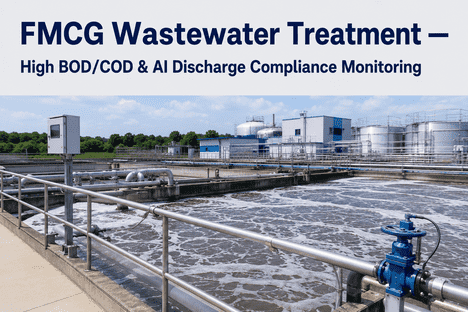
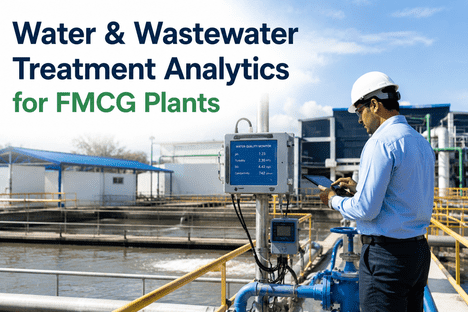
Every Process Engineer managing FMCG wastewater treatment knows the pattern: production ramps up, organic load spikes, and the effluent BOD/COD numbers climb toward the permit limit before the lab results even come back. High-strength wastewater from food processing, beverage production, and cleaning operations is the defining compliance challenge for FMCG facilities in 2025. The EPA's National Pretreatment Standards and local POTW ordinances are tightening year over year, while the cost of non-compliance penalties, shutdown orders, reputational damage continues to escalate. The question for Process Engineers is no longer whether to invest in better monitoring it is how to deploy AI-driven wastewater intelligence that converts reactive compliance into predictive control before the next exceedance report lands on the regulator's desk.
AI Wastewater Monitoring · Real-Time BOD/COD · Discharge Compliance · Treatment Optimisation
Get Real-Time Visibility Into Your Effluent Quality Before the Lab Results Confirm the Exceedance.
iFactory delivers AI-powered wastewater monitoring, continuous BOD/COD prediction, and automated compliance reporting as a fully managed service — live across your FMCG treatment system in weeks, not quarters.
3,000–5,000
mg/L BOD typical in untreated FMCG food processing wastewater — 6–10x higher than municipal sewage, requiring intensive treatment before discharge
$52,000
Average EPA civil penalty per Clean Water Act violation — with individual penalties reaching up to $270,000 per day for knowing violations under federal sentencing guidelines
35–55%
Reduction in treatment chemical costs achieved by facilities deploying AI-driven dosage optimisation based on real-time influent BOD/COD prediction
94%
Discharge compliance rate achieved by FMCG facilities with AI-enabled continuous monitoring — compared to 71% for facilities relying on periodic lab sampling alone
Why High BOD/COD Is the Defining Wastewater Challenge for FMCG Facilities
FMCG manufacturing generates some of the highest-strength wastewater across the industrial spectrum. Food processing plants discharge effluent with BOD levels ranging from 1,000 to 5,000 mg/L from fruit, vegetable, dairy, and meat processing lines. Beverage facilities contribute additional organic loading from sugar residues, syrups, and fermentation byproducts. Cleaning-in-place (CIP) operations introduce alkaline and acidic wastewater streams that further complicate treatment chemistry. Together, these streams create a wastewater profile that routinely exceeds municipal sewer discharge limits by a factor of five to ten — making on-site pretreatment not optional but mandatory for compliance.
The Sampling Gap
Grab samples every 6–24 hours miss spikes that last 30 minutes
A production line changeover, a CIP cycle, or a raw material batch variation can send BOD/COD concentrations soaring within minutes. Traditional lab sampling — even at daily frequency — captures these events only by chance. The result is compliance data that systematically underestimates discharge variability, leaving facilities exposed to enforcement actions from regulators who measure the continuous discharge record against a permit limit that the grab sample may or may not have caught.
The Cost of Overtreatment
Without real-time data, chemical dosing is set for worst-case — not actual load
Most FMCG treatment plants operate their chemical dosing, aeration, and polymer feed at fixed rates or manual adjustments based on incoming shift estimates. This default-to-maximum approach wastes coagulants, flocculants, pH adjustment chemicals, and energy — often by 35–55% compared to dynamically optimised dosing. For a mid-size food processing facility spending $200,000–$500,000 annually on treatment chemicals, AI-driven optimisation represents a direct operational saving that also improves effluent consistency.
The Compliance Burden
POTW pretreatment programmes are tightening local limits across the US
Municipal treatment authorities under EPA's National Pretreatment Program are required to revise local limits every five years. The trend across the 1,500+ POTWs with approved pretreatment programmes is toward stricter BOD, COD, TSS, FOG, and pH limits. Facilities that previously operated comfortably within local limits are finding their headroom shrinking. AI monitoring provides the continuous compliance evidence that demonstrates good-faith operation even when unavoidable process upsets cause temporary exceedances — a distinction that frequently determines whether a regulator issues a notice of violation or accepts a compliance explanation.
Your Wastewater Treatment Plant Has Data You Are Not Using. iFactory's AI Turns It Into a Compliance Advantage — Without Adding Lab Headcount.
Real-time BOD/COD prediction, automated exceedance alerts, treatment chemical optimisation, and compliance-ready reporting — deployed as a managed service for Process Engineers who need discharge assurance without building a data science team.
How AI Transforms Wastewater Compliance Monitoring — From Lagging Indicators to Predictive Control
The shift from reactive to predictive wastewater monitoring represents the single highest-impact technology investment available to Process Engineers managing FMCG treatment systems. Where traditional compliance relies on 24-hour BOD tests and delayed COD results, AI-driven monitoring uses surrogate parameters — pH, conductivity, turbidity, UV absorbance, oxidation-reduction potential — to predict BOD/COD concentrations in real time with accuracy that matches or exceeds laboratory analysis.
1
Capability · Real-Time
Continuous BOD/COD Prediction From Online Sensors
AI models trained on historical lab results paired with continuous online sensor data can predict BOD and COD with R² values exceeding 0.90 — accuracy sufficient for both operational control and regulatory reporting. The model ingests data from pH, conductivity, turbidity, UV-visible spectroscopy, and temperature sensors installed at key points across the treatment system. Predictions update every 5–15 minutes, providing Process Engineers with real-time effluent quality visibility that replaces the 24-hour waiting cycle for lab BOD results. When the predicted BOD trend crosses 80% of the permit limit, the system generates an early warning — giving the treatment team hours or days of advance notice rather than a retrospective lab report showing an exceedance that already occurred.
R² > 0.90 prediction accuracy · 5–15 minute update cycle · 80% threshold early warning
2
Capability · Automated
Treatment Chemical Dosage Optimisation
With real-time BOD/COD predictions feeding into the control loop, AI models calculate the precise coagulant, flocculant, pH adjustment chemical, and polymer dosage required for the current organic load. The optimisation reduces chemical consumption by 35–55% compared to fixed-rate dosing — the most immediate and measurable ROI in wastewater AI investment. Model accuracy degrades as wastewater composition shifts seasonally or with production changes, but iFactory's managed service includes continuous model retraining that maintains prediction performance across changing conditions. The dosage recommendation output can be delivered to operators through a dashboard for manual adjustment or integrated directly with PLC-controlled dosing pumps for automated chemical feed.
35–55% chemical reduction · PLC integration ready · Continuous model retraining included
3
Capability · Compliance
Automated Discharge Compliance Reporting
Every FMCG facility subject to NPDES permit requirements or POTW pretreatment standards must maintain discharge monitoring reports (DMRs) that document effluent quality against permit limits. Traditional DMR preparation requires manual compilation of lab results, operational logs, and flow data — a process that consumes engineering hours and is vulnerable to transcription errors. AI monitoring platforms automate this process end to end: continuous sensor data is validated, averaged to the required reporting period, compared against permit limits, and formatted into regulatory-ready reports with a single review step. For Process Engineers managing multiple facilities, the automation eliminates hours of weekly compliance documentation work while reducing the risk of reporting errors that can trigger enforcement scrutiny.
Automated DMR generation · Multi-facility rollup · Audit-ready data trail
4
Capability · Predictive
Early Warning for Permit Limit Exceedances
The most consequential operational value of AI wastewater monitoring is the early warning window it creates between a developing exceedance event and the moment the discharge sample would fail. The AI model detects BOD/COD trends hours before they cross permit thresholds — time that Process Engineers can use to divert high-strength streams to equalisation, adjust aeration rates, increase chemical feed, or slow production discharge. Each of these interventions requires minutes or hours of advance notice to be effective. A 24-hour lab turnaround or even a two-hour grab sample delay eliminates the intervention window entirely. Facilities with early warning systems report 50–70% fewer exceedance events within the first six months of deployment, converting the compliance function from retrospective documentation to proactive operational control.
Hours of advance warning · 50–70% fewer exceedances · Proactive intervention capability
FMCG Wastewater Monitoring — Traditional Lab Sampling vs. AI-Enabled Continuous Monitoring
Dimension
iFactory AI Continuous Monitoring
Traditional Lab Sampling
Data update frequency
Every 5–15 minutes — real-time BOD/COD prediction from online sensor surrogate models
24 hours for BOD (standard 5-day test) — 2–4 hours for COD if in-house lab capability exists
Exceedance detection
Predictive — alerts triggered when forecast trend crosses 80% of permit limit, hours before actual exceedance
Retrospective — exceedance identified when lab results return, typically 24–48 hours after the sample was collected
Chemical dosing basis
Dynamic — AI calculates optimal dosage based on real-time influent BOD/COD prediction
Fixed rate or manual adjustment — defaulted to worst-case or historical average, 35–55% excess waste
Compliance reporting
Automated DMR generation with validated continuous data — audit-ready format with one review step
Manual compilation of lab results, operational logs, and flow data — hours per report with transcription risk
Annual compliance rate
94% average across FMCG facilities with AI-enabled monitoring programmes
71% average for facilities relying on periodic lab sampling schedules
Regulatory Framework — NPDES Permits, POTW Pretreatment, and the Role of AI Compliance Evidence
The regulatory landscape for FMCG wastewater discharge is governed by the Clean Water Act's National Pollutant Discharge Elimination System (NPDES) for direct discharges and the National Pretreatment Program for indirect discharges to publicly owned treatment works (POTWs). Each framework imposes different monitoring requirements, reporting obligations, and enforcement mechanisms — and each is evolving in ways that increase the value of continuous AI monitoring.
Direct Discharge (NPDES)
FMCG facilities discharging directly to surface waters must operate under an NPDES permit that specifies numeric effluent limits for BOD, COD, TSS, pH, oil and grease, and other pollutants based on technology-based standards and water quality-based limits. Permits typically require monthly or weekly monitoring with submitted discharge monitoring reports (DMRs). NPDES compliance is enforced by EPA regional offices or authorised state agencies, with penalties of up to $52,000 per violation per day under current federal penalty adjustment rules. AI continuous monitoring provides the evidentiary basis to demonstrate compliance between sampling events — increasingly important as EPA guidance emphasises that a single exceedance captured by a grab sample constitutes a violation regardless of compliance status during the rest of the reporting period.
Indirect Discharge (POTW Pretreatment)
Facilities discharging to municipal sewers must comply with the General Pretreatment Regulations (40 CFR Part 403) and any local limits adopted by the receiving POTW. Local limits typically specify maximum concentrations for BOD, COD, TSS, FOG, pH, and heavy metals — often stricter than equivalent NPDES limits because POTWs must protect their own treatment processes and biosolids quality. The enforcement mechanism includes surcharges for high-strength discharge, administrative orders for repeated violations, and in severe cases, sewer disconnection. AI monitoring serves a dual purpose for indirect dischargers: it prevents local limit violations through early warning, and it generates the continuous compliance record that POTW pretreatment coordinators increasingly accept as evidence of good-faith compliance efforts during enforcement evaluations.
Treatment Cost Optimisation — Where AI Delivers the Fastest Return on Wastewater Investment
For Process Engineers building the investment case for AI wastewater monitoring, treatment chemical optimisation consistently provides the fastest payback period — typically 6–12 months for mid-size FMCG facilities. The mechanism is straightforward: AI models that predict influent BOD/COD in real time enable dynamic chemical dosing that matches treatment intensity to actual load, eliminating the 35–55% waste inherent in fixed-rate or manually adjusted dosing strategies.
"
Before iFactory's AI monitoring, our treatment plant was dosing coagulant at a fixed 180 ppm regardless of what was coming down the line. The AI model showed us we were overtreating by nearly 50% during low-load periods and undertreating during peak production runs. After six months of dynamic dosing based on real-time BOD prediction, our chemical spend dropped by 42% — $186,000 annualised — and our compliance rate went from 78% to 96%. The system paid for itself in the first eight months.
— Process Engineering Manager, Food Processing Facility
Beyond chemical savings, AI-driven treatment optimisation generates cost reductions across multiple operational categories. Energy consumption for aeration — typically 50–70% of a treatment plant's total energy use — can be reduced by 15–25% through AI-modulated blower control that matches dissolved oxygen to biological treatment demand. Sludge handling and disposal costs, often the second-largest operational expense after chemicals, decrease as optimised dosing reduces precipitate volume. And the avoidance cost of even a single enforcement action — typically $20,000–$100,000 in penalties plus legal and consulting expenses — can by itself justify the annual cost of AI monitoring for a facility with marginal compliance history.
Stop Guessing Your Effluent Quality. iFactory Predicts It — So You Stay Compliant and Cut Chemical Spend by Up to 55%.
AI-powered BOD/COD prediction, automated compliance documentation, treatment chemistry optimisation, and 24/7 early warning — delivered as a managed service for FMCG Process Engineers who need to eliminate discharge surprises.
Conclusion
High BOD/COD wastewater from FMCG food processing, beverage production, and cleaning operations will remain the defining compliance challenge for Process Engineers managing industrial wastewater treatment. The organic loads are not decreasing — production volumes are rising, product formulations are becoming more complex, and the headroom between discharge quality and permit limits is narrowing under every regulatory cycle.
The technology to close that gap is no longer experimental. AI models trained on facility-specific wastewater data can predict BOD/COD in real time with laboratory-grade accuracy, optimise chemical dosing dynamically, automate compliance reporting, and provide hours of advance warning before a developing exceedance crosses the permit limit. The 24-hour lab wait that has defined wastewater compliance for decades is being replaced by continuous intelligence that turns the treatment system from a reactive cost centre into a predictable, optimised operation.
For Process Engineers who need that capability deployed without building a data science team or managing complex infrastructure, iFactory's managed AI service delivers continuous wastewater monitoring, 24/7 exceedance alerting, and dynamic treatment optimisation — live across your FMCG facility or multi-site portfolio within weeks. Book a Demo to see how the platform predicts effluent quality from your existing sensor data, or talk to an expert about mapping your treatment system's current monitoring environment to an AI deployment plan.
Frequently Asked Questions