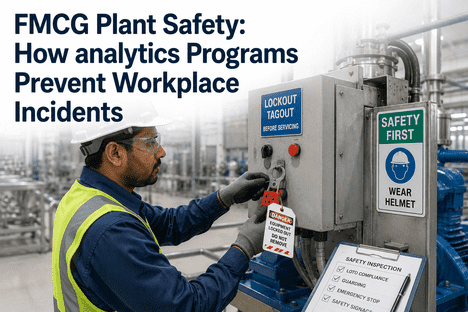
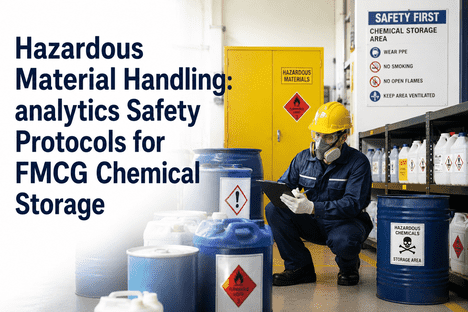
The safety manager at a 400,000-sq-ft FMCG production facility in the Midwest reviews the previous quarter's chemical incident log and sees a pattern that has cost the plant $94,000 in preventable expenses three chemical spills in the CIP chemical storage area, two near-miss events involving incompatible chemical mixing during a night-shift sanitation operation, and one OSHA-recordable chemical burn to a sanitation operator who reached into a floor drain sump containing residual peracetic acid without verifying that the neutralisation cycle had completed. The root cause was not a failure to follow the safety data sheet instructions. It was that the plant maintained paper SDS binders in three separate locations the chemical storage warehouse, the CIP skid control room, and the safety office and the SDS for the peracetic acid solution had been updated by the chemical supplier six weeks before the incident with a change in the recommended PPE section that added butyl rubber gloves for splash protection. The paper binder in the CIP skid control room still contained the previous SDS revision the one that listed natural rubber gloves as acceptable. The operator had worn natural rubber gloves. The peracetic acid penetrated the natural rubber in 90 seconds and caused a second-degree chemical burn on the operator's forearm that required two weeks of medical leave and generated a $12,000 workers' compensation claim plus a $7,200 OSHA citation for failure to maintain an up-to-date hazard communication program under 29 CFR 1910.1200. The plant's chemical inventory was managed on a spreadsheet updated once per quarter. The SDS revisions were tracked by a part-time administrative assistant who cross-referenced supplier emails against a paper log. The training records were in a filing cabinet in the HR office. The spill response drills were documented on paper forms that were filed and never reviewed. No single system connected the SDS revision status to the chemical inventory to the training records to the incident log. iFactory's Safety and Compliance, Smart Document Management, and Incident Reporting modules give FMCG environmental health and safety managers the digital infrastructure to centralise every SDS, automate GHS hazard communication updates, track chemical inventory by location and quantity, manage spill response drills with digital checklists, and generate real-time compliance reports all from a single platform that runs on the plant floor and in the cloud. Book a Demo to see iFactory's chemical safety platform configured for your FMCG facility's hazardous material management program.
From Paper Binders and Spreadsheets to a Digital Chemical Safety Program — Hazardous Material Management for FMCG Plants
Every CIP chemical tank, every sanitizer drum, every solvent container in an FMCG facility generates compliance obligations — SDS management, GHS labelling, storage segregation, spill response readiness, and training documentation. iFactory's chemical safety platform connects chemical inventory, SDS libraries, inspection workflows, and incident reporting in one real-time dashboard.
Why Chemical Safety Programs Fail Silently in FMCG Facilities — and What It Costs When They Do
Chemical safety programs in FMCG facilities operate under a web of overlapping regulatory requirements OSHA Hazard Communication (29 CFR 1910.1200), OSHA Process Safety Management (29 CFR 1910.119) for ammonia refrigeration systems, EPA Risk Management Plan (40 CFR Part 68) for threshold quantities of hazardous substances, NFPA 30 for flammable and combustible liquids storage, and state-specific environmental health and safety regulations that vary by jurisdiction. When a chemical safety program begins to fail, the failure is almost never sudden. It develops over weeks or months an SDS binder that has not been updated since the last supplier change, a secondary container that lost its GHS label during a sanitation cycle, a spill kit whose absorbent socks expired 18 months ago, a training record that was never filed after the annual Hazard Communication refresher. The data that would reveal these developing problems exists in the SDS binder, the chemical inventory spreadsheet, the training file cabinet, and the incident log — but it is not connected in a way that allows the EHS manager or the plant manager to see the pattern before it becomes a recordable event. The six problems below are the most common failure modes that iFactory's chemical safety platform detects before they trigger an OSHA citation, a chemical spill, or a lost-time injury at FMCG facilities.
Decentralised and outdated SDS libraries the root cause of most OSHA Hazard Communication citations
OSHA's Hazard Communication Standard (1910.1200) requires employers to maintain a current SDS for each hazardous chemical in the workplace and make it readily accessible to employees during each work shift. FMCG facilities that rely on paper SDS binders in multiple locations cannot ensure that every binder contains every SDS at the current revision level. When chemical suppliers update formulations or hazard classifications, the revised SDS must be integrated into every binder — a manual process that is prone to error and rarely completed within the 30-day window that OSHA considers reasonable. The result is that employees working on the plant floor — sanitation operators, CIP technicians, maintenance mechanics — often have access to an SDS that does not accurately reflect the chemical's current hazards, PPE requirements, or first aid procedures.
Incomplete GHS secondary container labelling — a compliance gap that every OSHA inspection finds
OSHA requires that secondary containers (spray bottles, day tanks, totes, dosing system reservoirs) be labelled with the product name, hazard pictograms, signal word, hazard statements, and precautionary statements from the SDS. In FMCG facilities where sanitation chemicals are transferred from bulk containers to portable containers multiple times per shift, labelling compliance degrades rapidly. A spray bottle of isopropyl alcohol used for lab equipment cleaning may have its label washed off during a sanitation cycle. A day tank of quaternary ammonium sanitizer may be filled from a bulk tote but the day tank label may not be updated when the supplier changes the formulation. These labelling gaps are the most frequently cited Hazard Communication violations in FMCG facilities.
Chemical storage incompatibility — incompatible chemicals stored too close together in warehouses and satellite areas
NFPA 30 and the International Fire Code require specific segregation distances between incompatible chemical classes — acids must be separated from alkalis, oxidisers must be separated from flammables, water-reactive substances must be stored in dry locations with separate containment. In FMCG facilities where floor space is at a premium and production schedules drive chemical delivery and staging decisions, incompatible chemicals are frequently stored in adjacent locations. A pallet of nitric acid (CIP acid) stored next to a pallet of sodium hypochlorite (sanitiser) creates the risk of chlorine gas release if a leak or spill brings the two chemicals into contact. A drum of isopropyl alcohol (flammable solvent for lab cleaning) stored near a container of peracetic acid (oxidiser sanitiser) creates a fire risk that may not be covered by the facility's fire suppression system design.
Expired or incomplete spill kit inventories — spill response plans that work only on paper
OSHA 1910.120 (HAZWOPER) and EPA SPCC regulations require facilities that store hazardous chemicals above threshold quantities to maintain spill response equipment that is appropriate for the chemicals stored and to inspect that equipment on a regular schedule. In FMCG facilities, spill kits are often located in chemical storage areas, CIP skid rooms, and loading docks — but the contents of those kits are not systematically inspected for completeness and expiration. Absorbent socks have a shelf life of 3-5 years. Neutralising agents expire. PPE stored in spill kits may degrade over time. When a spill occurs, the response team discovers that the kit is missing the correct absorbent for the chemical spilled, that the neutralising agent has crystallised, or that the chemical-resistant gloves have dry-rotted from age.
Training compliance gaps — GHS and chemical-specific training records that cannot survive an audit
OSHA requires that employees receive Hazard Communication training at the time of initial assignment and whenever a new chemical hazard is introduced into the workplace. FMCG facilities with high employee turnover rates, seasonal production shifts, and third-party sanitation contractors face unique challenges in maintaining auditable training records. Paper-based training sign-in sheets are often incomplete, illegible, or misfiled. When an OSHA compliance officer requests training records during an inspection, the EHS manager must locate the physical files for each employee — a process that can take hours or days and frequently reveals gaps that result in citations for failure to provide adequate hazard communication training.
Reactive incident management — no systematic process for chemical incident investigation and corrective action tracking
When a chemical spill, exposure event, or near-miss occurs in an FMCG facility, the immediate response is often appropriate — the spill is contained, the affected employee receives medical attention, the area is decontaminated. But the systematic investigation of root causes, documentation of corrective actions, and tracking of action items to closure is rarely completed in a consistent and auditable manner. Without a digital incident management system that guides the investigator through the root cause analysis process, assigns corrective actions to responsible persons with due dates, and tracks completion status, the same chemical safety failure can recur and produce the same consequences.
Chemical Hazard Classes in FMCG Production — Categories, Risks, and Compliance Requirements
FMCG facilities handle a broader range of hazardous chemical classes than most industrial sectors — from CIP acids and alkalis to flammable solvents to ammonia refrigerants. Each chemical class presents distinct hazards, requires specific storage conditions, and triggers different regulatory compliance obligations. The table below presents the primary chemical classes found across FMCG operations — dairy, beverage, personal care, household products, and specialty food processing — with their typical hazards, regulatory drivers, and control measures.
| Chemical Class | Common Examples | Primary Hazard(s) | Key Regulation | Control Measure |
|---|---|---|---|---|
| CIP Acids | Nitric acid (HNO₃), phosphoric acid (H₃PO₄), peracetic acid (PAA) | Corrosive (skin, eyes, respiratory), oxidiser (PAA) | OSHA 1910.1200, NFPA 30 | Bunded storage, automated dosing, acid-resistant PPE, eyewash stations |
| CIP Alkalis | Sodium hydroxide (NaOH), potassium hydroxide (KOH) | Corrosive (severe tissue damage), heat generation on dilution | OSHA 1910.1200, NFPA 30 | Dedicated alkali storage, dilution control, face shields, rubber aprons |
| Sanitizers & Disinfectants | Sodium hypochlorite (NaOCl), QUATs, chlorine dioxide, ozone | Oxidiser, skin sensitiser, respiratory irritant, toxic gas release on mixing | EPA FIFRA, OSHA 1910.1200 | Ventilation, contact-time compliance, segregation from acids, PPE |
| Flammable Solvents | Ethanol, isopropyl alcohol (IPA), acetone, denatured alcohol | Flammable (Class IB/IC), CNS depressant, respiratory irritant | OSHA 1910.106, NFPA 30 | Flammable-liquid cabinets, grounding/bonding, explosion-proof electrical |
| Refrigerants | Anhydrous ammonia (NH₃, R-717), R-404A, R-410A | Toxic (ammonia), asphyxiant, flammable at high concentrations | OSHA PSM 1910.119, EPA RMP 40 CFR 68, IIAR-2 | Gas detection, mechanical ventilation, PHA, emergency pressure relief |
| Lubricants & Greases | NSF H1 / H2 food-grade lubricants, hydraulic oils | Irritant (skin, eyes), environmental hazard, slip hazard | FDA 21 CFR 178.3570, OSHA 1910.1200 | Food-grade certification, drip pans, secondary containment, spill kits |
| Processing Aids | Enzymes (protease, amylase), anti-foaming agents, pH adjusters | Respiratory sensitiser (enzymes), irritant (pH adjusters) | OSHA 1910.1200, GHS | Local exhaust ventilation, dust control, respiratory protection program |
Safety Data Sheet Management and GHS Hazard Communication — Five Capabilities That Transform Chemical Safety Compliance
The following five capabilities represent the highest-impact applications of digital SDS management and automated GHS hazard communication for FMCG facilities. Each capability addresses a specific compliance gap or operational risk that iFactory has identified across deployments at dairy processing plants, beverage bottling facilities, personal care manufacturing sites, and food processing operations. Each capability is delivered through the iFactory platform running on the facility's existing IT infrastructure, with mobile access for plant-floor personnel and cloud-based central management for the EHS team.
Centralised Digital SDS Repository with Automated Version Control
iFactory provides a cloud-based, centralised SDS library that is accessible from any mobile device on the plant floor via QR-code placards affixed to chemical storage areas, dosing skids, and satellite accumulation points. Each SDS is indexed by chemical name, CAS number, hazard class, GHS hazard category, and storage location. When a chemical supplier issues a revised SDS, the system automatically flags the previous version, notifies the EHS manager, and requires electronic acknowledgement before the new SDS is published to the plant-floor access points — creating an auditable revision history that satisfies OSHA's documentation requirements.
Automated GHS Secondary Container Label Generation
iFactory generates GHS-compliant secondary container labels directly from the SDS library — including the product identifier, signal word, hazard pictograms, hazard statements, precautionary statements, and supplier information. Labels are printed on demand from a mobile tablet and can be produced in multiple languages for facilities with multilingual workforces. The system tracks which containers have been labelled, when the label was last printed, and when the SDS revision requires a new label — eliminating the most common source of Hazard Communication citations in FMCG facilities.
Chemical Inventory Tracking by Location, Quantity, and Hazard Class
iFactory maintains a real-time chemical inventory that tracks every hazardous chemical on site by storage location, container quantity, hazard class, and SDS revision date. The inventory dashboard displays the chemical segregation status of each storage area — identifying locations where incompatible chemicals are stored within the NFPA 30 separation distance and generating alerts when corrective action is required.
Digital Spill Kit Inspection and Chemical Storage Area Audit Workflows
iFactory's Inspection Management module provides pre-built checklists for spill kit inspections, chemical storage area audits, and satellite accumulation area compliance reviews. Each checklist is customised for the specific chemicals stored in each area and includes photo documentation, digital signatures, and automated escalation of deficiencies to the responsible EHS team member.
Hazard Communication Training Assignment and Completion Tracking
iFactory's Training Management module assigns GHS Hazard Communication training and chemical-specific safe-handling courses to employees based on their job roles and the chemicals they work with. The system tracks training completion status, sends automated reminders for annual refresher courses, and generates audit-ready training matrices that correlate each employee's training record with the specific chemicals they are authorised to handle.
Chemical Spill Response Protocols and Emergency Preparedness for FMCG Facilities
Under OSHA 1910.120 (HAZWOPER) and EPA's Oil Pollution Prevention regulations (40 CFR Part 112), FMCG facilities that store hazardous chemicals above threshold quantities must have a written spill prevention, control, and countermeasure (SPCC) plan and a trained emergency response team. Facilities that handle CIP chemicals in bulk quantities, maintain ammonia refrigeration systems, or store flammable solvents in quantities exceeding 55 gallons are squarely within scope. The four-phase spill response protocol below is based on OSHA 1910.120 requirements and National Fire Protection Association (NFPA) guidance for hazardous materials release response — adapted for the chemical types and facility configurations typical of FMCG production environments.
Discovery and Isolation
Operator detects a chemical leak or spill from a CIP line connection, chemical drum, bulk storage tank, or process equipment. Immediate actions: isolate the source (close valve, upright drum, activate emergency shutdown), evacuate non-essential personnel from the affected zone, and alert the facility emergency response coordinator via iFactory's mobile Incident Reporting module — which captures the time, location, chemical involved, and estimated spill volume from the operator's initial report.
Hazard Assessment and PPE Selection
The emergency response coordinator assesses the spill from a safe distance — identifying the chemical via the SDS QR-code placard in the storage area (which opens the current SDS on a mobile device), consulting the chemical-specific hazard information, and selecting the appropriate PPE based on the SDS Section 8 (Exposure Controls/Personal Protection) recommendations. The digital incident record captures the hazard assessment and PPE selection for post-incident review.
Containment and Clean-Up
The response team deploys the appropriate spill kit based on the chemical type — universal absorbent pads for non-aggressive liquids, acid neutraliser for acid spills, caustic neutraliser for alkali spills, and hydrophobic absorbent booms for hydrocarbon-based lubricants. The team establishes a containment perimeter, applies absorbent materials from the outer edge inward, collects the saturated absorbent in approved disposal containers, and labels the waste containers with the chemical name and hazard classification for proper waste stream management.
Decontamination, Investigation, and Corrective Action
The affected area is decontaminated according to the chemical-specific procedures in the SDS Section 6 (Accidental Release Measures). Air monitoring is conducted for residual vapours if the chemical has a significant vapour hazard. The incident investigation is launched through iFactory's Incident Reporting module — which guides the investigator through root cause analysis, captures photo evidence and witness statements, generates a corrective action plan with assigned owners and due dates, and routes the report to the EHS manager and safety committee for review and sign-off.
Chemical Storage Applications Across the FMCG Facility — Warehouses, Production Areas, and Satellite Accumulation Zones
Chemical storage in an FMCG facility spans multiple areas — the central chemical warehouse (where bulk quantities of CIP chemicals, sanitizers, and solvents are received and stored), the production-area satellite storage (where day tanks and portable containers are staged for daily use), the CIP skid rooms (where concentrated acids and alkalis are stored in bulk tanks adjacent to the cleaning equipment), the laboratory chemical storage (where analytical-grade solvents and reagents are kept in small quantities), and the hazardous waste satellite accumulation areas (where spent chemicals and contaminated materials are stored pending off-site disposal). Each storage application has distinct containment requirements, segregation rules, and inspection frequency requirements that determine the appropriate compliance management approach.
Bulk Chemical Storage and Segregation
The central chemical warehouse receives and stores the facility's primary inventory of CIP acids, CIP alkalis, sanitizers, solvents, lubricants, and processing aids — typically in 55-gallon drums, 275-gallon totes, and bulk tanks that hold 1,000 to 5,000 gallons. Compliance priorities: NFPA 30 segregation by hazard class (acids separated from alkalis, oxidisers separated from flammables), secondary containment for each storage bay, racking system compatibility with container weight and chemical compatibility, emergency ventilation, fire suppression system design appropriate for the chemical classes stored, and weekly inspection checklists that verify containment integrity and segregation compliance.
Satellite Chemical Storage and Day Tank Management
Production-area satellite storage zones hold the chemicals that are used on each shift — day tanks of CIP chemicals adjacent to the CIP skid, portable containers of sanitizers at the filling line, and spray bottles of cleaning solvents in the quality lab. These areas are subject to different regulatory requirements than the central warehouse because the chemicals are in active use rather than in long-term storage. Compliance priorities: GHS-compliant labelling of every secondary container, daily visual inspections of container condition and containment, segregation verification for chemicals stored in close proximity, and documentation of container fill dates and contents for FIFO inventory rotation.
Satellite Accumulation Area Compliance
FMCG facilities generate hazardous waste streams from spent CIP solutions, contaminated solvents, expired chemicals, and spill clean-up residues. The satellite accumulation areas where these wastes are collected pending transfer to the central accumulation area are subject to EPA RCRA regulations (40 CFR 262) that require weekly inspections, container labelling with the accumulation start date, container compatibility with the waste type, and secondary containment. Non-compliance with satellite accumulation area requirements is one of the most frequently cited RCRA violations in EPA inspections of manufacturing facilities.
Chemical Safety Digitalisation Readiness — What Your FMCG Facility Needs for Successful Deployment
Implementing a digital chemical safety platform at an FMCG facility requires preparation across five areas — chemical inventory data collection, SDS library digitisation, label printer configuration, inspection workflow design, and team training. The checklist below covers the essential elements that iFactory's implementation team reviews during the chemical safety module deployment at each FMCG facility.
Complete chemical inventory by department and storage location
iFactory requires a complete inventory of every hazardous chemical on site — including the chemical name, CAS number, supplier, container size and quantity, SDS revision date, storage location, and hazard classification. The bulk-import tool accepts inventory data from spreadsheets, ERP systems, or chemical supplier portals and reconciles it against the facility's procurement records to identify chemicals that may be present but not recorded in the inventory.
SDS library digitisation and supplier contact verification
iFactory ingests current SDS documents from the facility's paper binders and electronic files — or connects directly to the chemical supplier's SDS distribution portal to import the most recent revision automatically. The system verifies that each SDS is complete (all 16 GHS-required sections present) and flags any SDS that is missing required information.
QR-code placard placement in each chemical storage area and at each SDS access point
iFactory generates QR-code placards that link directly to the current SDS for each chemical stored in that location. Placards are printed on chemical-resistant material and placed at the entrance to each storage room, on each bulk storage tank, on each day tank, and at each satellite accumulation area — ensuring that employees can access the current SDS from any location within 30 seconds.
Inspection checklist configuration for each storage area type
iFactory configures inspection checklists for each type of chemical storage area — central warehouse weekly inspections, production-area daily inspections, satellite accumulation area weekly inspections, and spill kit monthly inspections. Each checklist includes storage-area-specific items (containment integrity, segregation compliance, label condition, container condition, ventilation operation, fire suppression system status) and generates automated escalation of deficiencies.
Chemical training matrix development and course assignment
iFactory's implementation team works with the facility's EHS manager to develop a chemical training matrix that maps each job role to the chemicals that role handles and the required training courses — GHS Hazard Communication initial and annual refresher, chemical-specific safe-handling training for each chemical class, HAZWOPER awareness for spill response team members, and PPE selection and use training. Training courses are assigned in the system and completion is tracked with automated reminders for overdue training.
Incident reporting workflow configuration and tabletop drill
iFactory configures the incident reporting workflow to match the facility's chemical incident classification system — near-miss, first aid, medical treatment, recordable injury, spill above or below reportable quantity, and property damage. The implementation team conducts a tabletop drill using a realistic chemical spill scenario to validate that the workflow routes the report to the correct investigator, generates the required notifications, and creates corrective actions with assigned owners and due dates.
Your FMCG Facility's Chemical Safety Data Is Telling You Where the Risks Are — iFactory Makes Sure You See Them
Every SDS revision date, every spill kit inspection result, every chemical inventory change, every incident report contains the signature of developing compliance gaps and safety risks — if the data is collected, connected, and analysed in real time. iFactory connects the data, surfaces the patterns, and alerts your EHS team before the gap becomes a citation, a spill, or an injury. Book a demo and see the chemical safety platform configured for your FMCG facility's hazardous material management program today.
Deploying a Digital Chemical Safety Program at an FMCG Facility — A Phased Approach
iFactory's chemical safety and compliance module is deployed in five phases, from initial chemical inventory setup through full operational capability with continuous improvement. Each phase builds on the previous phase and delivers measurable value before the next phase begins — the digital SDS library is live and accessible on the plant floor before the inspection workflows are configured.
Phase 1: Inventory and SDS Library
Complete chemical inventory by department and storage location; digitise all current SDS documents; connect supplier SDS portals for automatic revision updates; generate QR-code placards for each storage area. Duration: 1-2 weeks. Value: real-time SDS access from any plant-floor location.
Phase 2: Labelling and Containers
Configure mobile label-printing workflow; generate GHS-compliant secondary container labels for all portable containers and day tanks; install QR-code placards at each SDS access point. Duration: 1 week. Value: GHS-compliant labelling for every secondary container.
Phase 3: Inspections and Audits
Configure inspection checklists for each storage area type; deploy spill kit inspection workflow; configure chemical storage area audit checklists; train operators and EHS team members on mobile inspection procedures. Duration: 1-2 weeks. Value: systematic inspection coverage with automated deficiency escalation.
Phase 4: Training and Incident Management
Develop chemical training matrix; assign GHS and chemical-specific training courses; deploy mobile incident reporting workflow; conduct tabletop drill with realistic chemical spill scenario. Duration: 1-2 weeks. Value: auditable training records and consistent incident investigation process.
Phase 5: Continuous Improvement
Quarterly chemical inventory reconciliation; annual SDS audit; semi-annual training matrix review; annual tabletop exercise with cross-functional emergency response team; continuous refinement of inspection checklists based on inspection findings and incident root causes. Duration: ongoing. Value: sustained compliance and continuous improvement of chemical safety program.
What FMCG EHS Managers Say About Digital Chemical Safety Management
I have managed environmental health and safety programs at three FMCG facilities over twelve years — a dairy processing plant in Wisconsin with ammonia refrigeration and CIP chemical storage, a beverage bottling facility in Georgia with a 20,000-gallon caustic soda storage tank and multiple sanitizer injection points on the filling lines, and a personal care products manufacturing plant in New Jersey handling ethanol, isopropyl alcohol, and a complex inventory of fragrance compounds and active ingredients that are classified as hazardous substances under OSHA and EPA regulations. The most persistent failure mode I have seen across all three facilities is not that the chemical safety program is absent — every facility has an SDS binder, a chemical inventory spreadsheet, a spill response plan, and a training schedule. The problem is that none of these program elements are connected to each other. The SDS binder does not talk to the chemical inventory. The chemical inventory does not talk to the training records. The training records do not talk to the incident log. The incident log does not talk to the corrective action tracking system. Each program element exists in its own silo, maintained by a different person, updated on a different schedule, and reviewed in a different meeting. At the dairy processing plant, I experienced a CIP chemical mixing incident in February of 2022 — a night-shift sanitation operator connected a hose from a nitric acid day tank to the caustic day tank's discharge port during a CIP cleaning cycle, causing a violent exothermic reaction that blew the gasket off the caustic day tank's access hatch and sprayed a mixture of 12% sodium hydroxide and 7% nitric acid across a 30-foot radius in the CIP skid room. The operator suffered chemical burns on both forearms and was transported to the emergency room. The plant received an OSHA citation for the incident — the citation cited three violations: the secondary containers in the CIP skid room were not labelled with the GHS hazard pictograms (the labels had been washed off during a pressure washing of the skid room floor two weeks before the incident), the SDS binder in the CIP control room did not contain the current SDS for the nitric acid solution (the supplier had changed the concentration from 7% to 9% four months before the incident), and the facility's hazard communication training records for three of the six sanitation operators on the night shift could not be located during the inspection. After the incident, I implemented iFactory's chemical safety platform at the facility. We digitised the SDS library, generated QR-code placards for every storage area, configured a mobile label-printing workflow for secondary containers, established a weekly chemical storage area inspection schedule, and deployed the mobile incident reporting module. In the first year of operation, we identified 14 chemical storage segregation issues that were out of compliance with NFPA 30 — including a pallet of sodium hypochlorite stored adjacent to a pallet of citric acid in the central chemical warehouse, which would have released chlorine gas if a leak had occurred. We identified 22 secondary containers that did not have current GHS labels. We completed 286 chemical storage area inspections with a 94% on-time completion rate. We had zero chemical-related OSHA citations in the first 18 months after deployment. The same CIP skid room that experienced the 2022 mixing incident passed an unannounced OSHA inspection without a single chemical safety citation. That is what a connected chemical safety program does that a paper-based program cannot. It connects every program element — the SDS to the label to the inspection to the training record to the incident report — and it surfaces the gaps that an EHS manager scrolling through separate spreadsheets and paper binders will never see.
— EHS Manager, U.S. FMCG Manufacturing — 12 Years Chemical and Process Safety Management — Certified Hazardous Materials Manager (CHMM) — OSHA 30-Hour General Industry TrainerCommon Questions About Hazardous Material Handling and Chemical Safety for FMCG Facilities
Digital Chemical Safety Management Turns a Compliance Burden into a Managed Program — If You Connect the Data
Every chemical storage area, every SDS binder, every spill kit, every inspection checklist, every incident report in an FMCG facility generates data that contains the signature of developing compliance gaps and safety risks — SDS revisions that have not been processed, secondary containers that have lost their labels, incompatible chemicals stored within the prohibited separation distance, spill kit contents that have expired, training records that are overdue for renewal. The data exists. The SDS binders are on the shelves. The inspection forms are in the filing cabinets. The training records are in the HR office. What is missing in most FMCG facilities is the digital platform that connects those data streams, compares each program element against every other program element every day of every week, and surfaces the gaps that signal a developing compliance or safety problem before it becomes a citation, a spill, or an injury.
iFactory's Safety and Compliance, Smart Document Management, Incident Reporting, and Inspection Management modules provide FMCG EHS managers with the digital infrastructure to manage every aspect of their chemical safety program from a single platform — centralising SDS libraries with automated version control, generating GHS-compliant secondary container labels on demand, tracking chemical inventory by location and hazard class with segregation compliance monitoring, conducting systematic inspections with mobile checklists and automated deficiency escalation, managing chemical training assignments and completion tracking, and documenting incident investigations with root cause analysis and corrective action tracking. The 40 to 60% reduction in chemical safety incidents, the elimination of Hazard Communication citations related to SDS accessibility and secondary container labelling, and the documented improvement in chemical storage area inspection completion rates at iFactory-managed facilities are not the result of hiring additional EHS staff or implementing more policies. They are the result of having a digital platform that makes every chemical safety program element visible, connected, and actionable — every shift, every day. Book a demo to see how iFactory's platform manages hazardous material handling, chemical safety compliance, SDS management, and spill response for your FMCG facility.
Your Chemical Safety Data Already Contains the Pattern of the Next Gap — iFactory Finds It Before the Citation Arrives
Every SDS revision date, every inspection result, every chemical inventory change, every incident report is a data point that iFactory connects into a complete picture of your chemical safety program health. Book a demo and see the platform configured for your FMCG facility's hazardous material management program today.