In FMCG production, a single undetected failure mode in a fill-weight station can produce 12,000 underweight units before the next scheduled quality check triggering retailer chargebacks, regulatory penalties, and brand damage that compounds with every shift the root cause goes unidentified. Quality and process engineers routinely deploy Failure Mode and Effects Analysis (FMEA) to identify and mitigate these risks before they reach the consumer. But in practice, the choice between Design FMEA (DFMEA), Process FMEA (PFMEA), and system-level FMEA determines whether the analysis actually prevents failures or simply documents them. Each methodology addresses a different risk layer product design, manufacturing process, or integrated system and selecting the wrong one leaves critical failure modes unexamined. For quality leaders who need to match the right FMEA methodology to their operational risk profile, iFactory's FMEA module with AI-driven RPN scoring, robotic system risk assessment, and analytics program integration enables closed-loop failure prevention across every layer of FMCG production. Book a Demo to see iFactory's FMEA module in action.
AI-driven RPN scoring · Robotic system risk assessment · Cross-functional FMEA collaboration · Closed-loop CAPA integration — all unified in iFactory's FMEA module for FMCG quality teams.
Why FMEA Methodology Selection Matters in FMCG
Failure Mode and Effects Analysis is the most widely deployed proactive risk assessment tool in FMCG quality management — required by BRCGS, FSSC 22000, SQF, and ISO 9001 standards. But the standard itself does not specify which FMEA type to use, and quality teams frequently default to process-level analysis while leaving design-level and system-level failure modes unaddressed. A PFMEA on a filling line may capture every conceivable equipment failure, operator error, and process parameter deviation — yet completely miss the package seal failure mode introduced by a material change that was evaluated only through a DFMEA. The result is a documented FMEA that passes audit scrutiny but leaves the plant exposed to the failure modes that actually cause quality events.
In FMCG production, where product designs change seasonally, packaging formats shift across SKUs, and process lines are reconfigured for new product launches, the risk landscape shifts faster than annual FMEA reviews can capture. Quality teams operating a single FMEA methodology — typically PFMEA — find themselves managing failures that originate in design decisions, material specifications, or cross-system interactions that their process-focused analysis was never designed to address. Understanding the distinction between DFMEA, PFMEA, and system-level FMEA is not an academic exercise. It is the prerequisite for building a failure prevention program that covers the full risk surface of a modern FMCG operation.
DFMEA, PFMEA, and System FMEA: The Core Distinctions
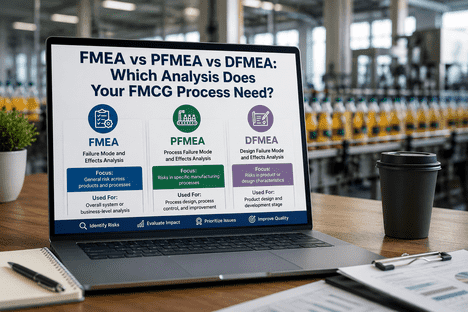
The three primary FMEA methodologies differ in scope, application timing, and the specific failure modes they are designed to identify. Understanding these distinctions is essential for quality leaders building a risk assessment program that covers every failure pathway in their operation.
When to Use Each FMEA Type in FMCG Operations
FMEA Scoring Methodology: How iFactory's AI Elevates RPN Accuracy
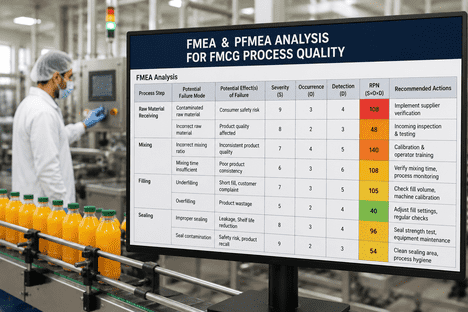
The Risk Priority Number — the product of Severity (S), Occurrence (O), and Detection (D) ratings — is the foundation of every FMEA methodology. But the accuracy of the RPN depends entirely on the quality of the input data. When severity ratings are drawn from generic industry tables, occurrence ratings from annual estimates, and detection ratings from subjective team consensus, the resulting RPN provides false confidence — ranking risks by convention rather than by actual plant performance. iFactory's AI-driven FMEA module transforms RPN accuracy by connecting each rating factor to operational data sources and machine learning models that reflect your actual process behaviour.
Severity ratings in iFactory's FMEA module are calibrated against your product category's actual failure history — not generic automotive-derived severity tables that over-weight manufacturing failures and under-weight packaging and material failures common in FMCG. The AI model analyses historical quality events, customer complaints, and regulatory findings to establish severity baselines that reflect your actual risk exposure. Occurrence ratings are populated from real-time process historian data, SPC control chart performance, and quality event frequency — updating automatically as process capability shifts. Detection ratings reflect the actual effectiveness of your current inspection and monitoring controls, populated from CMMS calibration records, inspection schedules, and verification check data. The resulting RPN is a living metric that changes as your process changes, not a static number reviewed once per year.
iFactory's FMEA module recalculates RPN values automatically from real-time process historian data, SPC control chart performance, and quality event frequency. When process capability improves, occurrence ratings decrease. When new inspection controls are added, detection ratings improve. The RPN always reflects your current risk state.
Robotic System FMEA in FMCG: Addressing the Automation Risk Blind Spot
As FMCG facilities deploy robotic systems for pick-and-place, case packing, palletising, and vision-guided inspection, they introduce failure modes that traditional PFMEA and DFMEA methodologies were never designed to evaluate. A robotic cell involves coordinated action between mechanical arms, vision systems, conveyors, sensors, and control software — each component operating within its own design tolerance but producing emergent failure modes at the system interfaces that no single-component analysis can predict. Robotic system FMEA evaluates these interface failure modes systematically, identifying risks such as vision-to-robot registration drift, conveyor timing mismatch, end-effector wear affecting grip force, and safety system communication latency. iFactory's FMEA module includes a dedicated robotic system risk assessment template that maps robot operating envelope, cycle count, end-effector type, and vision system calibration data to risk registers — enabling quality teams to evaluate robotic failure modes alongside traditional process and design risks within a single, unified platform.
The distinction between robotic system FMEA and component-level FMEA is critical for facilities operating collaborative robots (cobots) in direct interaction with production staff. Cobot risk assessment must evaluate not only the robot's functional failure modes but also the human-robot interface: unexpected robot motion during manual loading, force-limiting sensor degradation, workspace encroachment detection failure, and emergency stop system latency. iFactory's robotic FMEA module supports both full-system and human-robot interface risk assessment, with severity ratings calibrated for personnel safety impact and occurrence ratings informed by robot cycle count and operating hours from the CMMS asset register.
Integrating FMEA with iFactory's Analytics Program
An FMEA that exists as a standalone document — reviewed annually, updated reactively after a failure occurs — provides audit compliance without risk prevention. iFactory's FMEA module breaks this pattern by integrating every FMEA element with the plant's operational analytics program. When a PFMEA identifies a checkweigher drift failure mode with an occurrence rating based on historical data, the module connects to real-time checkweigher SPC charts and auto-updates the occurrence rating when process capability changes. When a corrective action is defined for a high-RPN failure mode, the action item generates a task in iFactory's work order module with automated follow-up verification. When a new product launch triggers a DFMEA, the module cross-references existing PFMEA and system FMEA data for the production lines involved, identifying duplicate or overlapping failure modes and ensuring consistent severity ratings across all FMEA types.
This integration transforms FMEA from a periodic compliance exercise into a continuous risk management system. Quality leaders can view the complete risk landscape across design, process, and system layers on a single dashboard, with RPN values that reflect real-time operational data, action items that track through to closure with verifiable evidence, and audit documentation that is complete and current at any point in the review cycle. For FMCG facilities managing multiple product lines, seasonal SKU rotations, and ongoing automation investment, this integrated approach eliminates the gap between FMEA documentation and operational reality — the gap where most preventable quality events originate.
FAQ
AI-powered FMEA module connecting DFMEA, PFMEA, and system-level risk assessment into one unified platform — with dynamic RPN scoring, robotic system evaluation, cross-functional action tracking, and analytics program integration for FMCG quality teams.


-in-fmcg-a-step-by-step-guide-to-eliminating-recurring-failures.png)