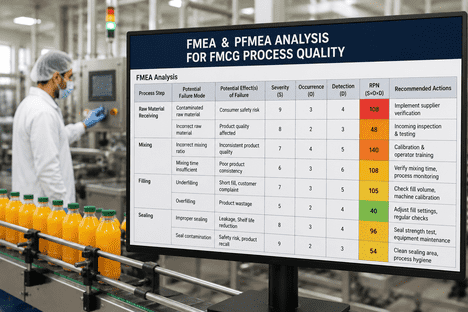
In FMCG manufacturing, a single undetected failure mode — a mis-sealed pouch, an under-dosed fill, a contaminated batch — can trigger a product recall averaging $10 million in direct costs, destroy shelf placement, and erode brand trust built over decades. FMEA (Failure Mode and Effects Analysis) and PFMEA (Process FMEA) exist to systematically prevent these failures before they reach the consumer. Yet most FMCG plants still rely on reactive quality inspections instead of proactive risk analysis. iFactory AI's quality management platform digitizes FMEA workflows — auto-calculating RPN scores, routing corrective actions to maintenance teams, and generating audit-ready risk documentation for BRC, FSSC 22000, and ISO 22000 compliance.
Systematic failure mode identification, Risk Priority Number quantification, and corrective action workflows purpose-built for FMCG production lines — from raw material receiving through final dispatch.
Why FMEA and PFMEA Matter for FMCG Process Quality
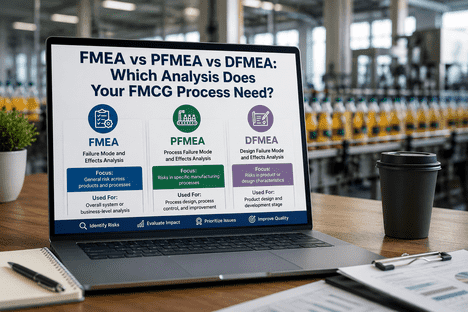
Failure Mode and Effects Analysis is a structured, bottom-up methodology that identifies every possible way a product or process can fail, then prioritizes which failures to address first based on severity, likelihood, and detectability. PFMEA — Process Failure Mode and Effects Analysis — applies this specifically to manufacturing and packaging processes, making it the core quality risk tool for FMCG production lines. The methodology quantifies risk through the Risk Priority Number (RPN), calculated as Severity × Occurrence × Detection, with scores ranging from 1 to 1,000. In FMCG, an RPN above 100 demands corrective action; above 200 requires documented intervention within 30 days; and above 400 signals critical risk requiring immediate process redesign. A single PFMEA for a beverage or food line typically covers 15–30 process steps, generating 45–240 failure mode entries that must be scored, ranked, and actioned.
Single recall event in FMCG — direct costs excluding brand damage, retailer penalties, and regulatory fines.
From raw material receiving through palletizing and dispatch — each step generates 3–8 failure modes needing RPN scoring.
FMCG manufacturers with structured digital FMEA programs see 74% fewer recalls within the first program year.
Return on investment from digital PFMEA programs in year one, driven by prevented recalls and reduced batch rejections.
The RPN Formula — How FMCG Quality Teams Prioritize Risk
Risk Priority Number (RPN) is the core output of every PFMEA. It tells your quality team which failure modes to address first — turning a long list of risks into a ranked action plan. RPN scores range from 1 to 1000. In FMCG manufacturing, the recommended action thresholds are: RPN below 100 — monitor during regular production reviews, no immediate action required. RPN 100–200 — schedule improvement actions within the next PM cycle or production planning period. RPN 200–400 — implement corrective actions within 30 days, assign specific owners, and track to closure. RPN above 400 — critical risk requiring immediate intervention before the next production run. However, RPN alone can be misleading. A failure mode with Severity 9 (safety hazard) should trigger action regardless of RPN value. Modern PFMEA practice supplements RPN with Severity-first prioritization — any failure mode with Severity 8+ receives mandatory action regardless of Occurrence and Detection scores.
Impact of the failure effect on consumer safety, product quality, and regulatory compliance. In FMCG: 1 = cosmetic defect, 5 = batch rework, 8 = consumer complaint, 10 = safety hazard or recall. Severity is evaluated without considering existing controls.
Likelihood the failure mode will occur. Based on historical process data, nonconformance trends, scrap rates, and CMMS work order history. 1 = less than 1 in 1,000,000 units, 5 = 1 in 2,000, 10 = 1 in 10 units. Occurrence scores must be updated with real production data.
Ability of current controls to catch the failure before it reaches the consumer. 1 = certain detection (automated 100% inline AI vision with reject mechanism), 5 = periodic sampling, 10 = no detection method available. Assessed on control effectiveness, not presence.
Ranked output driving corrective action sequencing. FMCG thresholds: below 100 = monitor, 100–200 = improve, 200–400 = urgent action within 30 days, above 400 = critical — stop production if risk cannot be immediately controlled.
8 High-Risk Failure Modes in FMCG Production Lines
These failure modes appear most frequently in FMCG PFMEA worksheets and cause the highest proportion of quality escapes and recall events when left unaddressed. Each has documented RPN ranges based on aggregated data from FMCG plants running structured FMEA programs.
Seal Integrity Failure
Incomplete heat seal allows contamination, spoilage, or tamper evidence loss. Caused by worn sealing jaws, incorrect dwell time, or film gauge variation. RPN: 180–400
Foreign Object Contamination
Metal, glass, plastic, or biological material entering product stream. Driven by equipment wear, broken tooling, pest ingress, or personnel practices. RPN: 200–480
Under/Overfill Events
Fill weight deviation beyond declared limits triggers regulatory non-compliance and consumer complaints. Caused by worn dosing components or flow sensor drift. RPN: 120–280
Label Application Errors
Wrong label, misaligned label, or unprinted date code creates allergen declaration failures and traceability gaps. Causes 22% of voluntary FMCG recalls. RPN: 100–240
CIP/SIP Failure
Inadequate clean-in-place cycles leave allergen or microbial residue in product contact surfaces. Results in cross-contamination between production runs. RPN: 90–200
Material Non-Conformance
Incoming film, carton, or closure material out of specification causes downstream processing failures including seal strength loss and print quality issues. RPN: 60–140
Temperature Excursion
Process temperature outside validated range compromises product safety, texture, or shelf life. Common in pasteurization, cooking, and cold chain handover points. RPN: 40–100
Changeover Contamination
Residual product from previous SKU remaining in line after changeover. Allergen, flavor, or color cross-contamination during incomplete changeovers. RPN: 180–360
PFMEA Risk Analysis by FMCG Process Step
Each FMCG process family carries distinct failure modes with characteristic RPN ranges. Understanding where the highest risks concentrate enables quality teams to allocate inspection resources and preventive maintenance where they deliver the greatest risk reduction. Below is a process-step breakdown with typical RPN ranges and recommended controls from iFactory AI deployments across food, beverage, and personal care lines.
- Wrong grade accepted, contaminated lot passed inspection
- Temperature abuse during transit, allergen mislabeling
- Supplier COA verification failures
- Storage condition deviations
- Incorrect ingredient weight, addition sequence errors
- Mixing time deviation, temperature overshoot
- Cross-contamination between batches
- Emulsification failure
- Pasteurization time shortfall, oven zone imbalance
- Cooling rate deviation, hot-fill temperature drift
- Heat exchanger fouling, steam pressure variability
- Cold chain break after thermal treatment
- Underfill/overfill beyond tolerance, seal contamination
- Label misregistration, cap torque out-of-spec
- Headspace oxygen drift, date code illegibility
- Tamper evidence failure
- Allergen cross-contact from incomplete rinse
- Wrong recipe parameters loaded for next SKU
- Gasket not replaced after wear cycle
- Chemical residue remaining in lines
- FIFO violation, temperature excursion in warehouse
- Pallet damage, incorrect batch code shipped
- Load consolidation errors, mixed SKU pallets
- Outbound documentation mismatch
Before PFMEA vs. After PFMEA — What Changes in Your Operation
The gap between reactive and proactive quality management in FMCG is measurable — in defect rates, recall frequency, line utilization, and consumer complaint volume. FMCG plants running PFMEA through iFactory AI achieve 62% faster risk identification and 3.4x higher corrective action closure rates than spreadsheet-based programs.
A leading dairy FMCG manufacturer was losing $460,000 per year to batch rejections caused by inconsistent pasteurization temperatures and CIP cycle failures — problems that persisted despite having a quality team of twelve engineers. When they implemented a structured PFMEA program across their four processing lines, they identified 47 previously undocumented process failure modes within the first 90 days. The batch rejection rate dropped from 4.8% to 0.9%, saving $144,000 annually. PFMEA is not a theoretical exercise — it is the most powerful systematic methodology for preventing manufacturing quality failures before they happen. The difference between a $24 corrective action and a $240,000 recall is whether you identify the failure mode before or after it reaches the consumer.
Frequently Asked Questions — FMEA and PFMEA for FMCG Process Quality
Conclusion: Make PFMEA a Living Risk Management Tool
The difference between FMCG manufacturers that prevent recalls and those that react to them is not the presence of a PFMEA document — it is whether that PFMEA is connected to the daily operational systems that control process quality. A PFMEA worksheet sitting in a quality folder has zero operational value. High-RPN components must become PM triggers. PFMEA control points must become digital inspection checklists. Inspection failures must generate corrective action work orders. And occurrence scores must be updated with real failure frequency data from your plant's actual production history. iFactory AI provides the integrated quality and maintenance platform that makes PFMEA a living operational tool — auto-calculating RPNs, routing corrective actions to the right teams, and generating audit-ready risk documentation for BRC, FSSC 22000, and ISO 22000 compliance. The question is not whether your FMCG operation needs PFMEA — it is whether your PFMEA is actually preventing failures or just documenting them.
Build a Quality-First FMEA Program With iFactory AI
iFactory AI gives FMCG quality teams one platform for FMEA/PFMEA analysis, RPN calculation, corrective action routing, CMMS integration, and audit-ready risk documentation — purpose-built for food, beverage, and consumer goods manufacturing.