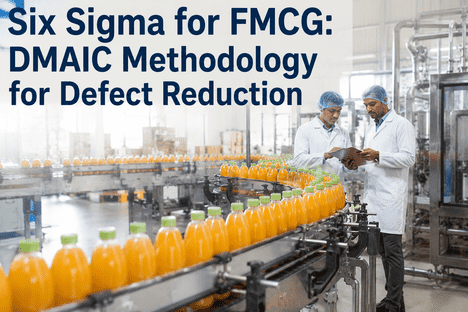
A mid-size FMCG beverage plant producing 1.2 million units per shift faced a chronic 2.4% defect rate across its high-speed filling and packaging lines — 28,800 defective units every single day. Each defect represented a direct hit to margin: overfill giveaway into the drain, underfill rework consuming labor and packaging materials, leaker complaints generating chargebacks from retailers, and lost production time during changeovers to clear jammed lines. In financial terms, the plant was bleeding $4.2M annually in scrap, rework, and brand-protection costs from quality variation that the operations team had come to accept as normal. Six Sigma DMAIC changed that equation. Over a 14-week deployment, the plant applied Define, Measure, Analyze, Improve, and Control to its highest-impact defect modes — reducing the aggregate defect rate from 24,000 PPM to 2,100 PPM and delivering $3.1M in first-year savings. For FMCG quality and operations leaders who want to understand how DMAIC drives measurable waste reduction, Book a Demo with iFactory's process improvement team to see how analytics-enabled DMAIC accelerates defect reduction in consumer goods production.
01 / The DMAIC Framework in FMCG Production
Six Sigma DMAIC is the most rigorously proven methodology for reducing process variation and eliminating defects in high-volume manufacturing. In FMCG — where line speeds routinely exceed 400 units per minute and a single process drift can produce thousands of defective units before any quality checkpoint detects the deviation — DMAIC provides the structured analytical framework that separates chronic quality problems from symptoms and delivers statistically validated, sustainable improvements.
The five phases — Define, Measure, Analyze, Improve, Control — form a closed-loop problem-solving engine that begins with a precisely scoped problem statement linked to financial impact and ends with a statistically controlled process whose improvements are sustained through SPC monitoring and updated standard operating procedures. Each phase uses specific tools drawn from statistical analysis, process mapping, design of experiments, and quality engineering to ensure that every improvement decision is data-driven rather than intuition-based.
02 / The Five DMAIC Phases — Applied to FMCG Waste and Defects
Each DMAIC phase has a specific objective, a defined set of tools, and a measurable deliverable that gates progression to the next phase. When executed rigorously, the framework ensures that improvement resources are deployed only against root causes that have been statistically validated — eliminating the common manufacturing trap of implementing solutions for symptoms rather than causes.
03 / Implementation Timeline — 14 Weeks to Sustainable Improvement
The following implementation timeline represents a typical DMAIC project for fill-weight variation on a high-speed FMCG beverage line. With iFactory's analytics platform enabling real-time data capture and automated measurement system analysis, the same project can be completed in 8–10 weeks by eliminating manual data collection and spreadsheet-based analysis steps.
Project charter developed with plant leadership. Problem statement: "Line 3B underfill rate of 21,600 PPM is costing $640K annually in rework labor and material waste." CTQ: fill-weight net content per 500mL bottle. Goal: reduce underfill rate to below 3,000 PPM (Cpk > 1.33) within 12 weeks. SIPOC map documents process scope from depalletizing to case sealing.
Checkweigher Gage R&R completed (repeatability 3.2%, reproducibility 2.8%, combined 4.1% — well below 10% threshold). Baseline capability: Cpk = 0.72, sigma level = 2.8. Data stratified by shift, filler nozzle, product SKU, and raw material lot. Pareto analysis identifies Shift B (57% of defects) and Filler Nozzle 4 (43% of Shift B defects). Hypothesis testing confirms fill temperature (p=0.003) and raw material viscosity (p=0.008) as statistically significant root causes.
DOE conducted to determine optimal fill temperature set point (validated at 18.5°C ±1.0°C). Raw material viscosity specification updated with supplier notification and lot hold/release procedure. Filler Nozzle 4 replaced with ceramic-tipped wear-resistant model. Pilot implementation over 2 weeks on 3 shifts: underfill rate drops from 21,600 to 2,800 PPM — 87% reduction.
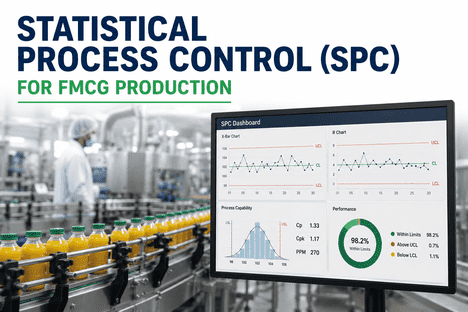
X-bar and R control charts deployed on fill weight with automated out-of-control alerts via iFactory platform. SOPs updated with fill temperature verification, nozzle inspection, and raw material viscosity check. Monthly Cpk trending added to plant KPI dashboard. After 30 days: underfill rate sustained at 2,100 PPM, Cpk = 1.41, sigma level = 4.3. Project closure report documents $3.1M annualized savings across all defect modes.
04 / DMAIC Results — Measurable Waste and Defect Reduction
The table below documents the results of the 14-week DMAIC project targeting fill-weight variation on the high-speed beverage line. The improvements have been sustained for 6+ months through the Control phase SPC monitoring and monthly capability reviews.
| Metric | Before DMAIC | After DMAIC | Improvement |
|---|---|---|---|
| Underfill Defect Rate (PPM) | 21,600 | 2,100 | 90.3% reduction |
| Fill Weight Cpk | 0.72 | 1.41 | +0.69 points |
| Sigma Level | 2.8σ | 4.3σ | +1.5 sigma |
| Annual Underfill Rework Cost | $640K | $62K | 90.3% reduction |
| Overfill Giveaway (per unit) | 3.8g avg | 0.6g avg | 84% reduction |
| Annual Overfill Material Cost | $1.4M | $220K | 84% reduction |
| Leaker Rate (consumer complaints) | 180 PPM | 22 PPM | 87.8% reduction |
| Line OEE | 72% | 89% | +17 points |
| Total Annualized Savings | — | $3.1M | Delivered in year one |
05 / Expert Analysis — Why DMAIC Works in FMCG
The DMAIC framework succeeds in FMCG production for four specific reasons that align with the operational realities of consumer goods manufacturing.
FMCG plants are rich in operational data — checkweigher readings, temperature logs, line speed records, and quality inspection results — but this data is rarely analyzed with statistical rigor. DMAIC forces the project team to validate every assumption with hypothesis testing, confidence intervals, and effect-size calculations. The result is that improvement resources are deployed only against statistically significant root causes, eliminating the waste of implementing fixes for coincidental correlations.
FMCG production environments are noisy — checkweighers drift, temperature sensors lose calibration, and manual measurements vary between operators. The Measure phase's mandatory Gage R&R study ensures that measurement system variation is less than 10% of total process variation before any baseline capability calculation is trusted. This simple discipline prevents the most common DMAIC failure mode: making decisions based on measurement noise rather than true process variation.Book a Demo
Every DMAIC project begins with a project charter that links the CTQ defect to a specific financial impact approved by the plant manager or business unit leader. This financial anchor ensures that improvement resources are deployed against problems that matter to the P&L rather than quality issues that are operationally visible but financially immaterial. The project closure report provides auditable savings documentation for financial controllers.
The Control phase is the most commonly skipped — and most critical — step in FMCG DMAIC projects. Without ongoing SPC monitoring, processes naturally drift back toward their pre-improvement variation levels as equipment wears, operators change, and raw material sources shift. iFactory's platform automates the Control phase by deploying real-time control charts with automated out-of-control alerting, ensuring that the improvements achieved in the Improve phase are sustained for the life of the process.