A single contractor walking onto a food production floor without proper hygiene induction can turn into a full batch hold, a failed audit, or worse, a genuine contamination event that recalls product already on retail shelves. Contractor turnover in FMCG plants is high, induction is often rushed to keep a project on schedule, and paper sign-in sheets rarely verify that a contractor actually understood the hygiene and GMP requirements they signed off on. EHS Managers are left holding the risk for a workforce they don't directly supervise and can't always verify was properly trained before stepping into a production area. iFactoryapp.com's AI-driven contractor induction and access control system closes that gap by verifying hygiene competency and GMP understanding before badge access is ever granted, and the sections below explain how this changes the daily reality of managing contractor risk, with a closer look available if you decide to Contact Support.
Why Paper-Based Contractor Induction Fails Food Production Plants
A paper sign-in sheet or a slideshow watched at double speed confirms attendance, not comprehension. It tells you a contractor was physically present for an induction session, not that they understood which zones require hairnets and beard covers, why hand sanitizing stations exist at specific transition points, or what to do if they notice a foreign material risk near an open product line. In a high-turnover contractor workforce, this gap compounds fast — the same generic induction gets repeated dozens of times a month, quality erodes with repetition fatigue on the trainer's side, and there's no reliable record proving any individual contractor actually retained the material they were shown.
The consequence isn't hypothetical. A contractor who doesn't understand allergen zone boundaries or proper glove change protocol is a genuine contamination vector, and when an audit or a customer complaint traces back to a specific access event, "we showed them a video" is a thin answer compared to a verified competency record tied to that individual's badge activation.
Contractors unfamiliar with allergen zone boundaries or sanitation transition points can introduce contamination without ever realizing they've done so.
Badges issued before hygiene competency is actually confirmed leave plants unable to prove that everyone on the floor was properly qualified to be there.
Sign-in sheets and attendance logs rarely satisfy an auditor asking for evidence of verified comprehension, not just presence at a session.
The AI Induction and Access Verification Sequence
Rather than replacing induction with more paperwork, an AI-driven system restructures it around actual verification rather than mere attendance. Each step below builds toward the same outcome: badge access that reflects confirmed understanding, not just a completed sign-in.
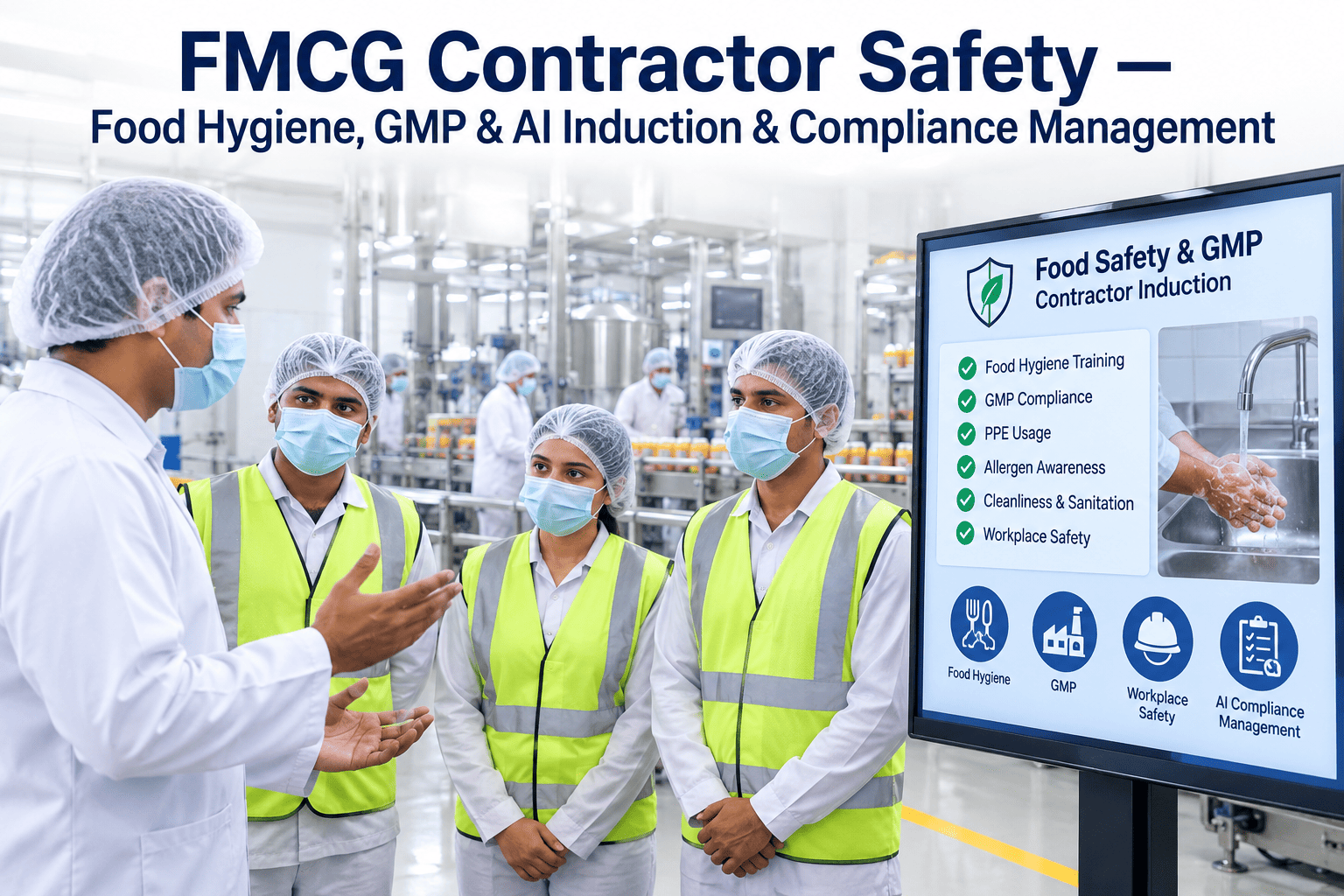
Contractors complete a structured, plant-specific hygiene and GMP module covering zone rules, PPE requirements, and allergen protocols before their first shift.
Scenario-based checks confirm the contractor can correctly apply the rules, not just recall that a session happened.
Access credentials activate only after verification is complete, with zone-specific access levels tied to the areas each contractor is actually qualified to enter.
Every induction, verification result, and access event is logged against the contractor's identity, ready to produce during an audit or investigation.
What Coverage Looks Like Across a Contractor Workforce
Not every contractor role carries the same hygiene and GMP risk, and induction depth should reflect that. The table below outlines how verification requirements typically scale with the level of production area access a role requires.
| Contractor Role | Typical Access Level | Induction Depth | Verification Frequency |
|---|---|---|---|
| Equipment maintenance | Full production floor access | Full hygiene, GMP, and allergen module | Every engagement |
| Sanitation crew | Post-shift production areas | Sanitation-specific GMP module | Every engagement |
| Utility/facilities | Perimeter and non-product zones | Basic hygiene and zone-boundary module | Quarterly refresh |
| Project/construction | Scheduled, escorted access | Site-specific safety and hygiene briefing | Per project engagement |
An EHS Manager's Experience After Switching to Verified Induction
Before this, our contractor induction was essentially a formality — watch a video, sign a sheet, get a badge. When an auditor asked us to prove that a specific contractor understood our allergen protocols during an incident review, all we had was their signature on an attendance log. Since we moved to verified induction, every contractor's competency record is tied directly to their badge activation, and our last audit cycle went from our most stressful week of the year to a genuinely straightforward review.