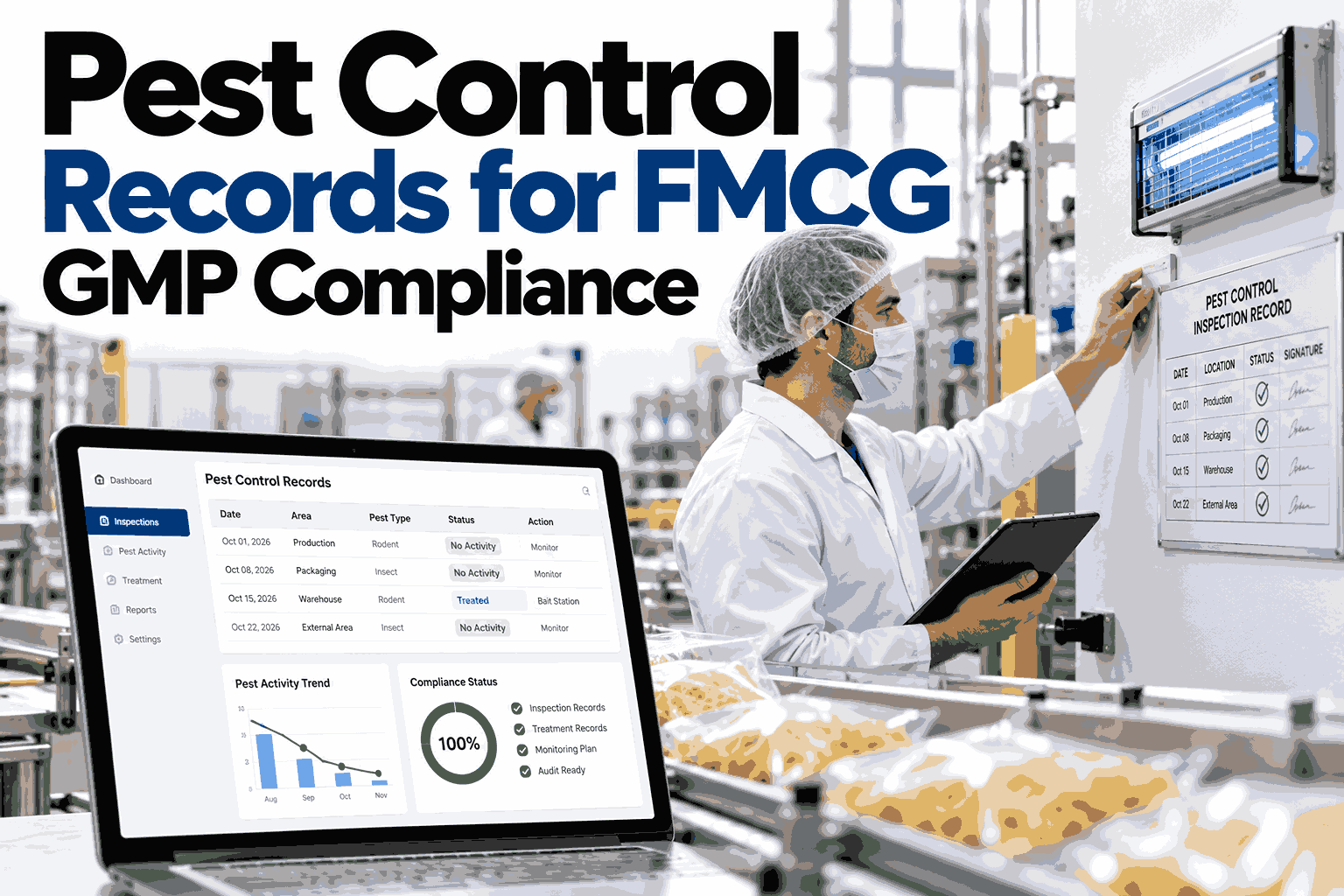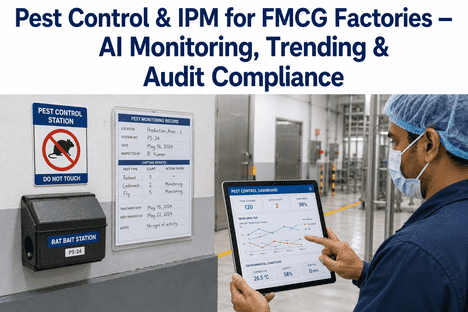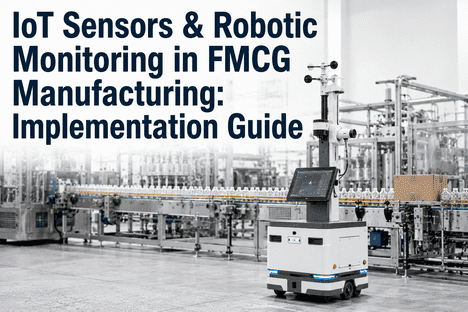
Pest contamination is one of the most frequently cited violations in FDA warning letters to food manufacturing facilities — and one of the most preventable. For FMCG plants operating under 21 CFR Part 117, FSMA, BRCGS Issue 9, SQF Edition 9, and FSSC 22000, the gap between a compliant Integrated Pest Management (IPM) program and a recall-triggering infestation often comes down to documentation quality, not pest activity levels. A single rodent dropping found on a production line during an FDA inspection can trigger a full facility shutdown order. A bait station with three consecutive weeks of elevated consumption signals that structural exclusion has failed — but only if someone is tracking the data. Most FMCG plants discover these failures when an auditor finds evidence their paper-based system missed. iFactory AI's IPM Compliance Platform connects bait station monitoring, pest activity logging, structural exclusion tracking, and corrective action workflows into a single digital system — delivering documented 40–60% reduction in pest-related audit non-conformances, elimination of manual record compilation, and complete audit-ready IPM documentation within 60 seconds. Book a Demo to see how iFactory digitizes your IPM program for every zone of your FMCG facility.
AI-powered IPM compliance platform connecting bait station monitoring, pest activity logging, structural exclusion tracking, and corrective action workflows — reducing audit non-conformances by 40–60% and delivering complete documentation in under 60 seconds.Pest Control & Integrated Management for FMCG Facilities
Why Paper-Based IPM Programs Fail FMCG Facilities During Audits
A biscuit manufacturer in the Midwest USA lost its Walmart supplier certification after a third-party audit found rodent droppings in the raw materials storage area — a zone that had passed every monthly internal inspection for the previous 11 months. The pest control contractor had visited 12 times over that period, recording clean observations on each occasion. What none of those visits captured was a 40 mm gap that had opened between a utility conduit and the exterior wall — created when a pipe support bracket failed three weeks earlier. The bracket failure had been reported to maintenance. The work order was still open. Nobody had connected the structural gap to the pest ingress risk. The supplier delisting cost $2.8 million in lost annual contract value. Here is why documented, connected IPM programs are the only defense against these failures.
BRCGS Issue 9 Clause 4.14, SQF Edition 9 Element 11, and FSSC 22000 all require documented proof of pest monitoring, trend analysis, corrective actions, and program review. Paper logbooks stored in supervisor offices cannot produce 12 months of bait station inspection histories, catch-rate trend reports, and corrective action close-out records on demand. When an auditor asks for zone-level trend data over a specific 90-day period, a facility relying on paper-based systems cannot produce it reliably — and that failure alone can trigger a major non-conformance. iFactory's digital IPM platform generates complete audit packs in under 60 seconds, formatted for any GFSI scheme.
Building fabric integrity — door sweeps, sealed utility penetrations, drain covers, roof vents — is 80% of effective pest management, yet it is typically managed by a maintenance team that has no connection to the pest control program. A maintenance technician repairs a wall gap and closes the work order without the food safety team ever knowing the vulnerability existed. iFactory connects maintenance work orders to pest risk zones, automatically flagging elevated-risk areas when structural defects are identified. When the gap is repaired, the pest risk zone status updates automatically — closing the loop that paper systems leave open.
Most FMCG plants rely on a licensed Pest Control Operator (PCO) who visits monthly, services bait stations, and leaves a paper report that goes into a binder. These reports rarely include zone-level trend analysis, corrective action tracking, or integration with the facility's internal inspection records. When a BRCGS auditor requests proof that a pest finding in Zone 3 triggered a documented corrective action within 24 hours, the contractor binder alone cannot provide it. iFactory's platform integrates contractor service records with internal monitoring data, creating a unified, timestamped, and searchable compliance history that satisfies even the most rigorous audit scrutiny.
IPM programs define action thresholds — the level of pest activity that triggers an escalated response. Below threshold, monitoring continues. At threshold, targeted intervention is deployed. Above threshold, immediate escalation and investigation occur. Without a system tracking device-by-device activity levels across multiple zones and time periods, these thresholds exist on paper only. A bait station showing 40% consumption for three consecutive weeks is a clear signal that structural exclusion has failed near that station — but without automated trend analysis, that signal is missed until pest pressure escalates into a compliance event. iFactory applies automated trend detection, surfacing early warning indicators 2–4 weeks before pest pressure reaches a threshold that triggers audit exposure.
In most FMCG facilities, pest sightings are reported informally — a line operator tells a supervisor, who mentions it to the QA manager, who may or may not log it before the next PCO visit. This informal chain means sightings are recorded inconsistently, if at all. A cockroach sighting near a production line that goes undocumented becomes an invisible data point — until an auditor finds the evidence three weeks later and asks why no corrective action was taken. iFactory enables every employee to log pest sightings directly through a mobile interface — with zone location, photo evidence, and automatic corrective action workflow creation — ensuring every finding is captured, tracked, and closed out with full audit traceability.
Digital IPM Compliance Platform for FMCG Facilities
Four integrated modules that transform pest management from a paper-based contractor service into a connected, audit-ready digital compliance program.
Every bait station, insect light trap (ILT), glue board, and pheromone trap registered as a digital asset with GPS-linked facility map placement, inspection frequency requirements, and automated scheduling. Interior stations, exterior perimeter stations, and mechanical traps each carry zone-specific inspection cadences. When an inspection is due, the assigned technician receives a digital task with structured data fields — consumption percentage, rodent evidence indicators, station condition, and photo capture. Supports 100+ device types across all major manufacturers. Missed inspections escalate automatically to QA management.
Every pest sighting — rodent, insect, bird, or other — captured with zone location, species identification, evidence type (droppings, gnaw marks, body parts, live sighting), photographic evidence, and severity rating. All records are time-stamped, linked to the facility zone map, and searchable by species, zone, date range, and severity. Line operators, quality technicians, and PCO staff can log sightings through mobile interface or desktop. Each sighting triggers a structured corrective action workflow with assignment, deadline, verification, and close-out documentation.
Log every structural vulnerability identified during facility inspections — gaps around pipes, damaged door seals, unsealed conduit entries, dock door deficiencies, missing kick plates, and roof vent gaps. Each finding is GPS-tagged with photographic evidence, severity rating, and associated pest risk zone. Automated work order creation assigns remediation tasks to maintenance with deadlines and completion verification. When a structural defect is repaired, the pest risk zone status updates automatically. Complete exclusion history from discovery to close-out, fully audit traceable.
Unified view connecting bait station inspection histories, pest activity trends, corrective action close-out records, contractor service documentation, and structural exclusion status. Heat maps showing pest activity by zone with trend overlays for 30, 90, and 365-day windows. Define action thresholds per zone and pest species — when activity exceeds threshold, automated escalation alerts are sent to QA management. Generate complete audit-ready IPM documentation packs in under 60 seconds, formatted for BRCGS, SQF, FSSC 22000, and FSMA requirements simultaneously.
Digital IPM Compliance at Scale in FMCG Operations
Actual FMCG facilities that deployed iFactory's digital IPM platform across multi-site operations, replacing paper-based pest management with connected compliance workflows.
Deployed across 14 production facilities including 3 bakeries, 4 snack food plants, 2 beverage lines, and 5 distribution centers. Legacy IPM program relied on paper bait station logs, PCO service reports stored in email inboxes, and manual trend analysis performed quarterly. Facilities operated under BRCGS Issue 9 with 3 major non-conformances across the network in the prior audit cycle related to missing pest activity records and incomplete corrective action documentation.
Pest-related audit non-conformances reduced 52% within 9 months. Bait station inspection compliance improved from 67% to 98%. Corrective action close-out time reduced from average 14 days to 48 hours. Complete audit-ready IPM documentation packs generated in under 60 seconds per facility — eliminating 40+ hours of pre-audit manual record compilation per site. Corporate food safety team gained real-time visibility into pest activity trends across all 14 facilities. Investment recovered in 7 months.
Single-site facility producing packaged baked goods and snack products for national retail distribution. High-risk pest environment due to flour and grain ingredient storage, warm production environment, and high-volume raw material receiving. Facility had experienced two pest-related customer complaints in the prior 12 months, triggering heightened retailer audit scrutiny. Paper-based IPM logs were incomplete for 3 of the prior 6 months.
Digital bait station registry established across 47 interior monitoring points and 32 exterior perimeter stations. Pest activity trending revealed elevated stored product insect pressure in raw material storage zone correlated with seasonal temperature increases — a pattern invisible in paper logs. Structural exclusion audit identified 18 undocumented building fabric gaps; all repaired and verified within 30 days. No pest-related non-conformances in next BRCGS audit. Customer complaints reduced to zero in the following 12 months.
High-speed beverage bottling operation targeting BRCGS AA rating. High-risk zones included sugar/syrup storage, warm processing areas, and exterior waste compaction zones. Facility had achieved BRCGS A rating but lost 4 points in the pest management section due to incomplete trend analysis documentation and missing corrective action close-out evidence from the prior 18 months. QA team spent 60+ hours per quarter manually compiling pest management records.
iFactory platform deployed across 9 production zones with 120+ registered monitoring devices. Automated trend analysis detected a rodent activity pattern near the waste compactor zone that paper logs had missed for 6 weeks — enabling targeted exclusion work before the next audit. Complete IPM documentation pack generated for BRCGS audit in 45 seconds. Facility achieved BRCGS AA rating with zero non-conformances in the pest management section. QA documentation time reduced by 75%, freeing 45 hours per quarter for proactive food safety activities.
Digital IPM Compliance Is the New Standard for FMCG Food Safety
Every GFSI-recognized audit scheme — BRCGS Issue 9, SQF Edition 9, FSSC 22000 — now requires documented, data-driven pest management programs that demonstrate proactive monitoring, trend analysis, and closed-loop corrective actions. Paper-based IPM programs cannot meet these requirements consistently. iFactory AI's digital IPM compliance platform connects every component of your pest management program — bait station monitoring, pest activity logging, structural exclusion tracking, contractor integration, and corrective action workflows — into a single, auditable system that delivers complete documentation in under 60 seconds.
40–60% reduction in audit non-conformances. Complete audit-ready documentation in under 60 seconds. Live within 4–6 weeks with your existing pest control provider.
IPM Compliance — Questions from FMCG Quality & Food Safety Leaders
Initial deployment on a single production facility takes 4–6 weeks — including bait station asset registry setup, inspection schedule configuration, threshold alert definitions, contractor data integration, and dashboard configuration. Additional facilities can be onboarded in 2–3 weeks each. Full deployment across a multi-site operation (up to 20 facilities) is typically complete within 3–4 months. First IPM compliance insights — including bait station inspection compliance rates and pest activity heat maps — are available within the first week of data collection. Book a Demo for a deployment timeline specific to your facility network.
No. iFactory's IPM platform is designed to work alongside your existing PCO and integrates their service records into your digital compliance system. Contractor service reports — whether uploaded as PDFs, entered through a limited-access portal, or transmitted via API — are linked to the relevant devices, zones, and dates within the platform. The majority of iFactory deployments operate with the same PCO, but now with complete, searchable, and auditable documentation. Less than 10% of facilities choose to change contractors after deployment, typically because the platform reveals documentation quality gaps in the existing service arrangement.
Auditors require a current, dated facility pest control site map showing the exact location and number of every device (bait stations, ILTs, mechanical traps, glue boards) alongside PCO service reports for the prior 12 months. Trend analysis reports showing catch-rate data by zone, all corrective actions triggered by activity spikes, and evidence of building exclusion inspections and follow-up repairs are also mandatory review items. Under BRCGS Issue 9 Clause 4.14, facilities must additionally demonstrate reduced reliance on permanent toxic baiting and provide documented evidence of non-toxic monitoring as the primary defense. iFactory generates complete audit-ready documentation packs covering all these requirements in under 60 seconds.
Every employee can log pest sightings directly through iFactory's mobile interface — capturing zone location, species, evidence type (droppings, gnaw marks, live sighting, body parts), photographic evidence, and severity rating in under 30 seconds. The sighting is automatically linked to the facility zone map and time-stamped. A structured corrective action workflow is triggered immediately — assigning investigation responsibility, setting a resolution deadline (configurable by severity and zone), and tracking through to verification and close-out. All sighting records are searchable by species, zone, date range, and severity, creating a complete pest activity history that satisfies auditor requirements for documented monitoring.
Yes. iFactory generates IPM compliance documentation that simultaneously satisfies BRCGS Issue 9, SQF Edition 9, FSSC 22000, and FDA FSMA 21 CFR Part 117 requirements. The platform applies each scheme's specific documentation criteria — including BRCGS Clause 4.14 trend analysis requirements, SQF Element 11 monitoring and corrective action standards, and FSMA preventive control documentation rules — from the same underlying data set. A single IPM compliance pack can be formatted for any scheme at any time, eliminating the need to maintain separate documentation streams for different certification standards or customer-specific audit requirements.
Turn Your Pest Management Program into a Documented Food Safety Strength
Digital bait station registry, automated pest activity tracking, structural exclusion workflows, and instant audit-ready IPM documentation — works alongside your existing PCO and integrates with your current food safety system. Live within 4–6 weeks.