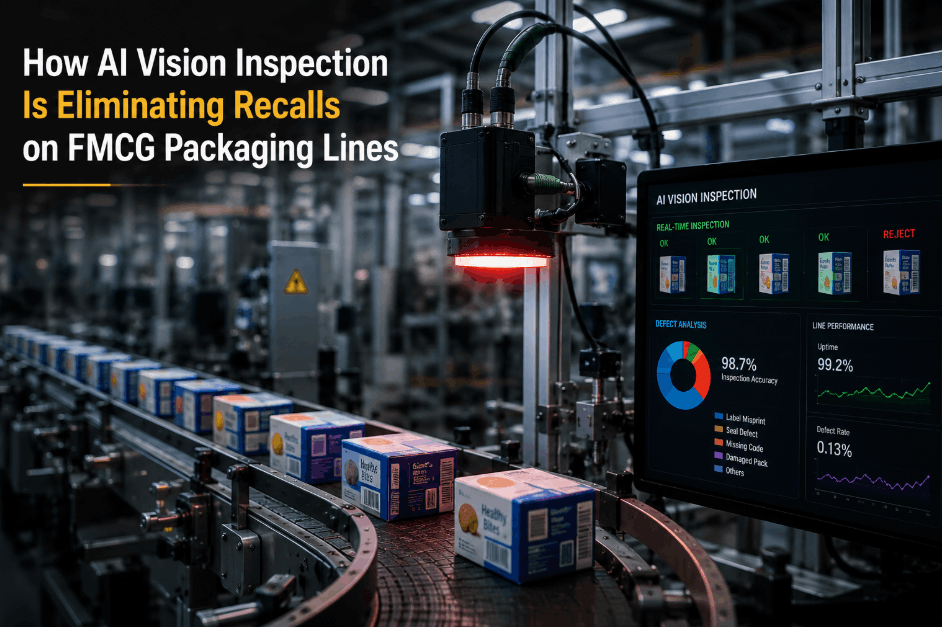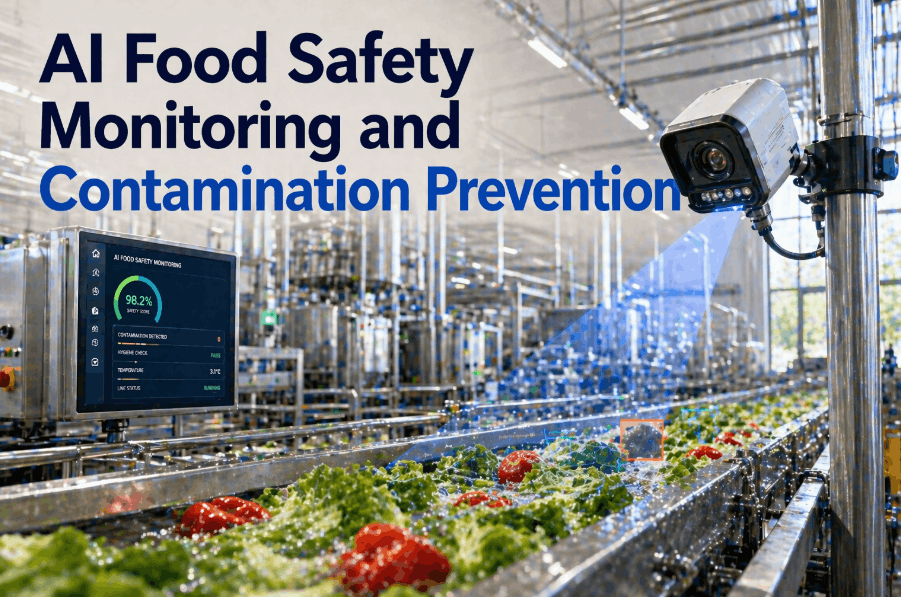
Foreign object contamination is among the most costly and reputation-damaging events a food manufacturer can face. Metal shavings, glass fragments, hard plastic shards, bone particles, and packaging material find their way into finished product through equipment wear, raw material variability, and process line failures that even the most rigorous HACCP plans struggle to prevent. Traditional detection methods — metal detectors, X-ray inspection, and manual visual checks — operate at fixed sensitivity thresholds and cannot adapt to changing product characteristics, line speeds, or contaminant profiles. AI foreign object detection in food manufacturing transforms this landscape by combining computer vision, deep learning, and multi-sensor data fusion to identify contaminants at speeds and accuracy levels that conventional inspection simply cannot match, while simultaneously reducing false rejects that erode yield and profitability.
Is Your Food Production Line Protected Against Invisible Contamination Risks?
iFactory AI delivers real-time AI vision inspection, X-ray image analysis, and multi-sensor contamination detection purpose-built for FMCG and food manufacturing production lines.
Why Foreign Object Contamination Remains a Critical Challenge in Modern Food Manufacturing
Despite decades of investment in metal detectors, X-ray inspection systems, and HACCP-based preventive controls, foreign object contamination continues to generate the highest number of Class I food recalls in markets worldwide. The underlying problem is structural rather than procedural: conventional inspection equipment is calibrated to fixed parameters at the start of a production run and cannot adapt to variations in product density, moisture content, packaging format, or line speed without manual intervention. A metal detector set to detect ferrous particles above 2 mm will miss a 1.5 mm stainless steel fragment embedded in a high-moisture product just as reliably on hour eight of a shift as it did on hour one — but the product characteristics that mask contaminant signals change continuously as raw material batches, temperature profiles, and equipment condition evolve throughout the production day.
The financial impact is compounding. A single foreign object recall in the U.S. food industry costs an average of $10 million in direct expenses — retrieval, testing, disposal, regulatory fines — before accounting for brand damage and lost shelf space. Meanwhile, the false reject rate on conventional inspection lines — products flagged as contaminated that are actually safe — typically runs between 0.5% and 3% of total production, representing millions of dollars in wasted raw material, energy, and labor annually at a mid-size facility. AI inspection platforms address both sides of this equation: they increase true positive detection rates for genuine contaminants while reducing false positives by 50–80% compared to conventional threshold-based systems.
Six Ways AI Is Transforming Foreign Object Detection in Food Production
AI foreign object detection is not a single sensor or algorithm — it is a layered inspection architecture that combines multiple imaging modalities, deep learning classification models, and real-time decision logic to address contaminant types that each require fundamentally different detection approaches.
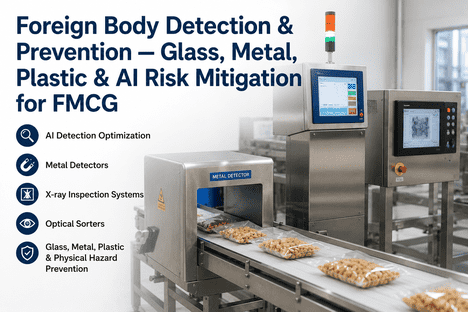
Conventional X-ray inspection systems rely on fixed灰度 thresholding to identify dense objects in a food product stream. AI-enhanced X-ray systems replace static thresholds with deep learning segmentation models trained on thousands of contaminant images across varying product densities, shapes, and orientations. The model distinguishes between a legitimate bone fragment in a chicken fillet and the product's natural density variation — a distinction that fixed-threshold X-ray systems routinely misclassify, generating false rejects on bone-in products or missing contaminants in high-density sauces and spreads. iFactory AI's AI Vision Camera module integrates directly with existing X-ray inspection hardware, upgrading detection capability without replacing the physical inspection tunnel.
Organic contaminants — insect fragments, mold, rodent hairs, and feather remnants — are effectively invisible to both metal detectors and conventional X-ray systems because their density is very close to the food matrix itself. Hyperspectral imaging captures reflectance data across hundreds of narrow wavelength bands, revealing spectral signatures that differentiate organic foreign material from the food product at the molecular level. AI models trained on hyperspectral libraries classify these contaminants in real time at production line speeds, triggering rejection mechanisms without slowing throughput. This is the only commercially viable technology for detecting organic contaminants in bulk processing environments such as flour milling, spice grinding, and frozen vegetable processing.
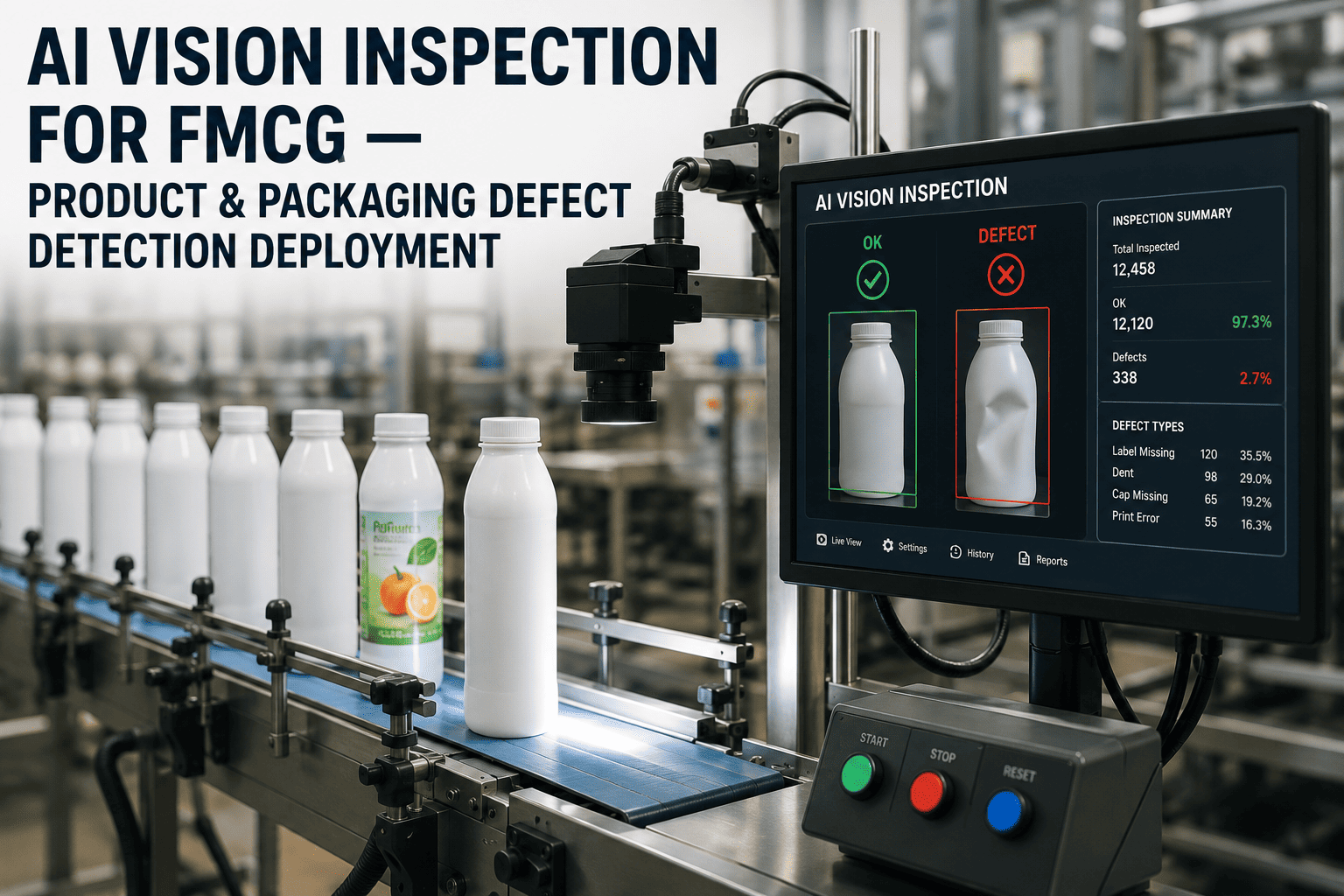
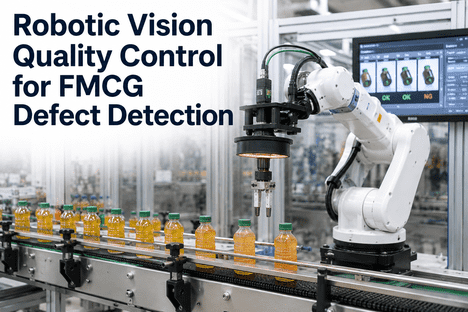
Surface-level contaminants — hair, fiber, insect fragments, packaging material fragments — require high-resolution optical imaging combined with AI classification that can distinguish between a surface blemish on the product and a genuine foreign object. Deep learning vision models analyze product images at line speeds exceeding 600 units per minute, identifying contaminants as small as 0.3 mm on irregular product surfaces. iFactory AI's AI Vision Camera module deploys multi-camera arrays across production lines, with models trained on facility-specific contaminant histories to maximize detection accuracy for the contaminant types most prevalent in each production environment.
No single sensor technology detects every contaminant type. Metal detectors excel at ferrous and non-ferrous metals but miss glass and stone. X-ray systems detect dense materials but struggle with organic contaminants. Hyperspectral imaging identifies organic material but cannot detect metals embedded below the product surface. AI-powered sensor fusion platforms combine outputs from metal detectors, X-ray units, hyperspectral cameras, and optical vision systems in real time, applying a unified classification model that synthesizes multi-sensor data into a single contamination decision per product unit. This layered approach achieves detection rates above 99.5% across all contaminant categories while maintaining false reject rates below 0.2% — performance levels that no single-sensor system can achieve independently.
Beyond real-time contaminant detection, AI platforms analyze historical inspection data, equipment maintenance records, raw material supplier quality scores, and production line condition data to predict contamination risk windows before they occur. When a grinder blade approaches its replacement interval, a raw material supplier's defect rate shifts, or a line speed change alters product residence time in an X-ray tunnel, the AI model re-calculates contamination probability and recommends preventive actions — tooling change, inspection threshold adjustment, or raw material quarantine — that prevent contamination events rather than simply catching them after they occur. iFactory AI's Predictive Maintenance module integrates with contamination risk models to automatically schedule equipment inspections based on contamination probability scores rather than fixed calendar intervals.
Regulatory compliance under FSMA, BRCGS, IFS, and SQF standards requires documented evidence of contaminant detection system validation, performance monitoring, and corrective action records. AI inspection platforms automate compliance documentation by time-stamping every inspection decision with product SKU, line ID, sensor configuration, and contaminant classification data — creating a tamper-evident digital audit trail that satisfies regulatory requirements without manual data compilation. When a contaminant is detected and rejected, the platform automatically generates an Incident Report in iFactory AI's Safety and Compliance module, assigns corrective actions to the responsible maintenance or quality team, and flags the event for regulatory reporting if the contaminant type or size exceeds HACCP critical limits.
Conventional Inspection vs. AI-Powered Foreign Object Detection: The Performance Gap
The operational difference between conventional inspection technology and AI-powered detection is not incremental — it is foundational. The table below maps the performance delta across the dimensions that determine food safety outcomes and production economics.
| Inspection Dimension | Conventional Approach | AI-Powered Approach | Performance Delta |
|---|---|---|---|
| Contaminant Detection | Fixed threshold metal detector + X-ray | Multi-sensor AI fusion with deep learning classification | 99.5%+ detection rate |
| False Reject Rate | 0.5–3% of total production | AI-optimized false reject rate below 0.2% | 50–80% reduction |
| Contaminant Size Threshold | 2–5 mm (technology dependent) | 0.3–1 mm with AI-enhanced multi-sensor fusion | 5–10× smaller detection |
| Organic Contaminant Detection | Not possible with metal detector or X-ray | Hyperspectral AI models for insect, mold, feather, hair | New detection capability |
| Adaptation to Product Variation | Manual recalibration required | Real-time AI model adaptation to density, moisture, shape | 100% automated adaptation |
| Compliance Documentation | Manual logs, paper-based audits | Automated digital audit trail with incident reporting | 90% reduction in admin time |
A Phased AI Deployment Roadmap for Foreign Object Detection in Food Manufacturing
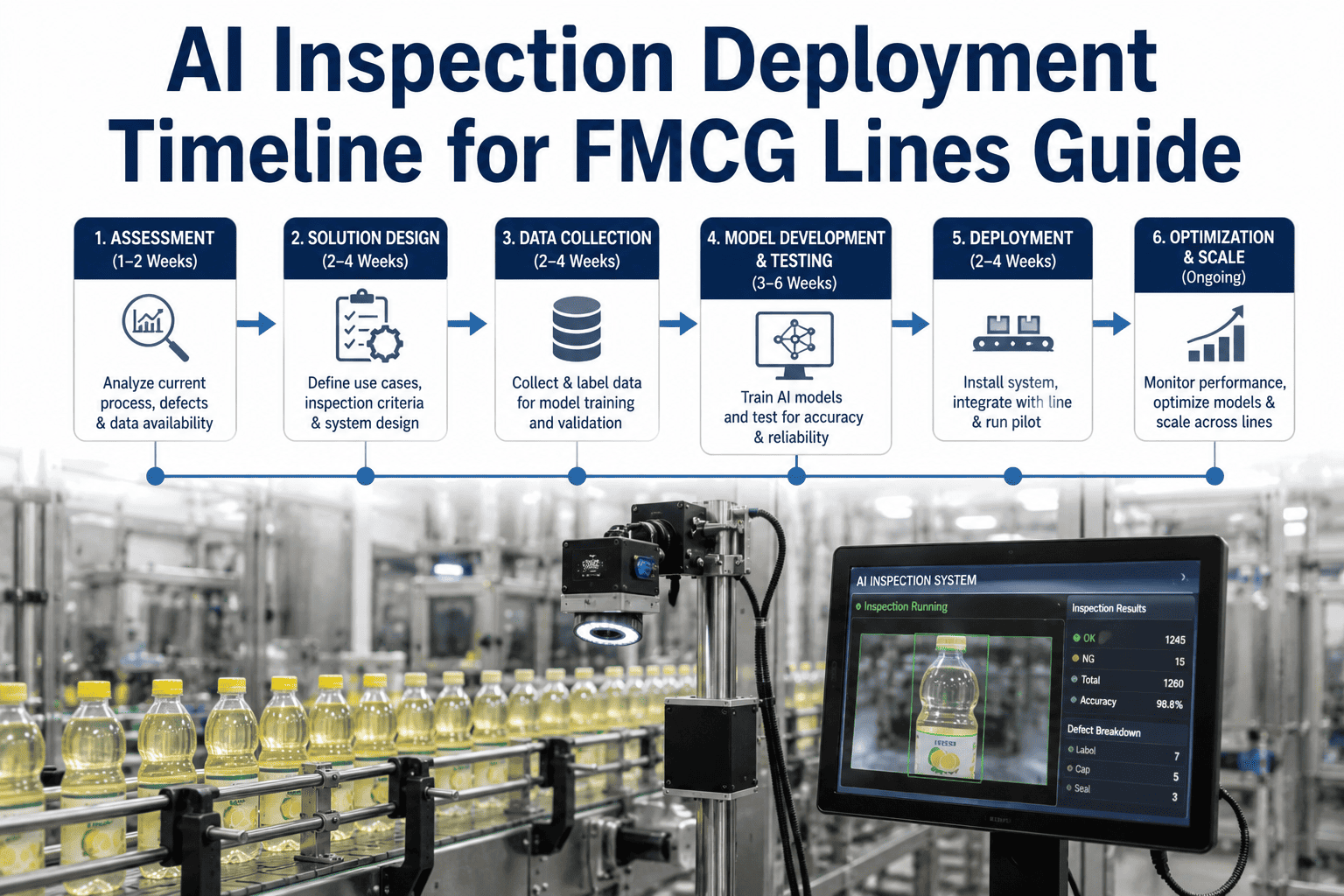
AI inspection deployment in food manufacturing does not require replacing existing production line infrastructure. The most effective implementation sequences layer AI intelligence on top of current metal detectors, X-ray units, and vision systems — delivering measurable contamination risk reduction at each phase.
Sensor Audit and Data Integration
Survey all existing inspection equipment across production lines — metal detectors, X-ray systems, checkweighers, and optical sorters — and establish data connectivity through OPC-UA, MQTT, or direct sensor API integration with iFactory AI's platform. Generate a baseline contamination event profile showing current detection rates, false reject percentages, and contaminant type distribution across all SKUs. Phase 1 is typically completed without any production disruption and establishes the performance baseline against which AI improvement is measured.
AI Model Training and Sensor Enhancement
Train contaminant classification models using facility-specific historical inspection data supplemented with iFactory AI's pre-trained contaminant libraries covering metal, glass, plastic, stone, bone, and organic foreign body types. Deploy AI-enhanced detection logic on existing X-ray and vision systems, upgrading their classification capability without hardware replacement. Integrate hyperspectral imaging on high-risk lines handling raw protein, bulk powders, and frozen products where organic contaminant risk is highest. Most facilities see detection rate improvements within the first two weeks of AI model activation.
Predictive Risk Modeling and CTA Integration
Activate predictive contamination risk models that integrate equipment condition data, raw material supplier quality scores, and production schedule information to forecast high-risk production windows. Connect iFactory AI's Work Order Management module to automatically generate preventive maintenance tasks when contamination probability exceeds configured thresholds. Establish shift-level quality dashboards that give production supervisors real-time visibility into contamination detection rates, false reject trends, and equipment health scores across all active lines.
Compliance Automation and Continuous Improvement
Deploy automated compliance documentation workflows covering FSMA, BRCGS, IFS, and SQF audit requirements. Configure iFactory AI's Incident Reporting module to capture every contaminant detection event with full contextual data — SKU, line, sensor configuration, contaminant type and size, rejection confirmation — and format the data for direct submission to regulatory bodies when critical limit excursions occur. Establish monthly AI model retraining cycles that incorporate new contaminant images from facility operations, improving detection accuracy continuously as the model encounters novel contaminant types and product configurations. Book a Demo to design your facility-specific AI food safety deployment roadmap.
From Contaminant Detection to Prevention — AI-Powered Food Safety
iFactory AI connects X-ray, vision, hyperspectral, and metal detection into a single intelligence platform — giving food manufacturers the visibility to detect contaminants before they reach finished product.
How iFactory AI's Platform Addresses Foreign Object Detection Challenges
iFactory AI is an integrated industrial intelligence platform purpose-built for food and beverage manufacturing, FMCG production, and consumer goods operations. The platform's modular architecture enables food manufacturers to deploy foreign object detection capabilities that address their highest-priority contamination risks first, without waiting for a full enterprise rollout.
AI Vision Camera
Real-time computer vision inspection for surface contaminants, packaging defects, and product anomalies. Deep learning models detect hair, fiber, insect fragments, and packaging material at line speeds exceeding 600 units per minute.
Learn More →Quality Control Management
Integrated contaminant detection data with SKU-level quality tracking, supplier scorecards, and HACCP critical limit monitoring. Real-time dashboards for quality teams and production management.
Predictive Maintenance
Condition-based monitoring for processing equipment that directly impacts contamination risk — grinders, slicers, conveyors, and packaging machines. AI failure prediction with contamination probability integration.
Statistical Quality Control
AI-driven SPC monitoring of contaminant detection trends, false reject patterns, and inspection equipment performance. Automated control limit alerts and capability analysis for all inspection checkpoints.
Incident Reporting
Automated contaminant detection event capture with full contextual data — SKU, line, sensor configuration, contaminant classification. Direct regulatory reporting integration for critical limit excursions.
Safety and Compliance
FSMA, BRCGS, IFS, and SQF compliance documentation automation. Digital audit trails for every contaminant detection event with automated regulatory reporting and corrective action tracking.
Expert Perspective: What AI Actually Delivers in Food Foreign Object Detection
The food industry's reliance on single-sensor inspection — a metal detector here, an X-ray unit there — creates a fundamental blind spot. Each sensor technology has a specific contaminant class it cannot see, and those blind spots are where recalls happen. AI multi-sensor fusion does not just improve detection accuracy on existing sensors; it closes the blind spots entirely by combining data across modalities. A facility running AI-fused inspection for 90 days will have contaminant profile data that reveals process failure modes the facility's HACCP team never knew existed. That intelligence is worth more than the detection itself — it enables preventive action rather than reactive rejection.
Key Operational Insights
False reject reduction is not just a yield improvement — it is a quality team productivity multiplier. Every false reject a quality inspector must investigate takes time away from genuine contamination risk assessment.
Organic contaminant detection is the largest unaddressed risk in most food HACCP plans. Metal detectors and X-ray systems cannot detect insect fragments, mold, or feather remnants — hyperspectral AI closes that gap completely.
The facilities that deploy AI inspection earliest will build contaminant image libraries and failure mode models that create an insurmountable data advantage over competitors still relying on conventional threshold-based inspection.
Regulatory auditors are beginning to ask whether food manufacturers have validated their inspection systems against the full contaminant profile of their products — not just metal — and AI inspection creates the documented validation evidence that satisfies this emerging audit expectation.
The Case for AI in Foreign Object Detection Is Built on Measurable Risk Reduction
Foreign object contamination is not a problem that conventional inspection technology can solve on its own — not because metal detectors and X-ray systems are ineffective, but because contaminant profiles, product characteristics, and production conditions change faster than fixed-threshold inspection systems can adapt. AI does not replace existing inspection infrastructure; it transforms the intelligence layer above it, enabling detection systems that learn, adapt, and improve continuously rather than degrading in accuracy as production conditions drift from calibration settings.
Food manufacturers who deploy AI foreign object detection are not running a fundamentally different production line. They are running the same line with a fundamentally better ability to see what is happening inside it — and that visibility translates directly and measurably into reduced recall risk, improved yield, lower false reject costs, and stronger regulatory compliance. iFactory AI's platform is in production at food manufacturing facilities across the FMCG, protein processing, dairy, bakery, and beverage sectors, with integration pathways designed specifically for existing metal detector, X-ray, and vision inspection infrastructure.
The contaminant detection capability gap between conventional and AI-powered inspection will continue to widen as AI models accumulate more training data and sensor technology advances. The question for food manufacturers is not whether AI inspection will become the industry standard — it is whether their facility will be leading that transition or catching up to it.
Deploy AI Inspection Intelligence Across Your Food Production Lines
iFactory AI gives food manufacturers real-time contaminant detection, multi-sensor AI fusion, predictive risk modeling, and automated compliance documentation — all on one platform built for FMCG and food processing operations.
AI Foreign Object Detection in Food Manufacturing — Frequently Asked Questions
What types of foreign objects can AI detect that conventional systems miss?
AI-enhanced inspection systems detect the full spectrum of food contaminants including metals (ferrous, non-ferrous, stainless steel), glass, hard and soft plastics, stones, bone fragments, insect fragments, rodent hairs, feather remnants, mold, packaging material fragments, and fiber. The critical advantage over conventional systems is detection of organic and low-density contaminants that metal detectors and X-ray systems cannot identify — including insect fragments in flour, feather remnants in poultry, and mold in spice products. Hyperspectral AI models identify these contaminants by their spectral signature rather than density, making organic contaminant detection commercially viable for the first time in high-speed production environments.
Does AI food inspection require replacing existing metal detectors and X-ray equipment?
No. iFactory AI integrates with existing metal detector, X-ray, checkweigher, and vision inspection equipment through standard industrial communication protocols — OPC-UA, MQTT, and direct sensor API connections. The AI platform sits as an intelligence layer above existing hardware, upgrading detection logic without requiring physical equipment replacement. In most food manufacturing facilities, AI integration with existing inspection infrastructure is completed in 2–4 weeks per production line. Facilities planning new inspection line installations can deploy AI-native sensor configurations that maximize detection capability from initial commissioning.
How does AI reduce false rejects while improving contaminant detection?
Conventional inspection systems apply fixed threshold parameters — if a signal exceeds a preset level, the product is rejected regardless of whether the signal source is a genuine contaminant or a product characteristic variation. AI classification models analyze the full signal profile — shape, density distribution, spectral signature, spatial location — and distinguish between contaminant signals and product-related signal artifacts that are harmless. The model continuously adapts to product variation across raw material batches, moisture content changes, and line speed adjustments without requiring manual recalibration. The net result is contaminant detection rates above 99.5% combined with false reject rates consistently below 0.2% — performance levels that are unattainable with fixed-threshold inspection logic.
What is the typical ROI timeline for AI foreign object detection deployment?
For a mid-size food manufacturing facility operating 4–8 production lines with existing metal detector and X-ray infrastructure, AI deployment typically delivers measurable ROI within the first 3–6 months of full platform activation. The fastest returns come from false reject reduction, where a 1–2 percentage point improvement in yield on a high-volume line can recover hundreds of thousands of dollars annually in raw material and labor costs. Recall risk reduction — while harder to quantify as direct savings — represents the highest-value benefit, with a single prevented Class I recall event covering the entire platform investment multiple times over. iFactory AI provides facility-specific ROI modeling as part of the demo process — Book a Demo to build your customized economic recovery scenario.
How does iFactory AI support FSMA and BRCGS compliance documentation?
iFactory AI's Safety and Compliance module automates FSMA Preventive Controls, BRCGS Food Safety Standard, IFS Food, and SQF Code compliance documentation by capturing every contaminant detection event with complete contextual metadata — product SKU, production line, sensor configuration, contaminant type and size classification, rejection confirmation timestamp, and corrective action record. The platform generates audit-ready compliance reports that include inspection system validation evidence, daily performance verification records, contaminant trend analysis, and corrective action closure documentation. When a contaminant detection event exceeds HACCP critical limits, the platform automatically creates an incident record in the Incident Reporting module and notifies the designated quality and regulatory contacts. This eliminates the manual data compilation work that typically consumes 15–25 hours per week of quality team time in conventionally managed facilities.