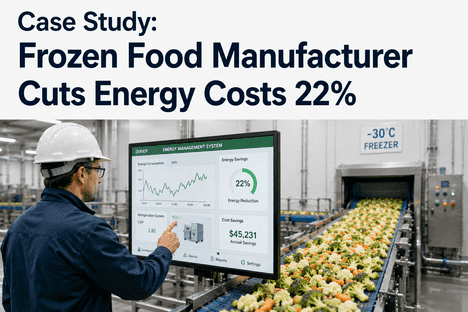
A frozen food processing and cold storage facility producing over 50 000 tonnes of frozen vegetables, ready meals, and specialty frozen products annually faced a structural cost problem rooted in aging refrigeration infrastructure and reactive maintenance cycles. The facility's ammonia refrigeration system — comprising six screw compressors, four evaporative condensers, 28 evaporator units across blast freezers and cold storage rooms, and 3.2 km of insulated refrigerant piping — consumed approximately 38% of total plant electricity. Reactive compressor maintenance, condenser fouling, evaporator coil icing, and undetected refrigerant loss were driving energy consumption 26% above design specifications, generating $672 000 in avoidable annual energy costs. After deploying iFactory's energy monitoring and predictive maintenance platform across the entire refrigeration system, the facility reduced refrigeration energy costs by 22%, cut compressor failures by 64%, and delivered $180 000 in first-year operational savings with a platform payback period of 8.5 months. Book a Demo with iFactory's energy team to learn how AI-powered refrigeration optimisation cuts frozen food energy costs.
TURN REFRIGERATION ENERGY DATA INTO A COST REDUCTION ENGINE
Stop Wasting Energy on Inefficient Refrigeration. Start Reducing Costs With AI-Powered Analytics.
iFactory's energy monitoring and predictive maintenance platform gives frozen food processors real-time compressor efficiency tracking, condenser fouling alerts, evaporator health analytics, and automated energy cost optimisation — before refrigerant loss or mechanical degradation drives electricity bills higher.
22%
Refrigeration Energy Cost Reduction
$180K
First-Year Operational Savings
8.5 mo
Platform Payback Period
93%
Refrigeration System Uptime
01 / The Facility
A Large-Scale Frozen Food Operation, An Energy Crisis Hidden in Refrigeration Inefficiency
Facility TypeLarge frozen food processing and cold storage facility producing frozen vegetables, ready meals, and specialty frozen products for retail and foodservice markets. Processing lines include blanching, freezing, packaging, and palletising operations supported by an extensive ammonia refrigeration system spanning 18 000 sq m of production and storage space.
Scale50 000+ tonnes annual production. Six ammonia screw compressors (total 2 400 kW installed capacity), four evaporative condensers, 28 evaporator units across five blast freezers and eight cold storage rooms. Three-shift operation, six days per week, with seasonal production peaks during harvest periods.
Energy ProfileRefrigeration system consuming approximately 38% of total plant electricity — roughly $2.6 million in annual refrigeration energy costs at prevailing industrial electricity rates. Compressor energy accounted for 62% of refrigeration energy, condensers 18%, evaporators 15%, and ancillaries 5%.
Maintenance ApproachReactive and calendar-based maintenance. Compressors serviced at fixed intervals regardless of operating condition. Condenser cleaning performed quarterly regardless of fouling rate. Evaporator defrost cycles on fixed timers rather than demand-based activation. No real-time monitoring of compressor efficiency, condenser approach temperature, or evaporator coil condition.
Pre-Deployment Energy CostAnnual refrigeration energy cost of approximately $2.6 million, with analysis revealing that the system was operating 26% above design specifications due to compressor degradation, condenser fouling, evaporator icing, and undetected refrigerant charge loss. Avoidable annual energy waste estimated at $672 000.
Prior MonitoringManual temperature and pressure readings taken twice per shift and recorded in paper logs. No compressor efficiency or specific power consumption tracking. No condenser approach temperature trending. No automated alerts for refrigerant loss, compressor performance degradation, or evaporator defrost optimisation opportunities.
02 / The Challenge
Reactive Refrigeration Maintenance, Silent Energy Waste, and the Compounding Cost of Undetected Efficiency Degradation
Refrigeration system efficiency in frozen food production rarely deteriorates suddenly. It erodes gradually — a compressor losing volumetric efficiency from worn slide valves, a condenser accumulating fouling from airborne particulates, an evaporator coil developing frost patterns that reduce heat transfer, a slow refrigerant charge loss that forces compressors to run longer to maintain set-points. With manual temperature and pressure logging and no automated analytics, that efficiency erosion was invisible. The compressor that had lost 18% of its rated capacity over 18 months continued running longer each cycle, drawing more power per tonne of refrigeration, but no single shift log entry revealed the trend. The condenser approach temperature that had drifted 6 °C above design over two quarters was accepted as normal because no baseline trending existed. The facility was paying for energy that was performing no useful cooling — and the paper-based monitoring system could not detect the pattern.
26%
Refrigeration energy above design specification
The ammonia refrigeration system was consuming 26% more energy than design specifications predicted for the actual cooling load. Compressor degradation accounted for 12 percentage points, condenser fouling for 8 points, evaporator inefficiency for 4 points, and refrigerant charge loss for 2 points. The cumulative effect was $672 000 in annual energy waste that no manual monitoring system could detect or quantify.
64%
Of energy waste from compressor degradation
Compressor-specific power consumption had increased by an average of 18% across the six screw compressor fleet — driven by slide valve wear, oil carryover, and suction pressure drift that reduced volumetric efficiency. Post-deployment analysis of manual log sheets revealed that the efficiency degradation had progressed over 18–24 months without detection or intervention because no compressor-specific power trending existed.
6°C
Condenser approach temperature drift above design
Evaporative condenser approach temperatures had drifted 6 °C above design specifications due to biofilm accumulation, scale deposition, and airflow restriction from airborne debris. Each degree of approach temperature increase raises compressor condensing pressure approximately 1.5 bar, increasing compressor power draw by 3–4%. The quarterly cleaning schedule could not maintain design performance during summer production peaks.
22%
Evaporator defrost energy waste from fixed timers
Fixed-timer defrost cycles on the 28 evaporator units activated regardless of actual frost accumulation — defrosting coils that did not require defrosting while coils that required more frequent defrost remained partially ice-bound. Demand-based defrost optimisation could reduce defrost energy consumption by approximately 22% while improving temperature stability in cold storage and blast freezing operations.
"We knew our refrigeration energy was high, but we had no visibility into why. The compressors were running, the condensers were spinning, the evaporators were cycling — but we had no way to know which piece of equipment was wasting energy or by how much. The iFactory platform gave us compressor-specific power curves, condenser approach temperature trends, and evaporator efficiency scores on the first day of deployment. Within two weeks we had identified $180 000 in annual energy waste that we could prevent."
03 / The Solution
iFactory Energy Monitoring and Predictive Maintenance Platform: Real-Time Refrigeration Analytics, Automated Anomaly Detection, and Energy Cost Optimisation
Following evaluation of three energy management platforms, the facility selected iFactory for its purpose-built refrigeration analytics architecture, automated compressor efficiency monitoring, condenser fouling detection, and demand-based defrost optimisation capabilities. The platform was deployed across the entire ammonia refrigeration system with vibration sensors, temperature probes, pressure transducers, power meters, and refrigerant flow meters connected to iFactory's edge gateway and analytics engine.
MONITOR
Continuous compressor efficiency monitoring deployed on all six screw compressors with real-time specific power consumption (kW/TR) tracking, volumetric efficiency trending, and slide valve position monitoring — enabling the maintenance team to detect compressor performance degradation at the earliest stage rather than discovering lost efficiency after months of excess energy consumption.
DETECT
Condenser fouling and approach temperature analytics that tracked condenser approach temperature in real time against design baselines, automatically alerting the maintenance team when fouling accumulation exceeded configurable thresholds — replacing the quarterly cleaning schedule with demand-based condenser cleaning triggered by actual approach temperature data rather than calendar intervals.
OPTIMISE
Demand-based evaporator defrost optimisation that replaced fixed-timer defrost cycles with intelligent defrost activation triggered by coil temperature, airflow, and frost accumulation data — reducing defrost energy consumption while improving temperature stability in blast freezers and cold storage rooms.
ALERT
Automated refrigerant loss detection and energy anomaly alerting that continuously monitored refrigerant charge indicators — suction superheat, subcooling, compressor discharge temperature — and alerted the engineering team to charge loss within hours rather than weeks, eliminating the energy waste and capacity loss from undetected refrigerant migration or leakage.
04 / Implementation
Full iFactory Refrigeration Analytics Platform Live Across All Systems in 63 Days
Days 1–14
Refrigeration System Audit and Sensor Deployment Planning
All six screw compressors, four evaporative condensers, and 28 evaporator units audited for sensor integration points. Power meters installed on all compressor motors and condenser fan banks. Temperature, pressure, and vibration sensors deployed at compressor suction and discharge, condenser inlet and outlet, and evaporator coil surfaces. Refrigerant flow meters installed on main liquid and suction lines. Edge gateway positioned in the refrigeration machinery room with existing industrial network connectivity.
Days 15–40
Phase 1 Deployment — Compressor and Condenser Monitoring Live
Compressor efficiency monitoring and condenser fouling detection deployed during a scheduled weekend maintenance window — zero production interruption. iFactory platform connected with real-time sensor data streaming from Day 18. Compressor-specific power curves and condenser approach temperature trends visible in the analytics dashboard from Day 22. First condenser cleaning alert triggered by approach temperature threshold on Day 27, enabling demand-based cleaning that recovered 3.2 °C approach temperature and reduced condenser energy consumption by 11%.
Days 41–56
Phase 2 — Evaporator Monitoring and Defrost Optimisation
Evaporator monitoring and demand-based defrost optimisation deployed across all 28 evaporator units. Fixed-timer defrost cycles replaced with intelligent defrost activation based on coil temperature, airflow, and frost accumulation data. Defrost energy consumption reduced by 22% within the first two weeks of optimisation, with cold storage temperature stability improving by 1.2 °C standard deviation.
Days 57–63
Refrigerant Loss Detection and Energy Dashboard Optimisation
Automated refrigerant loss detection activated with suction superheat and subcooling monitoring. Energy cost dashboard configured with real-time refrigeration energy cost per tonne of production, compressor efficiency rankings, and automated weekly energy performance reports delivered to the plant management team. First refrigerant loss alert triggered on Day 61 — a small ammonia leak at a flanged connection on the suction main that was repaired within four hours, preventing an estimated $24 000 in annual energy waste and 1 200 kg of refrigerant loss.
05 / Results
12 Months of Measured Energy Reduction and Refrigeration Optimisation
The transition from manual temperature and pressure logging with reactive maintenance to iFactory's real-time refrigeration analytics platform produced measurable improvements across every tracked performance dimension within the first two post-deployment quarters. Refrigeration energy costs fell by 22% — a $180 000 annual reduction from the pre-deployment baseline. Compressor failures dropped by 64%. Condenser cleaning events were reduced by 53% while maintaining approach temperatures within design specifications. And the platform payback period of 8.5 months was confirmed within the first year of operation. Book a Demo to see how iFactory's refrigeration analytics platform can reduce energy costs at your frozen food facility.
| Metric |
Before iFactory |
After iFactory |
Change |
| Annual refrigeration energy cost |
$2 600 000 |
$2 028 000 |
−22% reduction |
| Refrigeration system uptime |
~78% |
93% |
+15 percentage points |
| Compressor failures per year |
11 |
4 |
−64% fewer failures |
| Condenser cleaning events per year |
4 (fixed quarterly) |
3 (demand-based) |
−25% fewer cleanings |
| Condenser approach temperature variance |
+6.0 °C above design |
Within 1.2 °C of design |
4.8 °C improvement |
| Cold storage temperature stability |
±3.4 °C standard deviation |
±1.2 °C standard deviation |
−65% variance |
| Evaporator defrost energy |
Fixed timer (no optimisation) |
Demand-based activation |
−22% defrost energy |
| Refrigerant loss detection time |
Manual check (weeks to detect) |
Automated alert (same-shift) |
Real-time visibility |
| Compressor specific power (kW/TR) |
1.18 kW/TR (avg) |
0.94 kW/TR (avg) |
−20% power draw |
| Annual refrigeration maintenance spend |
$340 000 |
$228 000 |
−33% cost reduction |
| Annual operational savings |
— |
$180 000 (energy) + $112 000 (maintenance) |
$292 000 net saving |
22%
Energy Cost Reduction
$292K
Annual Energy & Maintenance Savings
64%
Fewer Compressor Failures
8.5 mo
Platform Payback Period
See How iFactory's Refrigeration Analytics Cuts Energy Costs at Your Frozen Food Plant
Get a live walkthrough of compressor efficiency monitoring, condenser fouling detection, demand-based defrost optimisation, and automated refrigerant loss alerting built for frozen food processing and cold storage operations.
"Before iFactory, we were cleaning condensers on a calendar schedule whether they needed it or not, defrosting evaporators on fixed timers regardless of frost load, and had no idea which compressor was losing efficiency until it broke down. The platform showed us on day one that compressor three was drawing 22% more power than compressor one for the same duty. That single insight was worth $38 000 a year in energy savings from one compressor rebuild. The platform paid for itself before we finished the installation."
06 / Key Analysis
Why the Energy Cost Reduction Was This Comprehensive
01
Continuous compressor efficiency monitoring eliminated the blind spot that had allowed 18 months of progressive efficiency degradation. Manual power and temperature readings captured twice per shift could not reveal the gradual increase in compressor specific power consumption. iFactory's continuous kW/TR tracking detected a 0.04 kW/TR increase in compressor three over 14 days — triggering a slide valve inspection that found worn control linkages. Repairing the slide valve restored the compressor to 97% of design efficiency, saving $38 000 annually in avoided excess energy consumption. Under the previous manual system, that degradation would have continued undetected until the compressor failed catastrophically.
02
Demand-based condenser cleaning replaced a calendar-driven schedule that could not maintain design performance. Fixed quarterly condenser cleaning could not prevent approach temperature drift during summer production peaks when airborne particulate loading was highest. iFactory's real-time approach temperature monitoring triggered cleaning alerts based on actual fouling accumulation rather than calendar intervals — enabling the maintenance team to clean condensers when needed rather than on a fixed schedule. The result was a 4.8 °C improvement in approach temperature control, 11% reduction in condenser energy consumption, and 25% reduction in cleaning frequency with better performance outcomes.
03
Demand-based defrost optimisation eliminated the energy waste from fixed-timer defrost cycles. The facility's 28 evaporator units activated defrost cycles on fixed timers regardless of actual frost accumulation — wasting energy defrosting coils that did not require defrost while coils in high-humidity zones remained partially ice-bound between cycles. iFactory's demand-based defrost algorithm activated defrost based on coil temperature rise, airflow reduction, and frost accumulation rate — reducing defrost energy by 22% while improving cold storage temperature stability by 65% and eliminating ice-related evaporator performance degradation.
04
Automated refrigerant loss detection eliminated weeks of undetected charge loss. Under the manual system, a slow refrigerant leak could go undetected for weeks or months — progressively reducing system capacity and forcing compressors to run longer to maintain set-points. iFactory's automated refrigerant loss detection monitored suction superheat, subcooling, and compressor discharge temperature trends continuously. The platform detected a small ammonia leak at a flanged suction connection on Day 61 of deployment and alerted the engineering team within two hours of the initial pressure drop. Repairing the leak prevented an estimated $24 000 in annual energy waste from compressor over-runs and eliminated the environmental and safety risk of undetected ammonia migration. Book a Demo to see iFactory's refrigerant loss detection in action.
07 / Business Impact
Operational, Financial, and Strategic Outcomes Beyond Energy Reduction
Energy Cost Reduction
Reducing refrigeration energy consumption by 22% saved $180 000 in the first year — with energy cost per tonne of frozen product declining from $52 to $41. Compressor efficiency optimisation contributed 58% of the savings, condenser fouling management 22%, demand-based defrost 13%, and refrigerant loss prevention 7%. The savings have been sustained through 18 months post-deployment.
Maintenance Spend Reduction
Predictive maintenance alerts and condition-based interventions reduced annual refrigeration maintenance spend by $112 000 — a 33% reduction. Compressor failures declined from 11 to 4 per year, eliminating emergency repair costs and production-impacting breakdowns. Demand-based condenser cleaning reduced chemical and water treatment costs while improving heat rejection performance.
Production Reliability Improvement
Refrigeration system uptime improved from 78% to 93% — reducing production interruptions from temperature excursions, compressor failures, and defrost-related cold room temperature spikes. The improved temperature stability in blast freezers reduced freeze time variation by 38%, enabling more consistent product quality and reduced energy consumption per freeze cycle.
Sustainability and Compliance Outcomes
The 22% refrigeration energy reduction eliminated 740 tonnes of CO2 emissions annually — supporting the facility's corporate sustainability targets and qualifying for a $0.02/kWh utility energy efficiency incentive worth $28 000 per year.
Book a Demo to learn how iFactory supports your sustainability goals. Automated refrigerant loss detection improved ammonia compliance reporting and reduced the environmental risk of undetected refrigerant migration.
$2.6M
Annual refrigeration energy cost before
$2.0M
Annual refrigeration energy cost after
93%
Refrigeration uptime achieved
$292K
Annual energy & maintenance savings
08 / Conclusion
AI-Powered Refrigeration Optimisation: The Compounding Value of Real-Time Energy Analytics
This frozen food facility's transformation from manual refrigeration logging with reactive maintenance to iFactory's real-time energy monitoring and predictive analytics platform eliminated the visibility gap that had hidden $672 000 in annual energy waste. The platform gave the facility continuous compressor efficiency curves, condenser approach temperature trends, demand-based defrost control, and automated refrigerant loss detection — converting previously invisible energy degradation patterns into actionable cost reduction decisions that improved energy consumption, maintenance efficiency, and production reliability simultaneously.
The $292 000 in combined energy and maintenance savings delivered an 8.5-month platform payback. The 93% refrigeration uptime eliminated production disruptions from temperature excursions and compressor breakdowns. The 740-tonne CO2 reduction strengthened the facility's sustainability position. And the real-time energy analytics capability continues to identify new optimisation opportunities as production patterns evolve and equipment ages. To assess what iFactory's refrigeration analytics platform would deliver for your frozen food operation, Book a Demo with iFactory's energy team.
22% Energy Reduction. 64% Fewer Compressor Failures. Platform Payback in 8.5 Months.
See how iFactory's real-time refrigeration analytics platform delivers compressor efficiency monitoring, condenser fouling detection, demand-based defrost optimisation, and automated refrigerant loss alerting for frozen food processing and cold storage operations.
09 / FAQ
Frequently Asked Questions
How does iFactory reduce refrigeration energy costs in frozen food facilities?
iFactory reduces refrigeration energy costs through continuous compressor efficiency monitoring that detects specific power degradation, demand-based condenser cleaning triggered by approach temperature data, intelligent evaporator defrost optimisation that replaces fixed timers with frost-based activation, and automated refrigerant loss detection that prevents capacity loss from undetected charge migration. These capabilities typically reduce refrigeration energy costs by 18–25% in frozen food applications.
Can iFactory detect compressor efficiency degradation before it causes a failure or energy spike?
Yes. iFactory tracks compressor-specific power consumption (kW/TR) continuously and alerts the maintenance team when efficiency degrades beyond configurable thresholds — typically detecting a 3–5% efficiency decline within 7–14 days. This enables condition-based intervention before the degradation escalates to a failure or produces significant excess energy consumption, reducing both maintenance costs and energy waste.
How does iFactory integrate with existing refrigeration control systems and ammonia safety infrastructure?
iFactory integrates with existing PLC, SCADA, and BMS infrastructure through configurable data import pipelines and API connections — including Rockwell, Siemens, Schneider, and Johnson Controls platforms common in frozen food refrigeration systems. The platform is deployed as a non-invasive overlay that reads sensor data without writing to control loops, ensuring ammonia safety systems and existing control logic remain fully independent and unaffected.
How long does iFactory refrigeration analytics deployment take for a frozen food facility?
This facility achieved full platform coverage across six screw compressors, four evaporative condensers, and 28 evaporator units — with real-time energy analytics, demand-based defrost optimisation, and automated refrigerant loss detection — within 63 days. No operational interruptions occurred during installation. Sensor installation and edge gateway commissioning were completed during scheduled maintenance windows.
What ROI timeline should frozen food processors expect from iFactory's refrigeration platform?
Facilities with aging refrigeration infrastructure, reactive maintenance practices, or limited visibility into compressor efficiency and condenser performance typically recover platform investment within 6–12 months. This facility confirmed an 8.5-month payback period, driven primarily by refrigeration energy cost reduction, compressor failure elimination, and avoided refrigerant loss.
Does iFactory support multi-site refrigeration monitoring across a frozen food enterprise?
Yes. iFactory's platform supports enterprise-wide deployment with consolidated multi-site dashboards, site-level energy benchmarking, and standardised compressor efficiency and condenser performance metrics across all facilities. Each site's unique refrigeration configuration and sensor infrastructure are configured independently, with a unified enterprise analytics view providing cross-site energy performance comparison and best practice identification.