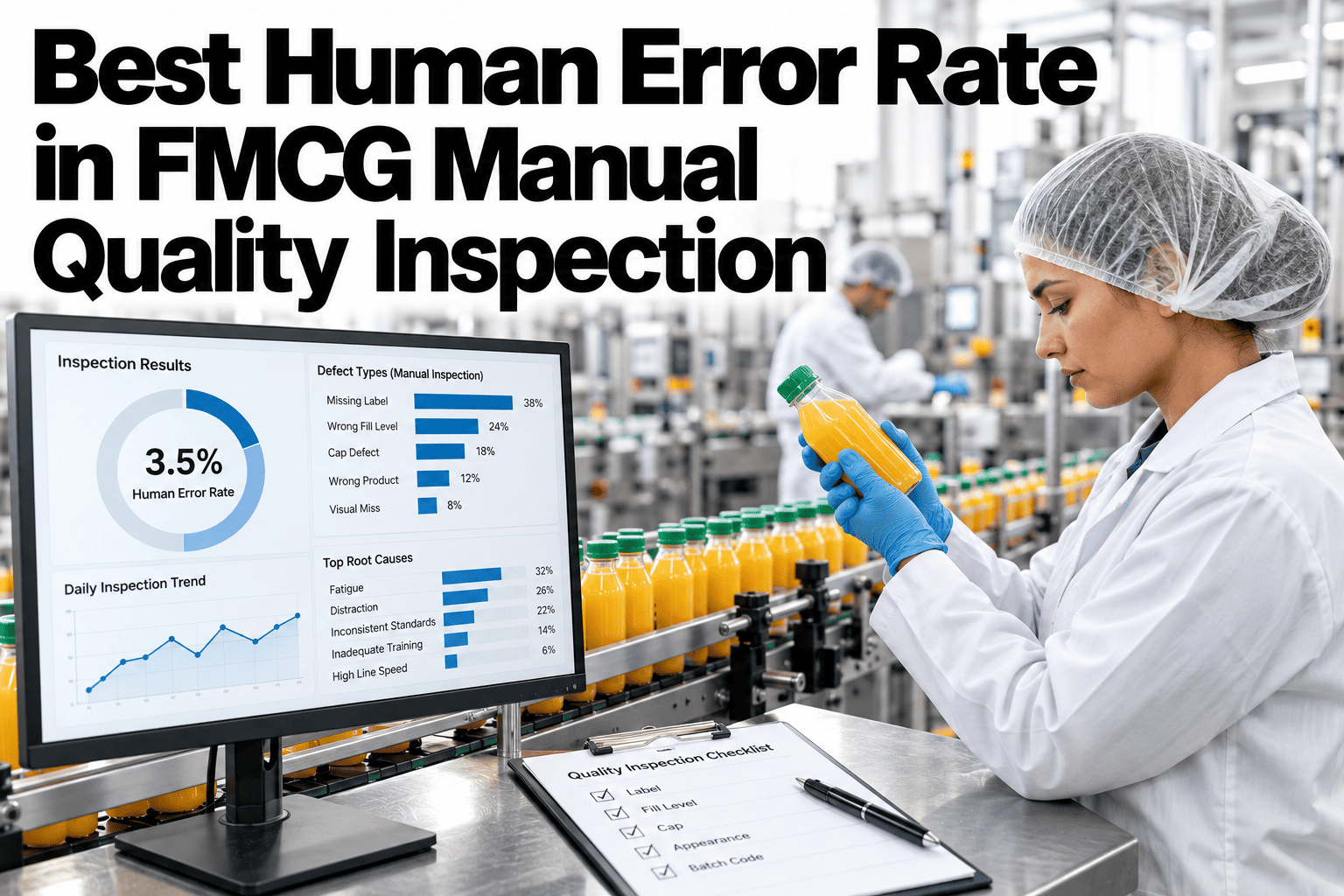
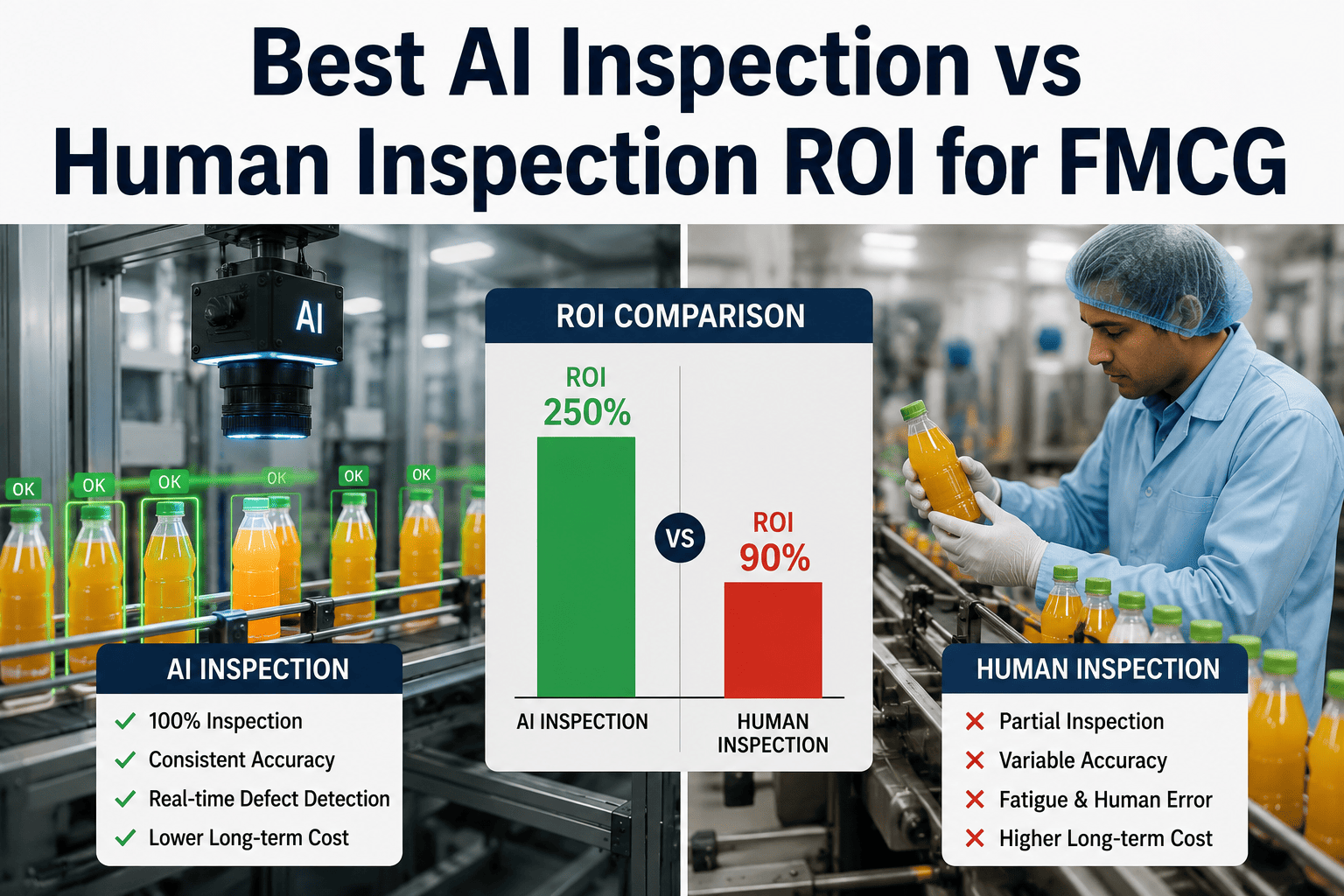
Every inspection system has an error rate, and manual inspection is no exception. Inspectors can miss real defects and can reject good products, and each mistake costs money in a different way. Knowing how errors differ by defect type, inspector and shift is the first step to reducing them. This guide explains how to measure your own error rates and how AI inspection can be deployed in practice. If you want help designing a measurement, you can plan an inspection error study with our team.
AI quality vision and inspection accuracy
Find Out How Often Manual Inspection Really Gets It Wrong
iFactory AI helps FMCG plants measure miss rates and false rejects, then deploy AI inspection where errors cost the most.
Every inspection call falls into one of four boxes
Caught defect
Missed defect
False reject
Correct pass
Two kinds of errorMisses and False Rejects Cost You in Different Ways
Most plants talk about missed defects, but false rejects also hurt through waste and lost output.
Missed defect
Faulty product reaches the customer
Costs appear as complaints and returns
Harder to notice internally
Can damage brand trust
False reject
Good product is scrapped or reworked
Costs appear as waste and lost output
Visible in reject counts
Can hide the true defect rate
Reducing one error at the expense of the other is not progress. The goal is to lower both together.
Where errors come fromWhat Drives Human Inspection Errors
Errors rarely have a single cause. This split is an illustrative example of how causes can combine.
30 percent: Subtle defects
Faint marks and small flaws are easy to overlook.
25 percent: Line speed
Little time to look at each item.
25 percent: Fatigue
Attention drops over long shifts.
20 percent: Unclear standards
Different ideas about what is acceptable.
Your own mix will differ. A measured study shows which causes matter most on your lines.
Measure your ownFive Steps to a Seeded Defect Test
A seeded test is the most reliable way to measure inspection performance. Known defects are mixed into normal production.
1
Prepare samples
Collect real defects of each important type, plus good product.
2
Record the truth
Label every sample and keep the answer key separate.
3
Mix into production
Insert samples without telling inspectors which are which.
4
Collect the calls
Record what each inspector caught or missed and when.
5
Analyse results
Calculate miss and false reject rates by type, inspector and shift.
Measure Your Inspection Error Rate With a Seeded Sample Test
Share your defect types and shift pattern and see how iFactory AI could help design and run a fair test on your lines.
The formulasTwo Simple Rates Describe Inspection Performance
Miss rate = missed defects / all defects present
False reject rate = good items rejected / all good items
Suppose a test includes 200 seeded defects and inspectors find 164. That leaves 36 missed defects, which is a miss rate of 18 percent. The number is illustrative.
By defect typeSome Defects Are Much Harder Than Others
| Defect type | Why it is hard | Typical pattern |
|---|
| Faint print fault | Low contrast against the label | Missed more when tired or rushed |
| Seal or closure flaw | Small and often at an angle | Missed on fast lines |
| Small scuff or mark | Looks like normal variation | Inconsistent between inspectors |
| Missing component | Obvious when looked for | Missed when attention drifts |
| Colour shift | Depends on lighting and judgment | Varies by shift and lighting |
Seed a mix of easy and hard defects. A test of only obvious defects gives a falsely comforting result.
By inspector and shiftLook at the Spread, Not Just the Average
An average error rate can hide large differences between people and shifts. This view is illustrative.
Manual inspection spread
Typical inspector detection
Weakest inspector detection
AI-assisted spread
Typical inspector detection
Weakest inspector detection
Use these results to improve the system, not to blame individuals. Errors usually reflect conditions and design.
What each error costsPut a Price on Both Types of Mistake
1
Cost of a miss
Complaints, returns, sorting and possible recalls. Often high but infrequent.
2
Cost of a false reject
Wasted product, rework labour and lost output. Lower per item but frequent.
3
Cost of slow inspection
Line slowdowns or rushed checks that raise error rates.
4
Cost of poor records
Time lost proving what happened when a complaint arrives.
Costs differ by product and customer. To build your own cost model, ask our team for a cost calculator outline.
Deployment pathA Practical Way to Add AI Inspection
Phase 1
Run the seeded test and set error targets.
Phase 2
Run AI beside inspectors and compare results on the same items.
Phase 3
Move to AI-assisted rejection with human review of exceptions.
Defect types ranked by cost
Seeded samples with answer key
Baseline miss and false reject rates
Targets agreed with quality and production
Plan for human review of exceptions
Owner for monthly results review
Expert reviewWhat a Quality Systems Specialist Would Check First
Expert review
Error rates only mean something when the test is fair. Use known samples, enough of them and a mix of defect types, then report ranges rather than a single number.
VerdictValuable when tests are blind, varied and repeated across shifts.
Watch forSmall tests, easy defects and results used to blame individuals.
Do nextRun a seeded test on one line and share the findings openly.
Frequently asked questionsWhat Teams Ask About Human Error in Inspection
What is a normal human error rate?
There is no single figure that applies everywhere. Error rates vary widely with defect type, line speed, lighting, shift and training, which is exactly why plants should measure their own. A seeded test on your own lines gives a number you can trust and track over time.
Plan your own measurement.
How many samples do we need for a fair test?
You need enough defects of each important type to give stable results, plus enough good product to measure false rejects. Small tests are easily distorted by chance, so use more samples for rare or costly defects and repeat the test across shifts.
Ask about sample sizes.
Should we tell inspectors about the test?
Inspectors should know in general that testing happens, but not which items are seeded, otherwise the result will not reflect normal work. Share the results openly afterwards and focus on improving the system. Using results to blame individuals quickly destroys trust.
Discuss test communication.
Can AI inspection also make errors?
Yes, which is why it should be tested in the same way as human inspection, using miss and false reject rates on your own product at full line speed. Compare both methods on the same items so the comparison is fair and the results are credible.
Ask about AI testing.
How often should we repeat the test?
Repeat it after any change in product, packaging, equipment or lighting, and at regular intervals such as every quarter. Regular testing shows whether performance is drifting and keeps inspectors calibrated. It also builds a record you can show to customers and auditors.
Plan a test schedule.
Measure first, then improve
Know Your Real Inspection Error Rate
Book a session with iFactory AI to design a seeded test, measure misses and false rejects and plan AI inspection where it will help most.