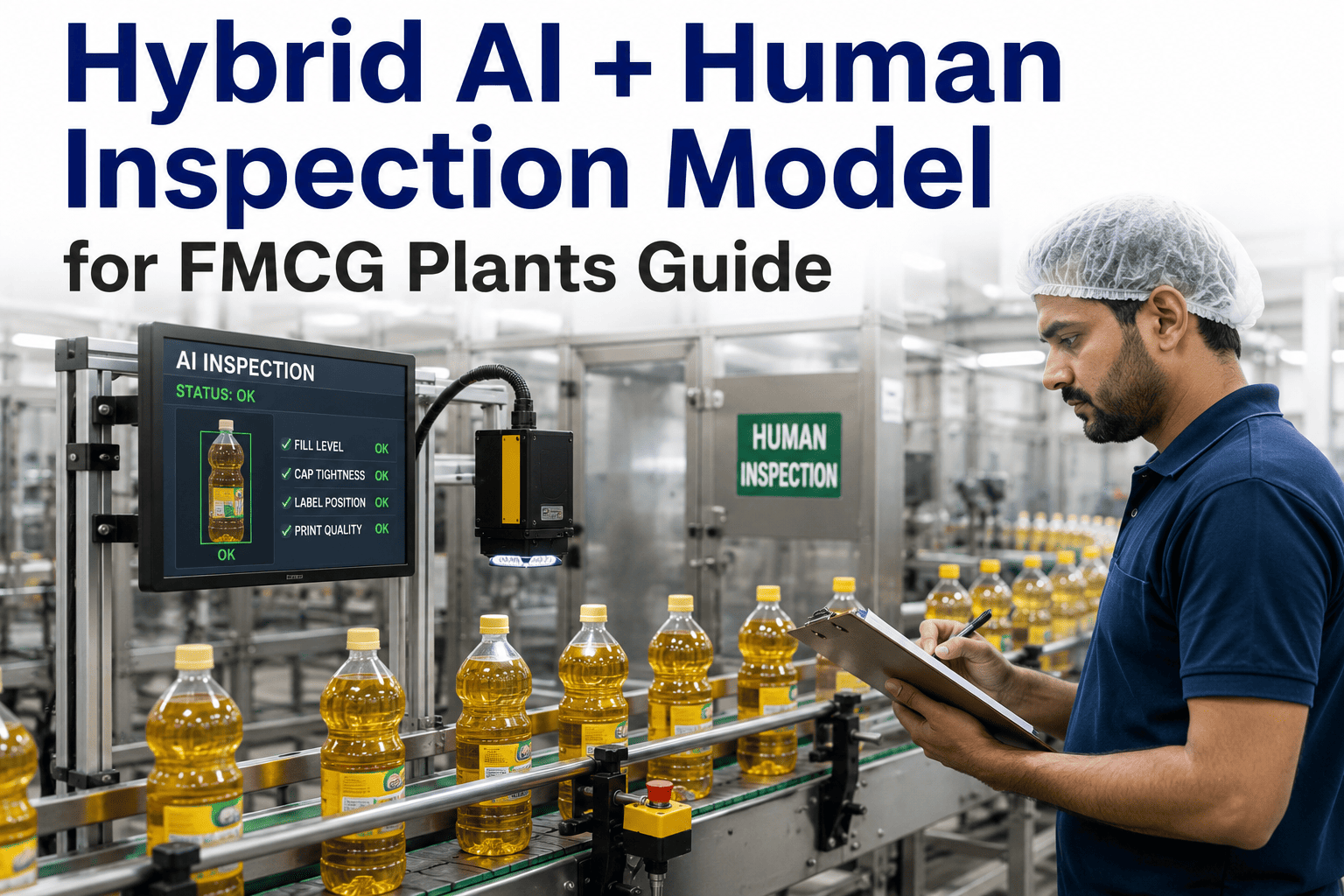
Hybrid AI + Human Inspection Model for FMCG Plants Guide

By James Smith on August 27, 2026

hybrid-ai-human-inspection-model-for-fmcg-plants-guide

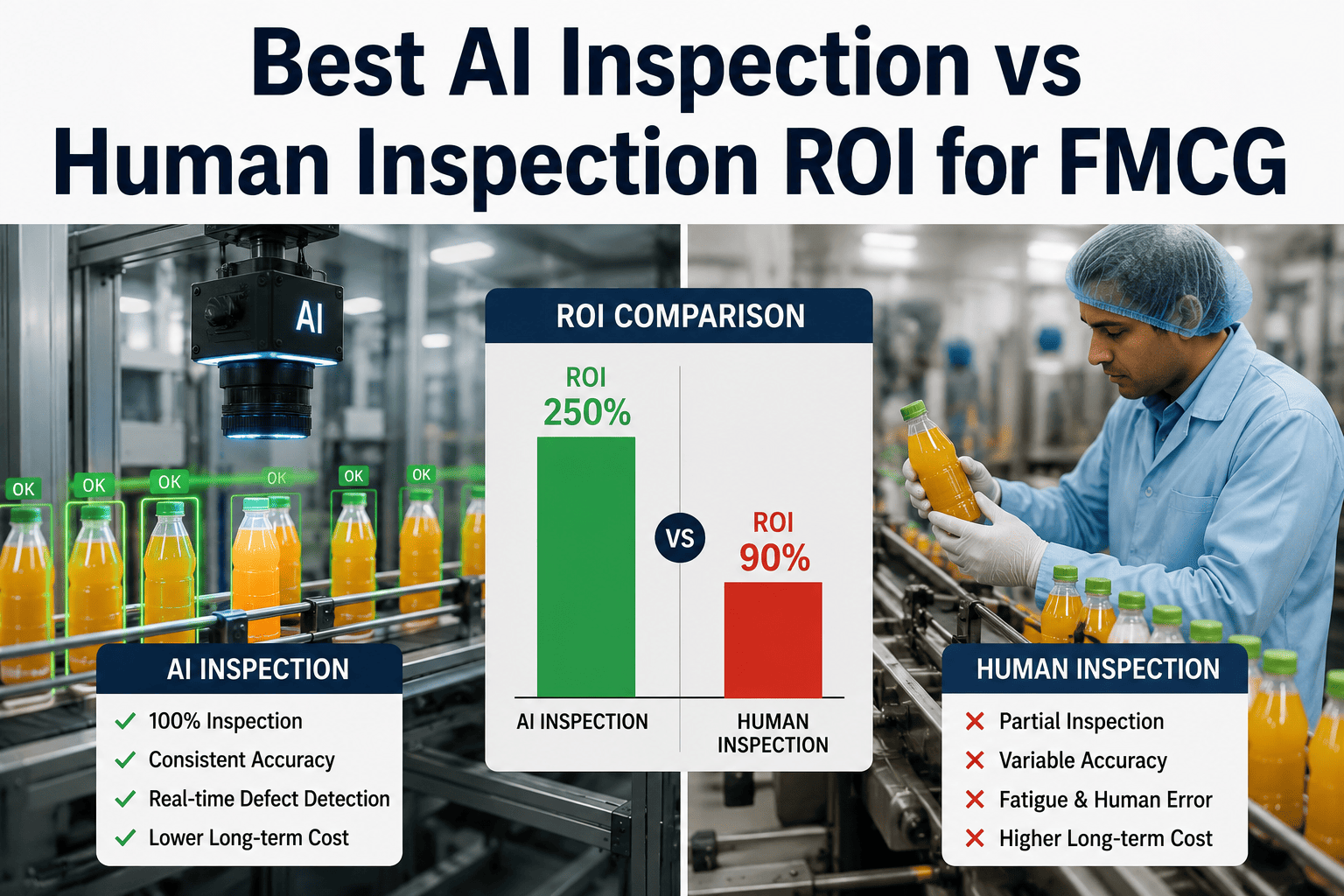
The plants that get the most value from AI inspection are rarely the ones that removed people from the quality process. They are the ones that redefined what those people spend their time doing, moving human attention away from staring at a fast-moving line for eight hours and toward the smaller set of genuinely ambiguous cases where judgment actually matters. That shift, not headcount reduction, is what a well-built hybrid model is designed around.

FMCG QUALITY VISION · HYBRID MODEL

A Hybrid AI and Human Inspection Model That Knows Where Each One Belongs

AI screens every unit at full line speed, humans arbitrate the borderline cases that genuinely need judgment, and the split between the two shifts as the AI system earns more trust over time.

WHAT AI HANDLES

Continuous Full-Line Screening

Every unit passing the inspection point is evaluated against trained defect models at full line speed, without fatigue, without a sampling gap, and without the shift-length degradation that affects even the most experienced human inspector. Clear-cut passes and clear-cut defects, the large majority of units on most lines, are resolved automatically with no human involvement required.

WHAT HUMANS HANDLE

Borderline Case Arbitration

Units the model scores with genuine uncertainty, sitting close to the decision boundary between pass and reject, are routed to a human reviewer rather than resolved automatically. This is a deliberate design choice, not a limitation to apologize for, since forcing a confident answer on a genuinely ambiguous case produces worse outcomes than acknowledging the ambiguity and routing it appropriately.

WHY ARBITRATION MATTERS MORE THAN ACCURACY ALONE

A Model That Refuses to Guess Is More Useful Than One That Always Answers

A common mistake in evaluating vision inspection systems is judging them purely on overall accuracy percentage, without asking what the model does when it genuinely does not know. A system tuned to always output a confident pass or reject, even on cases near its decision boundary, will make more confident mistakes than one designed to recognize uncertainty and defer that specific case to a human reviewer.

This is precisely why the hybrid model treats the confidence score attached to each unit's classification as a first-class output, not an internal detail hidden from the plant. Units above a high-confidence threshold in either direction are resolved automatically. Units falling into a defined uncertainty band are queued for human review, with the specific frame or image presented alongside the model's reasoning signals, so the reviewer is making an informed judgment rather than starting from nothing.

Over time, as the arbitrated cases accumulate labeled outcomes from human review, that data becomes the training signal that narrows the model's uncertainty band, meaning the volume of cases requiring human arbitration shrinks as the system operates and learns from real production data, rather than staying fixed at whatever the pilot phase established.

HOW THE SPLIT EVOLVES

The Hybrid Workflow Across Three Stages of Maturity

Phase 1
Wide Arbitration Band During Pilot and Early Rollout
A broader uncertainty band is deliberately configured during the first weeks of production, routing more borderline cases to human review than the model may strictly need to, so the quality team builds confidence in the system's judgment before narrowing that band.
Phase 2
Progressive Narrowing as Labeled Review Data Accumulates
As human-reviewed arbitration cases build a labeled dataset of genuinely ambiguous units and their correct outcomes, the model is retrained and the confidence thresholds are adjusted, reducing the share of units requiring human review without reducing overall detection accuracy.
Phase 3
Steady-State Operation With a Narrow, Stable Review Volume
The system reaches a stable state where the arbitration volume plateaus at a level reflecting the genuine, irreducible ambiguity in the product and defect categories themselves, with human reviewers focused entirely on that residual set rather than routine screening.

See how the AI-human split would work on your line

iFactory configures the arbitration threshold around your specific defect categories and risk tolerance, not a fixed default carried over from a different plant.

WHAT CHANGES FOR THE QUALITY TEAM

Redefining the Inspector Role, Not Eliminating It

Quality staff working within a hybrid model spend their time differently than they did under a manual inspection process. Instead of scanning a continuous stream of largely identical, mostly acceptable units for hours at a time, a reviewer works through a queue of specifically flagged, genuinely uncertain cases, each with supporting visual and confidence information attached. This is a fundamentally different and, by most accounts from plants running this model, less fatiguing type of work than continuous visual screening.

The role also gains a new responsibility that did not exist under a purely manual process: reviewers become the source of the labeled data that improves the model over time. Every arbitrated decision feeds back into the system, meaning the quality team's judgment compounds in value rather than being applied once to a single unit and then forgotten. This reframes quality staff as active contributors to a continuously improving system rather than a fixed inspection cost.

Automatic
Resolution of high-confidence pass and reject decisions at full line speed
Routed
Genuinely ambiguous units sent to a human reviewer with supporting context
Shrinking
Arbitration volume narrows over time as labeled review data accumulates
FREQUENTLY ASKED QUESTIONS

Common Questions on the Hybrid AI and Human Inspection Model

What percentage of units typically require human arbitration during a pilot?
The share of units routed to human review during an early pilot varies by defect category and product complexity, and is deliberately set on the higher side at first so the quality team can validate the model's judgment against real production data before the threshold is narrowed. The specific starting percentage is established during pilot scoping based on your product's defect categories and the plant's risk tolerance for false negatives versus false positives. Book a demo to discuss a starting arbitration threshold for your line.
Does a growing arbitration queue slow down the line while units wait for review?
No, units flagged for arbitration are typically diverted to a separate review lane or logged with a hold flag rather than stopping the main line to wait for a human decision, depending on the specific defect category's risk profile and the line's physical layout. High-risk categories may warrant an immediate hold, while lower-risk borderline cases can be reviewed after the fact without interrupting flow. Contact our support team to review the right diversion approach for your line layout.
How do reviewers' decisions actually improve the underlying AI model?
Each arbitrated case, along with the human reviewer's final pass or reject decision, becomes a labeled training example specific to the genuinely ambiguous region of the defect space where the model previously lacked confidence. Periodic retraining incorporates this accumulated labeled data, narrowing the model's uncertainty band and reducing future arbitration volume for similar cases, without requiring the plant to manually curate a separate training dataset.
Can we adjust how conservative or aggressive the arbitration threshold is over time?
Yes, the confidence threshold that determines what counts as a borderline case requiring human review is a configurable parameter, not a fixed setting. A plant can choose to keep the threshold wider for a higher-risk product category even after the model has matured, while narrowing it more aggressively for lower-risk categories, reflecting that different products can carry different tolerance for automated decisions. Book a demo to see how threshold tuning works across different product risk levels.
Does this hybrid approach cost more than a fully automated system with no human review step?
A hybrid model typically costs less in practice than either extreme, a fully manual process or an attempt at full automation with no human safety net, because it avoids both the ongoing full-shift labor cost of manual screening and the risk of a confidently wrong automated decision on a genuinely ambiguous unit. The human review component in a mature hybrid deployment handles a narrow, shrinking volume of cases rather than the full production stream. Contact our support team to compare cost structures for your specific line.
LET AI HANDLE VOLUME, LET PEOPLE HANDLE JUDGMENT

Build a Hybrid Model That Fits Your Product's Risk Profile

iFactory configures the arbitration threshold and workflow around your specific defect categories, then narrows it over time as your model earns more trust.

Share This Story, Choose Your Platform!