Overfill is the fill error nobody complains about, which is exactly why it survives on so many beverage lines for years without anyone quantifying what it actually costs. A consistent half-percent giveaway on a high-volume beverage SKU adds up to a meaningful share of a plant's annual raw material spend, yet it rarely shows up as a line item anyone reviews, because the bottles look correct and no customer ever files a complaint about getting slightly more than they paid for.
Fill Level AI Inspection That Catches Both Underfill Complaints and Overfill Giveaway
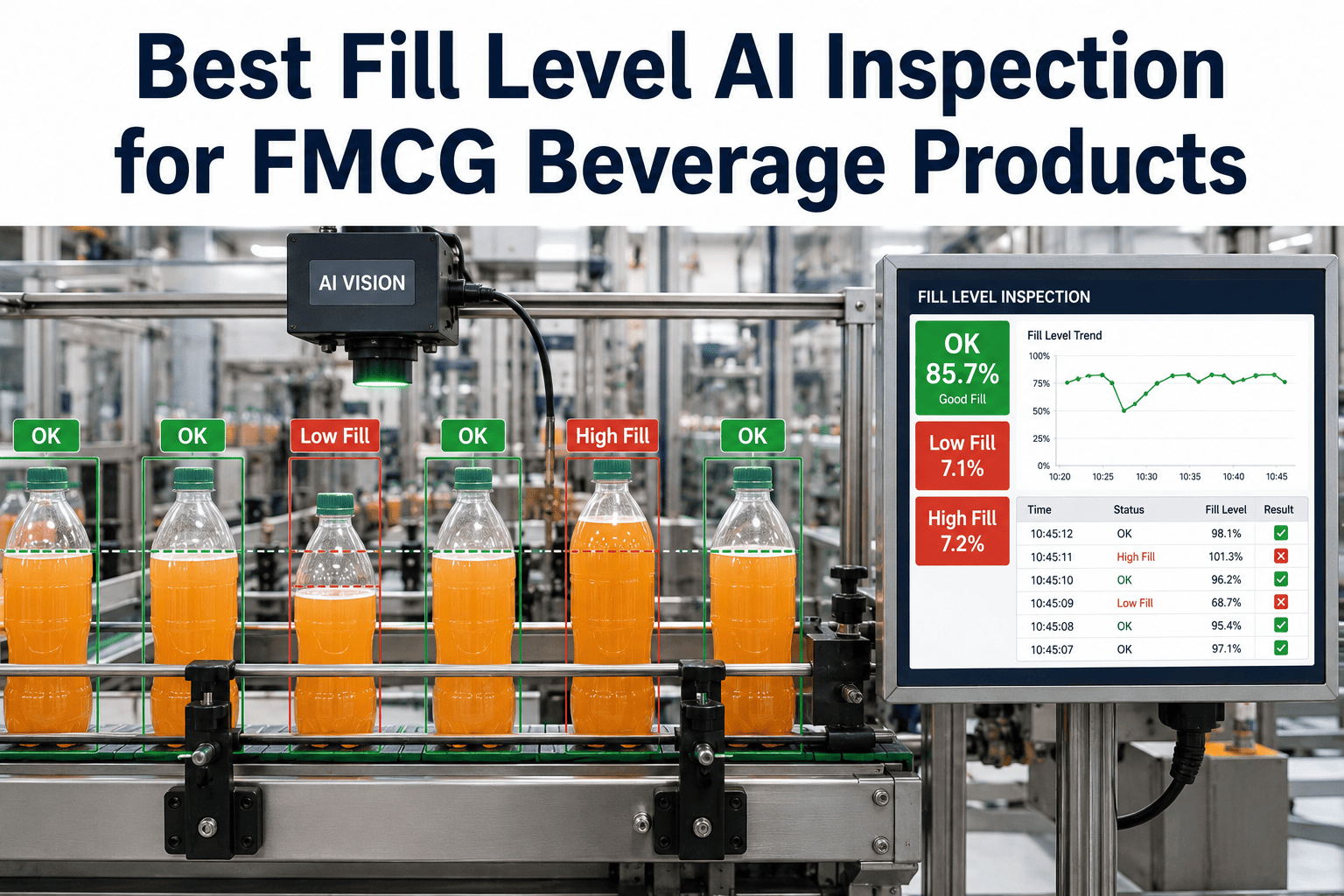
Vision-based height detection checks every container against tolerance in real time, feeding a closed loop back to the filler so drift gets corrected before it becomes a pattern instead of after a complaint arrives.
Underfill
An underfilled bottle is the defect every plant already watches for, because it is the one that generates a customer complaint, a retailer return, or in regulated categories a compliance flag tied to declared net contents. Most lines already have some form of underfill catch, whether a checkweigher or a fixed-height sensor, but the tolerance band on many of these systems is wider than it needs to be, letting borderline units through that sit right at the edge of acceptable variance.
Overfill
Overfill rarely triggers a complaint, a return, or a compliance flag, which is precisely why it can persist unnoticed for months while quietly consuming product above what the fill specification requires. A filler head drifting slightly high after a valve rebuild, or a fill program left at a conservative setpoint from a previous product run, both produce exactly this kind of invisible cost that a giveaway feedback loop is built to surface and correct.
Reading Fill Height Directly Through the Container Wall
The inspection point uses a calibrated camera positioned to read the fill line directly through the container wall or via a backlit silhouette method, depending on whether the container is clear, tinted, or opaque with a fill-visible zone. For clear and lightly tinted containers, the fill line is read as a direct edge detection against the product's optical properties, giving a precise height measurement without contact and without slowing the line to accommodate a mechanical probe.
Where the container is fully opaque, a different approach applies, using either a weight-correlated proxy at the filler head or a fill-level window if the container design includes one. The specific method is selected during pilot scoping based on the container type actually running on the line, rather than assuming a single universal method covers every SKU in a plant's portfolio.
Every reading is compared against an upper and lower tolerance band configured per SKU, since fill specifications vary by product and by market regulation. A unit outside tolerance in either direction is logged immediately, with the direction of the deviation, underfill or overfill, recorded separately so the two failure modes can be tracked and corrected as the distinct problems they actually are.
From a Single Reading to a Filler Correction Signal
Find out what your line's current giveaway actually costs
iFactory measures your existing fill distribution against target before recommending anything, so the business case is built on your own numbers rather than an industry average.
A Fixed Pass/Fail Line Misses Both Slow Drift and SKU-Specific Rules
A single fixed height threshold works reasonably well for a plant running one product on one line, but most FMCG bottling operations run multiple SKUs with different container geometries and different regulatory fill requirements through the same equipment across a production week. A tolerance enforcement approach configures the acceptable fill band per SKU profile, so the same physical line correctly applies a different standard depending on which product is actively running, without requiring a manual reconfiguration step that is easy to forget during a changeover.
The other advantage of tolerance enforcement over a simple pass/fail gate is sensitivity to slow drift. A filler head that drifts down by a fraction of a percent per week will stay inside a wide pass/fail band for a long time while still accumulating real cost, and a system that only reports binary pass or fail counts will never surface that trend. Tracking the actual distribution of fill readings against target, not just the reject count, is what lets a quality team catch drift while it is still a small correction rather than a larger rework problem.
Common Questions on Fill Level AI Inspection
Measure Your Real Fill Distribution Before You Decide Anything
iFactory starts every fill level engagement with a baseline measurement of your actual current giveaway and underfill rate, so any decision that follows is based on your own numbers.